
When custody disputes turn hostile, the difference between a well-documented case and a losing argument often comes down to one thing: proof. Without a clear, consistent record of what happened and when, co-parenting conflicts quickly become a "my word against yours" situation that drains emotional energy, wastes legal fees, and leaves judges with little to work from. Incident logging is the structured practice of recording custody-relevant events as they occur, and for co-parents in high-conflict situations, it can be the single most practical step toward protecting yourself and your children.
Table of Contents
- What is co-parenting incident logging?
- Why incident logging matters in high-conflict custody
- How to log co-parenting incidents effectively
- Key limitations and risks to understand
- Why consistency and honesty beat technology every time
- Streamline your communication and incident logging
- Frequently asked questions
Key Takeaways
| Point | Details |
|---|---|
| Structured logging reduces disputes | Organized, timely records help minimize 'he said, she said' conflicts in co-parenting. |
| Consistency boosts credibility | Making, and not editing, regular entries is key for building reliable documentation. |
| Logs support but don’t guarantee legal outcomes | Incident logs are useful evidence, but their acceptance depends on court rules and fairness. |
| Practical tools simplify the process | Apps and templates make keeping accurate, retrievable records much easier for co-parents. |
What is co-parenting incident logging?
Co-parenting incident logging is the practice of creating and maintaining organized, factual records of events related to custody arrangements and communication between co-parents. Unlike personal journaling or venting in a notebook, incident logging is intentionally objective, structured, and date-stamped. Think of it as a running business record for your co-parenting relationship.
An "incident" in this context is any concrete event that affects your custody agreement or your child's wellbeing. Common examples include:
- Missed or late pickups and drop-offs
- Violations of the parenting plan (such as taking a child out of state without notice)
- Inappropriate communication, including threatening texts or emails
- Changes to the visitation schedule that weren't mutually agreed upon
- Concerns about the child's health, safety, or emotional state after visits
- Third-party interference, such as a new partner involving themselves in custody exchanges
"Incident logging is used to reduce miscommunication and 'he said, she said' disputes by making exchanges and timing harder to contest."
The format of your log matters, too. Paper diaries are better than nothing, but they're easy to lose, hard to search, and vulnerable to claims of alteration. Spreadsheets give more structure. Dedicated co-parenting apps offer time-stamped entries, searchable records, and built-in accountability. Whatever format you use, the key is that your log looks and reads like an objective record, not a list of grievances. Proper maintaining effective records habits make the difference between logs that hold up and logs that get dismissed.
Why incident logging matters in high-conflict custody
With a clear idea of incident logging, let's explore why this simple habit is so impactful for co-parents amid conflict.
The biggest practical benefit is eliminating ambiguity. High-conflict co-parenting almost always involves disputes over who said what, when something happened, or whether a pattern of behavior exists. A time-stamped, objective log turns vague accusations into verifiable facts. That's enormous in mediation or court, where credibility is everything.
| Benefit | Without logging | With logging |
|---|---|---|
| Recalling exact dates/times | Guesswork, unreliable | Documented, precise |
| Proving a pattern of behavior | Near-impossible | Supported by multiple entries |
| Reducing emotional arguments | Difficult | Log speaks for itself |
| Supporting mediation | Weak position | Clear, credible foundation |
| Court preparation | Scrambling through texts | Organized, ready to present |
Organization is another underrated advantage. Most co-parents manage conflict by searching through months of texts, emails, and calendar notes, which is stressful and inefficient. A dedicated log gives you a single location to review. As research shows, single platform records of communication replace the chaos of fragmented messaging.
Pro Tip: Start your log before a crisis happens. Waiting until things escalate means your early entries are missing, which weakens the sense of a long-term pattern that courts often need to see.
There's also a genuine emotional management benefit that doesn't get enough attention. When you're dealing with a high-conflict co-parent, the anxiety of not knowing whether you'll remember an incident clearly is constant. Writing it down removes that burden. You stop replaying events in your head because you know it's documented. That mental shift is small but meaningful, especially over months or years of ongoing custody disputes.

How to log co-parenting incidents effectively
Understanding why incident logs matter makes it clear that how you do it is just as important. Here's how to set up a logging process that actually holds up.
1. Record incidents as close to the moment as possible. Memory degrades fast, especially under stress. Write your entry within a few hours, not a few days. Include the exact date, time, and location.
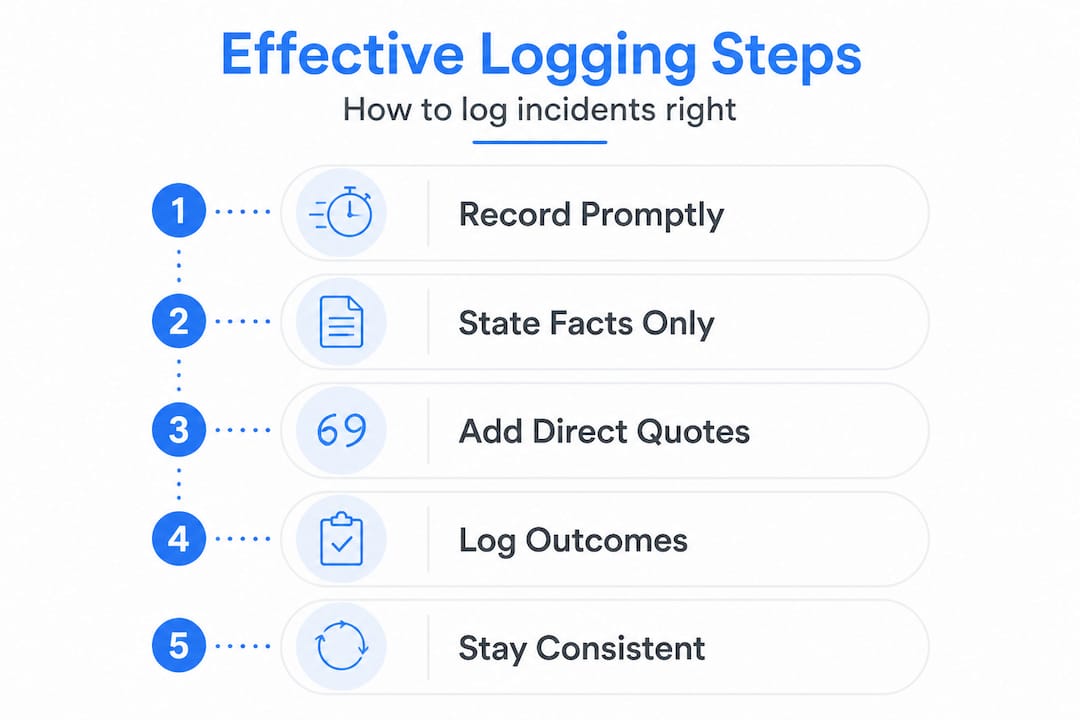
2. Stick to facts, not feelings. Instead of writing "He was hostile and intimidating again," write "At 4:17 PM on May 3, 2026, he arrived 38 minutes late for the pickup and raised his voice when I asked about the delay." One version is objective evidence. The other is an opinion.
3. Include direct quotes when possible. If the other parent said something specific, write it down word for word in quotation marks. Note who else was present as a potential witness.
4. Log the outcome. What happened as a result of the incident? Did the pickup not happen at all? Did you contact your attorney? Did your child come home upset? These follow-up details fill in the picture.
5. Organize entries consistently. Use a category system, such as "missed visitation," "agreement violation," or "inappropriate communication." Categories make it much easier to identify patterns and sort entries during legal proceedings.
6. Never edit or delete previous entries. This is critical. Credible documentation depends on consistency and contemporaneousness. Sporadic or edited records undermine your credibility in ways that are very difficult to recover from. If you made a mistake in an entry, add a new dated note correcting it rather than changing the original.
7. Choose a platform suited to legal use. A spreadsheet is functional but lacks automatic time-stamping. Dedicated co-parenting tools create entries with metadata that shows when the record was created, which is much harder to dispute.
Pro Tip: Keep your log completely separate from personal diaries or venting journals. Mixing emotional processing with factual records can compromise both. Treat your incident log like a business document, because in a custody case, that's exactly what it is.
The guidelines for credible records are not complicated, but they require discipline. The co-parents who benefit most from logging are those who treat it as a regular routine rather than something they only do when things get really bad.
Key limitations and risks to understand
After learning how to log incidents, it's important to clarify what incident logs can and can't do in real-world legal scenarios.
The most common misconception is that a detailed log automatically becomes evidence in court. It doesn't work that way. Admissibility depends on jurisdictional rules and court evaluation. A judge has discretion to exclude records that appear one-sided, selectively maintained, or created after the fact. Your attorney needs to advise you on how to present your logs in your specific jurisdiction.
Here's a direct comparison of how logs are treated differently depending on the quality and consistency of records:
| Log characteristic | Weak log | Strong log |
|---|---|---|
| Frequency | Only logged during conflicts | Regular, ongoing entries |
| Objectivity | Personal opinions and interpretations | Facts, quotes, dates only |
| Time stamps | Added later or missing | Automatic or logged same day |
| Coverage | One-sided, only bad incidents | Balanced, includes neutral events |
| Edit history | Modified or deleted entries | Unchanged, with corrections added as new notes |
Privacy is another real concern. Your logs may contain sensitive information about your child, your health, your finances, or third parties. Where you store that information and who can access it matters legally and ethically. Avoid storing logs in shared cloud accounts or on devices the other parent can access. Use platforms with strong privacy controls.
There are also risks if you use logging as a weapon rather than a tool. Some parents log obsessively, recording trivial events to manufacture a pattern of behavior that doesn't truly exist. Courts recognize this. Judges and mediators have seen thousands of family law cases, and they can spot inflated or manipulative records.
Selective and inconsistent logs do more damage to your credibility than having no logs at all.
The safest approach is to log everything relevant, including events that don't favor your position. If you were 15 minutes late to a pickup, record that too. Balanced logs are far more credible, because they demonstrate that you're tracking the facts rather than building a case.
A few specific risks to avoid:
- Coaching your children and then logging what they said as "spontaneous" statements
- Exaggerating or embellishing descriptions of incidents
- Logging hearsay (what someone told you another person said) without clearly labeling it as hearsay
- Sharing your logs on social media or with people who are not directly involved in your legal case
Why consistency and honesty beat technology every time
Here's the perspective most articles on this topic skip over: the technology you use for logging matters far less than the habits behind it. We've seen parents invest in every available co-parenting app, set up elaborate spreadsheets, and still produce logs that fall apart in court. We've also seen parents using simple note-taking apps whose records were given serious weight by a judge. The difference was never the tool. It was the honesty and consistency of the person using it.
Courts and mediators are not impressed by sophisticated software. What they look for in family law disputes is whether a record feels credible, whether it was maintained regularly over time, and whether it reads like a factual account rather than a curated argument. A log that you've kept faithfully for eight months, even in a plain text file, tells a more convincing story than a polished app-based record you started two weeks before a hearing.
The uncomfortable truth is that some co-parents start logging because they want to build a case, not because they want an honest record. That motivation tends to produce exactly the kind of log that gets dismissed, because the entries are sparse until conflict spikes, the language becomes more loaded over time, and the neutral or positive events are completely absent.
Honest logging, including recording your own mistakes and your co-parent's reasonable behavior on good days, actually strengthens your position. It signals to anyone reviewing the records that you're telling the truth, not selectively reporting. For more on credible record-keeping, the principle is always the same: accuracy over strategy, routine over reaction.
One more thing worth saying plainly: logging is not a substitute for getting legal advice, working on your own communication, or addressing the root dynamics of a high-conflict relationship. It is one tool, and a powerful one, but only if it's used with integrity.
Streamline your communication and incident logging
If you've recognized yourself in any part of this article, whether it's the stress of scrambling to remember incidents or the frustration of "he said, she said" disputes, there's a better way to manage it.
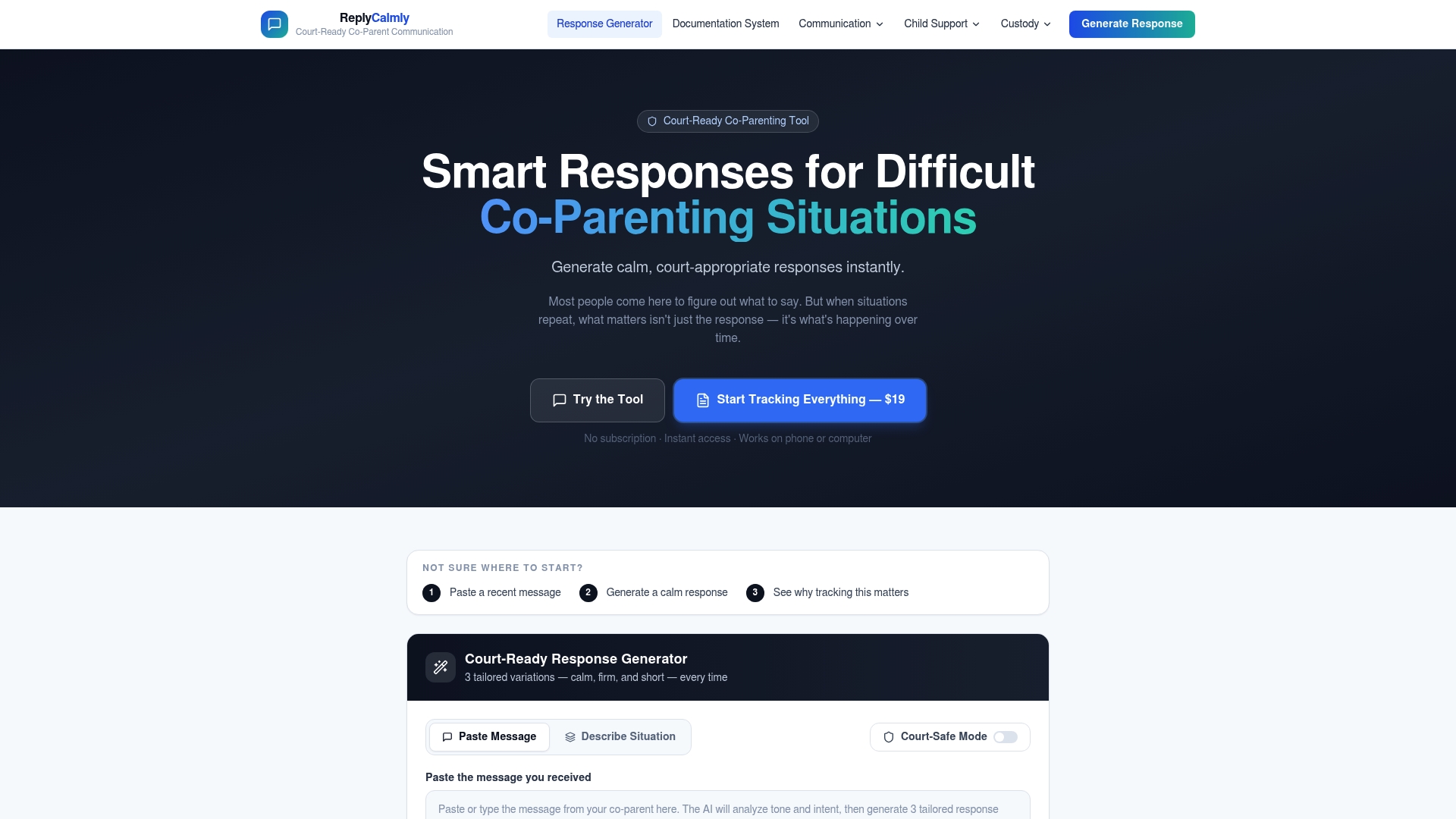
ReplyCalmly's smart platform is designed specifically for high-conflict co-parenting situations. It combines structured incident logging with a response generator that helps you communicate calmly and professionally, even when you're at your most frustrated. The platform categorizes incidents, tracks communication patterns over time, and visualizes them through dashboards so you can see the bigger picture at a glance. It also integrates with court-mandated tools like OurFamilyWizard, meaning it works alongside your existing legal requirements rather than replacing them. If you're serious about building a credible record and protecting your position, a dedicated tool removes the friction that causes most people to log inconsistently.
Frequently asked questions
What counts as an 'incident' in co-parenting logs?
Incidents typically include any concrete event relevant to custody, such as missed pickups, inappropriate communication, breached parenting plan agreements, or safety concerns reported after a visit.
Can incident logs be used in court?
Incident logs can support your case, but admissibility depends on jurisdictional rules and how a judge evaluates the records. Always consult your attorney on how to properly present them.
How often should I log incidents?
Entries should be made regularly and as soon after an incident as possible, because consistency and contemporaneousness matter in documentation and sporadic records reduce credibility.
Is a co-parenting app required for incident logging?
No app is required, but co-parenting apps provide automatic time-stamping and a single organized platform that makes records more consistent and harder to dispute than paper notes alone.