
Most co-parents focus on what was said in a difficult message. Co-parenting pattern analysis asks a different question: what keeps happening, and why? This approach is central to understanding co-parenting pattern analysis as a tool that moves you from reacting to individual conflicts to seeing the full picture of your interactions over time. When you know that conflict is the most damaging factor for children after separation, the case for analyzing and changing communication patterns becomes hard to ignore.
Table of Contents
- Key Takeaways
- What is co-parenting pattern analysis?
- How to track and analyze your co-parenting interactions
- Turning patterns into better communication
- Documentation, custody, and legal protection
- My perspective on what pattern analysis actually changes
- How Replycalmly supports your pattern analysis
- FAQ
Key Takeaways
| Point | Details |
|---|---|
| Pattern analysis is proactive | It identifies recurring triggers and trends before they escalate into serious conflict. |
| Objective records matter | Courts and mediators prioritize factual logs over emotional narratives. |
| Consistent tracking is non-negotiable | Sporadic logging misses systemic issues and produces unreliable results. |
| Communication methods reduce conflict | Structured techniques like BIFF and CLEAR depersonalize disputes and improve outcomes. |
| Technology supports legal goals | Digital platforms with analytics create court-ready documentation of co-parenting interactions. |
What is co-parenting pattern analysis?
Co-parenting pattern analysis is the practice of systematically reviewing your communication and interaction history with your co-parent to identify recurring behaviors, triggers, and trends. Instead of treating each conflict as a standalone event, you look for the structure underneath it. What time of day do difficult exchanges happen? Which topics reliably spiral? Who escalates first, and how?
The core components break down into three areas:
- Communication patterns: The frequency, tone, and length of messages exchanged between co-parents over time
- Conflict triggers: Specific subjects, events, or circumstances that consistently produce tension or hostility
- Behavioral trends: Repeated actions like late responses, over-explaining, boundary violations, or one-sided decision-making
One distinction that separates useful analysis from venting is the difference between subjective feelings and objective facts. Saying "they always make me feel attacked" is a feeling. Saying "in the last 30 days, 14 of 18 messages arrived after 9 PM and contained ultimatums about scheduling" is a fact. Courts, mediators, and even therapists work with facts. The goal of pattern analysis is not to win an argument but to uncover objective triggers so you can respond strategically rather than emotionally.
Common patterns co-parents discover include communication overload, where one parent sends far more messages than necessary; topic bundling, where unrelated complaints get layered into a single message to maximize pressure; and timing manipulation, where messages arrive at inconvenient hours to provoke reactive responses.
Pro Tip: Before you start analyzing, decide on a neutral framing. Ask yourself, "What would a stranger see if they read six months of these messages?" That perspective shift alone can reveal patterns you have been too close to notice.
How to track and analyze your co-parenting interactions
Knowing what to look for is one thing. Building a system that captures it reliably is another. The evidence for consistent, sustained logging is clear: parents who track sporadically miss the systemic issues and produce analysis that is unreliable at best and misleading at worst.
Here is a practical framework to get started:
- Choose a dedicated log. Use a notebook, spreadsheet, or a purpose-built co-parenting platform. The method matters less than the consistency. Every interaction gets recorded, every time.
- Record the essentials for each entry. Date, time, channel (text, email, app), the topic discussed, the tone (neutral, hostile, manipulative, positive), and your response time and theirs.
- Note the context. Was it a handoff day? Did a custody exchange happen that week? Context turns data points into patterns.
- Review weekly, not daily. Daily review invites reactivity. A weekly review gives you distance and lets genuine patterns emerge from noise.
- Flag outliers separately. If something is genuinely alarming, document it in detail and set it aside for legal review. Do not let it distort your broader pattern analysis.
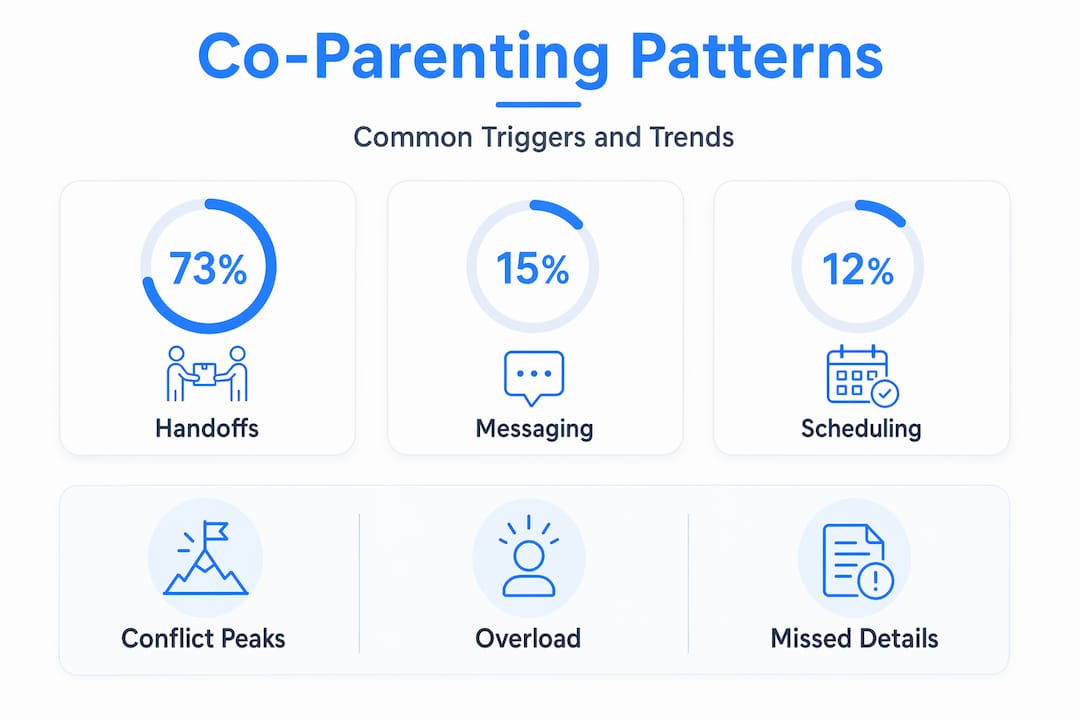
The data from one parent's six-month tracking experiment revealed that 73% of conflicts began during handoffs. A simple "no discussion at the doorstep" rule cut conflicts by 40%. That kind of insight is only visible if you have been tracking long enough and consistently enough to trust the data.
Pro Tip: When you review your log each week, look for timing clusters first. What day of the week and what time of day do difficult messages tend to arrive? This single variable often explains more than the content of the messages themselves.

Here is a comparison of what to record versus what to leave out:
| Record this | Leave this out |
|---|---|
| Date, time, and channel of contact | Your emotional reaction to the message |
| Topic or subject matter | Assumptions about their intent |
| Tone (neutral, hostile, defensive) | Interpretations or speculation |
| Response times (yours and theirs) | Unrelated historical grievances |
| Any boundary violations, clearly described | Subjective labels like "crazy" or "controlling" |
Turning patterns into better communication
Analysis without application is just data collection. The real value of understanding co-parenting patterns shows up when you use what you have learned to change how you communicate.
One of the most common findings in co-parenting communication analysis is over-explanation. In one tracked dataset, 82% of discussions involved one parent over-explaining, which consistently invited argument. Adopting a three-sentence rule for non-emergency messages solved the problem more effectively than any amount of negotiation had.
Structured communication methods give you a framework for applying your pattern insights:
- BIFF (Brief, Informative, Friendly, Firm): Keeps messages short and fact-focused, removing emotional hooks that invite escalation
- CLEAR (Concise, Legal, Emotionless, Accurate, Respectful): A structured approach that maps directly to what courts expect to see in co-parenting communication
- Response windows: Setting a two-hour window for non-urgent replies, rather than answering within five minutes, reduces the pressure that turns messages into arguments
- Topic limits per message: One subject per message prevents the bundling tactic that makes responses feel impossible
The shift that pattern analysis makes possible is moving from reactive to proactive. When you know that identifying triggers by time or topic depersonalizes disputes, you stop experiencing every difficult message as a personal attack. You start seeing it as a data point that fits a known pattern.
"The most useful thing pattern analysis taught me was that conflict had a shape. Once I could see the shape, I could step around it instead of walking straight into it every time."
For practical strategies on managing difficult exchanges once you understand your patterns, the high-conflict co-parent guide at Replycalmly walks through what actually works in practice.
Documentation, custody, and legal protection
Pattern analysis takes on a different weight when custody arrangements or legal proceedings are involved. Here, the difference between objective records and emotional impressions can determine outcomes that affect your children for years.
Courts and mediators prioritize factual patterns over emotional narratives. A log that says "They were hostile again" carries almost no weight. A log that says "On April 3, April 10, and April 17, messages arrived between 11 PM and midnight containing threats about schedule changes" is a different matter entirely.
| Documentation type | Legal weight |
|---|---|
| Factual logs with dates, times, and content | High: admissible and credible in court |
| Emotional summaries or interpreted accounts | Low: easily dismissed as biased |
| Platform-certified records (timestamped) | Very high: court-ready and tamper-resistant |
| Screenshots without context or metadata | Medium: useful but requires supporting evidence |
Modern co-parenting platforms now offer AI-powered sentiment analysis and court-certified records, which takes much of the manual labor out of documentation while producing output that meets current legal standards. These tools supplement your own tracking rather than replace it.
One critical pitfall to avoid: micromanagement behaviors in co-parenting can actually hurt your legal position. Courts may interpret minute-to-minute oversight as interference with the other parent's custodial rights. The goal of documentation is to record what happens, not to monitor every detail of your co-parent's household. Staying within that boundary protects both your child and your legal standing.
Pro Tip: When building a record for legal purposes, focus on patterns that affect your child directly. A log full of irrelevant grievances weakens your case. A focused record of custody violations, missed exchanges, or threatening communication is far more persuasive.
For a structured approach to what belongs in a legal record, the co-parenting evidence log guide at Replycalmly covers exactly what to track and how to present it effectively.
My perspective on what pattern analysis actually changes
In my experience, the most underestimated part of co-parenting pattern analysis is what it does to you, not just to the conflict. Most people expect it to produce ammunition. What it actually produces is clarity, and clarity changes everything.
I have seen co-parents go into this process certain they would uncover evidence of deliberate manipulation, only to find that the timing of difficult messages correlated directly with their co-parent's work schedule stress. That does not excuse hostile communication. But it shifts how you respond to it. You stop taking it personally, which means you stop responding in ways that escalate things further.
The hardest part of objective analysis is the discipline of separating fact from story. We are wired to interpret behavior through our own experience of the relationship. Pattern analysis forces you to look at what actually happened and hold back the "why" until the data gives you a real answer.
I have also watched people derail good analysis by turning it into a control exercise. Tracking becomes surveillance. Documentation becomes a weapon rather than a record. The moment that happens, the analysis stops being about your children's wellbeing and starts being about winning. Courts notice. Children notice. And the cycle of conflict continues.
The co-parents who use pattern analysis most effectively are the ones who stay focused on a single question: "What does this data tell me about what I can change in my own behavior?" That question is harder and more useful than any other.
— Devin
How Replycalmly supports your pattern analysis
Understanding your co-parenting patterns is the first step. Acting on them under pressure, when you are staring at a hostile message at 10 PM, is the real challenge. Replycalmly is built for exactly that moment. The platform's response generator produces calm, court-appropriate replies in multiple styles so you can respond without escalating. Its incident tracking system logs and categorizes your communications automatically, turning months of interactions into a clear, visual dashboard. For co-parents managing documentation for custody proceedings, Replycalmly's documentation tools create organized, court-ready records without the burden of doing it manually. If you are ready to move from analysis to action, Replycalmly gives you the structure to do it.
FAQ
What does co-parenting pattern analysis involve?
Co-parenting pattern analysis involves systematically reviewing communication logs, conflict triggers, and behavioral trends over time to identify recurring dynamics rather than treating each incident in isolation.
How long should I track interactions before patterns become clear?
Most co-parents need at least 60 to 90 days of consistent logging before genuine patterns emerge. Six months of tracking produces the most reliable and legally usable insights.
Can pattern analysis help in custody disputes?
Yes. Objective, factual records that show repeated behaviors carry significant weight with courts and mediators, especially when documentation is timestamped and consistent rather than anecdotal.
What is the difference between documenting and micromanaging?
Documentation records what directly affects your child and your custody arrangement. Micromanagement involves monitoring the other parent's household decisions, which courts may view as custodial interference.
What communication methods work best once I identify patterns?
Structured methods like BIFF (Brief, Informative, Friendly, Firm) and CLEAR (Concise, Legal, Emotionless, Accurate, Respectful) are the most effective co-parenting communication techniques for applying pattern insights and keeping exchanges factual and low-conflict.