
Many co-parents believe that responding quickly or trying to explain their perspective is the same as responding constructively. It isn't. In high-conflict custody situations, an impulsive reply, no matter how well-intentioned, can escalate tension, undermine legal boundaries, and work against your child's best interests. The difference between a response and a constructive response is significant, and understanding that gap is one of the most practical skills you can develop during a custody dispute.
Table of Contents
- Defining a constructive response in co-parenting
- Key frameworks: BIFF and active constructive response
- Common pitfalls: what is NOT a constructive response
- Documenting constructive responses for legal protection
- Why most advice misses the mark: a fresh take on constructive response
- Next steps: tools and templates for constructive responses
- Frequently asked questions
Key Takeaways
| Point | Details |
|---|---|
| Behavioral criteria matter | A constructive response is behavioral, not abstract—brief, factual, neutral, and child-focused. |
| Frameworks prevent escalation | Using templates like BIFF keeps interactions structured and reduces legal risk. |
| Documentation protects you | Written records of constructive responses are critical for court and mediation. |
| Avoid emotional language | Steer clear of sarcasm, venting, and explanations that invite argument. |
| Templates and tools help | Practical tools and message templates simplify and clarify constructive replies. |
Defining a constructive response in co-parenting
Most people assume any non-aggressive reply qualifies as constructive. That assumption causes real problems in custody disputes. A response is simply a reaction to a message. A constructive response, by contrast, is a specific type of reply that serves a defined purpose: protecting your child's wellbeing, maintaining legal boundaries, and reducing conflict rather than fueling it.
In practice, constructive co-parenting communication means staying brief, factual, neutral, and firm on boundaries to reduce escalation and keep interactions child-focused. Notice that "warm" and "apologetic" aren't in that list. Constructive doesn't mean kind in the traditional sense. It means purposeful and contained.
Here's a critical insight most people miss: constructive is a behavioral standard, not an emotional one.
"The phrase 'constructive response' isn't one single legal or court-defined term; in practice it varies by context. For custody/co-parenting disputes, established playbooks tend to define it behaviorally — brief, factual, neutral/civil, boundary-setting, child-focused, often documented/written."
That behavioral lens matters because it gives you something measurable. Instead of asking "Did I sound nice?" you can ask: Was my message brief? Did it stick to facts? Did it reinforce my boundaries without inviting debate?
What a constructive response looks like in practice:
- It addresses only what's relevant to the child or a specific logistics question
- It avoids emotional language, character assessments, or history-dragging
- It is written, timestamped, and ideally sent through a documented channel
- It doesn't open the door to negotiation on issues already decided by court order
- It uses neutral phrasing that a judge or mediator would view favorably
For a practical look at how these principles play out in real messages, check out these text response examples that apply each of these standards in typical custody scenarios. The examples make abstract guidelines concrete and immediately usable.
Key frameworks: BIFF and active constructive response
With the behavioral markers of constructive responses established, let's look at frameworks you can apply for practical, repeatable results.
The most widely used framework in high-conflict co-parenting communication is BIFF, which stands for Brief, Informative, Friendly, and Firm. It was developed by Bill Eddy, a family law attorney and mediator, and it has become a practical standard in custody communication coaching.
Here's why it works: BIFF provides a structured mechanics template for transforming reactive impulses into a reply that is harder to weaponize and easier for third parties to interpret later, because it stays tightly focused and structured.
Breaking down BIFF:
- Brief — Keep messages short. Three to five sentences is usually enough. Long replies give the other parent more material to misinterpret or respond to emotionally.
- Informative — Include only factual, relevant information. No explanations of why you feel a certain way. No backstory.
- Friendly — This doesn't mean warm or intimate. It means professionally civil. Think of how you'd message a coworker you don't particularly like but must work with professionally.
- Firm — Reinforce your position without inviting further debate. A firm response closes the loop rather than cracking it open.
A second framework worth understanding is active constructive response, which comes from workplace and relationship psychology. In that context, active constructive response describes a full-presence reaction to someone's positive news that signals genuine enthusiasm, reflects meaning, and invites elaboration. While that model is designed for building positive relationships, co-parents can borrow the core idea: presence and intentionality matter in any reply. Even in hostile co-parenting, choosing to respond with deliberate intent rather than reflex changes the quality of your communication.
BIFF vs. standard reactive replies: A quick comparison
| Feature | Reactive reply | BIFF-based reply |
|---|---|---|
| Length | Often long, defensive | 3 to 5 sentences max |
| Tone | Emotional, sometimes accusatory | Neutral, professionally civil |
| Focus | Your feelings or their behavior | Child logistics and facts |
| Legal risk | High, can be used against you | Low, court-friendly |
| Escalation risk | High | Significantly reduced |
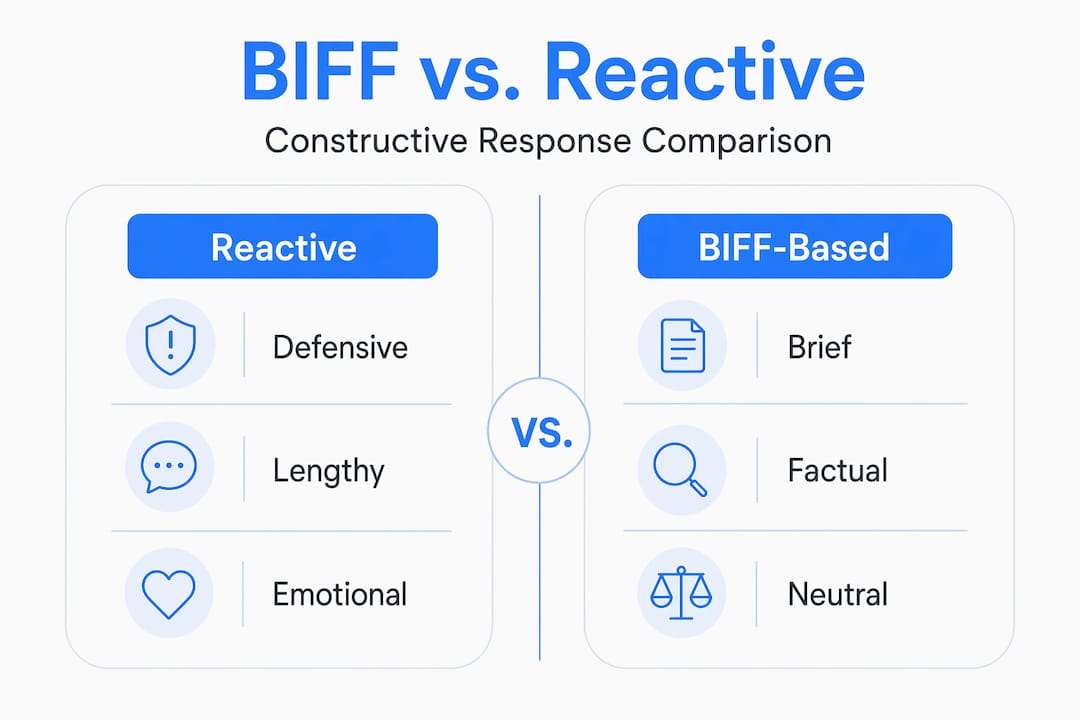
Pro Tip: Before sending any message, run a quick internal check: Is this brief? Is it factual? Would a judge reading this see me as the stable parent? If yes to all three, send it. If not, rewrite it.
For situations that call for you to hold your ground without softening your message, review these firm response examples that model assertiveness without aggression. When things are going more smoothly and you want to maintain a cooperative tone, a cooperative response strategy can also help keep communication productive over time.
Common pitfalls: what is NOT a constructive response
Understanding the frameworks is half the battle. The other half is recognizing what constructive is not, because many co-parents think they're communicating constructively when they're actually doing the opposite.
The most common mistake is length. When someone sends you an accusatory or unfair message, your instinct is to defend yourself point by point. That impulse is natural and completely understandable. It's also one of the most damaging things you can do in a custody dispute.
A response in communication is the reaction or reply to a message or situation, functioning as feedback that helps confirm or clarify understanding. In a custody context, every message you send is also potential evidence. Lengthy defensive replies don't clarify. They escalate.
What to actively avoid in co-parenting replies:
- Sarcasm or irony, even subtle forms. Sarcasm reads poorly in text and looks hostile to third parties.
- Emotional language like "you hurt me," "you never," or "you always" — these phrases invite counterarguments and make you appear reactive.
- Lengthy explanations of your parenting philosophy or past decisions. Courts care about facts, not justifications.
- Apologies that imply you're accepting blame for something you didn't do. This can be used against you.
- Questions that are really accusations in disguise, such as "Why would you do that to our child?"
- Responses that re-open closed issues or relitigate past decisions
A reply that feels cathartic in the moment often becomes the exact message your attorney wishes you hadn't sent.
Intent versus impact is a real and often overlooked trap. You might write something with genuine good faith, trying to clarify a misunderstanding or soften a disagreement. But the other parent (or a court reviewing the exchange) may read it differently. That's why constructive communication prioritizes demonstrable neutrality over felt sincerity.
If you're struggling with situations where agreements aren't being honored, reading about handling broken agreements will help you understand how to respond without escalating. And when you need a non-emotional, middle-ground tone, neutral response examples show you exactly how that plays out in common scenarios.
For broader context on giving feedback that doesn't backfire, these constructive criticism tips offer research-backed techniques that apply beyond parenting situations.
Documenting constructive responses for legal protection
Now that you know what to avoid and how to respond constructively, it's crucial to understand the importance of documenting your communication for legal purposes.

Written responses serve two functions. First, they create a record of what you said and when. Second, they demonstrate a pattern of behavior over time. Courts and mediators don't just look at individual messages. They look at the overall pattern, and a well-documented log of consistent, calm, child-focused replies can significantly support your legal position.
Custody documentation best practices define effective co-parenting communication as brief, factual, neutral/civil, boundary-setting, and often written specifically because written records are easier to organize, verify, and present.
Steps to document your constructive responses effectively:
- Use written channels whenever possible. Text messages and email create automatic timestamps. Verbal conversations don't.
- Keep a log. After any significant exchange, note the date, the subject, the content of your reply, and any relevant context.
- Categorize your records. Group incidents by type: custody schedule disputes, communication violations, financial disagreements. This makes patterns visible.
- Avoid editing or deleting messages. Even messages you regret sending are part of the record. Deleting them can raise questions about tampering.
- Store backups in at least two places. A screenshot alone isn't always enough if your device is lost or damaged.
Documentation tools comparison:
| Tool type | Benefit | Best used for |
|---|---|---|
| Dedicated co-parenting apps | Timestamped, court-admissible logs | Ongoing custody communication |
| Automatic records with search function | Scheduling and agreement documentation | |
| Incident tracking platforms | Categorized patterns and dashboards | Identifying repeated violations |
| Screenshot archives | Quick capture of text threads | Preserving volatile or deletable messages |
Pro Tip: Don't wait until you're heading to court to organize your documentation. Start tracking from the first difficult exchange. Patterns only become visible in hindsight if you've been recording all along.
For help choosing the right tools, the best documentation apps for co-parents guide breaks down platform options based on your specific needs. If you're starting the documentation process, this resource on documenting co-parent behavior gives you a step-by-step foundation. And when it's time to prepare materials for court, this guide on documenting issues for court covers what legal teams actually look for.
For expert-level guidance on how digital evidence is evaluated and handled, the team at Roffeh specializes in digital evidence and can provide deeper context on how electronic communication records are assessed in legal proceedings.
Why most advice misses the mark: a fresh take on constructive response
Here's something worth saying plainly: most communication advice aimed at co-parents is designed for people in low-conflict situations. The standard guidance, things like "practice active listening," "validate their feelings," and "keep the dialogue open," assumes a partner in good faith on the other side of the conversation. In high-conflict custody situations, that assumption is often not just wrong. It's dangerous.
We've seen co-parents follow the "open dialogue" advice only to have their attempts at empathy twisted into admissions, their clarifications used as evidence of inconsistency, and their flexibility reframed as agreement to change established arrangements. This isn't a failure of the advice in a vacuum. It's a failure of that advice in your specific context.
A constructive response in high-conflict co-parenting is not an invitation to deeper conversation. It's a boundary marker. It says: here is the relevant information, here is my position, and there is nothing in this message for you to escalate against. That's a fundamentally different communication goal than what most empathy-based frameworks are designed for.
This is also why the parallel parenting model often serves high-conflict families far better than traditional co-parenting models. Parallel parenting reduces direct interaction, focuses on structured logistics, and accepts that warmth and collaboration aren't realistic goals with every co-parent. It's not giving up. It's being strategic about where you direct your energy.
The uncomfortable truth is that constructive responses in hostile custody situations require you to suppress the most human instincts: defending yourself, explaining your reasoning, and seeking understanding. The co-parent who can do that consistently, who can send the brief, factual, boring reply over and over, is the one who builds the stronger legal record and protects their child most effectively.
Next steps: tools and templates for constructive responses
Managing constructive responses under pressure is genuinely hard. Writing a neutral, firm, child-focused message when you're hurt, frustrated, or worried about your child is not something most people do naturally. It's a skill, and like any skill, it helps to have the right tools.
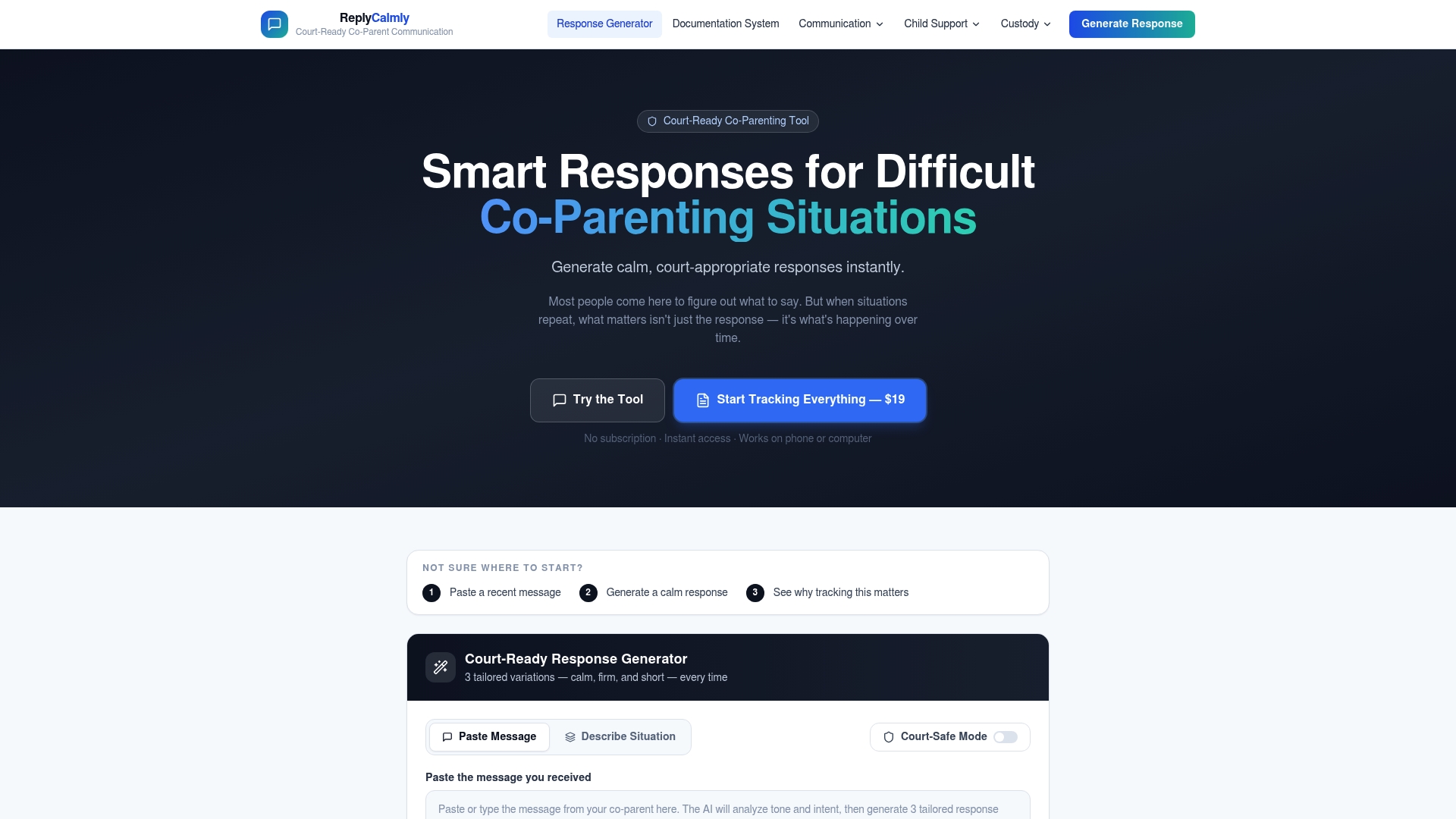
ReplyCalmly was built specifically for co-parents navigating high-conflict custody situations. Whether you need a starting point for structuring your communication or a system for tracking problematic patterns over time, the platform provides exactly what courts and mediators respond well to. Start with a co-parenting communication plan template to establish clear ground rules for how and when you communicate. Then use the response generator to get multiple reply variations, including calm, firm, and short options, for the messages that are hardest to respond to calmly on your own. These tools don't replace your judgment. They support it when the pressure is highest.
Frequently asked questions
What makes a response constructive in co-parenting?
A constructive response is brief, factual, neutral, boundary-setting, and child-focused, and it's typically documented in writing. Constructive co-parenting communication is commonly defined by these behavioral standards rather than by tone or warmth.
Are constructive responses legally required in custody disputes?
Constructive responses aren't a specific legal requirement, but courts and mediators consistently favor brief, factual, and well-documented replies because they demonstrate stability and child-focused priorities over time.
What should I avoid in high-conflict co-parenting replies?
Avoid emotional language, sarcasm, lengthy justifications, and anything that invites debate or re-opens settled issues. Every message you send is feedback within an ongoing communication record that third parties may review.
How should constructive responses be documented?
Use written channels with automatic timestamps, keep organized logs categorized by issue type, and consider using dedicated co-parenting documentation apps that create court-ready records from your communication history.