
Every message you send to a high-conflict co-parent could end up in front of a judge. That reality alone changes how you need to write, what you include, and what you leave out. Courts scrutinize tone, word choice, and intent when evaluating co-parent communications, and a single poorly worded text can shift a custody hearing in the wrong direction. This article breaks down exactly what qualifies as a court-approved message, gives you real examples you can adapt today, and provides a clear comparison table so you always know which approach to take.
Table of Contents
- What makes a message court-approved?
- Real-world examples of court-approved messages
- Comparison table: Approved vs. risky message styles
- Tailoring your message to the situation: Special considerations
- What most co-parents get wrong about court-approved communication
- Take the guesswork out of court-approved messaging
- Frequently asked questions
Key Takeaways
| Point | Details |
|---|---|
| Focus on clarity | Messages that are specific and child-focused are more likely to be approved in court. |
| Avoid emotional triggers | Keep communication neutral, factual, and free of blame to minimize conflict. |
| Use the right tools | Co-parenting apps help document communication and provide an extra measure of protection. |
| Adapt your strategy | Tailor your approach for special situations, like domestic violence or manipulative tactics. |
What makes a message court-approved?
Not every polite message is court-approved, and not every court-approved message feels natural to write. The term refers to communication between co-parents that meets the legal and behavioral standards courts use to evaluate parental fitness and cooperation. These standards focus on three things: child well-being, factual clarity, and emotional neutrality.
A court-approved message typically checks these boxes:
- Child-focused: The content centers on your child's needs, schedule, health, or education, not on grievances between the adults.
- Factual and specific: Dates, times, locations, and names are spelled out clearly. Vague language like "sometime next week" or "you know what you did" has no place in these messages.
- Emotionally neutral: No sarcasm, no passive aggression, no loaded phrases. The tone reads the same whether a judge or a kindergarten teacher is reading it.
- Concise: Short messages are easier to interpret and harder to misread. Long messages tend to drift into emotional territory.
- Free of personal attacks: Criticism of the other parent's character, parenting style, or personal life is a red flag for courts.
Courts are particularly alert to patterns. One heated message might be dismissed as a bad day. A series of them paints a picture of a parent who cannot co-parent cooperatively, which directly affects custody decisions.
As noted in research on high-conflict co-parenting plans, vague parenting plans are frequently rejected by courts that prefer detailed schedules. The same logic applies to messages. Vague communication creates conflict, and courts see that conflict as evidence of poor co-parenting. Similarly, right of first refusal (ROFR) clauses, which give one parent the option to care for the child before a third party does, can spiral into disputes if not precisely worded in both the plan and related messages.
In domestic violence or narcissistic abuse situations, using a neutral third-party app adds a layer of legal protection. These apps timestamp messages, prevent editing after sending, and create a clear record that neither party can manipulate. You can explore model messages for court settings that are already structured to meet these standards.
Pro Tip: Before sending any message, read it out loud and ask yourself: "Would I be comfortable if my attorney read this right now?" If the answer is no, rewrite it.
Real-world examples of court-approved messages
Seeing the difference between approved and risky messages is far more useful than reading abstract rules. Here are four common co-parenting scenarios with side-by-side examples showing what works and what does not.
1. Schedule coordination
Court-approved: "I am confirming pickup for Emma on Friday, March 14, at 5:00 PM from school. Please let me know by Wednesday if there is a conflict."
Not approved: "Are you actually going to show up this time or should I make other plans like always?"
The approved version is specific, unemotional, and gives a clear deadline for a response. The risky version implies a history of unreliability and invites conflict.

2. Medical updates
Court-approved: "Emma had a fever of 101.3 last night. I gave her children's ibuprofen at 8:00 PM. She is staying home from school today. I will update you if her temperature changes or if she needs to see a doctor."
Not approved: "Emma is sick again. I don't know why this keeps happening when she comes back from your house."
The approved message sticks to medical facts. The risky version implies blame and will almost certainly provoke a defensive response, escalating the conflict.
3. Last-minute changes
Court-approved: "I need to request a schedule adjustment for this Saturday. I have a family obligation from 10:00 AM to 3:00 PM. Would you be available to take Emma during that window, and I can make up the time the following Saturday?"
Not approved: "Something came up Saturday. Can you take her? I'll figure out the makeup time later."
The approved message is respectful, specific, and proposes a concrete solution. The risky version is vague, and as courts consistently reject plans and messages that leave logistics undefined, this kind of message can be used against you.
4. Conflict triggers
Court-approved: "I received your message. I want to keep our communication focused on Emma's needs. If there is a specific schedule or care issue to address, I am happy to discuss it."
Not approved: "I can't believe you're doing this again. You always try to start something."
Overlooked pitfall: Many parents assume that staying calm means staying silent. It does not. Courts want to see that you are engaged, cooperative, and responsive. Ignoring messages, even hostile ones, can be interpreted as stonewalling. A brief, neutral acknowledgment is almost always the better move.
You can find additional court-approved response examples organized by situation type to make this process faster and less stressful.
Numbered summary of what every approved message should include:
- A clear subject or topic (who, what, when, where)
- A neutral, factual tone with no emotional language
- A specific request or update, not a vague reference
- A reasonable timeframe for a response if one is needed
- No references to past conflicts, personal behavior, or character judgments
Comparison table: Approved vs. risky message styles
The table below makes the distinctions concrete. Use it as a quick reference before you send anything.
| Approved style | Risky style | Why it matters |
|---|---|---|
| "Pickup is confirmed for Friday at 5:00 PM." | "I assume you'll be there Friday like we talked about." | Vague assumptions create disputes courts have to resolve. |
| "Emma's doctor appointment is Tuesday at 2:00 PM. Can you confirm you received this?" | "You never pay attention to her appointments anyway." | Accusatory language signals poor co-parenting to a judge. |
| "I need to adjust Saturday's schedule. Here is my proposed solution." | "Something came up. Deal with it." | Courts favor parents who offer solutions, not problems. |
| "Per our parenting plan, section 3, pickup is at the school." | "You know what the agreement says. Follow it." | Citing the plan calmly shows legal awareness and good faith. |
| "I will not be able to respond until this evening. I will reply by 7:00 PM." | Silence for 48 hours | Non-response can be framed as uncooperative behavior. |
| "Emma mentioned she is anxious about the transition. Can we discuss this?" | "You're making her anxious and you don't even care." | Child-focused framing invites cooperation rather than defense. |
As research on high-conflict plans confirms, courts strongly prefer specific, actionable communication over anything open to interpretation. The risky column is not just impolite. It is legally dangerous. Each example in that column has the potential to be presented as evidence of hostility, bad faith, or inability to prioritize the child's needs.
Judges and family court evaluators are trained to look for patterns of smart co-parent communication versus patterns of conflict creation. Your messages are part of that record whether you intend them to be or not.
Tailoring your message to the situation: Special considerations
Having templates is a great start, but high-conflict co-parenting situations are rarely simple. You need to know how to adapt your approach when the other parent is using manipulative tactics, threatening language, or trying to bait you into an emotional response.
Here are specific situations and how to handle them:
- When you receive a threatening or hostile message: Do not respond in kind. Send a brief, neutral acknowledgment and document the original message with a timestamp. Example: "I received your message. I will respond to any specific requests about Emma's schedule or care."
- When the other parent ignores your messages: Send a follow-up after a reasonable window (24 to 48 hours) and document both the original message and the lack of response. Courts notice when one parent is consistently unresponsive.
- When you need to reference the court order: Be calm and factual. "Per section 4 of our parenting plan, I am requesting..." This signals that you know the agreement and are following it, which is exactly what courts want to see.
- When the other parent tries to renegotiate terms in a message: Redirect. "This is something we should address through our attorneys or mediator. I am not able to modify the parenting plan through text messages."
- When you feel triggered: Wait. Even a 10-minute pause before responding can mean the difference between a message that helps your case and one that hurts it.
Using a dedicated co-parenting communication app adds a critical layer of protection in these situations. As documented in high-conflict cases, apps designed for co-parent communication provide a buffer that reduces emotional escalation and creates a timestamped, uneditable record. This is especially important in cases involving domestic violence, controlling behavior, or narcissistic patterns where the other parent may try to manipulate or reframe what was said.
Pro Tip: Keep all co-parenting communication in one place. Switching between text, email, and app messages makes it harder to track patterns and easier for the other parent to claim something was said in a channel you cannot easily access.
Helpful message openers for challenging contexts:
- "I want to make sure Emma's needs are addressed here. My understanding is..."
- "Per our parenting plan, the agreed arrangement is..."
- "I am not able to discuss this topic right now, but I will respond to any specific requests about Emma by [time]."
- "I want to keep this conversation focused on what is best for Emma."
Explore more strategies for neutralizing high-conflict interactions when the other parent is not cooperating.
What most co-parents get wrong about court-approved communication
Here is the uncomfortable truth: most parents who focus on court-approved messaging treat it as a legal defense strategy, not a communication strategy. They write messages that are technically clean but emotionally hollow, and over time, that hollowness creates its own kind of damage.
A message that says "Confirmed. 5 PM Friday." is court-approved. It is also the bare minimum. It tells your child nothing about how their parents relate to each other. It gives the other parent no reason to reciprocate with good faith. It checks a box but builds nothing.
The parents who navigate high-conflict co-parenting most successfully over the long term are the ones who understand that every message is a small act of modeling. Your child will eventually be old enough to understand how their parents communicated during this period. The messages you send today are part of the story they will tell themselves about their childhood.
This does not mean being warm or friendly with someone who has hurt you. It means being intentional. A message like "Emma did great at her recital last night. Thought you'd want to know." takes five seconds to write and costs you nothing emotionally. But it signals something important: that you are capable of putting your child first even when the relationship is difficult.
Legal compliance is the floor, not the ceiling. The sustainable communication tips that actually reduce conflict over time are the ones that go slightly beyond neutral and toward genuinely child-centered. Courts notice this too. So do children.
The goal is not to win every message exchange. The goal is to build a record that shows you as the parent who consistently chose your child over the conflict.
Take the guesswork out of court-approved messaging
Writing court-approved messages under stress is genuinely hard. You are managing your emotions, protecting your legal position, and trying to do right by your child, all at the same time.
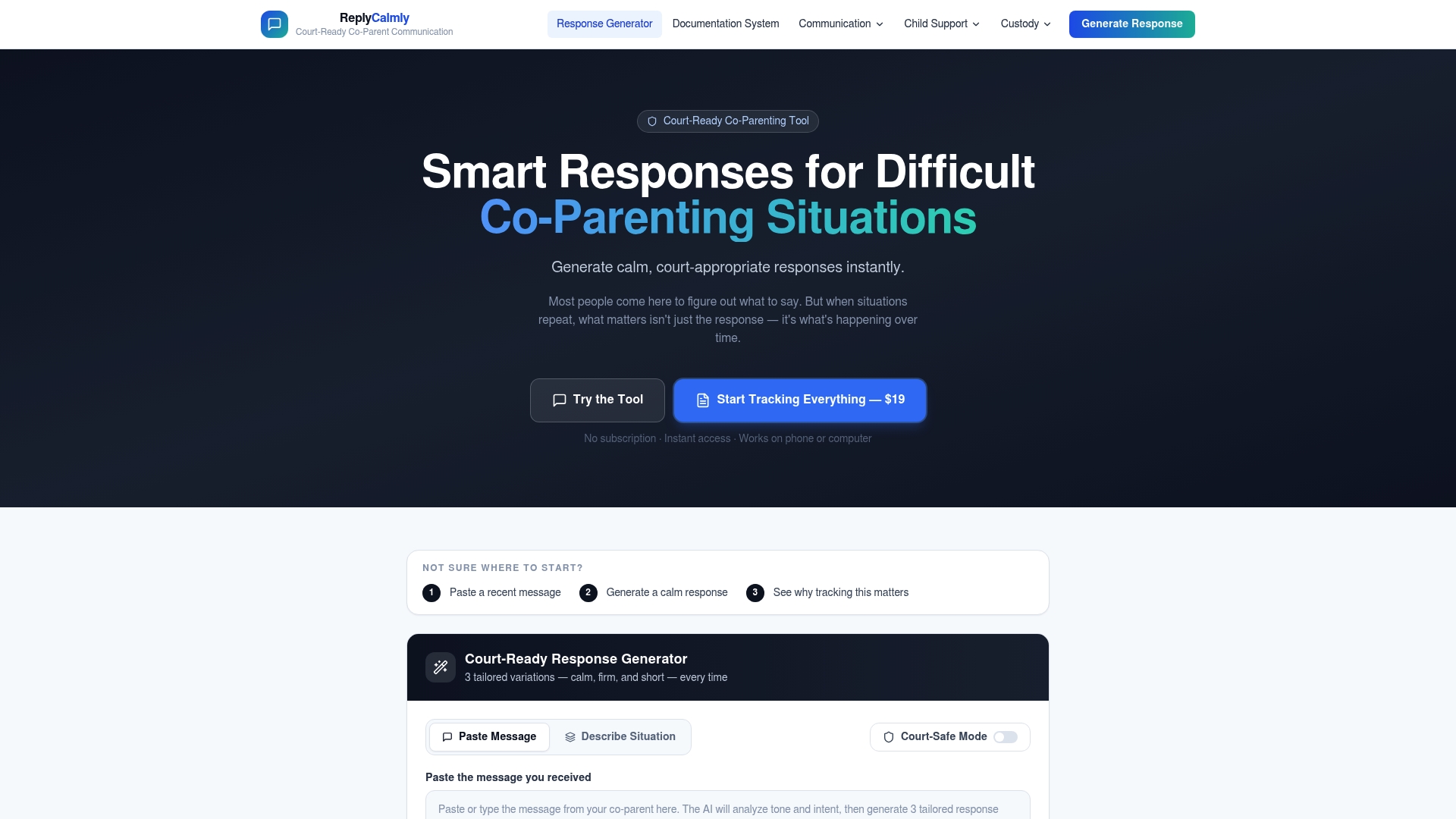
ReplyCalmly was built specifically for this challenge. The platform generates multiple response variations, including calm, firm, and short options, so you always have a court-appropriate reply ready without having to draft it from scratch while you are upset. It also tracks communication patterns over time, giving you a documented record you can bring to court if needed. If you are already using a tool like OurFamilyWizard, ReplyCalmly integrates with your existing setup rather than replacing it. Try ReplyCalmly smart co-parenting messages and feel more confident the next time a difficult message lands in your inbox.
Frequently asked questions
What is a court-approved co-parenting message?
A court-approved message is a communication between co-parents that meets legal standards for neutrality, specificity, and child-focused language. As courts consistently note, vague or emotionally charged messages create conflict and are viewed negatively in custody proceedings.
Why do courts reject certain co-parent messages?
Courts typically reject messages that are vague, emotional, accusatory, or not focused on the child's needs because these patterns signal an inability to co-parent cooperatively. Poorly worded messages and plans are frequently flagged as evidence of ongoing conflict.
How can I protect myself in communications with a high-conflict co-parent?
Stick to neutral, factual statements and use a secure co-parenting app that timestamps and preserves records. App-based communication is especially recommended in domestic violence or narcissistic abuse situations.
Are there recommended communication apps for court-approved messaging?
Yes, several apps are designed specifically to document co-parenting communication and provide a safer buffer in high-conflict situations. These tools create uneditable timestamped records that neither party can alter after the fact.