The safest way to document co-parent phone calls is to skip hidden recordings altogether: write a neutral, contemporaneous note after every call, preserve original audio or voicemail only when your state's consent law allows it, and back up everything with timestamps intact. Check your state's recording law before you hit record. A tool like Replycalmly can help you log the details consistently.
TL;DR:
- Recording calls is legally safe only in states with one-party consent, but neutral, contemporaneous notes are valid everywhere and carry no legal risk.
- Always document call details immediately after each conversation, including timestamps, participants, exact quotes, witnesses, and a neutral summary.
- Store original audio files securely in two places, create clear exhibit references, and export logs as PDFs to ensure evidence integrity for court.
- Court weight favors original files with metadata over transcripts, and logs should be factual and emotion-neutral to maintain credibility.
- Using dedicated co-parenting platforms with structured logs and evidence attachment simplifies consistent documentation and reduces the risk of losing records.
Table of Contents
- Three Practical Methods for Recording Co-Parent Calls
- How Do I Know If Recording Phone Calls Is Legal in My State?
- What Should You Capture During and After Each Call?
- Which Tools Actually Create a Credible Call Record?
- How Do You Preserve Files So They Hold Up as Evidence?
- What Do Courts Actually Expect From Call Evidence?
- Documentation Should Serve Your Case, Not Your Anger
- Let Replycalmly Handle the Logging So You Can Focus on Your Kids
- Sources
Three Practical Methods for Recording Co-Parent Calls
Not every method works for every situation, and picking the wrong one can actually hurt you in court. Here's how the three main approaches stack up:
- Lawful recorded calls. Legal only where your state permits it (more on that below), this gives you the actual audio, but a botched recording can backfire hard if you got the consent rules wrong.
- Contemporaneous neutral notes. Written immediately after the call with date, time, and a factual summary, this works everywhere and carries no legal risk, though it lacks the exact wording a recording provides.
- Documented in-app calls. Made through a co-parenting communication platform, these generate server-side timestamps automatically, but they only capture calls placed inside that platform.
If you're in a one-party consent state and the conversation is likely to get contentious, recording (with a heads-up disclosure) is often your strongest option. If you're unsure about your state's law or the other parent lives elsewhere, contemporaneous notes are the safer default.
How Do I Know If Recording Phone Calls Is Legal in My State?
Recording law hinges on consent, and the rules vary by state. Some states allow one-party consent, meaning you can record a call you're part of without telling the other person. Others require all-party consent, meaning everyone on the line has to agree before you press record. Get this wrong and the recording can be thrown out of court, or worse, used against you as evidence of misconduct.
Announcing the recording, simply saying "I'm going to record this call," solves the problem in most mixed-consent situations. It removes any later argument that you taped someone secretly, and it often satisfies the law outright even in stricter states. If the other parent objects or hangs up, that reaction itself is worth noting in your log.
When recording feels legally murky, fall back on two safer habits:
- Write a neutral summary of the call within minutes of hanging up.
- Send a short, factual follow-up text or email confirming what was discussed, creating a written record the other parent has a chance to dispute in real time.
Pro Tip: Before you record anything, spend five minutes checking your specific state's statute. A family law attorney's take on recording risk is worth reading if you're on the fence.
What Should You Capture During and After Each Call?
The moment a difficult call ends is when your memory is sharpest and your documentation is most credible. Don't wait until that night or the next day.
Capture these details immediately:
- Date and exact time the call started and ended
- Who initiated the call and who was present on either end
- A factual, word-for-word quote if something specific was said (avoid paraphrasing when the exact language matters)
- Any witnesses who overheard the conversation
- A one or two sentence neutral summary of what was discussed or decided
If a voicemail was left instead of a live call, save the audio file directly rather than relying on a screenshot of the notification. Voicemail audio preserves metadata, including the original timestamp, that a screenshot simply can't show. Store the file somewhere it won't get auto-deleted after a period, as carrier retention times vary.
Every entry in your log needs an exhibit reference number that ties back to the actual saved file. This is the piece people skip, and it's the piece that turns a personal diary into something an attorney can actually use. A seven-column log format works well here:
Export this log to a spreadsheet or a dedicated log template weekly, and back it up in two places. A phone that gets lost or replaced shouldn't mean losing six months of evidence.
Which Tools Actually Create a Credible Call Record?
Different tools solve different problems, and matching the tool to your conflict level matters more than picking the fanciest option.
- Court-focused communication platforms log in-app audio and video calls with server-side timestamps that are hard to dispute, but they only capture activity that happens inside the platform itself. A call made on a regular cell phone won't show up.
- Voice-recording apps capture the actual audio when your state's consent law permits it, and preserving the original file, not a re-recorded copy, matters for authenticity later.
- Transcription services turn audio into searchable text with timestamps, but keep the original audio file alongside the transcript. A transcript alone is easier to challenge than audio with a written companion.
- Spreadsheet or log templates work fine for lower-conflict situations where you mainly need a factual timeline rather than audio evidence.
Whatever category you land on, consistency beats sophistication. A basic log kept faithfully every week outperforms an elaborate system used sporadically.
How Do You Preserve Files So They Hold Up as Evidence?
Store unedited original files in two locations: a cloud backup and a local drive or external hard drive. If one fails, you're not starting over.
Keep an export manifest, a simple document listing every file name, its original timestamp, and how it was exported. Tying each log entry to a specific exhibit reference and file name makes it far easier for an attorney to authenticate your timeline later instead of guessing which voicemail matches which log entry.
When it's time to hand records to an attorney, export your log as a PDF with exhibit references intact rather than sending a folder of loose files. It saves your attorney hours and makes your case look organized before they've even read the first page.
- Store two backup copies, one cloud and one local, of every original audio file or voicemail.
- Maintain a running export manifest with file names, timestamps, and export method.
- Convert logs to PDF with exhibit references before sharing with counsel.
Pro Tip: Name your files with the exhibit number first (EX-014_voicemail_March4.mp3), so they sort chronologically and match your log without extra work.
What Do Courts Actually Expect From Call Evidence?
Judges and attorneys consistently favor original files with intact metadata over edited transcripts or cropped screenshots. An audio file that shows its original creation date carries more weight than a text summary someone typed up later.
Neutral, factual logs also read as more credible than emotionally charged narratives. A log entry that reads "Call ended after other parent raised voice; I stated I would call back later" holds up better than one full of accusations and adjectives.
Evidence commonly gets excluded when it's unlawfully recorded, edited after the fact, or missing any chain of custody explaining where the file came from. Combining message threads, timestamped calls, and a chronological log gives your attorney a complete package instead of scattered fragments.
- Prioritize original files over transcripts or screenshots whenever possible.
- Keep logs factual, not emotional.
- Talk to an attorney before submitting recordings if you're unsure about your state's consent law.
Documentation Should Serve Your Case, Not Your Anger
Good documentation habits exist to protect your parenting time and your credibility, not to build a case against the other parent out of spite. Courts notice the difference between a parent keeping careful records and a parent building an obsessive paper trail meant to punish.
The parents who do this well treat logging like a chore, not a mission. They write the note, save the file, move on with their day. That consistency is what actually holds up months later when a judge asks for a timeline. Documentation supports solving problems, not settling scores.
— Reply Calmly Team
Let Replycalmly Handle the Logging So You Can Focus on Your Kids
Keeping a court-ready log by hand works, but it's tedious, and tedium is exactly why most people's records fall apart after a few weeks. The platform gives you a structured incident tracker built specifically for this, with category tags for custody conflicts, false accusations, or communication breakdowns, plus a place to attach evidence directly to each entry.
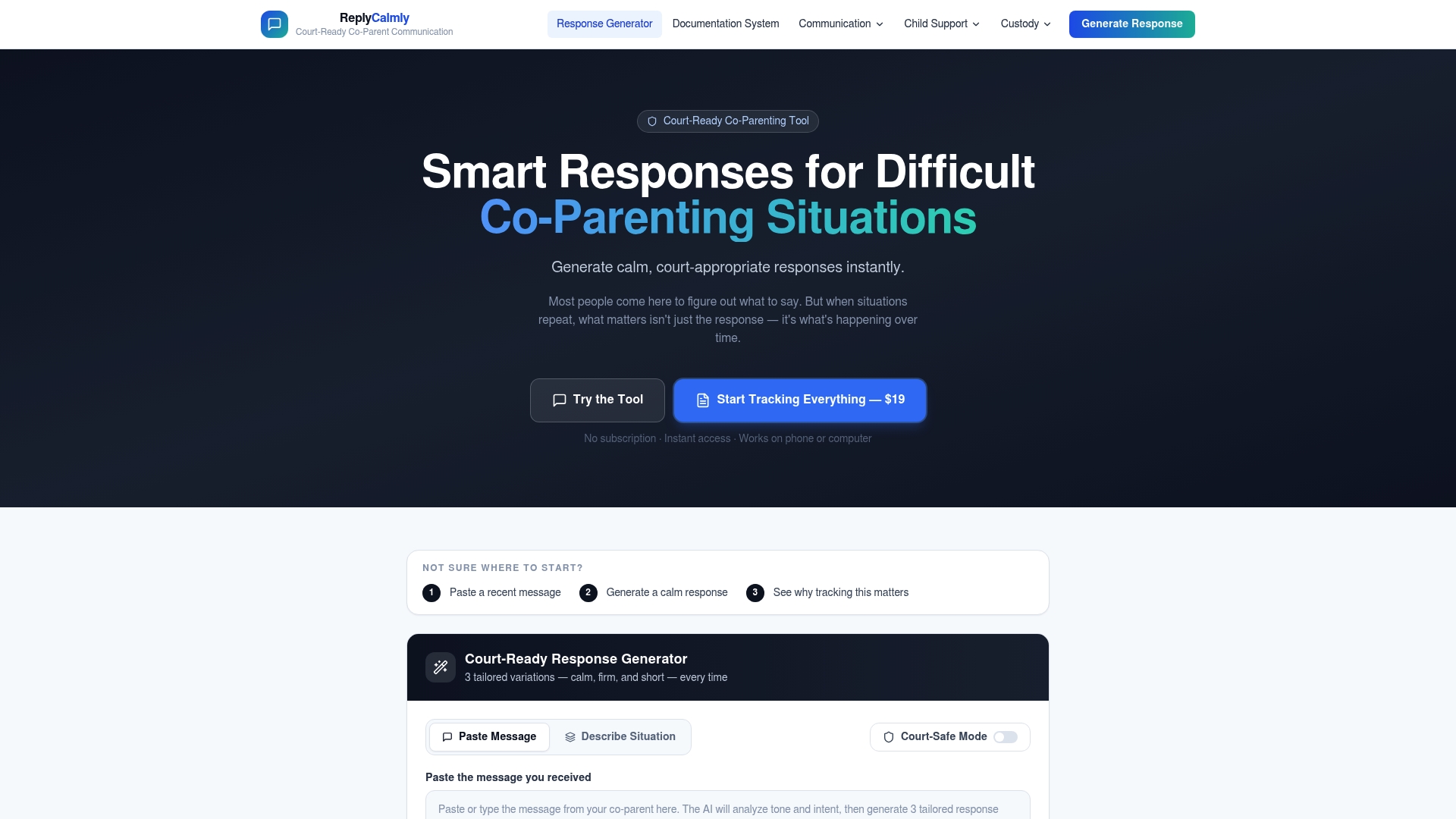
The platform also includes a response generator that turns a difficult text or email into a calm, court-appropriate reply in seconds, so you're not drafting under pressure right after a hard phone call. When it's time to hand records to an attorney or mediator, you can export a clean, dated report instead of piecing together screenshots. If you're comparing your options first, the roundup of documentation-focused co-parenting apps is a good place to start. Otherwise, try the free response generator right now with your next difficult message, no subscription required to test it out.
This article is general information, not a substitute for advice from a qualified lawyer. Consult a qualified legal professional about your own circumstances before acting on anything here.
Sources
- How to Document Co-Parenting Communication for Court
- How to Document Co-Parenting for Court: The Complete System (2026) | Copareo