
Effective coparenting habits are the consistent behaviors that help separated or divorced parents communicate, collaborate, and maintain stable environments for their children. The clinical term for this arrangement is cooperative co-parenting, and researchers at Children's Mercy confirm that low conflict and steady routines are the two factors most predictive of children thriving after divorce. That finding reframes the entire goal: you are not trying to repair a relationship with your ex. You are building a functional working partnership centered entirely on your child's well-being. Tools like OurFamilyWizard, 2Houses, and platforms like Replycalmly exist precisely because that partnership needs structure, not goodwill alone.
1. Effective coparenting habits start with communication ground rules
The foundation of every successful coparenting strategy is a shared agreement on how you communicate, not just what you say. Child-focused language means every message passes one test before it is sent: does this sentence serve my child's needs, or does it serve my frustration? Blame, sarcasm, and emotional triggers fail that test every time.
Active listening is the habit most co-parents skip because it feels unnecessary in writing. Psychology Today's CARE framework shows that paraphrasing what the other parent said before responding builds shared understanding and cuts conflict. In practice, this means replying with "I understand you're saying pickup needs to move to 4 p.m." before you address whether that works for you.

For high-conflict exchanges, the BIFF method developed by Bill Eddy gives you a four-word filter. Keep messages Brief, Informative, Friendly, Firm to prevent escalation. A BIFF message about a schedule change runs three sentences, states the facts, and closes without an invitation to argue.
Pro Tip: Set a firm rule that personal grievances, finances unrelated to the child, and relationship history are off-limits in all co-parent communication. Write that rule into your parenting plan so both parties have signed it.
2. Predictable routines reduce child anxiety across both homes
Children do not experience divorce as an adult legal event. They experience it as a disruption to the rhythms that make them feel safe. Consistent bedtimes, homework schedules, and mealtimes across both households directly reduce anxiety and behavioral problems. This is not about identical parenting styles. It is about agreeing on the non-negotiables.
A written parenting plan is the most practical tool for locking in those non-negotiables. The plan should specify call times between the child and the other parent, homework expectations, and bedtime windows. Predictability must cover both child routines and parent-to-parent communication norms to prevent the kind of last-minute surprises that spike conflict.
Co-parenting apps like OurFamilyWizard and 2Houses centralize schedules and make changes visible to both parents in real time. Apps like these reduce the "I never got that message" dispute that derails otherwise functional arrangements. Parallel parenting, where parents maintain separate styles but align on critical routines, works well when emotional cooperation is limited.
| Routine area | Recommended alignment |
|---|---|
| Bedtime | Agree on a 30-minute window, not an exact time |
| Homework | Same start time and device rules in both homes |
| Parent contact | Set call/text windows so the child expects them |
| Transitions | Consistent pickup location and handoff script |
3. Emotional regulation is the habit no one talks about enough
Functional cooperation, not emotional closeness, is the key to healthy co-parenting. That distinction matters because many parents exhaust themselves trying to feel neutral about someone who hurt them. The goal is not neutrality. The goal is behavior that does not harm your child, regardless of how you feel internally.
The most practical emotional regulation habit is the 48-hour pause. Eti Valdez-Kaminsky, MFT, recommends that you draft your response, wait two days, then review it before sending. Most messages that feel urgent at 9 p.m. look very different at 9 a.m. two days later. This single habit eliminates a significant percentage of escalations before they start.
Additional habits that protect your emotional baseline:
- Designate one communication channel for emergencies only, separate from your regular co-parent channel.
- Avoid discussing the relationship or past grievances during any child-related conversation.
- Identify your personal triggers (specific phrases, tones, or topics) and prepare scripted neutral responses for each.
- Seek individual therapy or a co-parenting counselor when patterns of reactivity persist.
Pro Tip: Before responding to any message that raises your heart rate, read the Replycalmly guide on when not to respond to your co-parent. Knowing when silence is the right answer is as important as knowing what to say.
4. Texting is a notification tool, not a dialogue channel
Most co-parenting conflict lives in text threads. That is not a coincidence. Psychology Today's CARE research is direct: treat texting as notification, not conversation. Texts are for logistics. "Pickup at 3:30 confirmed." "Soccer practice moved to Tuesday." Anything requiring interpretation, nuance, or a back-and-forth belongs in a co-parenting app with a message log or a scheduled phone call.
Written messages serve a second function that most parents underestimate. Switching to written communication early after separation acts as a delay mechanism for emotional conversations. The act of typing forces a pause that speaking does not. That pause is where reactive responses die before they cause damage.
Write every message as if a family court judge will read it. That standard, recommended by family law professionals at Lydon Law, keeps tone professional and content factual. It also builds a communication record that protects you legally if disputes escalate.
5. How to handle co-parenting conflicts without escalating them
Conflict in co-parenting is not a sign of failure. It is a predictable feature of two people with different perspectives making decisions about a child they both love. The habit that separates functional co-parents from high-conflict ones is how they process disagreement, not whether disagreement exists.
Apply the BIFF filter to every reply in a heated exchange. Keep messages brief and factual and resist the pull to defend yourself against every accusation. Responding to every provocation is itself a form of escalation. Sometimes the most effective reply is one sentence confirming the logistics and nothing else.
When conflict persists despite structured communication, mediation is the next step, not litigation. A family mediator trained in co-parenting disputes costs significantly less than court proceedings and produces agreements both parents helped create, which makes compliance more likely. For ongoing high-conflict situations, the Replycalmly guide on co-parenting with a difficult ex outlines specific protocols for managing communication without feeding cycles of escalation.
Use a cooling-off protocol for every provocative message: pause, rewrite without emotional language, and review before sending. Document exchanges in a co-parenting app so patterns are visible over time. That documentation becomes critical if the conflict ever reaches a family court.
6. Building a co-parenting plan that actually gets used
A co-parenting plan fails when it is too vague to apply or too rigid to survive real life. The most effective plans specify decision-making authority (who decides on medical care, school enrollment, extracurriculars), communication protocols, and a process for resolving disagreements. Vague plans produce arguments. Specific plans produce answers.
Review the plan at least once a year and whenever a major developmental change occurs, such as a child starting school, entering adolescence, or changing medical needs. Children's needs shift, and a plan written for a five-year-old will not serve a twelve-year-old. Build a review clause directly into the document so neither parent can block updates.
For parents starting from scratch, Replycalmly's communication plan template provides a structured starting point that covers the categories most likely to generate conflict. A template does not replace legal counsel, but it organizes your thinking before you pay an attorney by the hour.
7. Positive coparenting practices that protect the child's relationship with both parents
Children benefit most when both parents actively support the child's relationship with the other parent. This means speaking about the other parent in neutral or positive terms in front of the child, never using the child as a messenger, and never asking the child to report on the other household.
The adult-first mindset means prioritizing the child's need for security even when emotional alignment between parents is absent. A child who hears one parent criticize the other experiences that criticism as an attack on half of their own identity. The psychological research on parental alienation is unambiguous on this point.
Balanced coparenting approaches also mean sharing information proactively. If your child had a hard week at school, the other parent needs to know before pickup, not after a meltdown. Information sharing is not a favor to your co-parent. It is a service to your child.
Key takeaways
Effective coparenting requires consistent communication habits, predictable routines, and emotional regulation practiced daily, not just during conflicts.
| Point | Details |
|---|---|
| Communication ground rules | Use BIFF and CARE frameworks to keep exchanges child-focused and conflict-free. |
| Routine consistency | Align bedtimes, homework, and call windows across both homes to reduce child anxiety. |
| Emotional regulation | Apply the 48-hour pause before sending any message written in a reactive state. |
| Conflict management | Document exchanges in a co-parenting app and use mediation before escalating to court. |
| Child-first mindset | Never use the child as a messenger or speak negatively about the other parent in their presence. |
What I've learned after watching co-parents succeed and fail
The single biggest predictor of whether co-parenting works is not how much the parents like each other. It is whether both parents have genuinely accepted that the relationship is now a business partnership. That shift sounds cold, but it is actually liberating. Business partners do not need to process each other's feelings. They need to show up, communicate clearly, and make decisions that serve the shared interest, which in this case is the child.
What surprises most parents is how much the tone of communication changes when they stop trying to be understood emotionally and start focusing on logistics. The arguments shrink. The messages get shorter. The child stops being caught in the middle.
I have also seen parents underestimate how much routines matter to kids. Adults adapt to unpredictability. Children do not. A consistent bedtime across two homes is not a small thing. For a seven-year-old, it is the signal that the world is still predictable and safe.
The hardest part is emotional regulation, and no framework fixes it overnight. The 48-hour pause works, but only if you actually wait. Technology helps, but over-relying on texting creates its own problems because tone disappears in text and misunderstandings multiply. The parents who do this well use apps for logistics, phone calls for nuanced decisions, and written records for anything that might matter later.
Persistence and professional support are not signs of weakness. They are signs that you take the job seriously.
— Devin
How Replycalmly helps you build these habits
Managing co-parent communication under pressure is where most good intentions break down. Replycalmly gives you the tools to respond calmly even when the message you received was anything but calm.
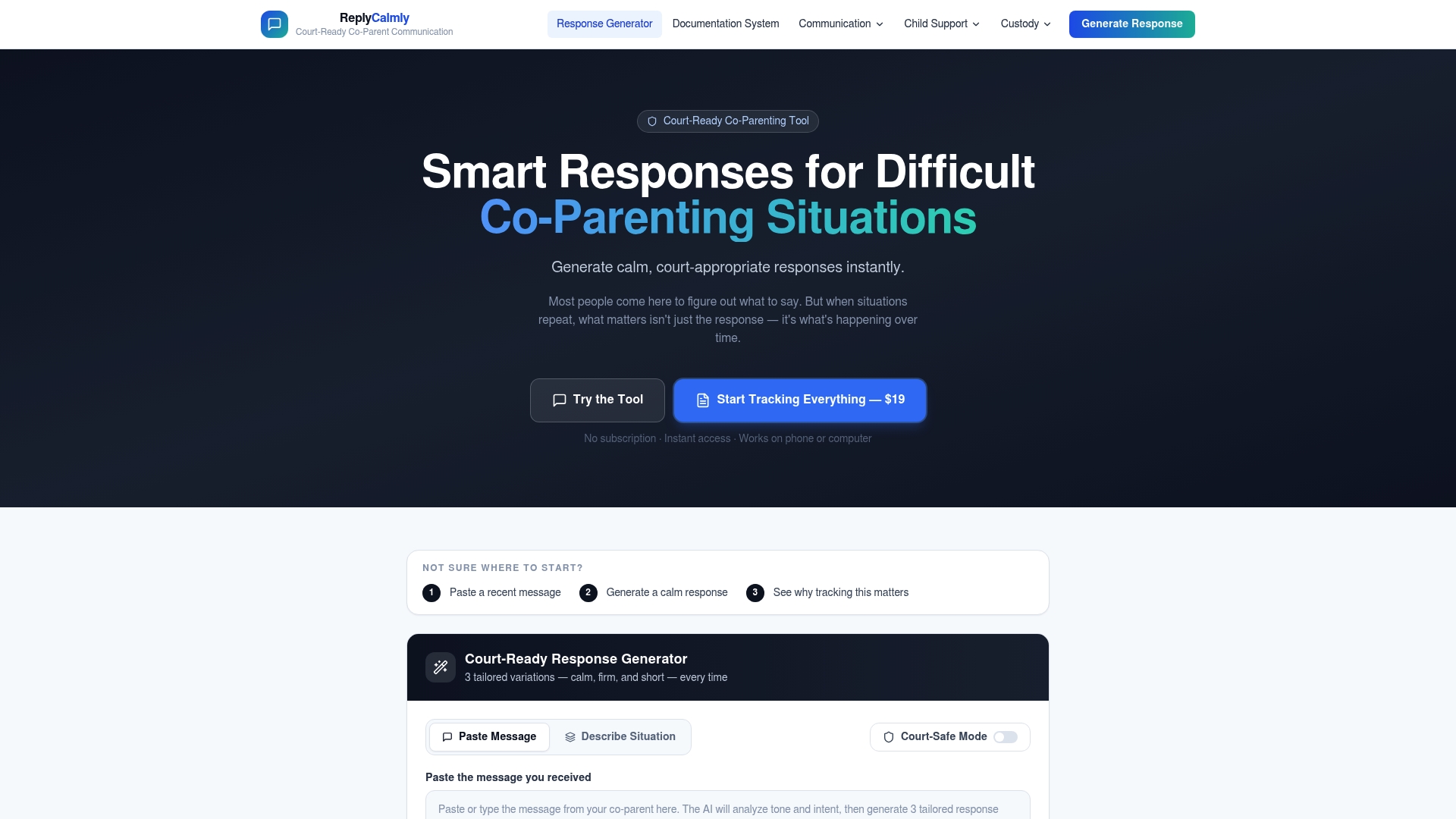
The platform's response generator produces calm, firm, and short reply variations for any message you paste in, so you never have to write a difficult response from scratch. The documentation tools log incidents, categorize patterns, and create a visual record that matters in family court. Replycalmly also integrates with OurFamilyWizard to strengthen accountability without replacing court-mandated tools. For parents who want a structured starting point, the best co-parenting apps for documentation guide walks through which tools fit which situations.
FAQ
What are the most effective coparenting habits?
The most effective habits are consistent, child-focused communication using frameworks like BIFF, predictable routines across both homes, and the 48-hour pause before responding to emotionally charged messages. These three practices address the majority of co-parenting conflicts before they escalate.
How do you improve communication with a difficult co-parent?
Use written communication for all logistics, apply the BIFF method to keep messages brief and factual, and document exchanges in a co-parenting app. If conflict persists, parallel parenting strategies reduce direct interaction while maintaining child stability.
What is the 48-hour pause in co-parenting?
The 48-hour pause, recommended by Eti Valdez-Kaminsky, MFT, means drafting your response to a difficult message, waiting two days, then reviewing it before sending. This single habit significantly reduces reactive replies that escalate conflict.
When should co-parents consider mediation?
Mediation is appropriate when structured communication tools and cooling-off protocols have not resolved recurring conflicts. A trained family mediator produces agreements both parents helped create, which improves compliance and reduces the need for court intervention.
Do co-parenting apps actually reduce conflict?
Yes. Apps like OurFamilyWizard and 2Houses centralize schedules and message logs, which eliminates the "I never received that" disputes that fuel conflict. Replycalmly's communication improvement guide explains how to integrate these tools into a broader communication plan.