
An emotional regulation checklist is a structured self-assessment tool that helps parents identify emotional triggers, evaluate their responses, and choose behaviors that align with their goals during high-conflict co-parenting situations. The clinical framework behind these checklists comes from Dialectical Behavior Therapy (DBT), which separates emotion regulation into two distinct tracks: preventive skills like ABC PLEASE and in-the-moment tools like Check the Facts and Opposite Action. Research confirms that parental emotion regulation profiles directly affect parental exhaustion and children's psychological outcomes. For co-parents managing custody disputes, hostile messages, or court-adjacent communication, a well-built checklist is not optional. It is the difference between a response you regret and one that holds up in court.
1. What an emotional regulation checklist actually includes
A practical emotional regulation checklist does more than remind you to breathe. According to DBT-based guidance, an effective checklist for co-parents covers three core functions: labeling emotions accurately, checking basic physical and social needs, and selecting responses that match your actual goals.

The labeling step requires distinguishing primary emotions from secondary ones. Anger is often a secondary emotion sitting on top of fear, shame, or grief. Distinguishing primary from secondary emotions changes which skill you apply next, because the underlying driver is what needs addressing, not the surface behavior. A co-parent who thinks they are angry at a schedule change may actually be afraid of losing time with their child. That fear calls for a different response than pure anger would.
The basic needs check is unglamorous but non-negotiable. Before responding to any triggering message, run through:
- Sleep: Did you sleep fewer than six hours last night?
- Food: Have you eaten a real meal in the last four hours?
- Movement: Has your body moved today?
- Connection: Have you spoken to a supportive person recently?
- Sunlight and space: Have you had any time outside or alone?
If two or more of these are red, your nervous system is already compromised. Responding now increases the risk of saying something that damages your legal position or your child's stability.
Pro Tip: Write your primary emotion first, then ask yourself what that emotion is protecting. If the answer is a different emotion entirely, that second emotion is your real target for regulation.
2. How preventive ABC PLEASE skills reduce emotional vulnerability
Most co-parents reach for regulation tools only when they are already activated. DBT's two-part structure separates preventive baseline skills from reactive in-the-moment skills, and the preventive layer is where lasting change actually happens. The ABC PLEASE framework is the foundation.
The ABC skills build positive emotional reserves before conflict arises:
- Accumulate positive experiences. Schedule activities that generate genuine pleasure or meaning, not just distraction. A weekly activity you look forward to creates a buffer against emotional depletion.
- Build mastery. Do one thing each day that creates a sense of competence. This could be finishing a task at work, completing a workout, or learning something new. Mastery counters the helplessness that high-conflict co-parenting often produces.
- Cope ahead. Before a difficult handoff, court date, or anticipated hostile message, mentally rehearse your regulated response. Walk through the scenario and plan your behavior in advance. This is not pessimism. It is preparation.
The PLEASE skills address physical vulnerability directly:
- Treat Physical illness. Unmanaged pain or illness lowers your emotional threshold significantly.
- Balance Eating. Skipping meals or eating erratically destabilizes mood more than most people realize.
- Avoid mood-altering substances. Alcohol and other substances reduce the prefrontal control you need for skillful responses.
- Balance Sleep. Sleep deprivation is the single fastest way to compromise emotional regulation capacity.
- Exercise. Even 20 minutes of moderate movement reduces cortisol and improves emotional resilience.
For co-parents, the PLEASE skills are especially relevant because custody stress often disrupts all five simultaneously. Treating them as a stress management checklist you review weekly, not just during crises, builds the kind of resilience that shows up when you need it most.
3. In-the-moment steps for skillful responses during conflict
When a triggering message arrives or a handoff goes sideways, you need a coping strategies list you can run through in under two minutes. DBT's Check the Facts and Opposite Action skills form the core of any effective in-the-moment checklist.
- Name the emotion precisely. Not "I feel bad." Identify whether it is fear, anger, shame, guilt, or sadness. Precision matters because each emotion has a specific opposite action.
- Identify the triggering event. What specifically happened? A message, a tone, a missed pickup? Keep this factual, not interpretive.
- Check the fit. Ask: does the intensity of my emotion match the actual probability and severity of what happened? An 85% emotional response to a 5% likelihood event signals a mismatch. That mismatch is your cue to use Opposite Action rather than act on the emotion.
- Choose your action. If the emotion fits the facts, act on it skillfully. If it does not fit, do the opposite of what the emotion is urging. Fear urges avoidance, so approach. Anger urges attack, so speak softly or disengage. Shame urges hiding, so disclose to a trusted person.
- Pause before sending. Write your response, then wait at least 10 minutes before sending. Read it once as if you are a judge seeing it for the first time.
For co-parents specifically, learning to respond to an angry co-parent without matching their emotional register is a skill that protects both your child and your legal record.
Pro Tip: Mid-conversation with a co-parent, plan a regulation "handoff" to yourself. Pausing and resetting mid-exchange is more realistic than expecting total neutrality, and it prevents you from transmitting your activation to the other person.
4. How co-regulation improves emotional outcomes in co-parenting
Emotional regulation is not purely a solo practice. Co-regulation describes the process by which one person's nervous system influences another's, and it operates whether you intend it to or not. Co-regulation theory reframes the goal from "staying calm at all times" to "returning to groundedness and not transmitting activation."
This distinction matters enormously for co-parents. You will not be perfectly calm during every custody exchange. The realistic goal is to recognize when you are activated, interrupt the transmission of that activation, and return partially to a regulated state before continuing. That partial return is enough to change the outcome of an interaction.
Practical ways to build co-regulation capacity into your co-parenting interactions:
- Use written communication as a buffer. Text and email give you time to regulate before responding. Apps like OurFamilyWizard create a documented record that also slows the exchange down.
- Keep exchanges short and factual. The longer a message, the more emotional content tends to leak in. Stick to logistics.
- Model groundedness, not suppression. Steady adult presence helps the other person's nervous system down-regulate. You do not need to be warm. You need to be stable.
- Recognize your co-parent's activation as information, not a command. Their anger does not require your anger in return.
"The goal is not to be unmoved. The goal is to return to groundedness fast enough that you do not become part of the escalation."
Parental emotion regulation profiles show that parents who consistently practice regulation, rather than relying on in-the-moment control alone, produce better outcomes for both themselves and their children over time.
5. How to customize your checklist for your co-parenting situation
A generic feelings assessment guide will not hold up under the specific pressures of your custody arrangement. Effective emotional self-regulation tools require personalization to work consistently.
The table below shows the difference between a generic checklist and a personalized one:
| Generic checklist | Personalized checklist |
|---|---|
| "Notice your emotions" | "When I receive a message about schedule changes, I feel fear first, then anger" |
| "Check your needs" | "I need sleep and food before I respond to anything after 8 PM" |
| "Choose a calm response" | "My goal is a response that protects my custody record and my child's stability" |
| "Use a coping strategy" | "I use a 10-minute pause and one grounding breath before drafting any reply" |
| "Practice self-care" | "I exercise Tuesday and Thursday mornings to maintain my emotional baseline" |
The specificity column is what makes the checklist usable under pressure. When you are activated, vague instructions fail. Concrete, personal language triggers the right behavior automatically.
Effective checklists separate baseline prevention strategies from reactive skills. Build your checklist in two sections: one for daily maintenance (PLEASE skills, mood tracking worksheet entries, self-reflection questions) and one for triggered moments (Check the Facts, Opposite Action, pause protocol). Review the maintenance section weekly and the reactive section before any anticipated difficult interaction.
Technology supports consistency here. Replycalmly's response generator and documentation tools help you apply your checklist in real time, especially when emotions are running high and clear thinking is hardest to access.
Key takeaways
A co-parenting emotional regulation checklist works best when it combines DBT's preventive ABC PLEASE skills with in-the-moment tools like Check the Facts and Opposite Action, personalized to your specific triggers and goals.
| Point | Details |
|---|---|
| Label emotions precisely | Distinguish primary from secondary emotions to target the real driver, not the surface reaction. |
| Run the basic needs check | Sleep, food, movement, and connection deficits compromise regulation before conflict even starts. |
| Use Check the Facts | Match emotional intensity to actual event probability before choosing how to respond. |
| Build preventive habits | ABC PLEASE skills reduce baseline vulnerability so in-the-moment tools work better. |
| Personalize your checklist | Replace generic prompts with specific triggers, goals, and response protocols that fit your situation. |
What I've learned from watching parents use these tools
I have seen co-parents arrive at regulation checklists expecting a quick fix, and I understand why. When someone is sending you hostile messages at 11 PM, you want a solution that works tonight. The honest truth is that the parents who get the most out of these tools are the ones who treat them as a practice, not a prescription.
The ABC PLEASE skills feel tedious until the moment they are not. A parent who has been exercising consistently and sleeping reasonably well handles a false accusation in a co-parent message very differently than one who has been running on empty for three weeks. The checklist does not create regulation. It surfaces the regulation capacity you have already built.
The co-regulation piece is the part most people underestimate. You cannot control your co-parent's behavior, but your nervous system is always broadcasting a signal. A steady, factual message lands differently than one written from activation, even if the words are technically the same. I have watched parents transform their communication records simply by adding a 10-minute pause and a basic needs check before every response.
If you are feeling overwhelmed by co-parenting, start with the PLEASE skills and one in-the-moment tool. Do not try to overhaul everything at once. Consistency with two skills beats perfection with ten.
— Devin
How Replycalmly supports your regulation practice
Knowing what to do and doing it under pressure are two different things. Replycalmly is built for the gap between them.
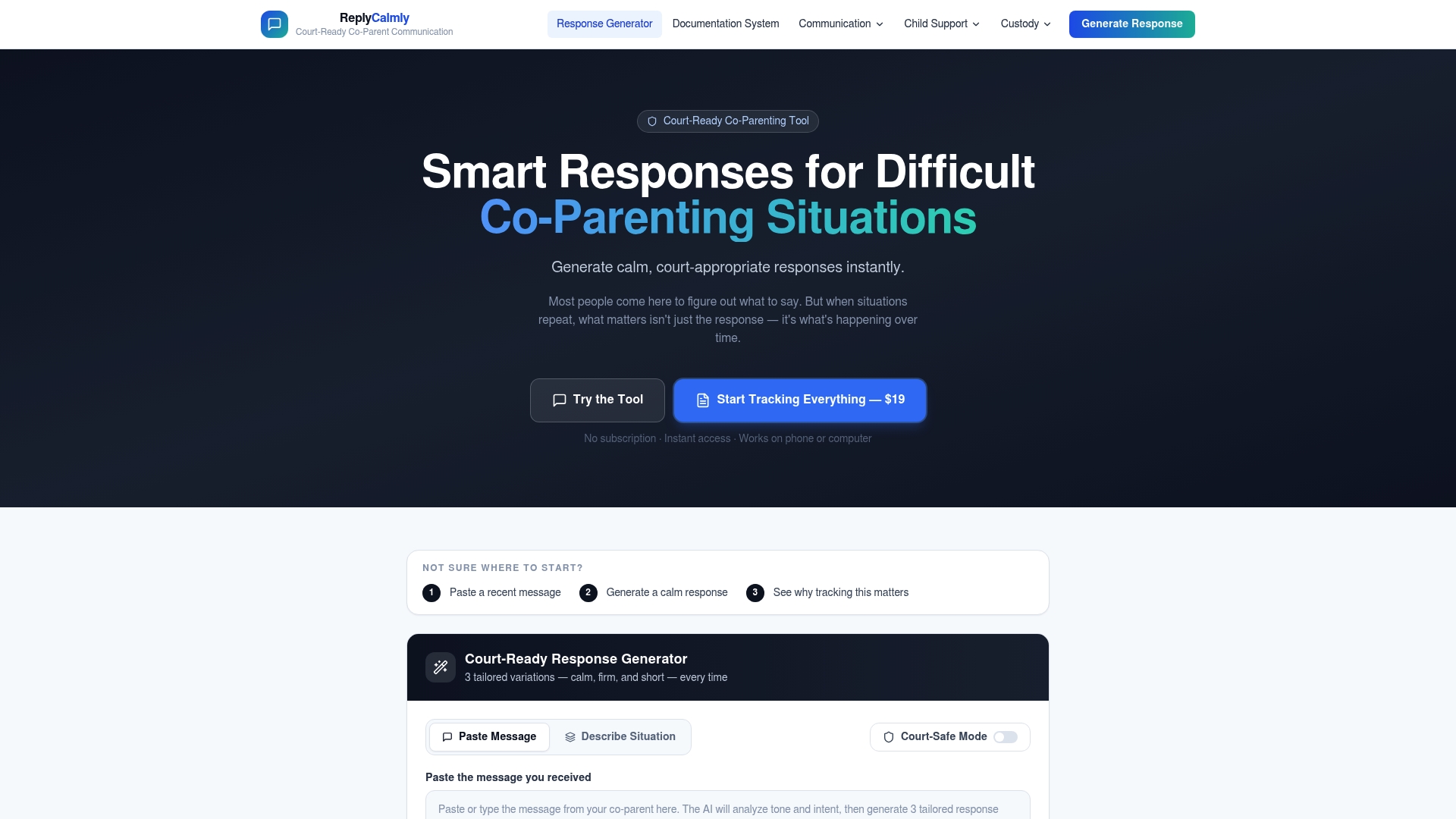
The co-parenting communication plan template gives you a structured format for applying your regulation checklist to real exchanges, so you are not starting from scratch every time a difficult message arrives. The response generator produces calm, firm, and short variations of your reply, which is exactly what you need when your emotional regulation checklist says "pause and choose your tone." Both tools work alongside OurFamilyWizard and other court-mandated platforms, keeping your communication record clean and your responses court-appropriate.
FAQ
What is an emotional regulation checklist?
An emotional regulation checklist is a structured tool that guides you through labeling emotions, checking basic needs, and choosing goal-aligned responses before acting. It draws from DBT's emotion regulation module and is designed for use in high-stress situations like co-parenting conflicts.
How is DBT used in co-parenting emotion regulation?
DBT provides two layers of skills: ABC PLEASE for building daily emotional resilience, and Check the Facts plus Opposite Action for responding skillfully in the moment. Co-parents benefit from both layers because custody stress is both chronic and acute.
What does "Check the Facts" mean in practice?
Check the Facts means naming your emotion, identifying the specific trigger, and asking whether your emotional intensity matches the actual probability of harm. If an 85% fear response is attached to a 5% likelihood event, Opposite Action is the appropriate next step.
Can emotional regulation improve co-parenting communication?
Yes. Research on parental regulation profiles shows that consistent regulation practice reduces parental exhaustion and improves children's psychological outcomes. Regulated parents produce more factual, less reactive communication, which holds up better in legal contexts.
What is co-regulation and why does it matter for co-parents?
Co-regulation is the process by which one person's nervous system influences another's through subtle signals. For co-parents, returning to groundedness before responding prevents emotional activation from spreading and escalating an already tense exchange.