
Healthy co-parenting is not about being friends with your ex. It is about being strategic partners for your child. Many parents struggling in difficult custody situations believe they have failed if their relationship with the other parent feels cold or formal. That belief is wrong, and it costs kids their sense of stability. Real examples of healthy co-parenting show that structure, consistency, and respectful communication matter far more than warmth. Children in low-conflict divorced families actually have better outcomes than those in high-conflict intact homes. That fact alone reframes everything.
Table of Contents
- Key takeaways
- 1. Examples of healthy co-parenting: what makes it actually work
- 2. Examples of positive communication practices
- 3. Examples of coordinating schedules and shared responsibilities
- 4. Examples of fostering emotional support for your child
- 5. How to co-parent effectively in high-conflict situations
- 6. Real examples of co-parenting success in practice
- My honest take on healthy co-parenting
- Tools that make healthy co-parenting less exhausting
- FAQ
Key takeaways
| Point | Details |
|---|---|
| Friendship is not required | Healthy co-parenting is strategic collaboration, not an emotional relationship between ex-partners. |
| Communication style shapes outcomes | Brief, factual, and polite messages reduce conflict and protect your case in court. |
| Parallel parenting is a valid tool | High-conflict situations call for limited, logistics-only contact to protect children from exposure. |
| Structure beats spontaneity | Consistent schedules and documented plans give children the reliability they need to feel safe. |
| Technology reduces friction | Co-parenting apps and response tools help parents stay professional when emotions run high. |
1. Examples of healthy co-parenting: what makes it actually work
Before looking at specific examples, it helps to understand what you are aiming for. Healthy co-parenting is built on a handful of foundational behaviors that any two parents can practice regardless of how difficult the relationship is.
Emotional maturity over emotional reactivity. This means responding to messages when you are calm, not when you are angry. It means keeping your child out of adult conflict. It does not require you to like the other parent.

Child-centered decision making. Every major question, from schooling to medical care to extracurriculars, gets filtered through one question: what is best for my child? When both parents apply that filter consistently, disputes shrink dramatically.
Consistent boundaries across households. Bedtimes, screen time rules, and homework expectations do not need to be identical in both homes. But they should not be wildly different either. Extreme differences create anxiety and give kids room to manipulate the situation.
Reliable follow-through. Children's sense of safety comes from caregiver reliability far more than from the status of the parental relationship. Showing up on time, following the schedule, and doing what you said you would do are the most underrated co-parenting behaviors.
Pro Tip: Think of your co-parenting relationship like a business partnership. You do not need to enjoy your business partner. You need to communicate clearly, honor agreements, and keep the business, which in this case is your child's wellbeing, running smoothly.
2. Examples of positive communication practices
The way you communicate with your co-parent sets the tone for every interaction. Most conflict escalates not because of the original issue but because of how messages are written and received. These are co-parenting communication examples that consistently reduce friction.
- Keep messages brief and factual. "School pickup Tuesday is at 3:15 p.m. due to early release" is a complete, useful message. There is nothing to react to emotionally. Compare that to a message that mixes logistical information with grievances.
- Use a 24-hour delay before responding to emotional messages. Avoiding quick emotional responses is one of the simplest ways to prevent conflict from escalating. If a message triggers you, wait. Your reply will be better for it.
- Share important updates promptly. Medical appointments, school events, and activity changes should be communicated as soon as you know. Withholding information is not a power move. It is a documentation liability.
- Separate messages by topic. Mixing a custody schedule question with a grievance about a missed pickup creates confusion and escalation. Send one topic per message when possible.
- Use co-parenting apps for accountability. Platforms designed for this purpose create a transparent record of every interaction. This matters enormously if your case ever returns to court.
Pro Tip: If you are not sure whether a message sounds calm and professional, read it out loud as if a judge were listening. That simple mental exercise changes how you phrase things.
3. Examples of coordinating schedules and shared responsibilities
Scheduling conflict is one of the top triggers for co-parenting disputes. The families that manage it well share one trait: they have a system. These are positive co-parenting practices that bring order to the chaos.
Clear, written parenting time schedules remove ambiguity. When both parents know exactly whose time is whose, there is nothing to argue about. A shared digital calendar with automatic reminders for appointments and events works for many families.
Documenting what-if scenarios in a parenting plan, such as what happens if a child is sick on a transition day or if a scheduled activity falls on the other parent's time, reduces the number of live disputes you have to navigate. It converts recurring arguments into pre-decided answers.
The following table compares two common approaches to scheduling coordination:
| Approach | Best for | Key feature | Watch out for |
|---|---|---|---|
| Shared digital calendar | Low to medium conflict situations | Real-time visibility for both parents | Requires mutual access and good faith |
| Written parenting plan only | High-conflict situations | No live interaction required | Needs regular legal updates as life changes |
| Co-parenting app with calendar | Any conflict level | Integrated messaging and scheduling | Learning curve for less tech-savvy parents |
Flexibility balanced with structure is another hallmark of co-parenting success. Life happens. A child gets sick. A work schedule shifts. The parents who handle this well treat each deviation from the schedule as a logistical problem to solve, not a betrayal to punish.
4. Examples of fostering emotional support for your child
Protecting your child's relationship with both parents is one of the most concrete examples of healthy co-parenting in action. Children do not need their parents to be friends. They need both parents to be safe places.
- Never speak negatively about the other parent in front of your child. Not once. Not even indirectly through sighs or eye rolls. Children internalize criticism of a parent as criticism of themselves, since they are made of both of you.
- Actively encourage the relationship. Tell your child you are glad they had a good time with the other parent. Ask positive questions about their time. Your child should never feel like enjoying the other home is a betrayal.
- Align on core values where possible. You do not need identical parenting styles. But alignment on discipline philosophy, screen time, and school expectations reduces children's confusion and the manipulation that naturally emerges from inconsistency.
- Create predictable transition rituals. The moment of handoff is often the hardest for children. A consistent, low-drama routine at pickup and dropoff signals safety and normalcy.
"Viewing the other parent as a teammate rather than an enemy is fundamental to co-parenting success." Abandoning the villain narrative does not mean excusing bad behavior. It means staying focused on your child's experience instead of your own grievances.
Research confirms that healthy co-parenting signals emotional maturity and child-centered focus, even if some people misread it as suspicious. Do not let social pressure push you toward adversarial co-parenting when your child is thriving.
5. How to co-parent effectively in high-conflict situations
Not every co-parenting situation allows for warmth or collaboration. Some require a completely different model. Understanding which approach fits your situation is how to co-parent effectively without burning yourself out.
Collaborative co-parenting works when both parents can communicate with minimal conflict, keep children out of disputes, and make joint decisions. It is characterized by open communication, flexibility, and shared presence at events.
Parallel parenting is the right model for high-conflict situations. It is not a failure but a strategic, endorsed tool that protects children by limiting co-parent contact strictly to logistics. Each parent runs their household independently. Communication is minimal, written, and strictly factual.
| Feature | Collaborative co-parenting | Parallel parenting |
|---|---|---|
| Communication frequency | Regular, sometimes spontaneous | Minimal, written only |
| Joint decisions | Yes, ongoing | Pre-set in legal documents |
| Child-facing presence | Both parents at events together | Separate attendance |
| Best for | Low to medium conflict | High conflict or toxic dynamics |
| Technology use | Shared apps, calendars | Formal co-parenting platforms only |
Pro Tip: Parallel parenting is often a temporary phase, not a permanent sentence. As situations stabilize, some families gradually shift toward a more collaborative model. Review your approach every year, especially as your child's needs change.
Platforms like OurFamilyWizard and similar court-approved tools help parents in either model stay organized and accountable. Using one removes the "he said, she said" dynamic from your communication record.
6. Real examples of co-parenting success in practice
You do not need celebrity relationships to find concrete examples of co-parenting success. You find them in everyday decisions made by ordinary parents under real pressure.
A parent who receives a hostile message and waits until morning to send a calm, two-sentence reply. A parent who adjusts a pickup time without complaint because the child had a school event run long. A parent who tells their child, "I know you miss the other house when you are here. That is okay. You are loved at both homes."
These are not dramatic gestures. They are the daily deposits into your child's emotional account. They are also the behaviors that matter in court when patterns of communication become evidence. Documenting co-parent messages is not paranoia. It is protection for you and your child.
Platforms that support over 500,000 families with court-certified communication records exist precisely because the need is that widespread. You are not alone in needing structure to make this work.
My honest take on healthy co-parenting
I have seen parents exhaust themselves trying to be warm, cooperative, and friendly with a co-parent who gives them nothing in return. That effort is noble, but it often becomes an emotional trap.
What I have learned is this: the goal is not a good relationship with your ex. The goal is a good childhood for your kid. Those are not the same thing. Once you separate them, the pressure drops significantly.
The most overlooked element in any co-parenting situation is nervous system regulation. You can know every healthy co-parenting tip in existence, but if you are reading their messages in a triggered state, none of it applies. The 24-hour rule is not a communication tactic. It is physiological recovery time.
I also think the villain narrative is the single most destructive habit in co-parenting. Not because your ex is not genuinely difficult. They may be. But the story you tell yourself about them shapes how you respond to every message, every request, every transition. Treat them like a vendor you are contractually obligated to work with. Polite, professional, and completely unaffected by their personality. That is where the real examples of co-parenting success come from.
The parents who make this work long-term are not the ones with the most patience. They are the ones with the best systems.
— Devin
Tools that make healthy co-parenting less exhausting
When your co-parenting situation is difficult, even writing a simple message can feel like defusing a bomb. Replycalmly was built for exactly that moment.
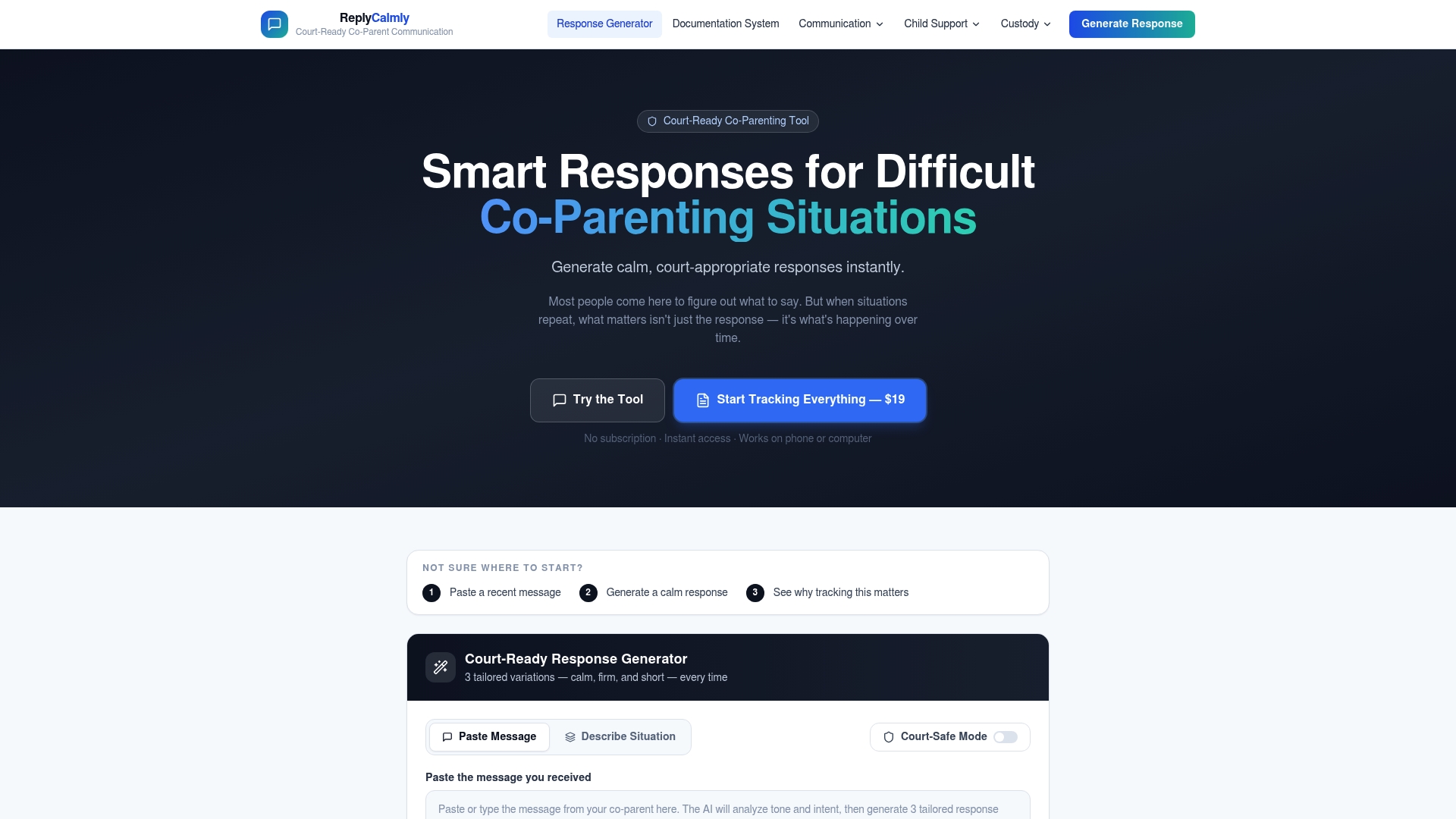
The platform gives you a co-parent response generator that produces calm, firm, or short versions of any reply you need to send. It also tracks communication patterns over time so you can see exactly what is happening and build a documented record for court. You can explore the best co-parenting apps for documentation and find the right fit for your situation. If you want to start with a structure, a communication plan template walks you through building an agreement that reduces live conflict before it starts.
FAQ
What are examples of healthy co-parenting?
Healthy co-parenting examples include using written-only communication through a co-parenting app, sticking to a consistent parenting schedule, never speaking negatively about the other parent in front of children, and making child-centered decisions together without involving personal conflict.
What is parallel parenting and when should I use it?
Parallel parenting is a model where each parent operates their household independently with minimal co-parent contact. It is the recommended approach in high-conflict or toxic co-parenting situations, endorsed by family practitioners as a protective strategy for children.
How do you communicate effectively with a difficult co-parent?
Keep messages brief, factual, and polite, and use a 24-hour waiting period before responding to emotionally charged messages. Using a dedicated co-parenting app creates an accountable, court-admissible record of all communication.
Does healthy co-parenting require a friendly relationship?
No. Healthy co-parenting requires respectful, child-focused collaboration, not friendship. Many successful co-parents maintain a strictly professional tone, which actually reduces conflict and protects children from exposure to adult tension.
How does co-parenting affect children long-term?
Children raised in low-conflict co-parenting situations have measurably better emotional and social outcomes than those exposed to ongoing parental conflict, even compared to children in intact but high-conflict homes.