
Co-parenting after a separation puts your communication skills to the test in ways you probably never anticipated. Old grievances, new tensions, and the constant pressure of shared parenting decisions make it easy for exchanges to turn hostile fast. But the good news is that respectful communication is a learned skill, not a personality trait. This article gives you concrete examples of respectful responses you can use right now, across the situations that come up most often, so you can protect your relationship with your child and your standing in any legal process.
Table of Contents
- Key takeaways
- 1. Examples of respectful responses start with clear criteria
- 2. Responding to scheduling requests and changes
- 3. De-escalating hostile or provocative messages
- 4. Setting respectful boundaries around tone and topics
- 5. Acknowledging your co-parent's perspective
- 6. Suggesting compromises and inviting input
- 7. Comparing respectful vs. disrespectful responses
- 8. How to decide when and how to respond
- My honest take on respectful co-parent communication
- Tools that make respectful responses easier
- FAQ
Key takeaways
| Point | Details |
|---|---|
| Use the BIFF method | Keep messages Brief, Informative, Friendly, and Firm to reduce conflict and stay child-focused. |
| Respond to facts, not feelings | Address only the factual content of a message and skip the emotional bait entirely. |
| Written responses protect you | Every respectful written reply becomes a potential record in custody or legal proceedings. |
| Timing matters | Waiting before you reply gives you space to regulate emotion and write a clearer, calmer message. |
| Structure beats willpower | Templates and frameworks make respectful responses repeatable, not dependent on your mood. |
1. Examples of respectful responses start with clear criteria
Before you can model good responses, you need to know what makes a response respectful in the first place. In co-parenting, respectful does not mean warm. It means controlled, child-focused, and clear.
The BIFF method is one of the most practical frameworks available. BIFF stands for Brief (two to five sentences), Informative (facts and logistics only), Friendly (neutral and non-hostile), and Firm (clear, with no room for debate). A message that follows BIFF communicates what needs to be said without adding fuel to any existing conflict.
Respectful responses also share a few consistent traits:
- They stay focused on the child's needs, not the adult relationship
- They use neutral language with no sarcasm, blame, or loaded phrasing
- They include active listening phrases like "So, what you are saying is..." to verify understanding
- They set limits without attacking, for example: "Please message me with the specific request"
- They offer solutions or next steps rather than complaints
Pro Tip: Before sending any message, ask yourself: would I be comfortable if a judge read this? If not, revise it.
2. Responding to scheduling requests and changes
Scheduling conflicts are among the most common flashpoints in co-parenting. Here is how to respond respectfully when your co-parent requests a change.
Scenario: Your co-parent asks to swap weekends with little notice.
A disrespectful version might look like: "You always do this last minute. The answer is no."
A respectful version: "I received your request to swap the weekend of [date]. I can accommodate that if we agree that I get [alternate date] in return. Please confirm by [day] so I can plan accordingly."

Notice what the respectful version does. It acknowledges the request, offers a conditional yes, and sets a clear timeline. It focuses entirely on logistics. There is no emotional commentary attached.
Scenario: A scheduled exchange time cannot be met.
Polite response example: "I wanted to let you know that I will be arriving at 6:15 instead of 6:00 due to traffic. I will text when I am ten minutes away."
Short, factual, no drama. This is how to show respect in conversation without requiring warmth or friendship.
Pro Tip: When you need to say no to a request, offer an alternative in the same message. It shifts the tone from refusal to problem-solving.
3. De-escalating hostile or provocative messages
When your co-parent sends a message that is aggressive or emotionally charged, the natural reaction is to defend yourself or fire back. Both options make things worse.
The most effective tactic is to respond only to the facts, completely ignoring the emotional tone. This is not weakness. It is a strategic choice that protects you legally and stops the conflict loop.
Here are numbered examples of respectful responses to hostile messages:
-
Hostile message: "You never follow the schedule. You're completely unreliable." Respectful response: "Our pickup time this week is Saturday at 10 a.m. I will be there."
-
Hostile message: "I can't believe you told our kid that. You are undermining everything I say." Respectful response: "If there is a specific concern about something said, I am open to addressing it. Please share the details so we can find a resolution that works for the kids."
-
Hostile message: "You only care about yourself. This arrangement is a joke." Respectful response: "I want to make sure our children have consistency. Let me know if there is a scheduling issue you would like to resolve."
Each of these examples acknowledges there is a message without engaging the attack. They redirect to facts and the child's needs. This is what constructive communication examples look like in real life. They are not always elegant, but they are effective.
4. Setting respectful boundaries around tone and topics
You are allowed to set limits on how you are communicated with. Doing it respectfully means stating your boundary clearly without threatening or attacking.
Effective boundary phrases include:
- "I am not available to discuss anything from our past relationship. I am happy to focus on the kids."
- "Please send scheduling requests through our co-parenting app so I can respond promptly."
- "I will not be able to continue this conversation if the tone remains this way. I am happy to reconnect once we can focus on the children's needs."
These are not ultimatums. They are clear statements of what you will and will not engage with. They demonstrate how to respond with kindness while still holding a firm line.
5. Acknowledging your co-parent's perspective
One of the most underused tools in co-parenting communication is simple acknowledgment. You do not have to agree to validate. And when someone feels heard, they tend to escalate less.
Try phrases like:
- "I understand you feel strongly about this."
- "I hear that this timing is difficult for you."
- "That makes sense from your perspective. Here is where I am coming from."
These are polite response examples that defuse tension without conceding your position. Using collaborative phrases like "So, what you are saying is..." moves conversations from defensiveness into actual problem-solving. It is one of the clearest examples of empathy in conversation that you can apply in a co-parenting context.
6. Suggesting compromises and inviting input
Co-parenting works better when both parents feel they have a voice. Constructive communication examples include language that invites input without handing over all decision-making authority.
Try: "I have a suggestion for how we handle the school break schedule. Would you be open to discussing it this week?"
Or: "I know we have different views on this. I would like to find something that works for both of us. Can we each share what matters most and go from there?"
Inviting input signals that you see this as a shared project. That framing alone can shift the entire dynamic of a conversation.
7. Comparing respectful vs. disrespectful responses
Seeing these two types of responses side by side makes the difference concrete.
| Situation | Disrespectful response | Respectful response |
|---|---|---|
| Late pickup | "You're always late. This is so typical." | "Please let me know if your arrival time changes so I can plan accordingly." |
| Disagreement on school choice | "Of course you want that school. You never think about what's best for the kids." | "I have some concerns about that school. Can we schedule a time to go over both options?" |
| Missed payment | "You never pay on time. This is completely irresponsible." | "I noticed the scheduled payment has not arrived. Please let me know the expected date." |
| Request ignored | "You always ignore me. Why do I even bother?" | "I sent a message on [date] about [topic]. Please let me know if you received it." |
Disrespectful responses do more than sound bad. They escalate conflict and harm children, who are far more aware of adult tension than most parents realize. Respectful responses build the kind of working relationship that keeps your child out of the middle.
A few patterns to actively avoid:
- Sarcasm, even when subtle
- Bringing up past relationship issues
- Using your child as a messenger or source of information
- Responding in all caps or with multiple exclamation points
- Sending messages when you are angry without waiting to cool down
8. How to decide when and how to respond
Knowing what to say is only part of the challenge. Knowing when and how to say it is just as critical.
Waiting 24 hours before responding to an emotionally charged message is one of the most consistently recommended practices. Write the angry version if you need to. Just do not send it. Reread the message the next day and ask whether your response serves your child. That single question reframes everything.
A few more practical guidelines:
- Choose written communication. Written responses create a record that protects you legally and gives you more time to choose your words carefully.
- Use structured templates. Structured message formats narrow the conversation topic and prevent open-ended conflict loops.
- Know when to pause. If a conversation is spiraling, it is acceptable to say: "I need some time to consider this and will follow up by [date]."
- Focus on the issue, not the person. Effective response techniques always address what happened, not who your co-parent is as a person.
Pro Tip: Keep a simple folder where you save examples of your best responses. When you face a similar situation again, you already have a template you trust.
My honest take on respectful co-parent communication
I have seen a lot of people approach respectful co-parenting communication as if it requires liking the other person. It does not. In my experience, the parents who communicate most effectively in high-conflict situations are not the warmest ones. They are the most disciplined ones.
What I have found is that respectful communication is structural, not emotional. When you have a template, a rule about timing, and a clear filter (does this serve my child?), the quality of your messages improves regardless of how you feel that day. The skill is in the process, not the sentiment.
I will also say this directly: focusing on shared goals rather than winning individual exchanges is one of the most practical mindset shifts you can make. You will not win every argument. But you can build a communication record that demonstrates your consistent good faith over time. And that matters enormously in any legal context.
Progress will be gradual. Some exchanges will still go sideways. But each message you send with intention is a deposit toward a more stable dynamic. Your child benefits from every one of those deposits, even when it does not feel like it in the moment.
— Devin
Tools that make respectful responses easier
Knowing what to say is one thing. Having the right support to say it consistently is another. Replycalmly is built specifically for co-parents dealing with difficult communication. The platform generates calm, court-appropriate message variations for any situation you are facing, so you are never starting from scratch when emotions are high.
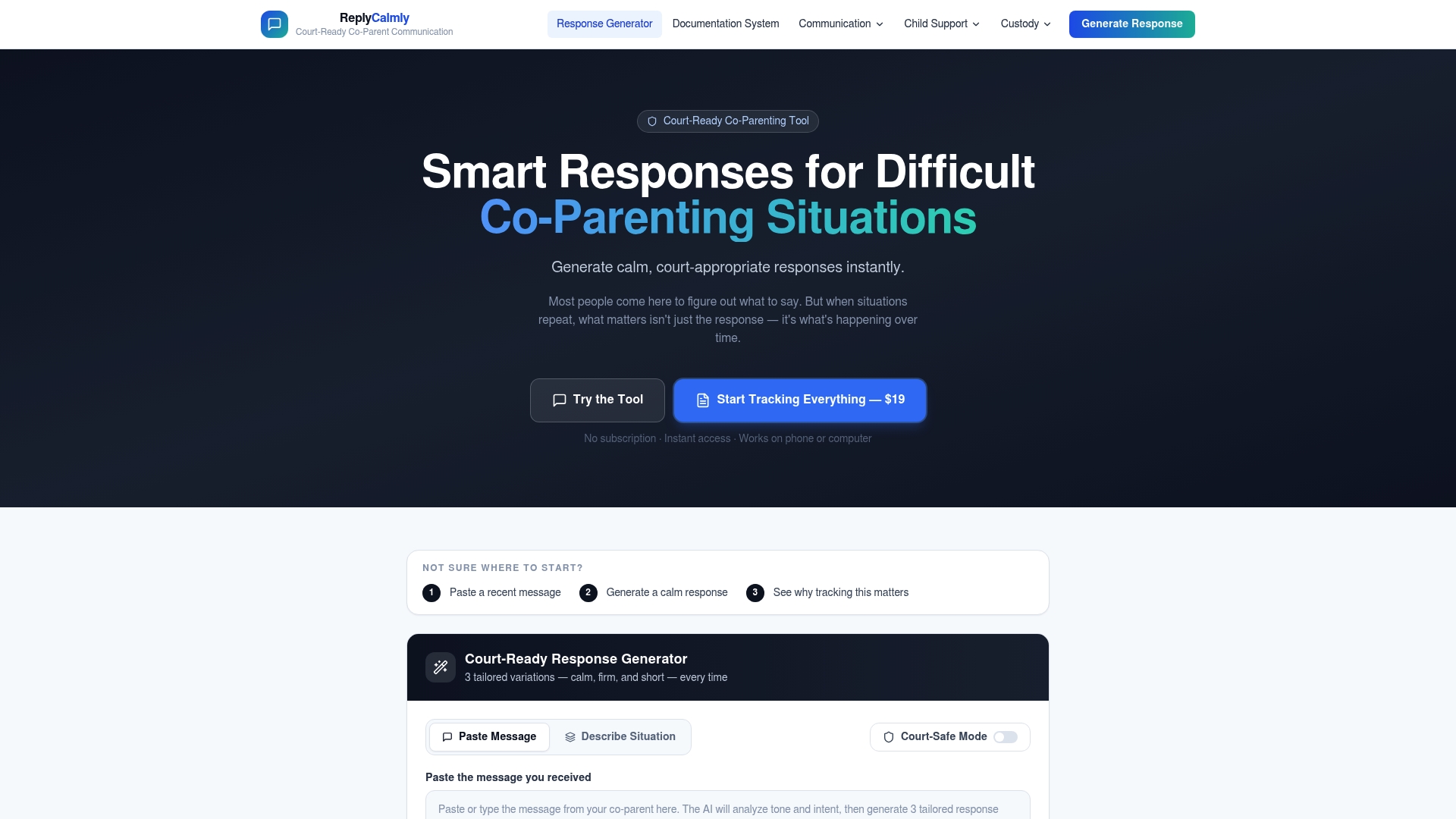
Whether you need a communication plan template to structure your exchanges, or you want to explore the best documentation apps for tracking patterns over time, Replycalmly has tools designed for exactly your situation. It also integrates with court-mandated platforms to keep everything in one place. If you are serious about protecting your children and your legal standing, it is worth exploring what structured communication support can do.
FAQ
What are examples of respectful responses in co-parenting?
Respectful responses in co-parenting are brief, factual, and child-focused. An example is: "I can accommodate that schedule change if we agree on [alternate date]. Please confirm by [day]."
How do you respond respectfully to a hostile co-parent?
Address only the factual content of the message and ignore the emotional tone entirely. For example, if accused of being unreliable, respond only with the confirmed logistics: "Pickup is Saturday at 10 a.m. I will be there."
What is the BIFF method for co-parenting communication?
BIFF stands for Brief, Informative, Friendly, and Firm. It is a structured approach that helps parents reduce communication conflict by keeping messages short, factual, neutral in tone, and clear about expectations.
When should you wait before responding to a co-parent message?
Wait at least 24 hours before responding to any message that triggered an emotional reaction. Rereading and revising before sending helps prevent escalation and produces a clearer, more constructive reply.
Does written communication really matter in co-parenting disputes?
Yes. Written communication creates documentation that can be used as evidence in custody and legal proceedings, making it both a practical and protective choice.