
Gray rock co-parenting works as a short-term, harm-reduction tactic for dealing with a high-conflict or narcissistic ex, not a long-term fix for a broken co-parenting relationship. If your ex thrives on reactions, going flat and factual can cut off the supply. The immediate move: pick a neutral channel, reply in one to three sentences, and log every exchange in case you need it later.
TL;DR:
- Gray rock responses should be limited to short, factual replies focused on logistics and avoided personal disclosures, especially during high-stakes situations.
- The technique is most effective during brief exchanges, handovers, or provocations, but should be paired with detailed documentation to avoid being mistaken for stonewalling.
- Preparing neutral phrases and logging every interaction helps protect your case in court and maintains a clear record of your behavior.
- Using a custody app and incident logs is recommended to ensure transparency and prevent gray rock from being misconstrued as obstructive.
- Outside help, such as legal counsel or a mediator, becomes necessary if threats or safety concerns arise, as gray rock is not suitable for managing abuse or coercive control.
Table of Contents
- What Is the Gray Rock Method in Co-Parenting?
- When Should You Actually Use Gray Rock?
- How to Apply the Gray Rock Method Step by Step
- Sample Gray Rock Scripts You Can Copy
- The Emotional and Legal Limits of Gray Rock
- Alternatives to Gray Rock and When to Get Outside Help
- Why Neutral Scripts Only Work if You Document Them
- Where to Learn More
- What Gray Rock Gets Wrong in Most Advice Columns
- Sources
What Is the Gray Rock Method in Co-Parenting?
The gray rock method means making yourself deliberately uninteresting in your communication with a high-conflict ex. You stay factual, brief, and emotionally flat, on purpose, so there's nothing left to provoke. Clinical psychologists describe the mechanism plainly: gray rocking works by denying the manipulator the emotional reaction they seek. No tears, no anger, no long justification. Just a rock.
Why does that matter with a narcissistic co-parent specifically? Provocation is often the point, not a side effect. A dramatic reply, a defensive paragraph, a guilt trip you take the bait on. All of it feeds the cycle. Take away the emotional payoff and some people lose interest fast.
The tactical rules are simple, even if they're hard to execute under pressure:
- Keep replies short and factual, often just one to three sentences.
- Skip the personal disclosures. Your feelings, your new relationship, your stress level. None of it is information they need.
- Answer the logistics question only. "Pickup is at 6" beats a three-paragraph explanation of why 6 works better than 5:30.
- Don't chase the last word. One reply, then stop.
Pro Tip: If you catch yourself drafting a third paragraph to a message that only asked a yes/no question, that's the tell you're feeding the reaction loop instead of starving it.
None of this is guaranteed to calm things down. Gray rock responses popularized in online communities during the 2010s were never validated in large clinical trials, so treat the technique as harm reduction, not therapy. It tends to work best against ex-partners who are genuinely feeding off your reactions. It works worse, sometimes backfiring, against people with escalating control patterns, where flat responses read as a challenge to overcome rather than a wall to give up on.
When Should You Actually Use Gray Rock?
Gray rock communication fits situational moments, not your entire relationship with your co-parent. It's a tool for a specific text thread or a two-minute handover, not a permanent personality.
Good fits for gray rock:
- Brief custody handovers where extended conversation isn't needed anyway
- A single provocative text that's clearly designed to bait a reaction
- Short, unavoidable exchanges about logistics, schedules, or school pickup
- Temporary de-escalation while you're waiting on a mediator or attorney response
Not appropriate for gray rock:
- Ongoing abuse or coercive control, where staying flat won't stop the pattern
- Situations where you need to build a clear, detailed record for a custody hearing right now
- Moments involving your child's safety, where silence or brevity could look like negligence later
That last point matters more than most articles admit. Going gray rock and going silent aren't the same thing, and a court won't always see the difference unless you show it. That's why gray rock pairs naturally with BIFF messaging (brief, informative, firm, friendly) and a custody app that timestamps everything. Psychologists who study grey rocking styles warn it can be mistaken for stonewalling if you use it without a written trail behind it. Gray rock the tone. Document the substance.
How to Apply the Gray Rock Method Step by Step
Going neutral under pressure is a skill, not a personality trait, and it falls apart without preparation. Here's the sequence that actually holds up in real handovers and real text threads.
- Prepare before contact. Decide your objective for this specific exchange: stay safe, stay brief, or stay child-focused. Do a quick emotion check, box breathing, a walk around the block, whatever gets your heart rate down before you open the message.
- Choose your channel deliberately. In-person handovers call for different tactics than texts. If you have a choice, route anything contentious through a custody app rather than personal texts.
- Use pre-approved phrases in person. "We'll be there at 6." "I'll follow up in writing." Practice two or three lines so you're not improvising while your ex is standing in your driveway.
- Exit safely and promptly. Don't linger for a debate. A calm handover ends the moment the exchange is done, not after you've explained yourself for the fourth time.
- Delay written replies when needed. You don't owe an instant response to a provocative text. Draft it, sit on it for ten minutes, then send.
- Document immediately afterward. Log what was said, screenshot the message, note the time, and flag any witness who was present. Practical implementations of gray rock in co-parenting often combine pre-decided short phrases with routing anything sensitive through a custody app specifically so it exists as evidence later.
Pro Tip: Keep a running note on your phone with your two or three go-to neutral phrases for handovers. Rehearsed lines beat improvised ones every time your ex tries to pull you into an argument on the driveway.
If drafting a calm reply feels like the hardest part of your day, ReplyCalmly's free co-parent response generator builds calm, firm, or short variants from whatever message you paste in, so you're not starting from a blank page while you're upset.
Sample Gray Rock Scripts You Can Copy
Different triggers call for different tones. A late pickup gets a firmer reply than a routine schedule question. Here's how the three main variants break down.
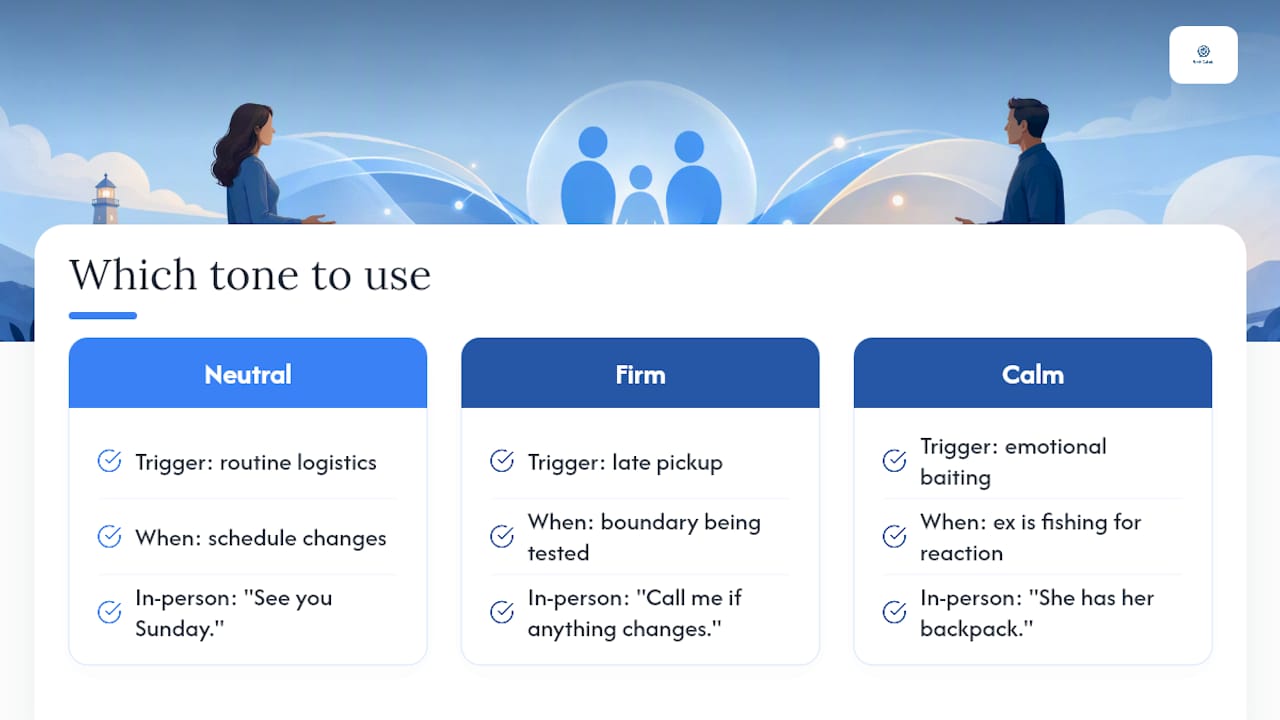
Late pickup: Schedule change request: School concern raised by your ex: Boundary violation (showing up unannounced, contacting you outside agreed hours): For in-person handovers, keep it even shorter. "See you Sunday." "She has her backpack." "Call me if anything changes." A single line, delivered evenly, does more than a paragraph delivered defensively.
Choosing which variant to use comes down to stakes. Use the neutral tone for routine logistics, the firm tone when a boundary is actually being tested, and the calm tone when your ex is fishing for an emotional reaction and you want to give them nothing to work with. ReplyCalmly's gray rock guide for co-parents walks through more of these scenario-by-scenario, if you want a fuller library before your next difficult text lands.
The Emotional and Legal Limits of Gray Rock
Gray rock costs you something even when it works. Suppressing a reaction over and over is tiring, and clinicians note it can take a mental toll on the person using it, even as it de-escalates the immediate conflict. Build in actual recovery time, whether that's a therapist, a support group, or just twenty minutes to decompress after a hard handover.
There's a legal wrinkle too. Courts don't always distinguish gray rocking from stonewalling, and a pattern of terse, unexplained replies can look obstructive on paper even when your intent was de-escalation.
- Pair every gray rock reply with a written record, not silence
- Route decisions and disputes through a custody app instead of personal texts when possible
- Never use gray rock as a substitute for responding to genuine safety concerns
- Stop using it immediately if flat responses seem to be escalating threats rather than reducing them, since gray rock isn't appropriate when safety is at risk
Alternatives to Gray Rock and When to Get Outside Help
Gray rock isn't the only option, and it's not always the right one. BIFF (brief, informative, firm, friendly) messaging works well for written communication you know will end up in a file. Parallel parenting takes things further, minimizing direct contact altogether by dividing decisions along separate lanes. Low or no contact becomes necessary when a relationship is abusive enough that any exchange, gray rocked or not, carries risk.
Know the signs that mean it's time to bring in outside help:
- Direct or implied threats, in writing or in person
- Repeated violations of a custody or court order
- Stalking, surveillance, or showing up uninvited
- Any concern about your child's immediate safety
At that point, a family law attorney, a court-appointed mediator, or a therapist experienced in high-conflict divorce should be your next call, not another carefully worded text. If you're facing active threats, the National Domestic Violence Hotline has escalation resources built for exactly this. For readers weighing bigger structural decisions, like whether to keep a shared home during separation, a resource on selling a house during divorce covers the practical side most co-parenting guides skip. If your situation touches blended families and future planning, estate planning for blended families is worth a look too.
Why Neutral Scripts Only Work if You Document Them
Gray rock only holds up as a strategy if you're also building a record, and that's the part most advice leaves out. Staying calm in the moment protects your nervous system. Documentation protects your custody case. You need both running at the same time, not one instead of the other.
That's the gap ReplyCalmly was built to close. The response generator gives you calm, firm, or short variants for whatever message just landed in your inbox, so you're not composing a gray rock reply from scratch while you're still upset about what your ex just wrote. Behind that, the incident tracker logs the exchange, tags what kind of conflict it was (schedule dispute, boundary violation, false accusation), and builds toward the kind of dashboard a family law attorney can actually use.
Most parents doing this alone end up with a phone full of scattered screenshots and no pattern to point to when it matters. A system that pairs neutral replies with structured tracking turns "I know this keeps happening" into something you can show a judge.
Our suggestion if you're starting tonight: paste your ex's next message into a neutral template, send the shortest version that answers the actual question, and log it before you close the app. If your situation calls for less contact altogether rather than just calmer contact, our parallel parenting guide breaks down that next step.
Where to Learn More
For the clinical background on why gray rocking works, read Cleveland Clinic's explainer and, if narcissistic traits are part of your situation, Mayo Clinic's overview of narcissistic personality disorder. For documentation, pair whatever tactic you use with a court-recognized custody app and keep your own incident log as a backup.
What Gray Rock Gets Wrong in Most Advice Columns
Most articles on gray rock co-parenting treat it like a personality overhaul: be boring, be flat, problem solved. That framing sets parents up to fail, because it skips the part where gray rock is a scalpel, not a lifestyle.
The real skill isn't staying calm. It's knowing exactly which five minutes call for calm and which ones call for a written record with your attorney's name in the cc line. Parents who burn out on gray rock usually aren't bad at staying neutral. They're applying it everywhere, including moments that actually needed documentation, a boundary line, or a phone call to a mediator instead of a shorter text.
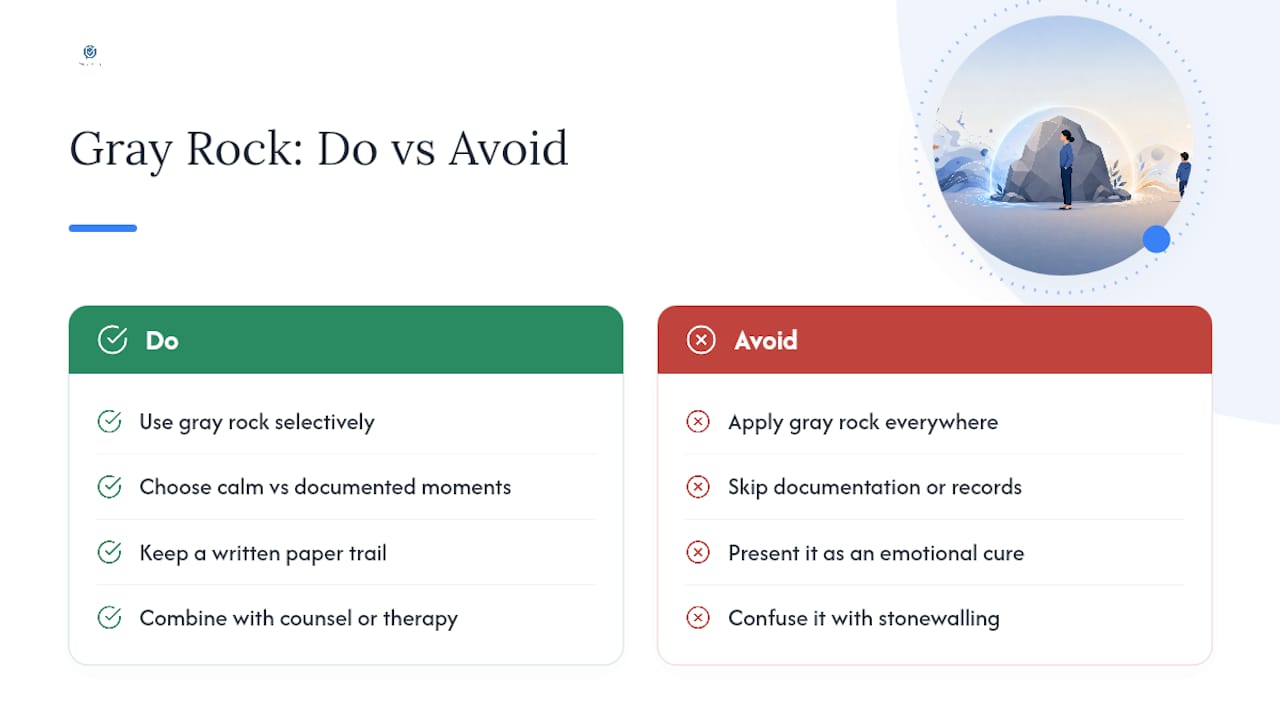
The other thing that gets buried: gray rock and stonewalling look identical from the outside. A judge reading a thread of terse one-liners can't tell if you were protecting yourself or punishing your ex, unless the rest of your record shows otherwise. That's not a reason to abandon the technique. It's a reason to never run it without a paper trail underneath it.
If there's one adjustment worth making to how this method gets taught, it's this: stop presenting gray rock as an emotional fix. Present it as a bridge tactic that buys you calm enough to make better decisions, while something else, documentation, legal counsel, a therapist, does the actual long-term work. The rock isn't the plan. It's just how you get through Tuesday.
— Reply Calmly Team