
Getting a hostile, blame-filled text from your co-parent at 7 AM sets a brutal tone for the entire day. Knowing how to respond to a co-parent in these moments is not just about keeping the peace. It is about protecting your legal position, your child's stability, and your own sanity. The strategies in this guide are grounded in real communication methods used in family court contexts. You will learn how to pause, prepare, and respond in ways that reduce conflict instead of fueling it.
Table of Contents
- Understanding the challenges of co-parent communication
- Preparing to respond: setting boundaries and choosing your communication style
- Executing effective responses to challenging messages
- Verifying outcomes: managing ongoing communication and knowing when to seek help
- Why mastering calm responses transforms high-conflict co-parenting
- Get tools and support for calm, effective co-parent responses
- Frequently asked questions
Key Takeaways
| Point | Details |
|---|---|
| Use the BIFF method | Keep responses brief, factual, friendly, and firm to reduce conflict and protect yourself legally. |
| Set clear boundaries | Focus on what you control, like your responses and timelines, avoiding emotional reactions. |
| Limit communication to child-related topics | Ignore personal attacks and messages unrelated to your child's wellbeing after clear explanations. |
| Document everything | Maintain detailed, dated records of communication attempts and responses for legal protection. |
| Seek help when needed | Consider mediators or attorneys if communication breaks down or court orders are violated. |
Understanding the challenges of co-parent communication
To respond well, you first need to understand why communication is so difficult in these relationships. High-conflict co-parenting is not just disagreement. It is a pattern of interaction where one or both parents regularly send messages designed to provoke, blame, or manipulate rather than solve problems.
Communications from a high-conflict co-parent tend to blame, use all-or-nothing thinking, and trigger impulsive responses. When you receive a message that says "You never care about the kids" or "You are breaking the agreement again," your nervous system reads it as a threat. Your instinct is to defend yourself or fire back. That reaction, understandable as it is, almost always makes things worse.
Common communication traps to recognize:
- Blame framing: Messages that assign total fault without room for discussion
- All-or-nothing statements: Words like "always," "never," and "every time" signal emotional escalation, not fact
- Emergency framing for non-emergencies: Creating urgency around minor logistics to pressure an immediate reaction
- Selective quoting: Referencing partial context to distort the record
- Copying others: Including attorneys or family members on routine messages to intimidate
Recognizing these patterns in real time gives you a moment to pause. That pause is everything. Before you think about what to say, notice what is happening: you are being provoked, not genuinely communicated with. Once you see it clearly, you can choose your response instead of reacting automatically. That shift is where setting co-parent boundaries begins.
Preparing to respond: setting boundaries and choosing your communication style
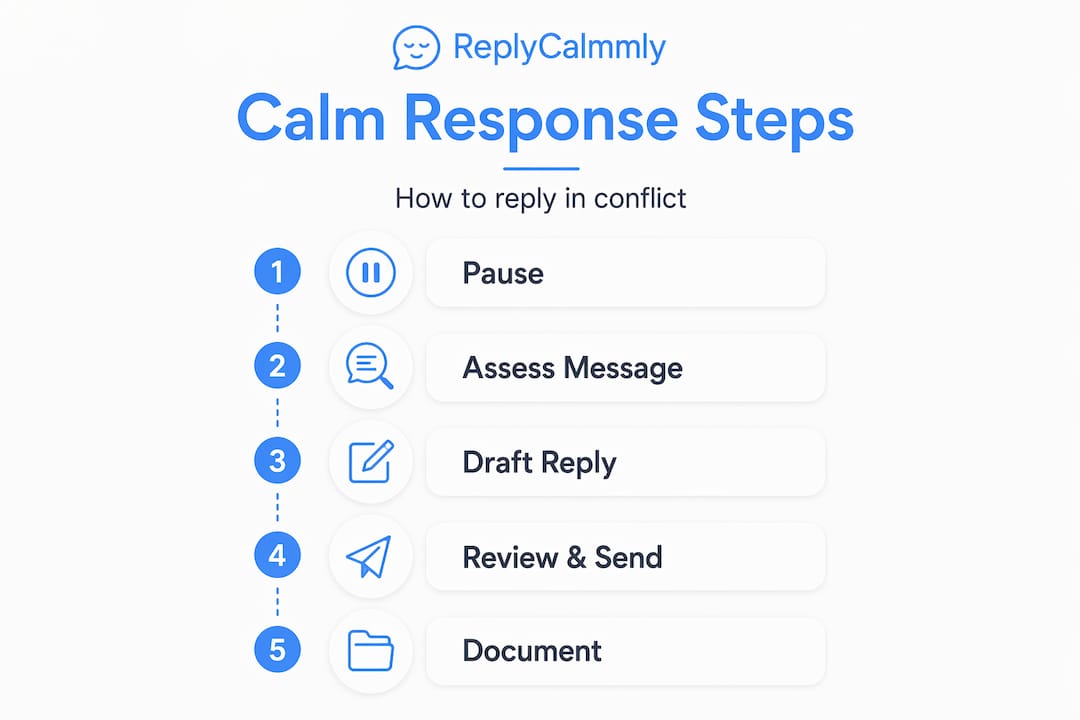
With these boundaries and methods in mind, you can now learn how to craft your responses step by step. Preparation is not about crafting perfect sentences. It is about deciding in advance what you will and will not engage with, so you are not making those decisions under emotional pressure.
Set boundaries around what you control. You cannot control whether your co-parent responds quickly, uses respectful language, or follows the parenting plan. You can control how and when you reply. Decide that you will only respond to messages about the children, and that you will take at least 30 minutes before responding to anything upsetting.
The BIFF method, which stands for Brief, Informative, Friendly, and Firm, is one of the most recommended tools for de-escalating hostile messages in high-conflict co-parenting. Here is what each element means in practice:
- Brief: Two to four sentences. No explanations, no backstory, no defending past decisions.
- Informative: Stick to facts. Dates, times, locations, and child-related logistics only.
- Friendly: Not warm or chatty, but civil. One neutral phrase like "I hope that works" signals good faith without opening the door to extended conversation.
- Firm: End with a clear statement that signals the topic is resolved. "I will proceed accordingly" closes the loop.
You generally have no obligation to respond to personal attacks or messages that have nothing to do with your child's wellbeing. After you have clearly stated your boundary once or twice in writing, you can stop engaging with that category of message entirely. Silence in response to attacks is not weakness. It is a documented refusal to participate in conflict.
Pro Tip: Considering using hostile co-parent text responses as templates. Having pre-written language for common scenarios removes the emotional labor of crafting a calm reply in the heat of the moment.
| Communication approach | Emotional tone | Legal risk | Child impact |
|---|---|---|---|
| Defensive reply | High | Moderate to high | Increases instability |
| Aggressive reply | Very high | High | Harmful |
| No reply (all messages) | Low | Moderate | May cause logistics issues |
| BIFF method | Low | Low | Supports stability |
| Personal boundary statement | Neutral | Low | Neutral to positive |
Executing effective responses to challenging messages
Now that you have the tools and mindset, you can put these strategies into action with practical response examples and documentation tips. Knowing the theory is different from knowing what to actually type.
Follow this four-step process when responding to difficult co-parent messages:
- Wait before replying. Set a rule for yourself: no same-minute responses to upsetting messages. Even 20 minutes of distance changes what you write.
- Identify the actual request. Strip out the blame, emotional language, and accusations. What is the factual question or logistical issue buried in the message? Respond only to that.
- Write your reply using BIFF. Keep replies to one paragraph focusing only on facts and logistics with a firm closing. No sarcasm. No references to past conflicts. No emotional temperature.
- Document before you send. Screenshot or log the original message and your response. Date and time matter for any future legal proceedings.
Use parallel parenting principles, which means limiting communication strictly to essential logistics and keeping it in writing whenever possible. Unlike cooperative co-parenting, parallel parenting does not require you to build a relationship or reach emotional understanding. It only asks that both parents handle the logistics of raising a child without requiring direct contact or agreement on parenting style.
For example, instead of: "You always drop her off late and it ruins her whole evening routine and you clearly don't care," write: "Drop-off is scheduled for 6 PM on Friday. Please confirm by Thursday evening."

Send short, fact-based requests specifying date, time, and the action expected, with a reasonable deadline and a note about next steps if there is no response. That note does not need to be a threat. "If I don't hear back by Thursday, I will proceed with our standard schedule" is firm and legally documented.
Pro Tip: Maintain a document co-parenting issues log from the start. Courts care about patterns, not isolated incidents. A six-month record of unanswered logistics requests tells a very different story than a single screenshot.
| Response style | Example language | De-escalation effect | Legal standing |
|---|---|---|---|
| Hostile | "You never follow the schedule. I'm done." | None, escalates | Negative |
| Defensive | "That's not what I said. You always twist things." | None | Neutral to negative |
| BIFF | "Drop-off is at 6 PM Friday. Please confirm." | Strong | Positive |
| Parallel parenting script | "I'll handle her medical appointment on my time." | Strong | Positive |
Verifying outcomes: managing ongoing communication and knowing when to seek help
Good communication strategies need ongoing attention. You will not always get immediate results. High-conflict patterns shift slowly, and the first sign that your approach is working may simply be that your stress level drops because you know exactly what you are going to do.
Watch for these signs that your approach is working:
- Logistics are being handled even when tone is still rough
- You are responding faster and with less emotional drain
- Written records are consistent and clear
- You are no longer engaging in circular arguments
Maintain your boundaries and reasonable deadlines consistently. Inconsistency gives high-conflict co-parents an opening. If you respond to personal attacks sometimes but not others, you signal that persistence will eventually work. Consistency, even when it feels cold, protects your energy and reduces escalation over time.
- Consider a parenting coordinator: A neutral professional who reviews disputes and makes binding recommendations can take the pressure off direct communication for recurring conflicts.
- Use a mediator for larger disagreements: Mediation is far less expensive than litigation and can reduce hostility while reopening communication channels.
- Know your legal trigger point: If your co-parent repeatedly violates court orders or the children are being affected, document carefully and consult an attorney. Your documentation log becomes your evidence.
Pro Tip: Before any court-related escalation, review your own message history too. Courts look at both sides. A record showing you responded calmly, concisely, and consistently is one of the most valuable things you can bring into a custody hearing.
Knowing when to involve co-parenting help from a professional is not failure. It is exactly the kind of proactive, child-centered decision that courts respond to favorably.
Why mastering calm responses transforms high-conflict co-parenting
Here is the uncomfortable truth most co-parenting advice avoids: you will probably never get your co-parent to cooperate fully. That is not the goal. The goal is to stop needing their cooperation to give your children stability.
You don't need your co-parent's cooperation to give your children stability. Controlling your own response changes the dynamic in ways that trying to control the other person never will. When you stop engaging with provocations, the conversation changes by default. Not because your co-parent becomes reasonable, but because you stop being a reactive target.
The other assumption worth challenging: that being thorough and detail-oriented in communication always helps. Even well-intentioned oversight can backfire and increase legal risks. Over-communication, extensive check-ins, and attempts to monitor the other household too closely can read as micromanagement in court. Judges see it. Attorneys argue it. Less is genuinely more.
Consistent boundary-setting paired with tight, documented communication is not just a communication strategy. It is a long-term legal strategy. Every calm reply is a data point. Every ignored provocation is a data point. Over months, that record builds a picture of who the stable, child-focused parent is. Courts notice patterns.
The hardest part is patience. Calm responses feel like losing in the moment. They are not. They are the slowest but most durable form of winning in a high-conflict custody situation. If you want high-conflict co-parenting help to stay consistent, tools that take the guesswork out of what to say next are worth considering.
Get tools and support for calm, effective co-parent responses
Knowing what to do and actually doing it under emotional pressure are two different things. ReplyCalmly was built for exactly this gap.
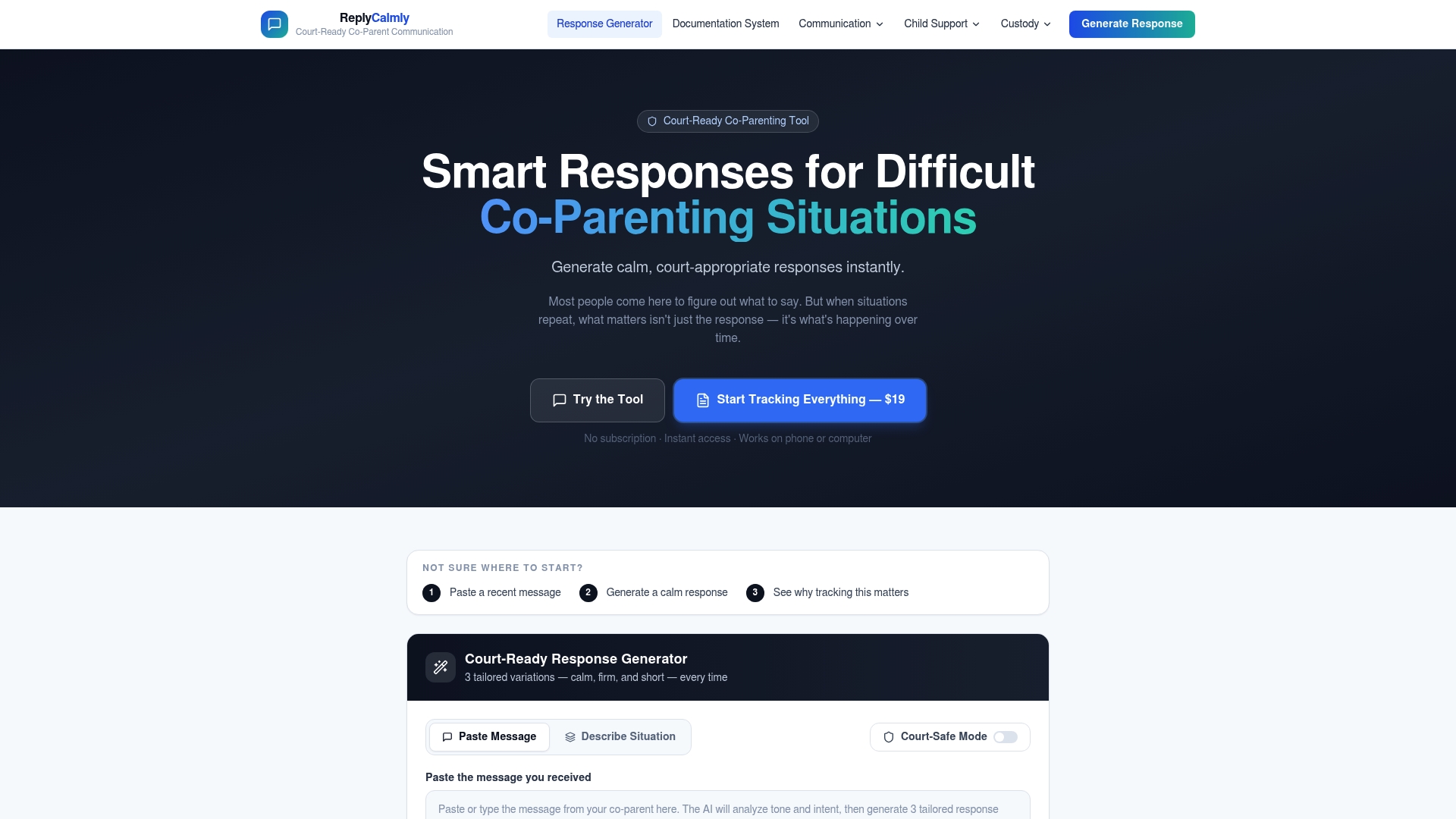
When you receive a message that makes your blood pressure spike, ReplyCalmly's AI response generator gives you multiple ready-to-use replies in seconds, including calm, firm, and short variations, all framed to be court-appropriate. No more staring at a screen trying to figure out what to say. Beyond responses, the platform's incident tracking system logs and categorizes communications over time, building the kind of documented pattern record that matters in custody hearings. You can also explore our co-parenting communication plan template to set clear expectations from the start, review best co-parenting apps for secure documentation, or get direct support through our high conflict co-parent help resources.
Frequently asked questions
How do I keep my responses to a hostile co-parent from escalating conflict?
Keep your replies brief, factual, friendly, and firm using the BIFF method to de-escalate tension without inviting further argument. One paragraph, facts only, firm close.
Should I respond to personal attacks or messages unrelated to the child?
No. You are generally not obligated to respond to messages that do not pertain directly to your child's wellbeing, especially after you have stated your boundary clearly in writing.
What if my co-parent refuses to communicate important information?
Send fact-based requests with clear deadlines in writing, document every attempt, and consider involving a mediator or legal counsel if the refusal becomes a pattern affecting the children.
When should I seek legal help regarding co-parent communication issues?
If your co-parent consistently violates court orders or parenting agreements in ways that affect your child's safety or wellbeing, consult an attorney to review your documented record and explore legal remedies.
Can using a co-parenting app improve communication in high-conflict situations?
Yes. Co-parenting apps create a secure, documented record of all communications, improve organization, and help maintain boundaries by keeping all contact in a single, accountable platform.