
When manipulation becomes a regular feature of your co-parenting relationship, every text message and email can feel like a trap. Research suggests that high-conflict custody situations affect between 10 and 20 percent of all custody cases, and the parents caught in them often feel exhausted, reactive, and unsure how to protect themselves legally. The good news is that a structured, step-by-step approach to responding can reduce escalation, preserve your credibility in court, and keep your child's wellbeing at the center of every decision you make.
Table of Contents
- What you need before you start: documentation, tools, and mindset
- Step-by-step: Responding calmly and effectively to manipulation
- Troubleshooting: Common mistakes and how to avoid them
- What to expect: Results, adjustments, and when to escalate
- The uncomfortable truth about defending yourself in manipulative disputes
- Tools that make step-by-step responses easier
- Frequently asked questions
Key Takeaways
| Point | Details |
|---|---|
| Preparation is key | Choosing the right documentation tools and mindset sets the stage for effective responses. |
| BIFF your responses | Brief, neutral, and consistent messages protect you and your child legally and emotionally. |
| Stay fact-focused | Avoid emotional traps and document facts, not feelings, for best results in court. |
| Know when to escalate | Consistent records help you decide when to seek outside help or legal action. |
What you need before you start: documentation, tools, and mindset
Preparation is not optional. Walking into a high-conflict communication without the right tools is like going to court without evidence. Before you respond to a single manipulative message, make sure you have the following in place.
Essential items every co-parent needs:
- A dedicated communication app (OurFamilyWizard, TalkingParents, or similar) that timestamps and preserves messages
- A physical or digital notebook to log incidents as they happen, including dates, times, and exact quotes
- A printed or saved summary of the BIFF method (Brief, Informative, Friendly, Firm), a proven framework for neutral communication
- Direct contact information for your attorney or family law advocate
- A folder, physical or cloud-based, for storing screenshots, emails, and court orders
The table below compares common documentation tools so you can pick what fits your situation.
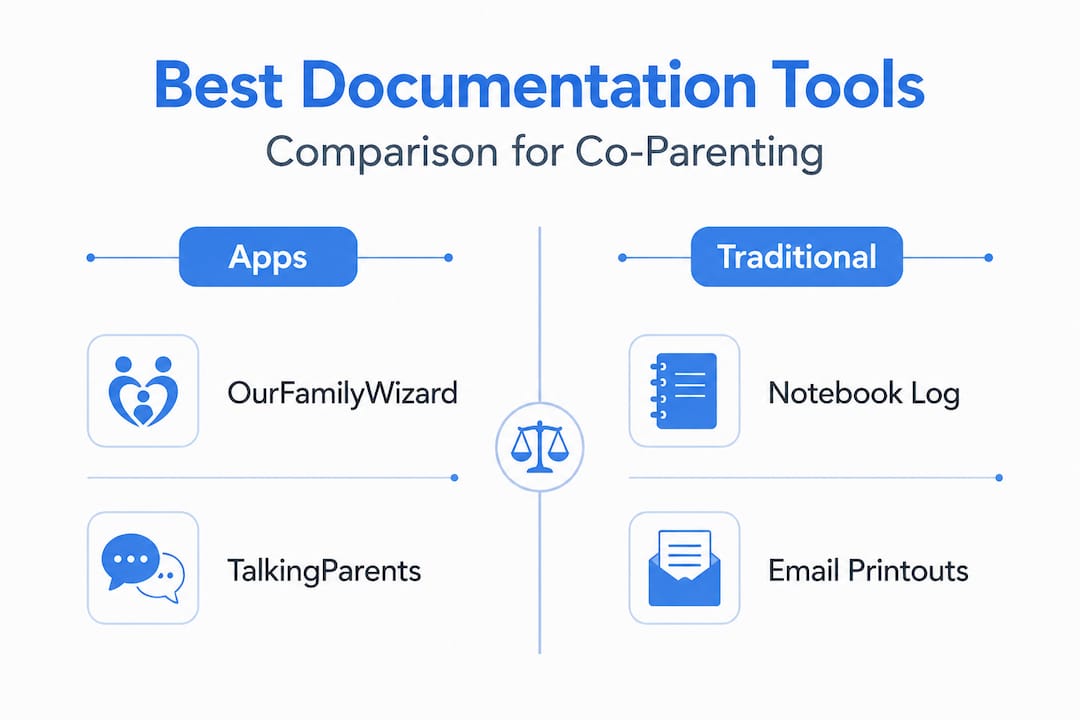
| Tool | Tamper-proof | Court-admissible | Cost | Best for |
|---|---|---|---|---|
| OurFamilyWizard | Yes | Yes | Paid | Full co-parenting record |
| TalkingParents | Yes | Yes | Free/Paid | Message-only documentation |
| No | Conditional | Free | Supplemental records | |
| Physical journal | No | Conditional | Free | Incident notes |
| Screenshot folder | No | Conditional | Free | Quick capture |
Pro Tip: Apps like OurFamilyWizard and TalkingParents create tamper-proof logs because neither party can delete or edit sent messages. This matters enormously in court, where your credibility depends on consistency. Prioritizing BIFF and documentation creates court-admissible records that demonstrate your reasonableness, even when the other parent is not behaving reasonably.
Beyond tools, your mindset is the most powerful asset you have. The shift from emotional reaction to fact-based focus is not easy, but it is essential. Every message you send is a potential exhibit. Ask yourself before you hit send: "Would I be comfortable if a judge read this?" If the answer is no, rewrite it.
Set clear internal boundaries about what you will and will not respond to. You do not need to address insults, false accusations embedded in otherwise routine messages, or attempts to relitigate past decisions. Respond only to what is logistically necessary for your child's care. You can access secure response tools to help you filter and draft messages that stay within those boundaries.
Step-by-step: Responding calmly and effectively to manipulation
With tools and a prepared mindset in place, here is your actionable roadmap for handling manipulative messages in writing.
The 6-step response process:
- Read the message once, then step away. Give yourself at least 15 to 30 minutes before drafting anything. Emotional reactions produce emotional responses, and emotional responses hurt your case.
- Pause and identify the manipulation tactic. Is this gaslighting (making you question your memory)? Blame-shifting? Threats? False urgency? Naming the tactic helps you depersonalize it.
- Identify what actually requires a response. Strip out the emotional content and find the logistical core. "You never care about our child's school schedule" contains one actual item worth addressing: the school schedule.
- Draft a BIFF response. Keep it Brief (under 5 sentences when possible), Informative (stick to facts and logistics), Friendly (neutral tone, no sarcasm), and Firm (no hedging or apologizing for things you did not do wrong).
- Check for emotion before sending. Read your draft out loud. If it sounds defensive, accusatory, or sarcastic, revise it. Remove any sentence that starts with "You always" or "You never."
- Send and save. Use your communication app so the record is automatic. If you used email, save a copy immediately with the date in the file name.
Here is a comparison of poor versus effective responses to a common manipulative message.
| Scenario | Poor response | Effective BIFF response |
|---|---|---|
| "You never show up for our kid. I'm documenting everything." | "That is completely false and you know it. I am always there." | "I will be at pickup on Friday at 3 p.m. as scheduled. Please confirm." |
| "You changed the schedule without asking me." | "I did not change anything. You are lying again." | "The schedule follows the court order dated [date]. I am happy to share a copy if helpful." |
| "My lawyer says you are in contempt." | "Tell your lawyer to call mine. I am done with this." | "I am following the parenting plan. Please have any legal concerns directed through proper channels." |
Pro Tip: Avoid defending yourself against false accusations in your written response. In manipulative dynamics, explaining and defending actually fuels the cycle because it gives the other parent more material to twist. State the facts once, briefly, and move on.
One of the most encouraging findings in co-parenting research is that consistent low-conflict responses from one parent can de-escalate the overall dynamic over time, even if the other parent does not change their behavior. Your calm is not weakness. It is strategy. You can find practical communication tips to help you build this habit consistently.

Troubleshooting: Common mistakes and how to avoid them
Now that you have the steps down, let us examine how to avoid common setbacks that can undermine even the best-prepared co-parents.
Mistakes that weaken your position:
- Engaging emotionally in writing. Anger, sarcasm, and lengthy explanations all make you look reactive in court documents.
- Failing to document in the moment. Memory fades. Write down incidents, including dates and exact words, as soon as they happen. A journal entry made the same day carries far more weight than one written weeks later.
- Inconsistent boundaries. If you ignore provocations 80 percent of the time but engage the other 20 percent, courts may see the pattern as mutual conflict rather than one-sided manipulation.
- Sending without reviewing. Always read your message twice before sending. Once for content, once for tone.
- Mixing legal threats into routine communication. Save legal escalation for your attorney. Mixing threats into everyday messages muddies your record and makes you look combative.
If you have already reacted poorly, do not panic. Acknowledge it internally, do not send an apology message that reopens the conversation, and return to your process immediately. One reactive message does not define your case. A pattern of reactive messages does.
Courts consistently pay attention to the overall pattern of communication, not just individual messages. A parent who maintains calm, factual records over months builds a far stronger case than one who wins individual arguments but loses the narrative.
This matters more than most co-parents realize. 78 percent of high-conflict cases last more than one year, and courts ordered structured communication in 16 percent of those cases. That means judges are actively watching how you communicate, not just what you are saying.
A particularly tricky situation arises when your child starts repeating phrases that sound like they came directly from the other parent. This is a recognized form of manipulation. When it happens, validate your child's feelings without interrogating them. Say something like, "It sounds like you heard something that worried you. You are safe here." Then document what your child said, the date, and the context, factually and without editorializing. Avoid asking leading questions. You can explore documentation strategies that help you log these incidents in a way that is useful for legal purposes without putting your child in the middle.
The mental health toll of sustained high-conflict co-parenting is real. Studies show that prolonged exposure to parental conflict significantly increases anxiety and behavioral issues in children. It also burns out the protective parent. Building a sustainable process, not just a reactive one, protects both you and your child over the long term.
What to expect: Results, adjustments, and when to escalate
Having mastered responses and troubleshooting, here is what to look for and what your next steps should be as the situation evolves.
Positive signals that your approach is working:
- Exchanges become more emotionally neutral over time
- The other parent focuses more on logistics and less on accusations
- Your child shows reduced anxiety around transitions
- You feel less dread before checking your messages
- Your attorney or advocate notes that your communication record looks strong
Warning signs that escalation may be necessary:
- Repeated violations of the court order despite documented communication
- Legal threats that move beyond posturing into actual filings
- Your child shows signs of coaching, fear, or loyalty conflicts
- The other parent involves third parties (new partners, relatives) in communications
- Harassment moves outside the approved communication channel
Stat callout: Parallel parenting, a structured approach where co-parents disengage from each other while both remaining active in their child's life, can reduce child stress by 40 to 60 percent in high-conflict situations. This model is worth discussing with your attorney if direct co-parenting continues to fail.
When warning signs appear consistently, it is time to bring in third-party support. APA guidelines emphasize that legal tools like detailed parenting plans, parenting coordinators, and professional evaluations are essential for enforcing boundaries against repeated violations. A parenting coordinator (a neutral third party appointed by the court to help resolve disputes) is appointed in approximately 18 percent of repeat high-conflict cases.
The key rule when escalating: bring documentation, not arguments. Your record of calm, factual communication is your strongest asset. Let the evidence do the talking.
The uncomfortable truth about defending yourself in manipulative disputes
Here is something most co-parenting guides will not tell you directly: the instinct to defend yourself is one of the most self-defeating things you can do in a high-conflict custody case.
Most co-parents spend enormous energy trying to prove a narrative. They write long emails explaining their side. They counter every accusation with a detailed rebuttal. They want the other parent, or the court, to understand that they are the reasonable one. The problem is that courts are not looking for the most persuasive argument. They are looking for the most consistent, child-focused parent.
APA guidelines on custody evaluations make this clear: impartial evaluations focus on the child's best interests, not on which parent tells a more compelling story. Evaluators are trained to recognize bias, including the bias of a parent who seems overly focused on proving the other parent wrong.
"Stick to facts, not feelings" is not just good advice for your mental health. It is the single most effective legal strategy available to you in a high-conflict case.
What actually moves the needle is a long, boring, consistent record of calm communication. Not dramatic evidence of the other parent's worst moments. Not a perfectly crafted email that makes you look like a saint. Just months of brief, factual, child-focused messages that show a judge exactly who you are under pressure.
Pro Tip: Quality beats quantity in documentation every single time. Ten clear, dated, factual incident logs are more powerful than fifty emotional journal entries. Use tools for neutral documentation to keep your records clean, organized, and court-ready.
The other thing most guides underestimate is that consistent, brief, neutral communication is not just legal protection. It is child protection. Every calm message you send models the behavior you want your child to see. Every time you choose facts over feelings in writing, you are reducing the emotional temperature your child lives in. That matters more than any single court outcome.
Tools that make step-by-step responses easier
If you are ready to streamline your documentation and responses, here is a tool designed for exactly this challenge.
Applying a six-step response process consistently is hard when you are emotionally exhausted and under pressure. That is where structured digital support makes a real difference.
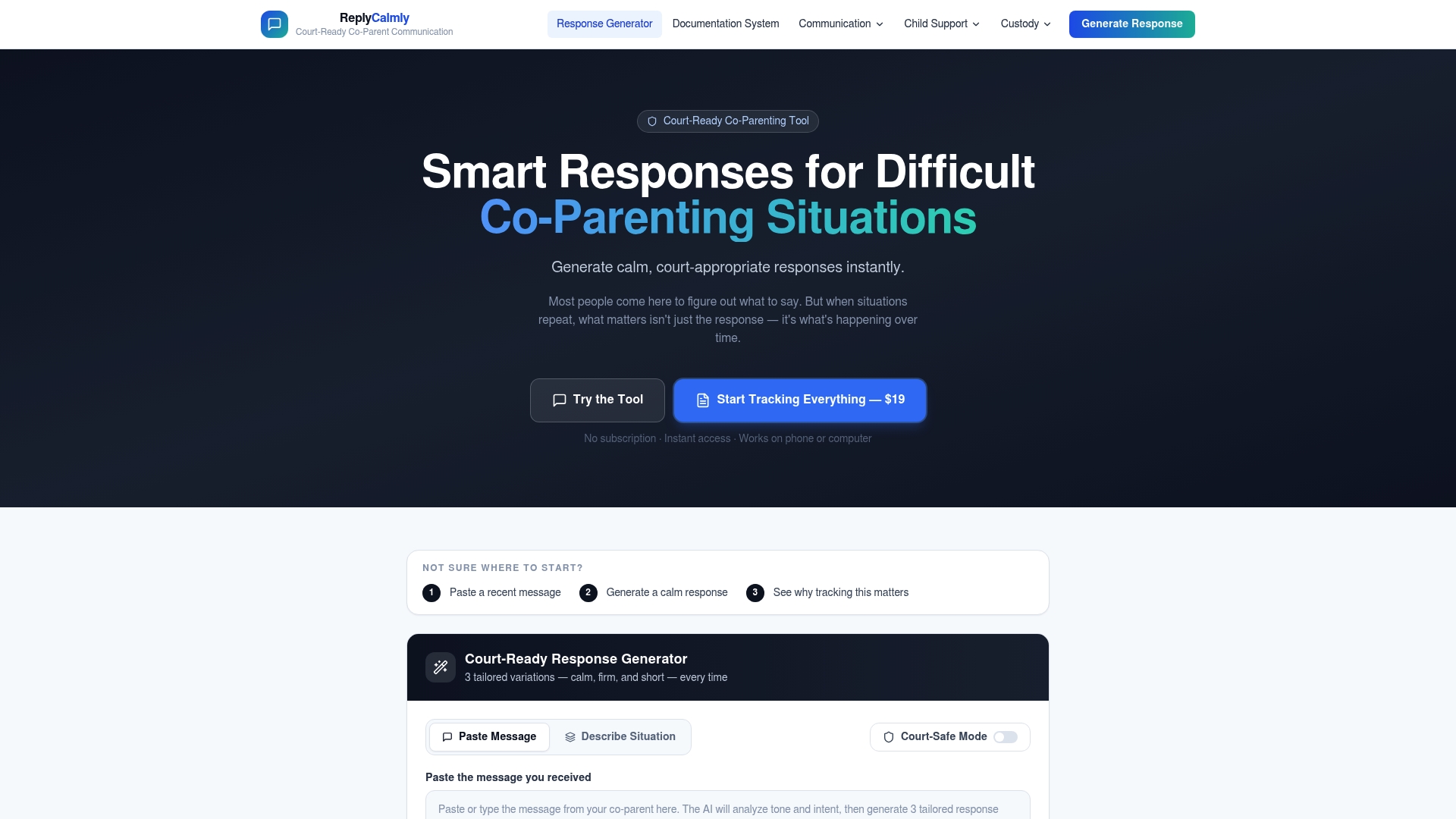
Smart co-parenting tools like ReplyCalmly are built specifically for high-conflict custody situations. The platform generates multiple response variations, including calm, firm, and short options, so you always have a court-appropriate reply ready without having to think from scratch under stress. Its incident tracking system logs and categorizes issues over time, turning scattered records into a clear, visual dashboard your attorney can actually use. ReplyCalmly also integrates with tools like OurFamilyWizard, so it supports your existing court-mandated systems rather than replacing them. When you need to export records for court, the process is straightforward and organized.
Frequently asked questions
What is the BIFF method and why is it useful?
The BIFF method (Brief, Informative, Friendly, Firm) is a proven framework for writing neutral, court-ready responses in high-conflict co-parenting. Using BIFF consistently builds a communication record that demonstrates your reasonableness to a judge, even when the other parent is not cooperating.
How can I document manipulation without escalating conflict?
Use tamper-proof messaging apps, keep all responses factual and brief, and log incidents the same day they occur with dates and exact quotes. Avoiding defensive explanations in your written responses prevents the other parent from using your words against you.
When should I involve a parenting coordinator or seek court intervention?
If the other parent repeatedly violates the custody order despite documented communication, it is time to escalate. Parenting coordinators and detailed plans are specifically designed for enforcement in repeat high-conflict cases.
What if my co-parent tries to manipulate my child?
Validate your child's feelings calmly without asking leading questions, then document what your child said, when they said it, and the context. Avoiding interrogation protects your child emotionally while still creating a usable legal record.