
Firm but calm responses are defined as messages that set clear boundaries and state specific needs using neutral, respectful language without emotional charge. Knowing how to write firm but calm responses is the single most practical skill in high-conflict communication, whether you are managing a custody dispute, a hostile co-parent, or a contentious legal exchange. The difference between a message that de-escalates and one that ignites a new argument often comes down to structure, not intent. Tools like Replycalmly and frameworks like the DESC method exist precisely because calm assertiveness is a learnable, repeatable skill.
What are the core principles of firm but calm communication?
Calm communication is a strategic choice, not just an emotional state. Responding to surface content rather than implied subtext or emotional bait is the single most effective way to disrupt an escalation cycle. When you answer only the logistical facts in a hostile message and ignore the accusations buried within it, you remove the fuel that keeps conflict burning.
The foundational principles of firm communication strategies break down into four clear behaviors:
- Separate facts from emotion. Address what was asked or stated. Do not respond to tone, implications, or what you think the other person meant.
- Use neutral language. Words like "I need," "the schedule states," and "please confirm" carry authority without blame. Sarcasm and loaded phrasing do the opposite.
- Avoid over-explaining. Over-justifying a boundary invites ongoing challenge. State your position once, clearly, and stop. Every additional sentence of explanation signals that you are open to negotiation on something that is not negotiable.
- Acknowledge briefly when genuine. A single sentence of acknowledgment before a firm request reduces defensiveness without conceding your position.
Assertiveness requires clarity, consistency, and courtesy in equal measure. Clarity without courtesy reads as aggression. Courtesy without clarity reads as weakness. The combination is what makes a response both firm and calm.
Pro Tip: Before sending any message in a high-conflict situation, read it aloud and ask yourself: "Does this sentence answer a logistical question, or does it respond to an emotion?" Delete every sentence that answers an emotion.

How to structure your firm but calm response for maximum clarity
Structure is what separates a composed response from a reactive one. The DESC framework, developed in assertive communication training, gives you a repeatable four-part format: Describe the situation factually, Express your position or need, Specify what you are requesting, and state the Consequence if the request is not met. I-statements and DESC frameworks keep the focus on your needs rather than the other person's behavior, which reduces defensiveness and keeps the exchange productive.
Here is how to build a firm but calm response step by step:
- Open with one genuine acknowledgment (optional but effective). "I received your message about the pickup time" is enough. Do not praise, apologize, or soften your position here.
- State your need or boundary with specificity. "The agreed pickup time is 3:00 PM on Saturdays as outlined in the parenting plan" is specific. "Please be on time" is not.
- Use an I-statement for your position. "I need 24 hours' notice for any schedule changes" is direct and non-blaming.
- Set a concrete next step with a deadline. "Please confirm by Thursday at noon whether you will maintain the Saturday schedule."
- State the consequence neutrally. "If I do not hear back, I will proceed with the existing plan."
The comparison below shows how the same message reads with and without this structure:
| Version | Example message |
|---|---|
| Unstructured | "You always do this. Just let me know what's happening with Saturday." |
| Structured (DESC) | "The parenting plan sets pickup at 3:00 PM Saturday. I need confirmation by Thursday noon. If I don't hear back, I'll proceed with the existing schedule." |
Clear, specific language with concrete next steps prevents misinterpretation and signals that you are organized and serious. Avoid ALL CAPS, exclamation marks, and vague phrases like "as soon as possible." These undermine the calm authority you are building.
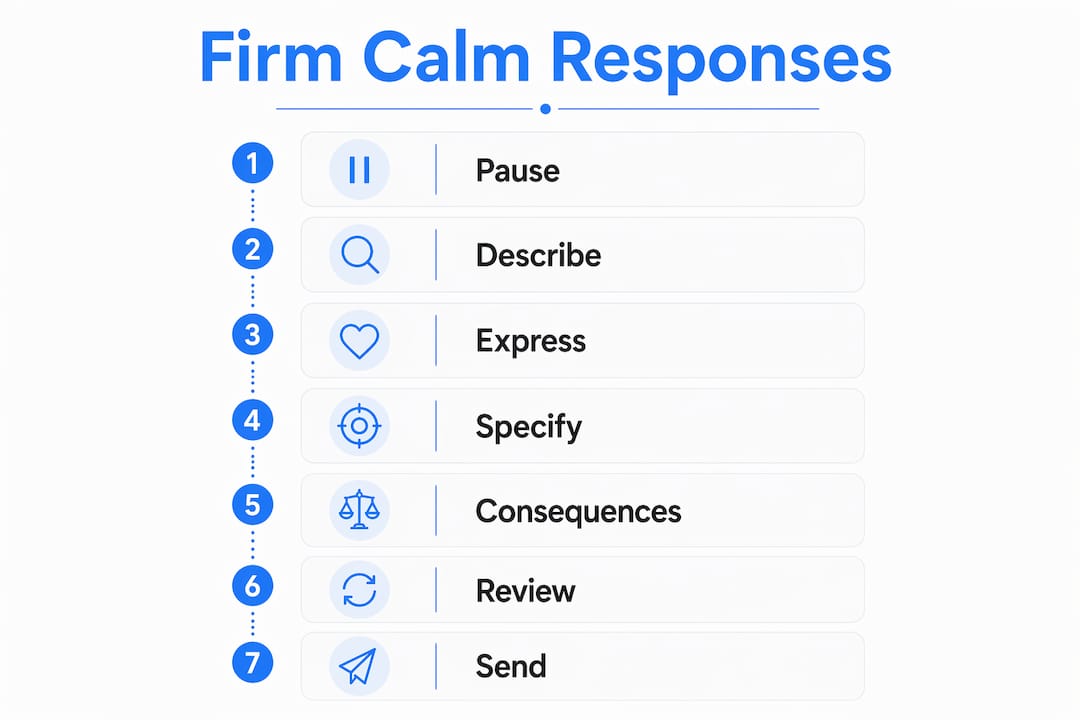
Pro Tip: Draft your response in a separate document first. Write the emotional version, then rewrite it using only facts, needs, and next steps. Send only the second version.
When and how to manage timing, tone, and emotional triggers
Timing is a communication tool, not just a courtesy. Structured breaks before replying outperform vague pauses because they give your nervous system time to reset, which directly reduces impulsive or aggressive replies. A forced 30-minute break after receiving a hostile message produces measurably calmer responses than simply telling yourself to "cool down."
Practical strategies for managing your emotional state before writing include:
- Set a response window. Decide in advance that you respond to co-parent messages within 24 hours, not immediately. Defined response timing also blocks emotional manipulation through unpredictable or urgent messaging.
- Recognize your triggers. If certain phrases or topics reliably produce a strong reaction in you, note them. When you see those phrases, add an extra 15 minutes to your break before drafting.
- Check your tone markers. Exclamation marks, capitalized words, and long paragraphs of justification are all signs that emotion has entered your writing. Remove them before sending.
- Read as a neutral third party. Before sending, ask: "If a family court judge read this message, would it reflect well on me?" This single question filters out most reactive language.
How to maintain calmness in replies is less about suppressing emotion and more about building a consistent process. Emotion does not disappear when you write. It shows up in word choice, sentence length, and the topics you choose to address. A structured process catches it before it reaches the recipient.
Pro Tip: Keep a "draft folder" for high-conflict messages. Write your response, save it, and re-read it the next morning before sending. You will almost always edit it.
How to apply these techniques in co-parenting and custody disputes
Co-parenting communication carries legal weight that ordinary workplace or personal communication does not. Every written message is a potential exhibit. Calm, child-focused, legally defensible communication protects your position in court and, more importantly, protects your children from being caught in adult conflict.
The table below maps common co-parenting scenarios to the correct composed response technique:
| Scenario | Recommended approach |
|---|---|
| Hostile message before pickup | Preserve the message, pause before replying, respond only to logistical facts |
| Request to change the schedule | Acknowledge receipt, state the parenting plan terms, request written confirmation |
| Personal attack in a message | Do not address the attack. Reply only to any child-related logistics in the same message |
| Repeated late pickups | Document each instance, send a brief factual notice, reference the parenting plan |
| Pressure to discuss relational issues | Redirect in writing: "I'm only able to discuss matters related to the children's schedule and needs" |
Preserving hostile messages and delaying responses strategically creates a stronger evidentiary record and avoids the reactive replies that tend to look poorly in court. Brevity is also a legal asset. A three-sentence reply focused on the child's schedule is harder to misrepresent than a paragraph defending your character.
Boundaries in high-conflict co-parenting function as communication architecture. They limit the surface area for conflict by restricting what topics you engage with in writing. When you consistently decline to address personal attacks or relitigate the relationship, you train the communication dynamic over time. The other party learns, through repetition, that those tactics produce no response.
Court-facing communication style means keeping tone calm, keeping focus on the child, limiting follow-up messages, and using language you would be comfortable reading aloud to a judge. This is not about performing for the court. It is about building a consistent record that accurately reflects your priorities as a parent.
For specific language on setting co-parent boundaries in writing, Replycalmly provides templates built around these exact principles.
Key takeaways
Firm but calm responses require structure, not just composure. The DESC framework, child-focused brevity, and defined response timing are the three mechanisms that make calm assertiveness repeatable under pressure.
| Point | Details |
|---|---|
| Separate facts from emotion | Address only logistical content; ignore emotional subtext and personal attacks entirely. |
| Use the DESC framework | Describe, Express, Specify, and state Consequences to build clear and non-blaming messages. |
| Set a response timing window | Replying within 24 hours rather than immediately reduces impulsive, reactive language. |
| Keep co-parent replies child-focused | Narrow responses to child logistics only; every other topic is an invitation to escalate. |
| Preserve all hostile messages | Documentation of hostile communication builds a legally defensible record over time. |
Why calm responses are the most underrated power move in conflict
Most people in high-conflict situations believe that a stronger, more forceful reply will finally get the point across. In my experience, the opposite is true. The person who writes shorter, calmer, and more specific messages consistently holds more power in the exchange. Not because they are passive, but because they are impossible to provoke.
What I have found working with co-parents in contentious custody situations is that the first calm response rarely changes anything. The second and third do. Repeated firm restatements without justification or emotional escalation eventually shift the dynamic because the other party runs out of material to react to. You are not winning an argument. You are ending the argument's ability to grow.
The hardest part is not the writing. It is the discipline to leave out the sentences that feel satisfying to write but serve no purpose. The sentence that explains why you are right. The sentence that points out the hypocrisy. Those sentences feel powerful in the moment and cost you credibility in every context that matters, including court.
Compassionate assertiveness is the professional term for this approach. It means standing up for your rights and your children's needs with a calm demeanor, without excusing bad behavior and without matching it. That combination is harder than either aggression or silence, and it is far more effective than both.
If you are managing hostile co-parent emails and struggling to find the right words, the framework is there. The practice is what builds the skill.
— Devin
How Replycalmly helps you respond with confidence
Writing firm but calm responses under pressure is genuinely difficult, especially when the messages you are receiving are designed to provoke a reaction. Replycalmly is built specifically for this situation.
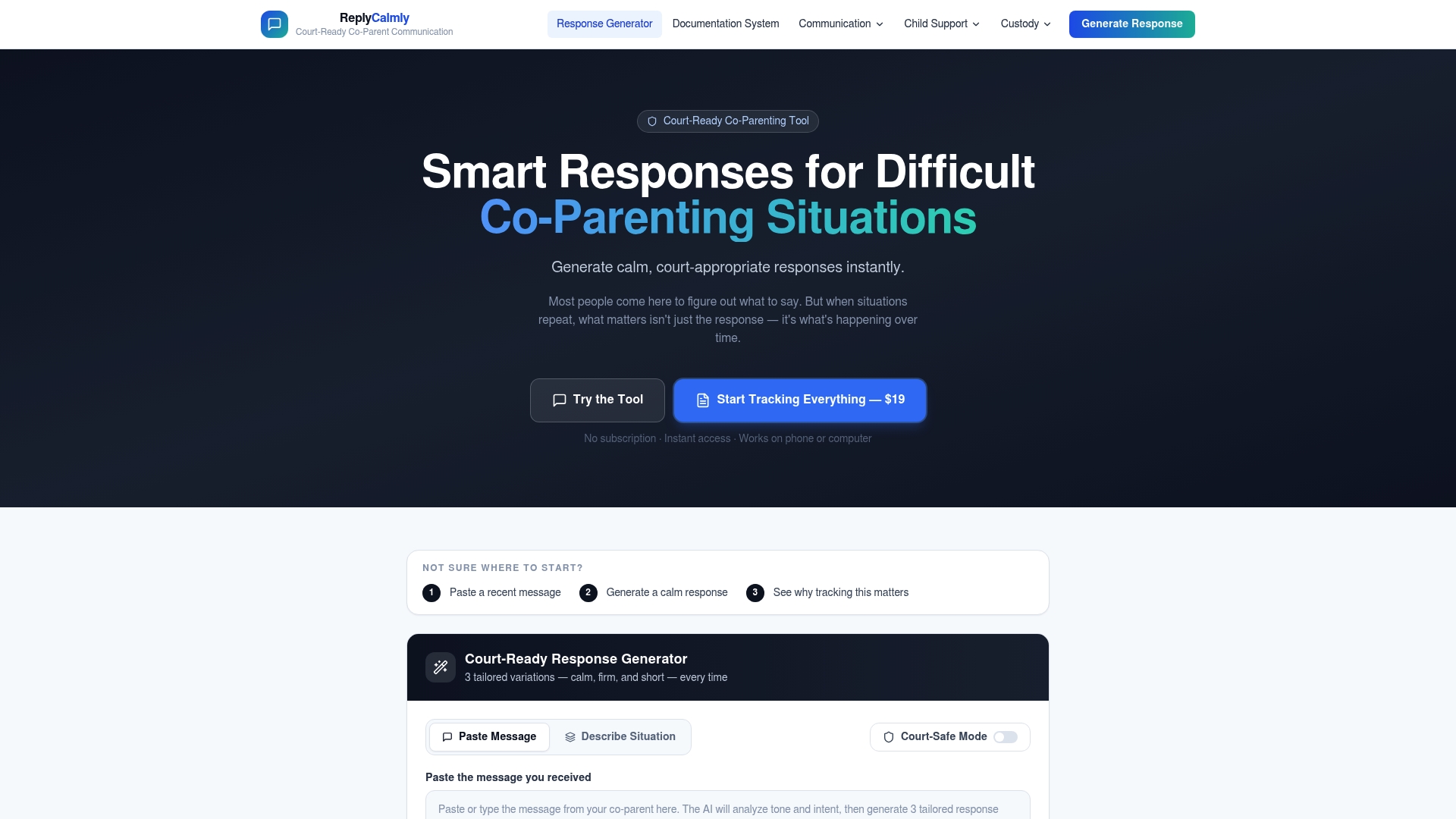
The platform's response generator takes the message you received and produces multiple reply variations: calm, firm, and short. You choose the version that fits the situation. Replycalmly also offers a co-parenting communication plan template that establishes the rules of engagement in writing before conflict escalates. For specific situations like repeated late pickups or schedule change requests, the platform provides ready-to-use language that is court-appropriate and child-focused. You spend less time drafting and second-guessing, and more time protecting what matters.
FAQ
What does "firm but calm" mean in communication?
A firm but calm response sets a clear boundary or states a specific need using neutral, factual language without emotional charge or personal attack. The goal is to be direct and unmistakable without escalating the exchange.
How do I stop reacting emotionally before I write a reply?
Use a structured break of at least 30 minutes after receiving a hostile message before drafting your reply. Draft in a separate document, write the emotional version first, then rewrite using only facts and next steps.
What is the DESC framework for assertive communication?
DESC stands for Describe, Express, Specify, and Consequence. It is a four-part structure that keeps responses focused on your needs and the required action rather than the other person's behavior or intent.
How should I respond to personal attacks in co-parent messages?
Do not address the attack directly. Reply only to child-related logistics in the same message and preserve the original for documentation. Responding to personal attacks in writing rarely resolves them and often escalates the conflict.
Can calm responses actually help in court?
Yes. Court-facing communication that is calm, child-focused, and free of personal attacks creates a written record that reflects well on your priorities as a parent and is harder for the opposing party to misrepresent.