
If a co-parent sends your child a message that's hostile, manipulative, or violates your custody order, respond only if it involves a genuine child-safety or scheduling issue. Otherwise, send one firm boundary-setting message and then go quiet.
Two things to do in the next ten minutes: save the original message thread (don't just screenshot it), and write down the date, time, and who was present when your child saw or received it.
Pro Tip: The only exception to "stay silent" is time-sensitive child logistics: a medical issue, a school matter, or an exchange time that's changing today. Everything else can wait 24 hours.
Key Takeaways
Calm, documented responses paired with child-focused conversations protect both your legal position and your child's emotional wellbeing.
| Point | Details |
|---|---|
| One boundary, then silence | Send a single firm notice about inappropriate messages, then stop responding to repeats of the same behavior. |
| Preserve originals, not screenshots | Original message threads keep metadata that makes them stronger evidence than screenshots. |
| Use BIFF for any reply | Keep necessary replies Brief, Informative, Friendly, and Firm, and wait 24 hours before sending. |
| Connect before you correct | Prioritize your child's emotional safety over proving a message was false or unfair. |
| Log incidents weekly | Record date, exact words, witnesses, and child impact, then file everything into categories once a week. |
| Replycalmly supports the whole workflow | Its response generator, incident tracker, and court-ready export map directly onto these documentation and reply steps. |
Table of Contents
- When Should You Respond to Inappropriate Messages to a Child?
- Court-Appropriate Templates You Can Send Right Now
- What Should You Document When You Get an Inappropriate Message?
- How Do You Talk to Your Child After an Inappropriate Message?
- When Should You Escalate to an Attorney or the Authorities?
- A Simple Workflow for Handling Every Incident
- Do You Need Consent to Monitor Messages Between a Co-Parent and Your Child?
- How Should You Address the Issue With Your Co-Parent Directly?
- What Legally Counts as an Inappropriate Message to a Child?
- What Impact Do These Messages Have on Children?
- Get Court-Ready Support for Every Difficult Message
- Useful Resources for Documentation and Response
- Frequently Asked Questions
- Sources
When Should You Respond to Inappropriate Messages to a Child?
Not every message deserves a reply, and figuring out which ones do is the skill that saves you months of stress. Run every message through this quick filter before you touch your keyboard.
- Is a child's immediate safety or schedule at stake? Medical needs, school pickups, or exchange changes happening within hours require a response. Everything else doesn't.
- Is the message provocative, insulting, or manipulative with no real informational content? If so, it usually doesn't need a reply at all.
- Has this boundary already been crossed once before? If you've already sent one firm notice about this exact behavior, silence is the appropriate follow-up, not a second explanation.
Silence isn't avoidance. It's a legitimate long-term strategy once you've clearly stated a boundary. Hostile co-parent emails specifically call for a cooling-off period. One documented approach recommends waiting at least 24 hours, sorting the message into categories (legitimate child question, grievance, or provocation), and replying only to the legitimate child-related parts.
Pro Tip: Waiting 24 hours isn't about being passive-aggressive. It gives your nervous system time to calm down so your reply reads as neutral, not defensive, if a judge ever sees it.
When a reply is warranted, use the BIFF framework: Brief, Informative, Friendly, Firm. It strips emotion out of the exchange and keeps the focus on facts a third party could read without taking sides.
Court-Appropriate Templates You Can Send Right Now
You don't need to draft from scratch under stress. These three templates cover most situations.
- Single firm boundary: "I'm not able to discuss this further over text. If there's a change to [child]'s schedule or a health concern, please let me know directly."
- Schedule-only reply: "Confirmed, I'll have [child] ready at [time] on [date]. No other changes needed."
- Escalate-to-attorney notice: "This message will be shared with my attorney. Future communication should relate only to [child]'s health, education, and schedule."
Match the tone to the situation. A calm tone fits routine logistics exchanges. A firm tone fits boundary enforcement, when a line has already been crossed once. An ultra-short, one-line reply fits anything provocative that still requires acknowledgment, like confirming you received a message without engaging its content.
Save every draft before you send it. If escalation seems likely, show the message to your attorney first. That record of restraint, of you sticking to short, factual, documentary language even under provocation, is exactly what a judge wants to see when comparing communication patterns between two co-parents. For more phrasing options across situations, see these co-parent text response examples.
What Should You Document When You Get an Inappropriate Message?
Courts don't want your interpretation of what happened. They want a record a stranger could read and reach the same conclusion you did. That means building the habit now, before you need it.
What to save:
- Original message threads, not screenshots, whenever the platform allows it. Original threads retain metadata that screenshots strip out, which makes them stronger evidence.
- Full email threads with headers intact, not forwarded snippets.
- Voicemails forwarded to email or a cloud folder immediately, before they're auto-deleted.
- Messages sent through court-mandated apps, which are typically server-stored and harder to dispute.
How to preserve the chain of custody: Export or back up original threads on a regular schedule, not just when something dramatic happens. Store copies somewhere off your primary device, like a dedicated email folder or secure cloud drive, so a lost or reset phone doesn't wipe your record. Documenting for court means keeping an organized, time-stamped set of records that a third party, like a judge, can authenticate and understand without your explanation.
Structure every incident log entry the same way:
- Date and time
- Exact quoted words, not a paraphrase
- Who else was present or heard it
- Supporting media (a photo, a timestamped location, a screenshot as backup only)
- A short, factual line describing the impact on your child, separate from your own commentary
Keeping factual notes separate from personal commentary matters because a log full of your opinions reads as biased, while a log full of dates, quotes, and observed behavior reads as evidence.
Pro Tip: Don't try to build a perfect file in the moment. Capture the raw facts fast, then set aside 15 minutes once a week to file everything into ordered folders by category. A messy timeline is almost as bad as no timeline.
How Do You Talk to Your Child After an Inappropriate Message?
The instinct to correct the record immediately is strong, and it's usually the wrong move. Focus on connection first: "connect, don't correct" means your first job is to make your child feel safe and heard, not to win an argument about what's true.
Do:
- Ask open-ended questions: "How did that make you feel?" instead of "Did they really say that?"
- Keep your response short and calm, even if the message upset you badly.
- Let your child lead the conversation and stop when they're done talking.
Don't:
- Cross-examine them for details to use later.
- Call them a liar or accuse them of siding with the other parent.
- React visibly angry in front of them, even if the anger isn't directed at them.
For younger kids, a simple line works: "That wasn't okay for them to say, and it's not your fault." For teenagers, give them more room: "You don't have to figure this out. I've got it handled." If your child fixates on the message for more than a few days, or their behavior changes at school, involve a therapist or school counselor rather than trying to manage it solo. This applies just as much when a co-parent uses your child as a messenger for adult conflict.
When Should You Escalate to an Attorney or the Authorities?
Some situations move past documentation and into legal action. Know the triggers before you're in the middle of one.
Escalate when you see:
- Credible threats, to you, your child, or anyone in the household
- Ongoing harassment aimed directly at the child, not just at you
- Repeated violations of the same custody-order provision
- Any disclosure from your child suggesting they've been harmed
What your attorney will want: a chronological summary at the top, followed by labeled exhibits, meaning message threads, medical records, or school records, plus names and contact information for any witnesses. A short summary with labeled exhibits underneath lets a judge absorb the facts fast instead of digging through a pile of screenshots.
Safety comes before paperwork. If your child or you are in immediate danger, contact authorities or a domestic violence support service right now. Documentation matters, but it's never worth delaying a safety response.
Pro Tip: If you're facing a serious false accusation instead of a genuine safety incident, the response strategy is different. This guidance on false domestic violence allegations covers how to protect yourself while still prioritizing your child's stability.
A Simple Workflow for Handling Every Incident
The pattern that actually works looks like this: preserve the message the moment it arrives, document it the same day or within the week, decide whether to reply or go silent, and escalate only if the trigger list above is met. Do it consistently and the timeline builds itself.
This is exactly where a dedicated tool earns its place instead of a folder full of scattered screenshots.
- A calm-response generator drafts BIFF-style replies in seconds, so you're not composing under stress.
- Incident tagging lets you categorize each message (harassment, schedule violation, manipulation) and attach supporting media without losing context.
- Court-ready export turns weeks of scattered entries into a single organized document your attorney can actually use.
- Integration with OurFamilyWizard strengthens your record further, since messages sent through court-mandated apps are typically server-stored and immutable, which makes them harder to dispute than personal texts.
Apps like OurFamilyWizard give you a tamper-resistant message log. Replycalmly's incident tracker gives you the analysis layer on top: pattern dashboards, category tags, and export formatting a co-parenting app alone doesn't provide.
Do You Need Consent to Monitor Messages Between a Co-Parent and Your Child?
Laws on recording and monitoring communications vary by state, and this is one area where guessing wrong can hurt your case instead of helping it. Many states require one-party consent for recorded calls, meaning you can legally record a conversation you're part of. A smaller number require all-party consent, meaning everyone on the call needs to agree before it's recorded.
Text messages and app-based communication are different from phone calls. If your child receives a message directly on their own device or through a shared family app, viewing it as a parent generally falls under your right to supervise a minor's communications, particularly when a custody order gives you decision-making authority over the child's welfare. That's not the same as secretly installing spyware on a co-parent's personal device or intercepting messages that never touched your child's device or a shared account.
The safest approach: monitor communications your child receives on devices or apps you own or jointly manage, keep records of what you find, and avoid any method that requires accessing accounts or devices belonging solely to the other parent. If you're unsure whether a specific monitoring method is legal in your state, ask a family law attorney before you act, not after. What's admissible in court and what's legal to collect are two different questions, and getting them confused can undermine an otherwise strong case.
How Should You Address the Issue With Your Co-Parent Directly?
Before jumping straight to an attorney, many situations call for one direct, documented attempt to address the behavior. How you frame that message matters almost as much as what it says.
Keep it factual and free of accusations you can't prove. Instead of "You're trying to manipulate our child," write "On [date], [child] received a message that said [exact quote]. Going forward, please keep communication with [child] limited to [specific topic]." The second version reads as a boundary. The first reads as a fight starting.
Use the same BIFF principles here that apply to any hostile exchange: brief, informative, friendly in tone even when the content is firm, and clear about the boundary. Skip in-person confrontations or phone calls if the relationship has any history of escalation. Written communication creates a record; a phone call creates a dispute about who said what. If you already use a strategy for hostile co-parent texts, apply the same discipline here.
One attempt is reasonable. If the behavior continues after that single documented boundary, further direct engagement usually accomplishes nothing except giving the other parent more material to twist. That's your signal to shift from direct communication to documentation and, if the triggers apply, escalation.
What Legally Counts as an Inappropriate Message to a Child?
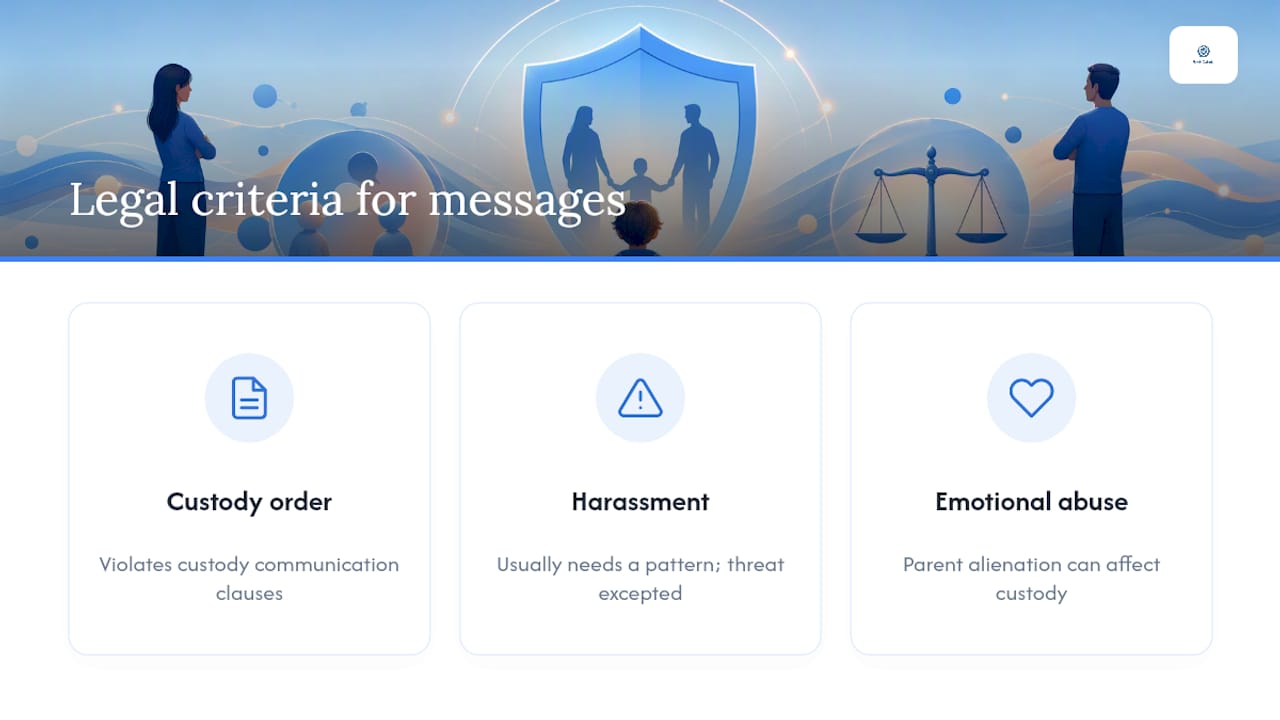
There's no single nationwide statute that defines "inappropriate message to a child" in the co-parenting context. What matters legally is usually one of three things: whether the message violates a specific provision in your custody order or parenting plan, whether it constitutes harassment under your state's civil or criminal code, or whether it rises to the level of emotional abuse that a family court would weigh in a custody modification.
Custody orders often include communication provisions, sometimes explicit ("no disparagement of the other parent to the child"), sometimes implied through a general best-interests standard. A message that coaches a child to lie, pressures them to choose sides, discloses adult financial or legal details, or uses the child to relay hostile messages typically falls under parental alienation behavior, which courts increasingly recognize as a factor in custody decisions.
Harassment statutes vary by state but generally require a pattern, not a single message, unless that message contains a direct threat. A single sharp text is unlikely to trigger legal consequences on its own. A documented pattern of messages designed to frighten, manipulate, or destabilize a child is a different story, and it's exactly the kind of pattern parental alienation documentation is built to reveal.
If you're unsure whether a specific message crosses a legal line, treat it as documentation-worthy regardless. The legal threshold is a question for your attorney. Your job right now is making sure the record exists when that question comes up.
What Impact Do These Messages Have on Children?
Kids caught in the middle of hostile co-parent communication absorb more than the words in any single message. They absorb the tension of being used as a channel between two adults who aren't speaking directly, and that role reversal, where a child manages adult emotions instead of the other way around, is where real damage accumulates.

A single inappropriate message rarely causes lasting harm on its own. A pattern does. Children exposed to repeated manipulative or hostile messages routed through them often show signs of divided loyalty: reluctance to share information with either parent, guilt about time spent with one parent versus the other, or anxiety before exchanges. Younger children may not have the language to explain what's bothering them, showing it instead through sleep changes, clinginess, or acting out at school. Teenagers are more likely to withdraw entirely or begin mirroring one parent's language about the other, a warning sign that alienation dynamics are taking hold.
The "connect, don't correct" approach matters here specifically because a child's nervous system needs to know that at least one parent is a stable, non-reactive presence, even when the message itself was upsetting. Every time you respond to a hard message with calm rather than counter-accusation, you're reinforcing that stability, which is the single biggest protective factor against the long-term emotional cost of high-conflict co-parenting.
A Note From the Reply Calmly Team
We built Replycalmly around one belief: your child's wellbeing outranks winning an argument. Connect first, correct later, if at all. Our response generator and incident tracker exist so you can hold that line consistently, even on the days it's hardest to stay calm.
Get Court-Ready Support for Every Difficult Message
Every strategy in this guide, waiting before you reply, using BIFF language, preserving original threads, logging incidents by category, is exactly what Replycalmly is built to do automatically. Instead of drafting a calm reply from scratch at 11 PM, paste the message in and get a calm, firm, or short version in seconds.
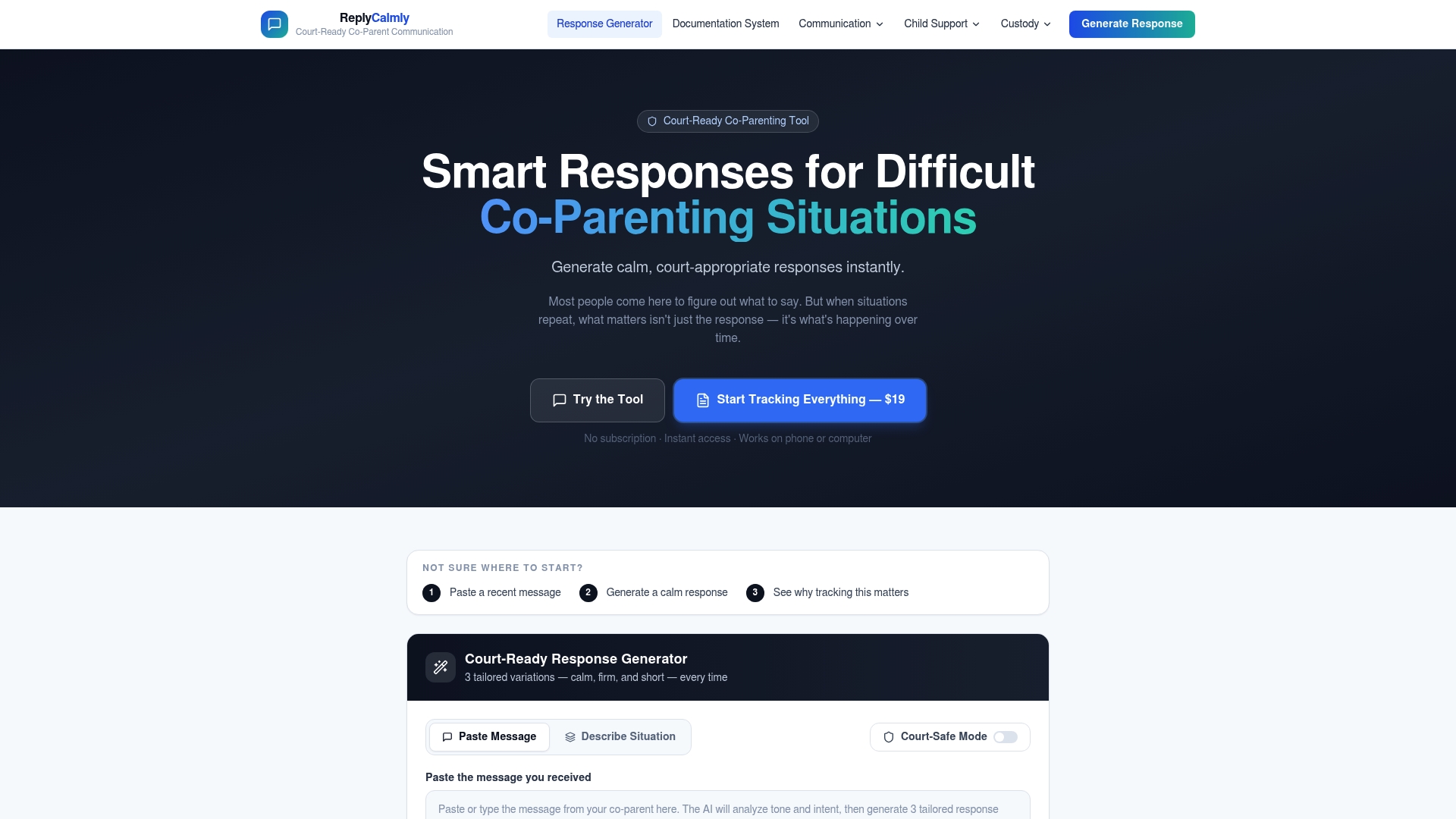
The incident tracker tags each entry by category (custody conflict, manipulation, false accusation) and attaches supporting evidence, so your log stays organized without a weekly spreadsheet session. When it's time to talk to your attorney, export the whole record in a court-ready format instead of scrolling through months of texts trying to remember what happened when. It also complements court-mandated platforms like OurFamilyWizard rather than replacing them, giving you the analysis layer those apps don't provide.
Try the free co-parent response generator on your next difficult message and see what a calm, documented reply actually looks like.
Useful Resources for Documentation and Response
- Copareo's court documentation system
- BIFF framework for hostile emails
- Best co-parenting apps for documentation
Frequently Asked Questions
Should I always reply to an inappropriate message from my co-parent? No. Reply only if it involves a child's immediate health, safety, or schedule. Otherwise, send one firm boundary and then stay silent on repeats.
What's the safest way to save an inappropriate text before it disappears? Preserve the original thread rather than a screenshot when the platform allows it, and back it up to a cloud folder or email the same day.
Do I need my co-parent's consent to keep a copy of messages sent to my child? Generally no, if the message was sent to a device or account you own or jointly manage. Rules vary by state, so confirm with a family law attorney if you're monitoring anything beyond that.
What should I say to my child after they show me a hurtful message? Lead with empathy, not investigation: "That wasn't okay for them to say, and it's not your fault" works better than pressing for more details right away.
When does an inappropriate message become a legal issue? When it violates a specific custody order provision, forms part of a documented harassment pattern, or reflects behavior a court would weigh as parental alienation or emotional harm.
This article is general information, not a substitute for advice from a qualified lawyer. Consult a qualified legal professional about your own circumstances before acting on anything here.
Sources
- How to Document Co-Parenting for Court: The Complete System (2026) | Copareo
- How to Document Everything in a High-Conflict Custody Case — The Complete System | Carl Knickerbocker Law
- Hostile Co-Parent Email: How to Respond Without Making It Worse | Parenting Agreement
- How Targeted Parents Should Respond to Unfair Accusations | Psychology Today