
When you're co-parenting in a high-conflict situation, every message you send carries legal weight. Most parents assume that staying calm or being polite is enough to keep their communications court-safe. It isn't. Family courts scrutinize not just your tone but your content, your focus, and whether your words serve your child's best interests or expose your own frustration. What feels reasonable in the moment can become damaging evidence in a hearing. This guide walks you through exactly what "legally appropriate" means in practice and how you can apply it to every exchange with your co-parent.
Table of Contents
- Why 'legally appropriate' matters in co-parenting communication
- Key elements of a legally appropriate response
- Common pitfalls and how to avoid them
- Framework for crafting your responses: a practical guide
- What most guides miss about co-parenting communication
- How ReplyCalmly can help you respond securely
- Frequently asked questions
Key Takeaways
| Point | Details |
|---|---|
| Legal standards matter | Family courts judge communications by legal, not emotional, standards. |
| Use a proven checklist | Fact-based, child-focused, and neutral messages protect you best. |
| Avoid risky language | Sarcasm, blame, and vague answers frequently backfire legally. |
| Frameworks ease stress | A simple process for drafting replies can lower anxiety and legal risks. |
| Help is available | ReplyCalmly and similar tools can guide you in sending safe responses. |
Why 'legally appropriate' matters in co-parenting communication
There's a critical difference between a response that feels civil and one that actually holds up in court. You might send a message without a single insult and still hand opposing counsel ammunition to use against you. Legally appropriate communication isn't about being nice. It's about producing written records that a judge can read and see a cooperative, child-focused parent.
Family courts look at the full picture of parental communication. They assess tone, content, context, and whether responses move toward or away from the child's wellbeing. A message that relitigates past grievances, includes sarcasm, or strays into irrelevant personal conflict can signal instability or inability to co-parent effectively. That signal can cost you in custody decisions.
Research on interparental conflict consistently shows that reducing parental conflict improves outcomes for children, though intervention programs themselves have real limitations in scope and design. The evidence makes one thing clear: courts treat parental communication as behavioral evidence of your fitness as a co-parent.
"High levels of interparental conflict expose children to chronic stress and are among the strongest predictors of poor child adjustment following parental separation." Journal of Child and Family Studies
Here is what you should avoid in written co-parenting communication:
- Bringing up past relationship grievances unrelated to the current issue
- Using sarcasm or passive-aggressive language, even if subtle
- Making threats, even veiled ones like "I'll see what my attorney thinks of this"
- Oversharing your emotional state or accusing your co-parent of manipulation
- Cc'ing third parties like new partners or family members without legal reason
Building effective legal responses starts with understanding that every word you type can end up in a courtroom. Once that reality sets in, you stop writing for your co-parent and start writing for the record.
Key elements of a legally appropriate response
Knowing what to avoid only gets you halfway there. You also need to know what a compliant, court-ready message actually looks like. The good news is that it follows a consistent pattern, and once you learn it, it becomes repeatable.
Interparental conflict interventions are supported by research but face ongoing challenges in measuring what actually works in daily co-parenting communication. What practitioners and family law attorneys consistently agree on is that legally sound messages share several identifiable features.
A legally appropriate response includes:
- Fact-based content. Stick to what is verifiable. Dates, times, agreements, and observable events.
- Relevance to the child. If your message can't be connected back to your child's needs, rethink sending it.
- Neutral tone. Flat, professional language. Not warm, not cold. Think email to a business colleague you barely like.
- No blame or accusations. Even if your co-parent is clearly in the wrong, let your attorney handle that framing. Your message is not the place.
- Closed questions or clear action items. Vague messages invite escalation. Be specific about what you're asking or confirming.
Comparison: Legally appropriate vs. risky responses
| Situation | Risky response | Legally appropriate response |
|---|---|---|
| Late pickup | "You're always doing this. It's so typical." | "The pickup time per our agreement was 3 p.m. Please confirm your ETA." |
| Missed school event | "You never prioritize her. She was heartbroken." | "Maya's school play was today at 2 p.m. I'm happy to share a recording with you." |
| Medical decision | "You never consult me. I'm her parent too." | "Per our custody order, joint medical decisions require both parties. Please contact me before the next appointment." |
| Schedule change request | "I already said no and I mean it." | "I'm not able to accommodate that change this weekend. Our current schedule stands." |
Pro Tip: Before hitting send, read your message out loud as if a judge is listening. If any sentence would make you cringe in a courtroom, cut it or rewrite it. This simple check can catch more problems than rereading silently.
Getting guidance on effective legal responses right requires practice, but this checklist makes the standard explicit rather than leaving you to guess.
Common pitfalls and how to avoid them
Even parents who know the rules slip up. High-conflict situations trigger emotional responses, and emotions are the enemy of legally clean communication. The most common mistakes aren't obvious in the moment. They feel justified, even necessary. That's exactly what makes them dangerous.

Research on conflict intervention limitations points out that addressing the full scope of problematic co-parenting behaviors remains a challenge, which is why individual awareness of your own patterns matters so much.
Watch out for these recurring traps:
- Sarcasm. It reads as hostility in text. "Thanks so much for the two-hour notice" is not a neutral statement. A judge will see it clearly.
- Over-explaining. Long, defensive messages suggest anxiety and invite further conflict. Courts often read length as emotional dysregulation.
- Emotional venting. Sentences like "I'm exhausted by your behavior" or "This is incredibly unfair" shift the focus from the child to you. That's the opposite of where you want the spotlight.
- Vague responses. "I'll think about it" or "We'll see" create ambiguity that can later be interpreted against you. Specificity protects you.
- Reactive timing. Replying within minutes of receiving a hostile message is almost always a mistake. The reply itself may be fine, but rushing increases errors.
The legal risk in each of these patterns is the same: they make you look reactive, emotionally unstable, or uncooperative. None of those impressions help your custody position.
Pro Tip: When you receive an inflammatory or off-topic message, a simple redirect keeps the record clean. Try: "My focus is on [child's name]'s wellbeing. If this relates to that, please clarify what you need." One sentence. Nothing more.
ReplyCalmly tools are built specifically to help you sidestep these patterns before they become part of your court record. Having a structured system to draft and review responses removes the guesswork from high-pressure moments.
Framework for crafting your responses: a practical guide
You need a repeatable process, not just a list of rules. Rules are easy to forget when you're stressed. A step-by-step framework becomes automatic over time, and that's the goal. Predictable, professional responses that you can produce even when the message you received made your blood pressure spike.
Targeted interventions for co-parenting conflict show real promise in improving communication outcomes when parents have structured support, which is exactly what a personal framework provides.
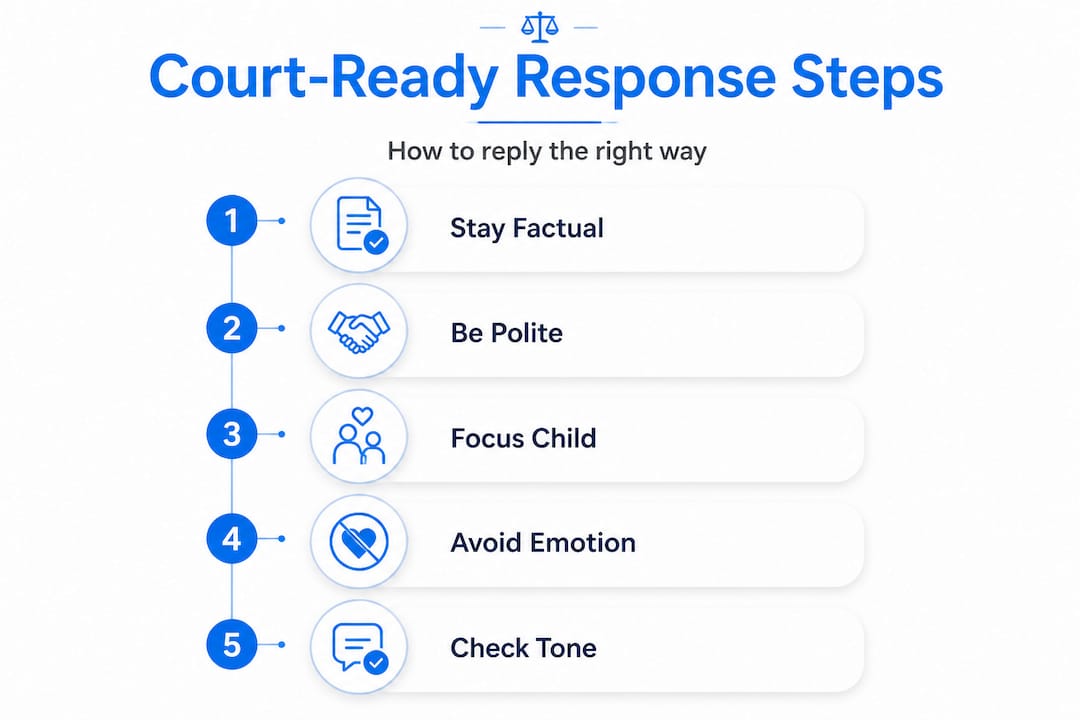
Follow this five-step process for every response:
- Read the message twice before typing anything. Identify what is actually being asked or communicated, separate from the emotional charge.
- List only the relevant facts. Write them down as bullet points. What is the specific logistical question? What does the custody agreement say? What action is needed?
- Draft in plain language. Write a rough version using short sentences. No adjectives describing your co-parent's behavior.
- Run a child focus check. Ask yourself: does this message, in any way, relate to my child's safety, schedule, health, or education? If not, consider whether a response is even necessary.
- Edit for neutrality. Remove anything that contains an emotional adjective, a past grievance, or an implied accusation. Read what remains. If it sounds like a calendar confirmation, you're probably done.
Message transformation examples
| Draft version | What's wrong | Improved version |
|---|---|---|
| "I can't believe you changed the pickup time again without asking." | Accusatory, emotional | "I noticed the pickup time was changed. Our agreement lists 4 p.m. on Fridays. Please confirm." |
| "She was upset all week because of what you said to her." | Hearsay, blame | "Lily had a difficult week. I'd like us to connect briefly about her emotional state." |
| "I'm not going to agree to that. You always spring things on me last minute." | "Always" language, emotional | "I need at least 72 hours notice to consider schedule changes per our parenting plan." |
| "Fine, do whatever you want." | Vague, passive aggressive | "I don't agree with this approach. Please refer to section 4 of our parenting plan." |
The mirror test is your final filter: Would I want a judge to read this? If there's any hesitation, keep editing. Using a smart response builder can speed up this process and apply the framework consistently without you having to reconstruct it from scratch each time.
What most guides miss about co-parenting communication
Most advice in this space focuses on what to say and what to avoid. That's useful but incomplete. What rarely gets discussed is the exhausting emotional labor of restraint, and why that labor is actually a legal asset.
Every time you hold back a sharp response, every time you delete the paragraph that tells your co-parent exactly what you think of them, you are making a legal investment. Courts don't see those deleted paragraphs. They see a parent who consistently communicates professionally. Over time, that pattern becomes your reputation in front of a judge.
There's also a misconception that silence is always the safest option. It isn't. When you consistently fail to respond to logistical questions or schedule requests, that silence can be read as non-cooperation. A brief, factual reply protects you in ways that no response does not. It shows you're engaged, available, and focused on your child rather than on winning a conflict.
"Restraint in communication is not passive. It is one of the most active, deliberate choices a co-parent can make, and courts notice the pattern over time."
The practical co-parenting wisdom that actually moves cases forward isn't about being emotionally detached. It's about channeling your emotional energy away from the message thread and into the other areas of your life where you can express it safely. That distinction changes everything.
Perfection is not realistic. You will send an imperfect message occasionally. What matters more than any single message is the overall pattern. Courts look at communication history. A consistent record of measured, child-focused responses far outweighs one or two slips. Build the pattern. That's the real goal.
How ReplyCalmly can help you respond securely
The framework in this article works. It also takes real mental energy to execute every single time, especially when you're already overwhelmed by the emotional weight of a high-conflict custody situation.
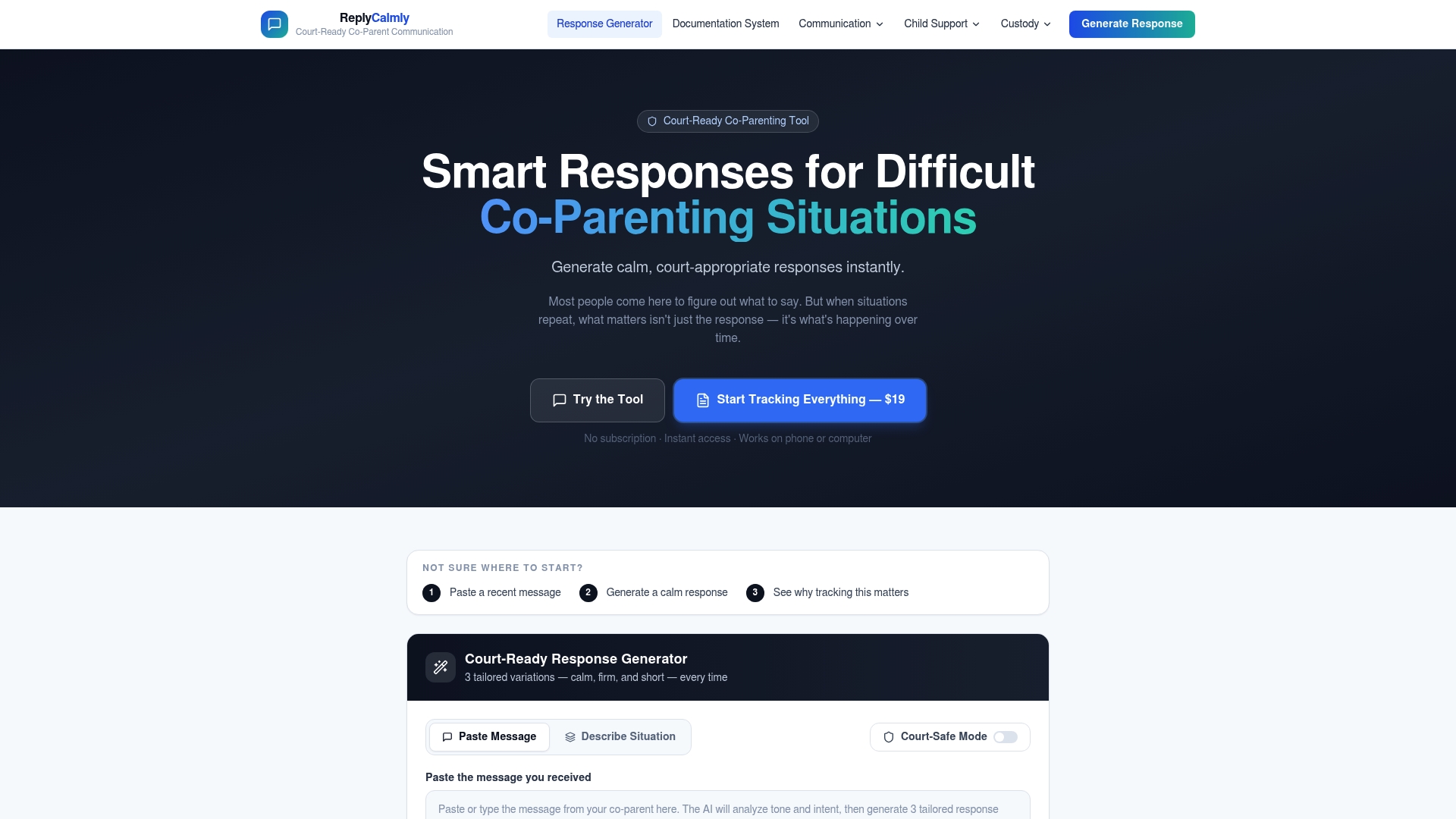
ReplyCalmly for co-parenting is built to take the repetitive cognitive load off your plate. The platform's response generator analyzes incoming messages and produces multiple response options, including calm, firm, and short variations, so you're never starting from a blank page under pressure. It tracks your communication history, categorizes recurring issues like manipulation or false accusations, and builds a dashboard that gives you and your attorney a clear picture of patterns over time. It also integrates with tools like OurFamilyWizard, so your records stay consistent and court-ready without extra effort on your part. When the stakes are this high, having structured backup isn't a luxury. It's a practical safeguard.
Frequently asked questions
What makes a response legally appropriate in family court?
A legally appropriate response stays fact-based, avoids insults or blame, focuses on the child, and can withstand scrutiny if presented to a judge. Courts examine the full tone and content of co-parent communications when assessing parental fitness.
Can I ignore aggressive or inflammatory messages from my co-parent?
Ignoring messages is not always advisable because consistent non-response can appear uncooperative to a court. A brief, neutral reply is usually the safer choice, demonstrating willingness to communicate without escalating the conflict.
Should my responses be shared with my attorney before sending?
On complex or legally sensitive issues, attorney review is always a good idea, but following a consistent legal response framework reduces that need for routine exchanges. Structured intervention approaches show that predictable communication patterns improve overall outcomes in co-parenting disputes.