
Many parents enter custody disputes believing their memory, a few saved emails, and a basic calendar are enough to make their case. They are not. Courts move on evidence, and evidence means structured, verifiable, timestamped records that a judge or custody evaluator can review without relying on your word alone. When documentation is missing or disorganized, even legitimate concerns about a co-parent's behavior can be dismissed as personal bias. Incident tracking closes that gap by turning chaotic, stressful interactions into a clear, credible record that speaks for itself in court.
Table of Contents
- Why incident tracking is critical in custody disputes
- What counts as an incident? Defining and categorizing co-parenting events
- Features of effective incident tracking tools
- How to establish an incident tracking routine that holds up in court
- The real impact of structured documentation in family law
- Take control with smart incident tracking tools
- Frequently asked questions
Key Takeaways
| Point | Details |
|---|---|
| Documentation drives outcomes | Incidents tracked with timestamps and facts have the greatest impact during custody disputes. |
| Facts over feelings | Records should focus on verifiable events, not interpretations or emotions. |
| Choose purpose-built tools | Apps designed for co-parenting disputes ensure records are court-ready and unbiased. |
| Consistency builds credibility | Regular, impartial documentation is preferred by judges and evaluators. |
Why incident tracking is critical in custody disputes
Custody disputes frequently turn on what was said, when it was said, and whether anyone can prove it. Personal memory is unreliable, and even saved text messages can be challenged if there is no system establishing their context or pattern. That is why structured incident tracking is not just helpful. It is often the deciding factor.
"Documenting communication with permanent, timestamped records prevents disputes about who said what and when." This principle is foundational to how family courts evaluate contested messaging and denial of prior statements.
Courts and custody evaluators are trained to look past emotional arguments. They want evidence with provenance, meaning records that show exactly when something happened, what was said or done, and whether that record has been altered. Structured evidence in custody evaluations carries far more weight than a parent's narrative, no matter how credible that parent seems in person.
Here is why this matters practically:
- Reduces "he said/she said" disputes. When both parties know that messages and incidents are logged with timestamps, the incentive to deny or distort events drops significantly.
- Supports modification requests. If you need to request a change in custody arrangements, a documented pattern of missed pickups or hostile communication is far more persuasive than a verbal account.
- Strengthens protective order applications. Courts require concrete evidence of threatening or harmful behavior. A well-maintained incident log can be the foundation of that evidence.
- Demonstrates your reliability as a parent. Consistent, calm documentation signals to evaluators that you are organized, focused on your child's wellbeing, and not acting out of spite.
Using structured evidence rather than emotional testimony is one of the most effective shifts you can make in how you approach a high-conflict custody case. It reframes your role from "angry ex-partner" to "concerned, organized parent."
Pro Tip: Start your incident log on the day you decide to take your custody case seriously, not the day before a court hearing. Judges notice when documentation begins suspiciously close to a legal event.
What counts as an incident? Defining and categorizing co-parenting events
Not every frustrating interaction with your co-parent belongs in a formal incident log. Knowing what qualifies is just as important as knowing how to record it. Vague or overly emotional entries can actually undermine your credibility. The goal is a log that reads like a factual report, not a personal diary.
Types of recommendations in custody reports consistently show that detailed, categorized incident documentation supports legal claims far more effectively than general complaints. Evaluators look for patterns, and patterns require categories.
Here are the primary incident types worth tracking:
| Category | Examples |
|---|---|
| Communication breakdown | Ignored messages, delayed responses, hostile language |
| Missed or late pickups | No-shows, late arrivals, unannounced schedule changes |
| Non-compliance with orders | Ignoring court-mandated communication tools, violating parenting plan terms |
| Inappropriate language or behavior | Threats, profanity directed at you or the child, manipulation tactics |
| Third-party interference | Involving new partners or family members in co-parenting conflicts |
| Child welfare concerns | Reports from the child about distress, neglect, or exposure to conflict |
Each category serves a different legal purpose. Communication breakdowns, for example, may support a request for court-mandated communication tools. Repeated missed pickups may justify a modification to the custody schedule. Child welfare concerns may warrant a formal investigation.
What you should avoid logging:
- Your emotional reaction to an incident (save that for your therapist, not your legal record)
- Speculation about your co-parent's motives
- Secondhand accounts you cannot verify
- Minor irritations that do not affect your child's safety or wellbeing
The discipline of tracking incidents for custody dispute resolution is really the discipline of separating fact from feeling. It takes practice, but it pays off significantly when your attorney or evaluator reviews your records.
Features of effective incident tracking tools
Once you understand what to log, you need a tool that creates records courts will actually trust. Not all tracking methods are equal. A spreadsheet you maintain yourself, for instance, can be challenged because you control it and can edit it at any time. Courts are aware of this.
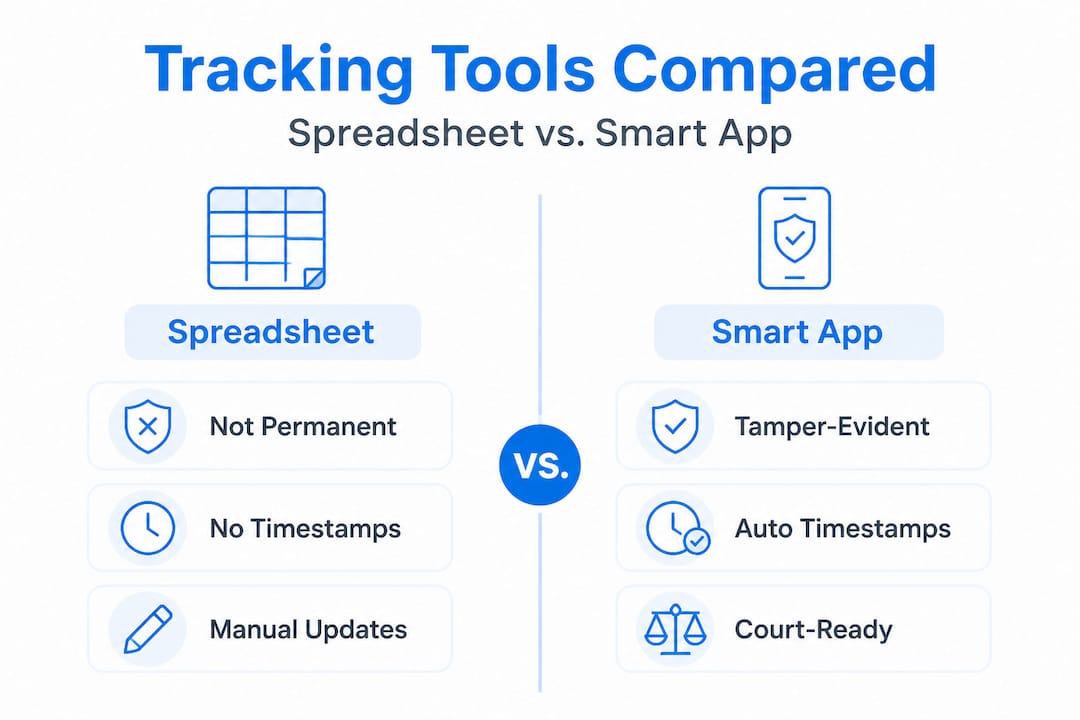
Unalterable records for legal use are a standard feature of purpose-built co-parenting platforms. These systems create entries that cannot be modified after the fact, which is exactly what gives them credibility in legal proceedings.
Here is what to look for when choosing a tracking tool:
- Permanent, unalterable records. Once an entry is saved, it cannot be edited or deleted. This protects both parties and gives courts confidence in the data.
- Automatic timestamps. Every entry should be date and time stamped at the moment of creation, not manually entered by the user.
- Categorization features. The ability to tag incidents by type (communication, visitation, compliance) makes pattern analysis far easier for attorneys and evaluators.
- Export functionality. You need to be able to produce a clean, formatted report for court without relying on screenshots or printouts that can be questioned.
- Secure, encrypted storage. Your records contain sensitive information. They should be stored securely and accessible only to you and authorized parties.
- Mobile access. Incidents happen in real time. You need to be able to log them immediately from your phone, not hours later when details have faded.
| Feature | Basic Spreadsheet | Purpose-Built Co-Parenting App |
|---|---|---|
| Permanent records | No | Yes |
| Automatic timestamps | No | Yes |
| Tamper-evident | No | Yes |
| Court-ready export | No | Yes |
| Categorization | Manual | Automated |
| Secure storage | Varies | Yes |
The comparison is stark. A spreadsheet may feel convenient, but it introduces doubt. Purpose-built smart response tools for co-parents remove that doubt by design.
Pro Tip: If you are already using a court-mandated platform like OurFamilyWizard, look for supplementary tools that integrate with it rather than replacing it. Layered documentation from multiple credible sources is even more persuasive in court.
How to establish an incident tracking routine that holds up in court
Choosing the right tool is only half the work. The other half is consistency. A log with 50 detailed entries from the past six months is far more credible than one with 200 entries from the last two weeks before a hearing. Courts notice timing, and so do evaluators.

Evidence structure matters in custody cases in ways that go beyond the content of individual entries. A well-maintained, regularly updated log signals that you are a parent who pays attention and takes your responsibilities seriously, not someone who scrambles to build a case at the last minute.
Here is how to build a routine that holds up:
- Log incidents within 24 hours. Memory degrades quickly. The sooner you document an event, the more accurate and credible your record will be. Make it a habit, like locking your front door.
- Use objective language only. Write what happened, not what you think it means. "Co-parent arrived 45 minutes late for pickup without prior notice" is strong. "Co-parent deliberately sabotaged my time with my child" is not.
- Include supporting evidence when available. Attach screenshots, voicemails, or photos directly to the incident entry if your tool allows it. Standalone records are stronger when supported by primary sources.
- Review your log monthly. Set a recurring reminder to review your entries with your attorney or on your own. Monthly reviews help you spot emerging patterns and prepare for upcoming hearings or mediation sessions.
- Export records before every legal event. Generate a formal report at least one week before any court date, mediation session, or custody evaluation. This gives your attorney time to review and incorporate the data.
- Keep a separate note of your child's statements. If your child says something concerning, log the exact words they used, the date, the time, and who else was present. Do not interpret or paraphrase.
The value of structured evidence for family court comes from its regularity and neutrality. Think of your log less as a weapon and more as a camera that runs continuously, capturing what actually happens without editorial commentary.
Pro Tip: Never log an incident while you are emotionally activated. Write a quick note to yourself, then return to the log when you are calm. Emotional language in formal records can make you look less credible, even when your underlying concern is completely valid.
The real impact of structured documentation in family law
Here is something most advice columns will not tell you: more documentation does not automatically mean better documentation. Many parents in high-conflict situations make the mistake of logging every minor irritation, every slightly late text, every perceived slight. The result is a log so bloated and emotionally charged that evaluators struggle to find the genuinely significant incidents buried inside it.
Judges and custody evaluators are experienced professionals who read these records regularly. They know the difference between a parent who is genuinely concerned about their child's safety and a parent who is using documentation as a tool for harassment or control. Ironically, an overly aggressive logging approach can signal the latter, even when that is not the intent.
What actually moves the needle in family court is a neutral documentation approach that shows clear, factual, consistent patterns of behavior. Three documented instances of a co-parent arriving more than an hour late for pickup, each logged calmly and factually, carry more weight than thirty entries that mix legitimate concerns with emotional commentary.
There is also a protective dimension to this that many parents overlook. When your records are neutral and factual, they protect you from counter-accusations. If your co-parent claims you are fabricating incidents or exaggerating, a clean, impartial log is your best defense. Tools that prevent editing after the fact make it nearly impossible for either party to credibly accuse the other of tampering.
The parents who fare best in high-conflict custody situations are not the ones who fight hardest. They are the ones who document most clearly. Precision and neutrality are not just legal strategies. They are the clearest signal to a court that your focus is on your child, not on winning.
Take control with smart incident tracking tools
If you are navigating a high-conflict custody situation, the gap between what you remember and what you can prove in court can define your child's future. Structured, secure, and court-ready documentation is no longer optional.
ReplyCalmly for co-parents was built specifically for situations like yours. The platform combines a smart response generator with a full incident tracking system, letting you log events by category, attach supporting evidence, and export clean reports for court or mediation. Every entry is timestamped and secure, giving your attorney and the court the credible, organized record they need to take your concerns seriously. Whether you are preparing for a custody modification, a protective order, or a routine evaluation, ReplyCalmly helps you stay focused, factual, and legally protected.
Frequently asked questions
What types of incidents should I track in a custody dispute?
Track any events involving communication breakdowns, missed or late visitations, non-compliance with your custody agreement, inappropriate behavior, or concerns about your child's welfare. Incident categorization supports legal claims far more effectively than general descriptions of conflict.
Is it better to use an app or keep a paper log?
Apps with permanent, timestamped records are strongly preferred for court reliability because they are tamper-evident and exportable. Co-parenting platforms create unalterable records with timestamps and export features that paper logs simply cannot replicate.
How do I present incident records in a legal setting?
Export a formatted digital report from your tracking tool and provide it to your attorney well before any hearing. Courts favor structured, timestamped records over personal narratives because they are harder to dispute and easier to analyze for patterns.
Do courts really prefer digital evidence over testimony?
Yes. Most family courts view digital, timestamped evidence as less biased and more reliable than personal testimony because it captures events at the moment they occur. Structured evidence with provenance removes the "he said/she said" problem that makes personal testimony so difficult to evaluate fairly.