
Parenting time interference means one parent violating the terms of a court-ordered custody arrangement, whether by withholding the child, blocking communication, or undermining scheduled visits. If it's happening to you, the first move isn't to retaliate by withholding time back. It's to document everything, preserve the originals, and understand that your remedies range from make-up parenting time to contempt sanctions to, in severe cases, criminal charges.
TL;DR:
- Repeated interference such as refusing to return the child, unauthorized relocation, or coaching the child to refuse visits can be legally enforced through civil or criminal actions.
- Strong evidence, including timestamped logs, third-party records, and preserved digital files, is essential for successful enforcement or modification cases.
- Routine scheduling violations typically warrant civil remedies like make-up time or fines, while serious cases like concealment or abduction may lead to criminal charges.
- Jurisdiction issues arise when parents move the child across states without proper order registration, complicating enforcement and potentially causing delays.
- Documenting interference calmly and consistently from the start underpins both enforcement and future custody modifications, with organized records favoring legal action.
Table of Contents
- What Counts as Parenting Time Interference Under the Law
- Direct and Indirect Interference: Examples That Actually Hold Up in Court
- What Happens Legally: Civil Remedies and Criminal Exposure
- How to Document Parenting Time Interference (Step by Step)
- Mediation, Emergency Filings, or Police: Choosing the Right Path
- How Calm Communication and Careful Tracking Strengthen Your Case
- What Rights and Duties Actually Come With Parenting Time
- Preventing Interference Before It Starts
- Why Jurisdiction Complicates Parenting Time Enforcement
- Modifying a Parenting Plan After Repeated Interference
- Our Take: Documentation Beats Drama Every Time
- Sources
What Counts as Parenting Time Interference Under the Law
Courts only recognize parenting time interference when there's an actual court order on the books. If you and your co-parent have an informal handshake agreement about who gets the kids on weekends, a judge has nothing to enforce. The moment a parenting plan or custody order is entered by the court, though, both parents are legally bound to it, and deviating from it without agreement or legitimate cause becomes an enforceable violation.
There's a meaningful line between an occasional scheduling headache and willful interference. A parent stuck in traffic for 20 minutes isn't violating a court order. A parent who repeatedly shows up two hours late, or who quietly enrolls the child in Saturday activities that swallow the other parent's weekend every single time, is doing something else entirely.
Family law treats this conduct through two separate tracks:
- Civil enforcement, which is the more common path and focuses on compliance, make-up time, and financial penalties.
- Criminal exposure, reserved for the more serious cases like concealment or taking a child across state lines.
Which track applies, and how aggressively a court pursues it, depends heavily on your state. Some states treat repeated denial of court-ordered parenting time as a minor civil matter unless it escalates. Others, as you'll see below, have gone as far as writing it into the criminal code.
Direct and Indirect Interference: Examples That Actually Hold Up in Court
Not every frustrating co-parenting moment rises to the level of a legal violation, but certain patterns consistently do. Here's how courts tend to categorize them.
- Refusing to return the child at the agreed time. This is the most obvious form: the pickup or drop-off simply doesn't happen on schedule, repeatedly, without agreement or emergency justification.
- Hiding the child or refusing to disclose location. Whether it's an unlisted address, a blocked phone number, or a school that suddenly won't confirm attendance, deliberate concealment is treated far more seriously than a missed exchange.
- Unauthorized relocation. Moving a child out of the jurisdiction, or even across town in a way that disrupts the custody schedule, without following the court's notice and consent procedures.
- Blocking phone or video calls. Consistently unreachable during scheduled contact windows, or a child who's mysteriously "asleep" every time the other parent calls.
- Scheduling conflicts that eat into the other parent's time. Booking travel, camps, or recurring activities during the other parent's parenting time, especially when it happens over and over.
- Coaching a child to refuse visits. A child suddenly announcing they "don't want to go" often traces back to comments made at home, and courts pay close attention to this pattern as a form of parental alienation.
- Chronic lateness at exchanges. One late pickup means nothing. A pattern of 30, 60, or 90 minute delays every week is different.
There's an important exception: a parent who withholds a child because of a genuine, documented safety concern, active abuse, intoxication, an unsafe home, isn't necessarily interfering, and knowing how to protect evidence from an abuser can be crucial in these situations. Courts distinguish protective refusal from punitive refusal, but the parent making that call still needs to document the reason and, ideally, seek emergency relief rather than just unilaterally stopping visits.
What Happens Legally: Civil Remedies and Criminal Exposure
Most parenting time interference cases stay in civil court, and for good reason: it's faster, cheaper, and judges have real tools to fix the problem. When you file a motion to enforce, a judge can order make-up parenting time to restore what was lost, hold the violating parent in contempt, order supervised exchanges going forward, or require the interfering parent to cover your attorney fees.
Here's the menu of civil remedies courts commonly use to purge a contempt finding:
- Make-up time calculated hour for hour or day for day against what was missed
- Civil contempt sanctions, which can include fines or, rarely, jail time for continued noncompliance
- Reimbursement of attorney fees and court costs tied to the enforcement action
- Supervised or third-party exchanges if trust has broken down at pickup and drop-off
- Modified transportation or communication terms baked into a revised order
Pro Tip: Judges respond best to parents who show up with a clean, factual record rather than an emotional retelling. A one-page log with dates and times will do more for your case than a heated affidavit.
Criminal charges enter the picture in the more extreme scenarios: concealing a child's whereabouts, ignoring a custody order to flee across state lines, or repeated abduction-like conduct. Illinois, for example, has a statute making unlawful visitation or parenting time interference a specific criminal offense with graded penalties depending on severity and prior violations. Not every state criminalizes it the same way, so what's a misdemeanor in one jurisdiction might not even be charged in another.
There's also a longer-term consequence worth naming directly: a documented pattern of interference can work against the violating parent in a future custody modification hearing, since judges weigh a parent's willingness to support the child's relationship with the other parent as part of the best-interest analysis.
How to Document Parenting Time Interference (Step by Step)
The single biggest factor in whether an enforcement motion succeeds is the quality of your evidence. Vague complaints lose. Specific, timestamped, third-party-corroborated records win.
Start with a running incident log. For every violation, note the date, the scheduled time, exactly what happened, and how long the interference lasted. Keep entries short and factual, "3:15 PM: scheduled pickup, no response to texts, child not released until 5:40 PM", rather than editorializing about motives or character. Judges consistently favor plain, neutral entries over anything that reads as inflamed or exaggerated, because a record that looks emotionally charged is easier for opposing counsel to dismiss as unreliable.
Preserve original digital files, not just screenshots. Save the full message thread rather than an isolated line pulled out of context, and if you're using a co-parenting app, export the raw timestamped logs rather than relying on your memory of when something happened. Courts sometimes want to verify metadata, and a cropped screenshot can raise more questions than it answers.
Third-party records carry weight screenshots can't match on their own:
- School attendance records showing late arrivals or absences tied to custody exchanges
- Medical or daycare logs confirming who dropped off or picked up, and when
- Witness statements from anyone present at a failed or delayed exchange
- Receipts for costs you incurred because of the interference, like extra childcare or mileage
Once you have a body of evidence, organize it chronologically before you file. A step-by-step documentation checklist built around dates, rather than a folder of loosely sorted screenshots, is what actually moves a motion forward efficiently in front of a judge who's reviewing a stack of filings that day.
Mediation, Emergency Filings, or Police: Choosing the Right Path
Before assuming you need to escalate straight to a courtroom, confirm the basics: do you actually have a signed custody order? Without one, there's no order to enforce, and your options narrow considerably until you get one in place.
If you do have an order, most jurisdictions expect you to try mediation before a judge will hear an enforcement motion, and waiving that requirement usually takes a documented justification, like a safety concern or an emergency. For garden-variety scheduling violations, mediation is often the faster and cheaper route.
Reserve emergency, or ex parte, filings for situations involving real risk: a child who's been concealed, a parent who appears to be a flight risk, or credible safety concerns that can't wait for a regular hearing date. If you believe a child has actually been abducted or hidden, bring your certified court order to local police immediately, though how far law enforcement will go varies significantly by jurisdiction and department.
- Confirm you have an active, signed order before filing anything
- Try mediation first for routine violations
- File for emergency relief only when safety or concealment is involved
- Involve police specifically for suspected abduction, order in hand
How Calm Communication and Careful Tracking Strengthen Your Case
Every enforcement motion lives or dies on the record behind it, which is exactly the gap Replycalmly was built to close. The platform's incident tracker logs violations with timestamps, tags them by category (missed exchange, blocked communication, coaching), and attaches supporting files so your evidence stays organized instead of scattered across texts and screenshots.
Just as important is what you send in the moment. A heated reply to a co-parent's provocation can undercut your credibility later, even when you're the one being wronged. Replycalmly's response generator produces calm, firm, or short reply options so your side of the record reads as measured and reasonable, which is exactly the tone judges respond to best when reviewing a contested case.
What Rights and Duties Actually Come With Parenting Time
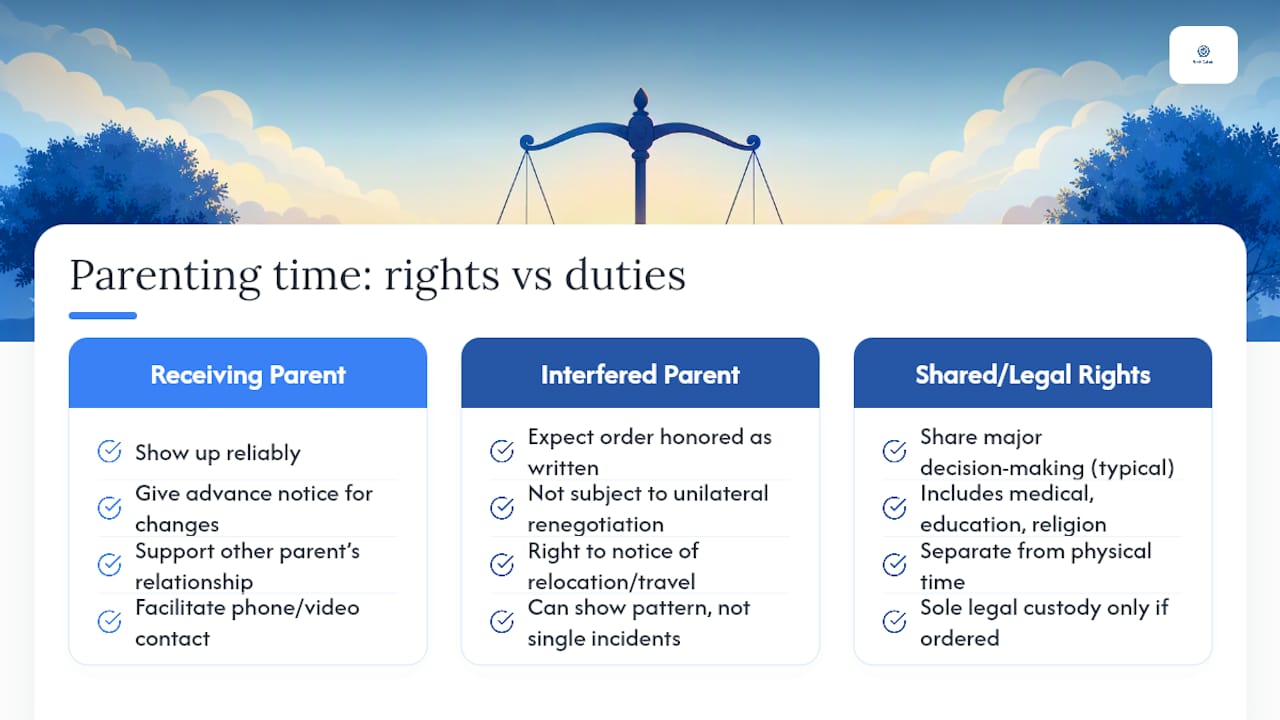
A custody order doesn't just grant you scheduled hours with your child; it comes paired with responsibilities that cut both ways. As the parent receiving time, you're expected to show up reliably, communicate schedule changes in advance, and support your child's relationship with the other parent rather than undermining it. As the parent whose time is being interfered with, you have the right to expect the order to be honored as written, not renegotiated unilaterally whenever it's inconvenient for the other household.
Both parents typically share decision-making authority on major issues, medical care, education, religious upbringing, unless the order specifically grants sole legal custody to one side. Parenting time and legal decision-making are separate concepts, and confusing them is a common mistake: a parent can have limited physical time with a child while still holding equal say in schooling decisions.
Responsibilities also extend to logistics most people don't think about until they're violated: giving reasonable notice for schedule changes, facilitating phone or video contact during the other parent's time, and not using the child as a messenger for adult disputes. Courts increasingly expect written notice of relocation or extended travel well in advance, not a same-week text.
None of this means perfection. A single missed call or a late pickup because of real traffic isn't a rights violation. What matters is the pattern, and whether a parent is acting in good faith toward the order they agreed to or signed onto.
Preventing Interference Before It Starts
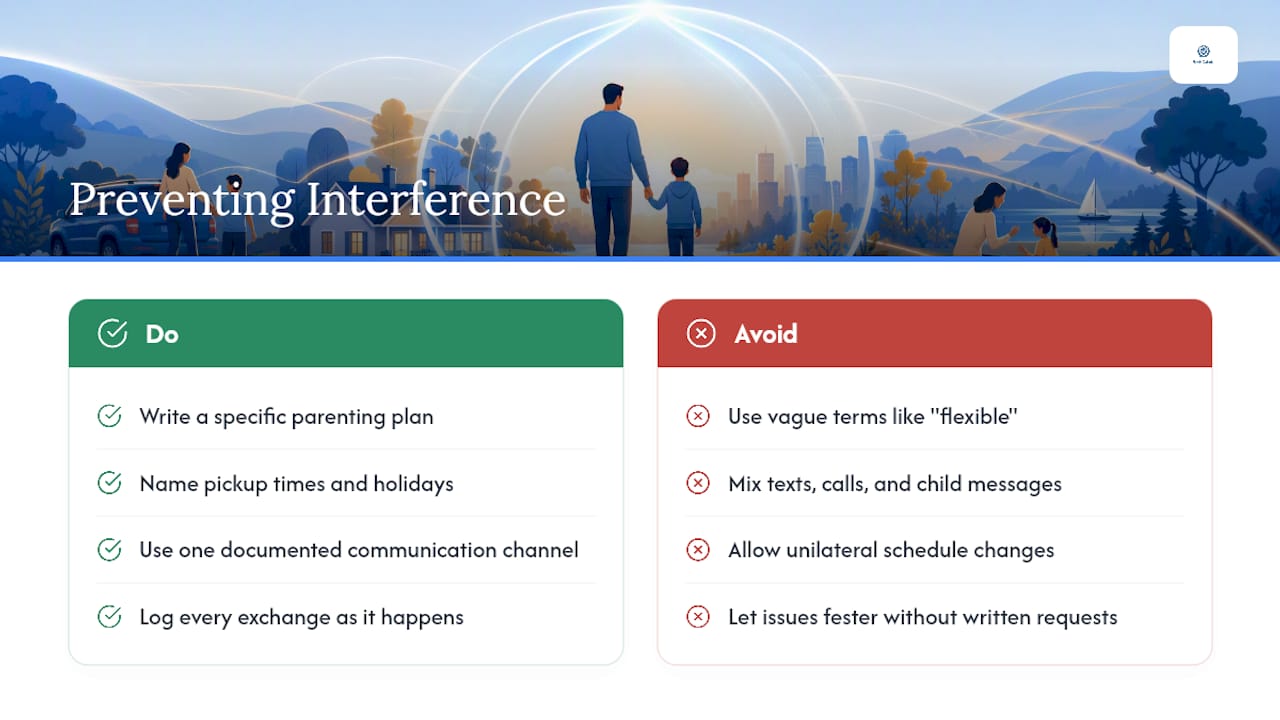
The cheapest fix for parenting time interference is a parenting plan detailed enough that there's little room for dispute in the first place. Vague language, "flexible weekend schedule", "reasonable phone access", invites conflict because both parents can interpret it differently and both can claim they're right. Specific pickup times, named holidays, and clear notice periods for changes remove most of that ambiguity.
Communication habits matter almost as much as the document itself. Parents who route logistics through a single, documented channel, rather than a mix of texts, calls, and messages passed through the child, create a natural record and reduce the "he said, she said" disputes that fuel most interference claims. This is also where a structured evidence log helps proactively: if every exchange is logged as it happens, small issues get resolved before they calcify into patterns worth fighting over in court.
It also helps to build in flexibility deliberately rather than by default. A plan with a built-in, documented process for one-off schedule swaps, requested in writing, confirmed in writing, gives both parents room to be human without opening the door to unilateral changes. And when one parent consistently pushes boundaries even with a solid plan in place, addressing it early through a calm written request, rather than letting resentment build silently, tends to produce better outcomes than waiting until frustration boils over into a court filing.
Why Jurisdiction Complicates Parenting Time Enforcement
Custody cases get legally messy fast once more than one state is involved, and this trips up more parents than almost any other procedural issue. The Uniform Child Custody Jurisdiction and Enforcement Act, adopted in some form by all fifty states, generally gives continuing jurisdiction to the child's "home state," typically wherever the child has lived for the six months before a case is filed. That matters enormously if a co-parent moves and tries to file a new case somewhere else.
If your custody order was issued in one state and your co-parent has since relocated with the child to another, you generally still enforce through the original issuing court, not by filing fresh wherever the child now lives. Attempting to file in the new location without properly registering the existing order first can create real delays and confusion about which court actually has authority.
Interstate relocation without following your order's notice requirements is one of the more serious jurisdiction-related violations, partly because it can look, functionally, like an attempt to forum-shop for a friendlier court. If you're facing a relocation situation, get the original order registered in the new state promptly and loop in an attorney familiar with interstate custody enforcement before things drift further. Jurisdiction fights add real time and cost to what might otherwise be a straightforward enforcement case.
Modifying a Parenting Plan After Repeated Interference
A pattern of documented violations is often the strongest argument for going back to court and asking for a formal modification, not just a one-time enforcement order. The difference matters: enforcement fixes the immediate violation, while modification changes the underlying terms going forward so the same problem is harder to repeat.
Common modifications after interference include tightening exchange logistics (specific times, specific locations, a named backup if a parent is running late), converting flexible language into fixed schedules, or requiring supervised exchanges at a neutral location if trust between the parents has broken down. In more serious or repeated cases, judges have reduced a violating parent's time or shifted primary custody, since willingness to honor the other parent's time is treated as evidence of parenting judgment.
To request a modification, you generally need to show a substantial change in circumstances, and a documented pattern of interference, dates, times, third-party records, qualifies in most jurisdictions. This is where organized evidence pays off twice: the same log you built for an enforcement motion becomes the backbone of your modification petition later. A complete custody documentation checklist makes it easier to present that history cleanly rather than reconstructing months of incidents from memory when the modification hearing finally arrives.
Our Take: Documentation Beats Drama Every Time
The research here points to one conclusion the average parent underestimates: courts don't reward the parent who's angriest or most persistent. They reward the parent who shows up with the cleanest, most boring record. That's a hard pill for anyone in the middle of a genuinely maddening co-parenting situation, but it's the truth of how family courts actually operate.
Where conventional advice falls short is in treating documentation as an afterthought, something you scramble to assemble the week before a hearing. By then you're reconstructing memory, not presenting facts. The parents who win enforcement motions are the ones who started logging on day one, calmly, factually, without editorializing.
If you're dealing with interference right now, prioritize two things immediately: stop responding emotionally to provocation, and start a dated log today, not after the next violation. Everything else, mediation, motions, modification, gets easier once that foundation exists. If you want a system built specifically for this, Replycalmly's documentation tools were built around exactly this workflow.
— Reply Calmly Team
This article is general information, not a substitute for advice from a qualified lawyer. Consult a qualified legal professional about your own circumstances before acting on anything here.
Sources
- Parenting Time Interference - FindLaw
- 720 ILCS 5/10-5.5 (Unlawful visitation or parenting time interference)
- Parental alienation (NCSC)