
The role of professional tone in co-parenting is to replace emotionally charged exchanges with clear, factual, and respectful communication that protects your child and your legal standing. When co-parenting turns high-conflict, the way you write a message matters as much as what you say. Frameworks like the BIFF method (Brief, Informative, Friendly, Firm) and tools like OurFamilyWizard exist precisely because tone is not just about manners. It is a strategic asset that shapes custody outcomes, reduces conflict, and gives your child a more stable environment.
What is a professional tone in co-parenting?
Professional tone in co-parenting is defined as communication that is respectful, brief, factual, and free of emotional commentary. Think of it as the standard you would hold yourself to when emailing a difficult colleague at work. You would not send that colleague a message full of accusations, sarcasm, or personal grievances. The same discipline applies here.
The BIFF method is the most widely recognized framework for achieving this standard. BIFF stands for Brief, Informative, Friendly, and Firm. Messages should be kept to 2–5 sentences to reduce potential conflict triggers. That constraint forces you to cut the emotional commentary and stick to facts.
Common mistakes that undermine professional tone include:
- Accusatory language ("You always..." or "You never...")
- Bringing up past relationship grievances in child-focused messages
- Sarcasm or passive-aggressive phrasing
- Lengthy messages that invite argument
- Responding while angry or upset
Written communication is the preferred standard in high-conflict co-parenting because it creates an objective evidence trail. Platforms like OurFamilyWizard monitor tone and resolve conflicts by flagging uncooperative language before you send it. That kind of real-time feedback is something a verbal conversation can never offer.
Pro Tip: Before sending any message, read it aloud as if your child's judge is listening. If a single sentence would make you uncomfortable in a courtroom, delete it.

Why does professional tone matter in high-conflict co-parenting?
Professionalism in co-parenting focuses on effectiveness over niceness. That distinction matters enormously in high-conflict situations. You are not trying to be warm toward someone who may have hurt you. You are trying to control your side of the communication so the conflict has nothing to feed on.
Think of conflict like a fire. Emotional, reactive messages are fuel. A calm, factual reply is the equivalent of cutting off the oxygen supply. When you stop providing emotional reactions, the other parent loses the leverage they need to escalate.
"Respectful communication in co-parenting requires self-control and calm, not friendship or warmth. Communication should be clear, brief, and free of emotional commentary, reducing conflict over time." — Child-Centered Divorce
Children are the most important reason to maintain this standard. Kids in high-conflict households absorb the tension between their parents even when adults believe they are hiding it. When your written exchanges stay calm and child-focused, you model emotional regulation for your child and reduce the ambient stress they carry.
The legal dimension is equally significant. Courts look favorably on parents who demonstrate the ability to cooperate, often assessing communication tone and problem-solving skills directly. Consistent calm, factual writing is considered evidence of a parent's commitment to the child's best interests. One hostile text thread can undercut months of good behavior in a judge's eyes.
Treating co-parenting like a business partnership creates boundaries that prevent emotional drama and keep the focus on child outcomes. This mindset shift enhances communication clarity and reduces conflict between co-parents over time. You are not ex-partners rehashing old wounds. You are two people running a shared operation with one goal: your child's wellbeing.
How do you apply professional tone in practice?
Knowing what professional tone looks like is one thing. Applying it when you are furious at 10 p.m. is another. These strategies close that gap.
Step-by-step approach using BIFF:
- Write your draft. Get your thoughts out without filtering.
- Cut it down. Remove anything that is not a fact or a direct request. Aim for 2–5 sentences.
- Remove emotional language. Replace "You ignored my message" with "I have not received a response yet."
- Apply the Colleague Test. The Colleague Test challenges you to communicate as you would with a supervisor. Read your message with that lens. Would you send this to your boss?
- Wait before sending. A 24-hour cooling-off period before responding to heated messages helps avoid immediate emotional reactions and produces more effective responses.
Pro Tip: Keep messages to one topic per exchange. Multi-topic messages create more opportunities for conflict and make it harder to track issues if you ever need to present communication records in court.
The table below compares reactive communication with professional communication across common co-parenting scenarios.
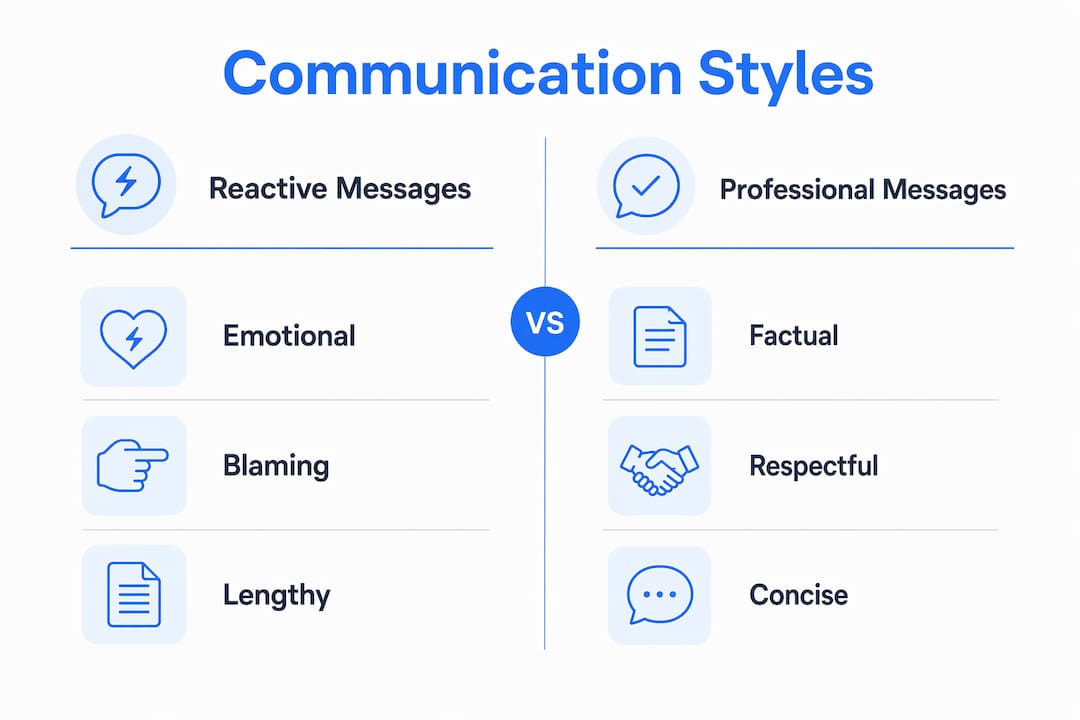
| Scenario | Reactive Message | Professional Message |
|---|---|---|
| Late pickup | "You're always late. This is disrespectful." | "Pickup was scheduled for 4 p.m. Please confirm your arrival time." |
| Schedule change request | "You can't just change plans whenever you feel like it." | "I received your request to adjust Saturday's schedule. I can confirm or decline by Thursday." |
| Child reports conflict | "You're putting ideas in their head again." | "Our child mentioned feeling upset after the last visit. Can we discuss this?" |
| Missed school event | "You never show up for them." | "The school concert was Tuesday at 6 p.m. Please check the shared calendar for upcoming events." |
Digital tools make this easier. OurFamilyWizard logs all messages and flags language that could be problematic. Replycalmly offers a response generator that produces calm, firm, and short variations of replies to difficult messages. These tools do not replace your judgment. They support it when emotions run high.
How do you handle provocations without losing professionalism?
Provocative messages are a test. The other parent may be trying to get an emotional reaction they can use against you. Your job is to recognize the bait and not take it.
Practical strategies for staying professional under pressure:
- Pause before you respond. Close the message and come back to it. A 24-hour wait is not weakness. It is strategy.
- Draft, then delete the emotional version. Write the angry reply you want to send, then delete it. You will feel better and you will not have sent anything damaging.
- Redirect to the child. If a message veers into personal attacks or old grievances, respond only to the child-related content. Ignore the rest entirely.
- Set boundaries through structure. Limit communication to one agreed channel, such as OurFamilyWizard or email. Decline to engage on platforms where tone cannot be monitored or recorded.
- Document everything. If a message is threatening or abusive, log it. A co-parenting evidence log creates a timestamped record that can support your case in court.
The hardest part of maintaining professional tone is accepting that you cannot control what the other parent does. You can only control your response. That is actually good news. Your communication record is entirely within your power to build, and courts read that record carefully.
Key takeaways
Professional tone in co-parenting is a legal and practical asset that reduces conflict, protects children, and builds a credible evidence record for custody proceedings.
| Point | Details |
|---|---|
| BIFF method is the standard | Keep messages Brief, Informative, Friendly, and Firm, targeting 2–5 sentences per exchange. |
| Tone shapes custody outcomes | Courts assess communication tone as evidence of a parent's commitment to the child's best interests. |
| Colleague Test reframes your mindset | Read every message as if sending it to a supervisor to strip out emotional language. |
| 24-hour rule reduces escalation | Waiting before replying to heated messages produces calmer, more court-friendly responses. |
| Digital tools reinforce consistency | Platforms like OurFamilyWizard and Replycalmly support professional tone when emotions are hardest to manage. |
The mindset shift that actually makes this work
I have seen a lot of co-parents try to maintain professional tone through sheer willpower, and most of them burn out within weeks. Willpower is not the answer. The mindset shift is.
The moment I started thinking about co-parenting communication as a business operation, everything changed. You are not writing to your ex. You are writing to a co-manager of your child's life. That reframing is not just a metaphor. It is a practical filter. Business partners do not send each other messages about who said what three years ago. They send updates, requests, and confirmations.
What I have found in practice is that the parents who struggle most with professional tone are the ones still trying to be heard emotionally through their messages. That is understandable. High-conflict situations often involve real injustice and real pain. But a co-parenting message is not the place to process that. Therapy, journaling, and trusted friends exist for that purpose.
The other thing I want to say directly: maintaining professional tone is not the same as being a pushover. You can be firm. You can decline requests. You can set hard limits on communication frequency and channel. Professionalism gives you more authority in those moments, not less. A calm, firm message carries far more weight than an angry one, both with your co-parent and with any judge who reads it later.
Persistence matters here. You will not get this right every time. The goal is a consistent pattern over time, not perfection in every exchange. Build the habit, use the tools, and give yourself credit for the messages you send well.
— Devin
How Replycalmly helps you communicate with confidence
High-conflict co-parenting puts your communication under a microscope. Every message you send can become evidence, and every reactive reply can cost you.
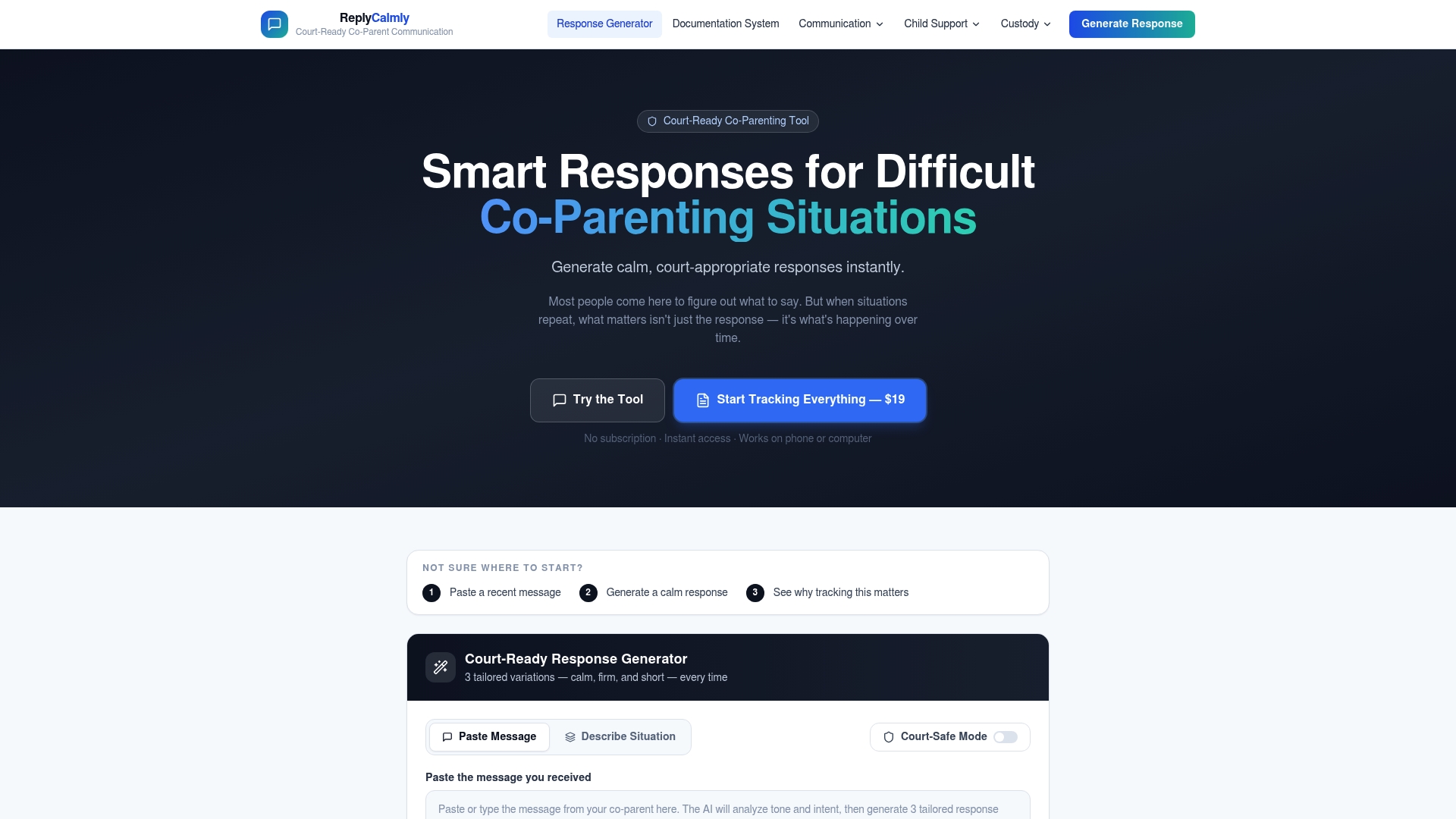
Replycalmly is built specifically for this situation. The platform's response generator takes a difficult message you have received and produces multiple professional reply options: calm, firm, and short. You choose the version that fits the moment. Replycalmly also integrates with tools like OurFamilyWizard and helps you log incidents with timestamps and categories. For co-parents who want to protect their record and stay within legal boundaries, the best co-parenting apps for documentation guide on Replycalmly is the right place to start.
FAQ
What is the BIFF method in co-parenting?
The BIFF method stands for Brief, Informative, Friendly, and Firm. It is the most widely recognized framework for maintaining a professional tone in co-parenting messages, with messages kept to 2–5 sentences to reduce conflict triggers.
How does tone affect a custody case?
Courts assess communication tone as evidence of a parent's ability to prioritize the child's best interests. Calm, factual, and cooperative messages strengthen your case, while hostile or emotional messages can work against you.
Do i have to be friendly to maintain a professional tone?
No. Respectful co-parenting communication requires self-control and clarity, not warmth or friendship. The goal is to be clear and brief, not to rebuild a personal relationship.
What should i do when my co-parent sends a provocative message?
Apply the 24-hour rule: wait before responding, draft a reply that addresses only child-related facts, and delete any emotional content before sending. Log the original message if it contains threats or abusive language.
What tools help maintain professional tone in co-parenting?
OurFamilyWizard monitors tone and flags problematic language before messages are sent. Replycalmly generates professional reply variations and tracks communication patterns over time, both of which support consistent, court-appropriate messaging.