
When a co-parent gaslights you, the most effective response is a short, factual message followed immediately by a timestamped entry in a chronological incident log. That combination, not an emotional rebuttal, is what family court actually evaluates. Tools like Replycalmly generate calm, firm, or brief replies on the spot, while court-mandated platforms like OurFamilyWizard create the timestamped, exportable record a judge can verify. Start both today, before the next message arrives.
Right now, send this: "I've noted your message. Per our parenting plan, [specific term]. I'll follow up in writing if anything changes." Screenshot it, save it to a secure folder, and open your incident log.
Key Takeaways
Responding to co-parent gaslighting requires a BIFF-style reply sent immediately, paired with a chronological incident log that ties every claim to a verifiable, exhibit-referenced record.
| Point | Details |
|---|---|
| Reply with BIFF 2.0 | Send a brief, factual, neutral message; avoid emotional language that undermines your credibility. |
| Preserve originals and metadata | Screenshot, export, and forward unaltered files to a secure account the same day. |
| Escalate when thresholds are met | Contact your attorney or call 911 for threats, repeated order violations, or parental alienation. |
| Label every exhibit | Use a consistent format (e.g., Exhibit 4: BIFF response, 2026-03-05) so your attorney can build a filing quickly. |
| Use Replycalmly | The free response generator and full documentation platform produce court-ready replies and exportable incident reports. |
Table of Contents
- How to respond to gaslighting: your first five steps
- Message templates that hold up in court
- Building a court-quality master incident log
- How to turn gaslighting incidents into court-useful evidence
- Legal cautions: recording laws, admissibility, and chain of custody
- When should you escalate to an attorney or emergency services?
- Replycalmly makes calm responses and court-ready records faster
- The Reply Calmly Team's perspective on what actually matters here
- Sources
How to respond to gaslighting: your first five steps
Safety comes before documentation. If a co-parent's behavior involves physical threats, take the children to a safe location and call 911 before anything else. Once you're safe, these steps protect your legal position.
-
Stop voice calls for disputed topics. Phone conversations leave no record and are easy to misrepresent. Switch to text, email, or a court-mandated app like OurFamilyWizard for anything related to schedules, finances, or the children's wellbeing. Limiting contact to written, timestamped channels is itself a court-ordered remedy in many parallel-parenting arrangements.
-
Screenshot before you reply. Capture the full message with the sender's name, timestamp, and platform visible. On iOS, a full-page screenshot preserves the thread. On Android, use a scrolling screenshot tool.
-
Export and forward originals. Email the screenshot to a dedicated, secure address you control (not a shared account). For app-based messages, use the platform's built-in export function so metadata stays intact.
-
Preserve everything unaltered. Do not delete, crop, or annotate originals. Courts treat altered files as compromised evidence. Keep a clean copy separate from any working copy you share with your attorney.
-
Record witness names immediately. If a third party (teacher, pediatrician, neighbor) witnessed an incident or received a communication, write down their full name and contact information the same day. Memory fades; a contemporaneous note does not.
Pro Tip: Set up a dedicated email address used only for custody documentation. Forward every screenshot and export there immediately after saving. The email timestamps create a second layer of authentication your attorney can cite.
Message templates that hold up in court
The BIFF 2.0 method (Brief, Informative, Friendly/Neutral, Firm and Factual) is the standard framework family law practitioners recommend for high-conflict co-parenting. A BIFF reply denies the other parent the emotional reaction they're looking for and creates a clean, factual record. Short neutral messages next to long inflammatory ones tell a story a judge can read at a glance.
Three scenarios with ready-to-adapt language:
-
Schedule dispute: "Per Section 4.2 of our parenting plan, [child's name]'s pickup is at 6:00 PM on Friday. I'll be at [location] at that time. Please confirm." Nothing more.
-
False claim about your parenting: "I understand you have concerns. My records show [specific date/event]. I'm happy to share documentation with our attorneys if needed."
-
Accusation about the child's wellbeing: "I take [child's name]'s wellbeing seriously. [Child] saw Dr. [Name] on [date]; the visit notes are available. Please direct any medical concerns through our agreed communication channel."
What not to say: Avoid "You always," "You never," "That's a lie," or any sentence that reads as an emotional response. Those phrases invite escalation and undermine your credibility on paper. Also avoid sarcasm, rhetorical questions, and anything that could be read as a threat.
Label every outgoing message before filing it: Exhibit 4: BIFF response to schedule dispute, 2026-03-05. That label makes your attorney's job faster and your exhibit list cleaner.
Pro Tip: Replycalmly's free co-parent response generator produces calm, firm, and brief variants for any message you paste in. Use it before you type a single word of your own reply.
Building a court-quality master incident log
Documentation is the single most important factor in a high-conflict custody case. Consistent, specific, contemporaneous records win credibility battles that emotional arguments lose. Your log needs to be organized so an attorney, judge, or custody evaluator can follow the pattern without asking you to explain it.
Each log entry should capture:
| Field | What to record |
|---|---|
| Date and time | Exact timestamp, including time zone |
| Channel | Text, email, OurFamilyWizard, voicemail, in-person |
| Quoted text | Copy the exact words; never paraphrase |
| Witness | Full name and contact info if applicable |
| Exhibit reference | e.g., Exhibit 7: Screenshot |
| Backup location | Cloud folder path or email thread link |
Organize your files into four category folders: Communications, Schedule Violations, Medical and School Records, and Financial. Cross-reference each log entry to its folder. When your attorney needs everything related to school pickup disputes, they pull one folder, not 200 mixed files.
For secure backup, use a private cloud account (Google Drive or iCloud with two-factor authentication) plus a local encrypted copy. Export your OurFamilyWizard or similar app logs monthly and store them in the Communications folder with the export date in the filename.
Pro Tip: Build a one-page evidence timeline summary: date, incident type, exhibit number, and a one-line description. Hand this to your attorney at the start of every meeting. It saves billable hours and keeps your case narrative clear.
How to turn gaslighting incidents into court-useful evidence
Courts expect gaslighting allegations to be tied to concrete facts, not labels. "My co-parent gaslights me" means nothing to a judge. "On March 5, 2026, co-parent claimed pickup was at 7:00 PM; the parenting plan (Exhibit 1, Section 4.2) states 6:00 PM; text message (Exhibit 3) confirms I arrived at 5:55 PM" is evidence.
Side-by-side comparison format:
- HCP claim: Quote the co-parent's exact statement with date and channel.
- Contemporaneous record: Cite the document that contradicts it (parenting plan section, medical record, school email) with its exhibit number.
- Authentication method: State how the record was preserved (OurFamilyWizard export, email forward with metadata, school letterhead).
Build this comparison for every significant incident over a few months of consistent documentation. A single contradiction looks like a misunderstanding. Six contradictions across three categories look like a pattern, which is what a custody journal with cross-referenced exhibits is designed to demonstrate.
Corroborating documents that carry significant weight: school attendance records, pediatric visit notes, pharmacy fill dates, daycare check-in logs, and witness statements from teachers or coaches. Each one anchors a log entry to an independent source.
Legal cautions: recording laws, admissibility, and chain of custody
-
Recording consent laws vary by state. The United States has a mix of one-party and two-party (all-party) consent states. In a two-party consent state, recording a phone call without the other person's knowledge is a criminal offense. Check your state's law with an attorney before recording any audio. Text messages and emails you are a party to are generally safe to preserve without consent issues, but audio is a different matter.
-
Contemporaneous entries carry more weight. A journal entry written the same day as an incident is far more credible than one reconstructed weeks later. Date and time-stamp every entry at the moment you write it.
-
Maintain originals and chain of custody. Never submit a screenshot you've edited, even to add a highlight. Judges and opposing counsel look for metadata inconsistencies. Export files directly from the source platform when possible.
-
Co-parenting apps produce court-ready exports. OurFamilyWizard and similar platforms generate timestamped, uneditable logs that courts and evaluators accept as authenticated records. If your court has ordered a specific platform, use it for all substantive communication.
-
Expert witnesses can translate patterns into testimony. Forensic psychologists and custody evaluators can review your documentation and provide expert testimony that contextualizes a pattern of coercive control for the court. Their reports move your case from "he said / she said" to professional assessment.
Family law practitioners note that the most dangerous form of co-parent gaslighting is influencing professionals (evaluators, GALs, school counselors) before you've established a documented record. Starting your log on day one is the primary defense against that tactic.
When should you escalate to an attorney or emergency services?
Some situations require immediate professional intervention, not more documentation.
Call 911 or seek emergency protective orders when: there are threats of physical harm, a co-parent has taken the children outside court-ordered jurisdiction, or a child reports abuse.
Contact your attorney immediately when: you receive false police reports filed against you, the co-parent violates a court order more than twice in a 30-day window, or you have documented evidence of parental alienation affecting the child's relationship with you.
Request a court hearing or modification when: a sustained pattern (3–6 months of documented incidents) shows the current order isn't working, or a co-parent repeatedly ignores written communication and uses verbal-only contact to avoid a paper trail.
Seek a custody evaluation when: the pattern suggests coercive control that a judge would benefit from having a professional assess. Ask your attorney about requesting a forensic evaluation or a guardian ad litem.
Pro Tip: Review your documentation with your attorney before filing any motion. A well-organized exhibit package, not just a stack of screenshots, is what moves a hearing forward.
Replycalmly makes calm responses and court-ready records faster
High-conflict co-parenting is exhausting, and the last thing you need is to spend 45 minutes drafting a reply that accidentally sounds reactive. Replycalmly cuts that time down to seconds.
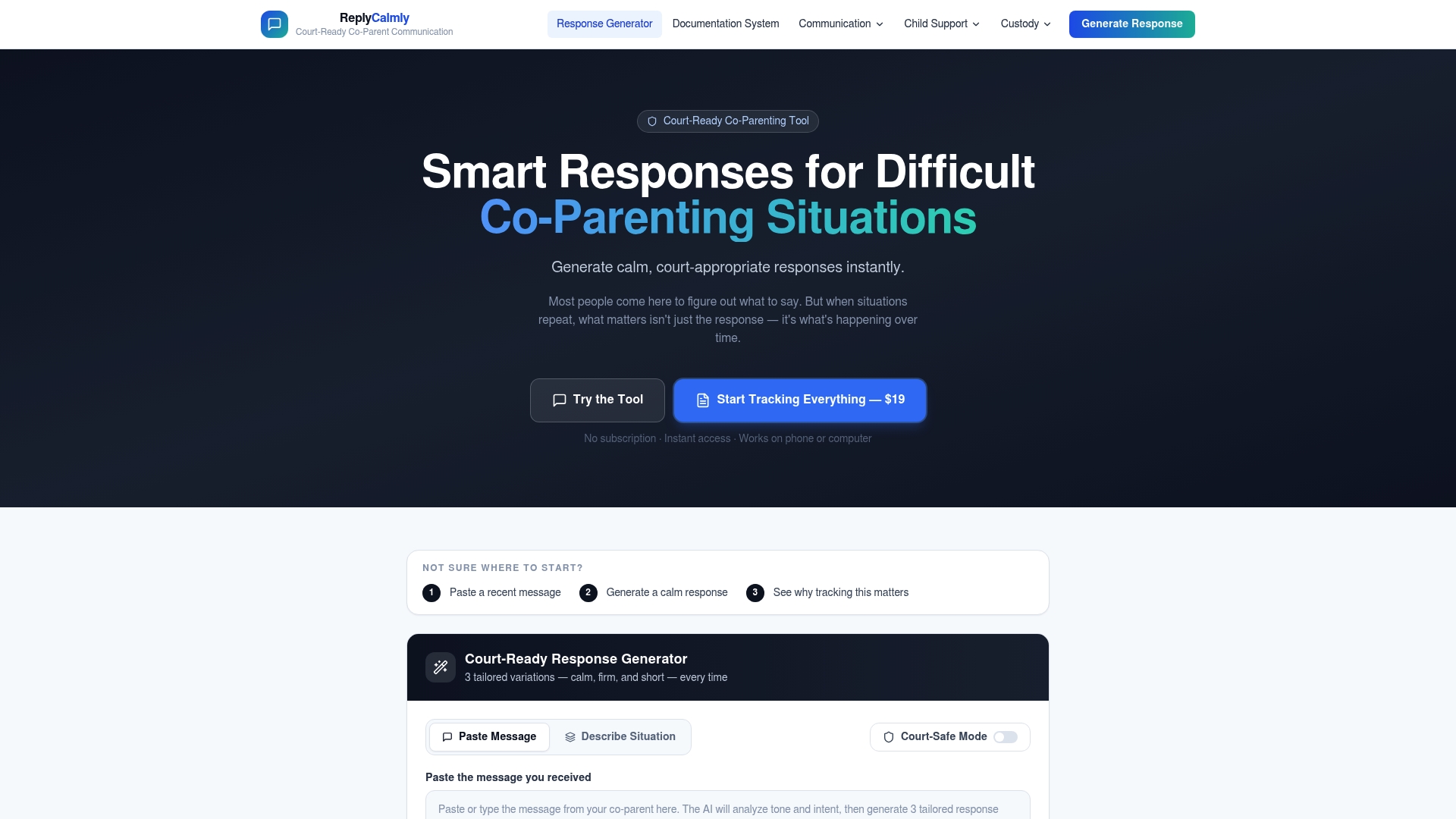
Paste any message into the free response generator and get calm, firm, and brief variants instantly, each written to stay within court-appropriate language. The full platform adds an incident tracker with category tagging, evidence attachment, pattern dashboards, and exportable reports your attorney can use directly. It integrates with OurFamilyWizard so your existing court-mandated record stays intact. Plans start at $19/month after a 3-day free trial. Try the free generator now, no account required, and see the difference a BIFF-style reply makes before you send another word.
The Reply Calmly Team's perspective on what actually matters here
Most co-parents in high-conflict situations focus on being believed. The court's actual question is different: can you prove it? That shift in framing changes everything about how you should spend your energy.
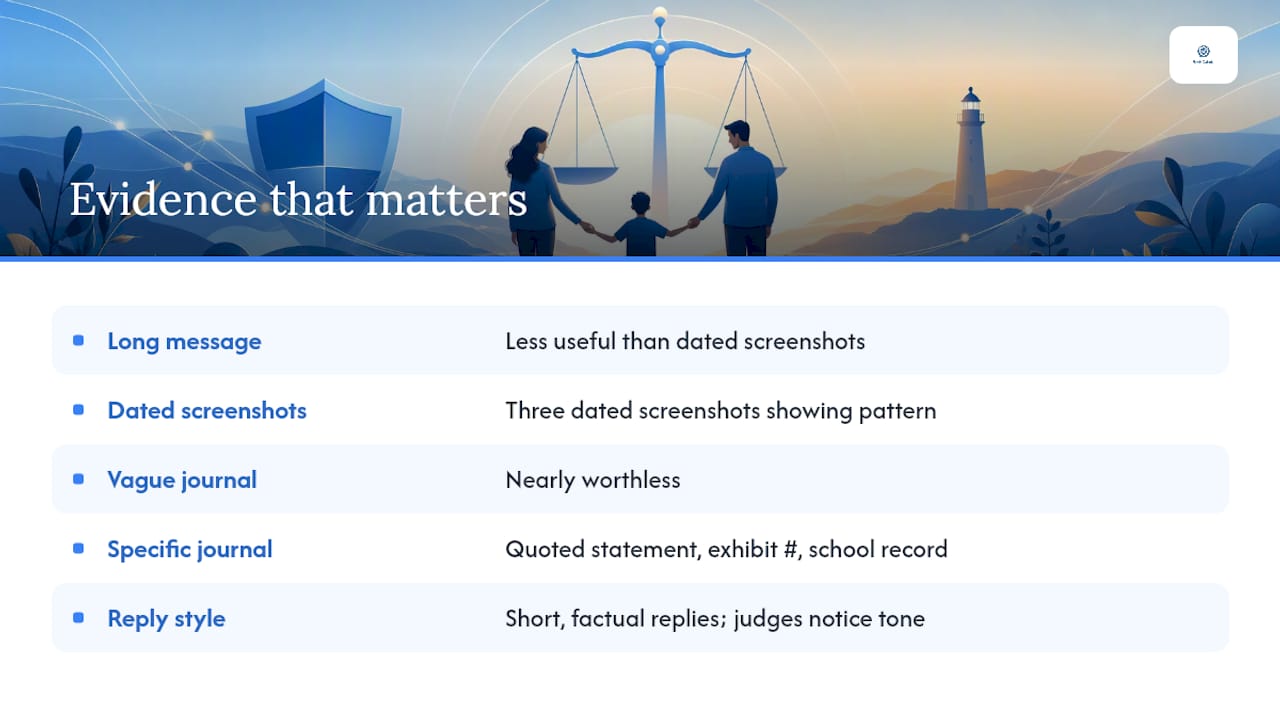
A long, emotional message explaining how the other parent manipulates you is less useful than three dated screenshots showing the same pattern three times. A vague journal entry ("co-parent was difficult again") is nearly worthless. A specific entry with a quoted statement, an exhibit number, and a cross-referenced school record is the kind of material that moves a hearing.
The other thing practitioners consistently underestimate: the contrast between your communication style and the other parent's. Short, factual, neutral replies next to long, accusatory messages tell a story without you having to narrate it. Judges read communication exhibits. They notice tone. Replycalmly's response generator exists precisely because writing that kind of reply under stress, when you're angry or scared, is genuinely hard. The tool removes the emotional variable so the record reflects your best judgment, not your worst moment.
Test the free generator before your next reply. Then talk to your attorney about what you've documented so far.
This article is general information, not a substitute for advice from a qualified lawyer. Consult a qualified legal professional about your own circumstances before acting on anything here.
Sources
- How to Document Everything in a High-Conflict Custody Case — The Complete System | Carl Knickerbocker Law
- Law
- Custody journal for court: what to track, how to format & what judges want - Co-Parenting Guide
- Gaslighting in Divorce: Signs, Evidence, and Court Strategy - LegalClarity