
When you're accused of parental alienation, the first 72 hours matter most. Stay calm, document everything, contact your attorney, and reply in writing using neutral language. That sequence protects your credibility, preserves evidence, and keeps the child's wellbeing front and center.
Here is what to do right now:
- Preserve originals. Screenshot or export every text, email, and app message related to the accusation. Save them with timestamps intact.
- Do not argue back. A heated reply hands the other parent exactly what they need. One calm, factual written response is worth more than ten defensive ones.
- Call your attorney today. Even a brief call lets counsel flag risks before you respond publicly or in court filings.
- Note witnesses. Write down who was present, who received messages, and who can corroborate your account. Include dates and locations.
- Keep a log. Start a running incident record: date, time, what happened, what was said, and any evidence attached.
Pro Tip: A single calm, written reply to an accusation does double duty. It creates a timestamped record of your measured tone and simultaneously undercuts any claim that you are hostile or uncooperative. Courts notice the difference between a parent who escalates and one who documents.
Key Takeaways
A calm, documented, attorney-connected response is the most effective defense against parental alienation accusations in U.S. family court.
| Point | Details |
|---|---|
| Act in the first 72 hours | Preserve communications, start an incident log, and call your attorney before responding publicly. |
| Documentation beats testimony | Contemporaneous records, third-party reports, and timestamped exports carry more weight than retrospective accounts. |
| Neutral written replies protect you | Short, factual responses to the other parent create evidence of cooperation and undercut hostility claims. |
| Involve professionals strategically | Request a court-ordered evaluation or guardian ad litem when accusations are patterned or escalating. |
| Replycalmly supports the workflow | The free response generator and subscription incident tracker help you document and reply consistently from day one. |
Table of Contents
- What parental alienation actually means, and why courts treat it carefully
- How U.S. family courts evaluate alienation claims and what evidence they want
- Step-by-step defense against parental alienation accusations
- How to build a court-ready documentation timeline
- How to talk to your child and reply to the other parent after an accusation
- Which professionals to involve and when to ask the court for help
- Tools and resources that help you stay calm and build your record
- What courts typically do next and how to prepare for each outcome
- What we've learned helping parents through high-conflict custody disputes
- Replycalmly gives you the tools to document and respond without the guesswork
- Sources
What parental alienation actually means, and why courts treat it carefully
Parental alienation, in custody contexts, refers to a pattern in which one parent allegedly undermines the child's relationship with the other parent. That can include badmouthing, limiting contact, coaching the child to make false statements, or presenting a one-sided narrative that causes the child to reject or fear the other parent without a legitimate reason.
Common behaviors courts and litigants label as alienating include:
- Repeatedly canceling or obstructing scheduled parenting time
- Making negative comments about the other parent in front of the child
- Intercepting phone calls or messages between the child and the other parent
- Coaching the child on what to say to evaluators or attorneys
- Telling the child the other parent does not love them or is dangerous
The label carries real legal weight, but it is also genuinely contested. ProPublica's reporting documents that parental alienation lacks strong scientific consensus and that some human-rights organizations have recommended restricting its use in family courts, partly because the concept has been used to dismiss legitimate abuse allegations. A California courts research review similarly warns that the term should not short-circuit independent investigation of abuse claims.
Understanding that controversy matters strategically. If you are accused, the label does not automatically stick. Courts are expected to investigate the full picture, and a well-documented record of your own conduct is your strongest asset.
How U.S. family courts evaluate alienation claims and what evidence they want
A single accusation rarely changes a custody arrangement. Jurisdictional practice confirms that judges look at the full pattern of behavior and documentary evidence, not just the allegation itself. That pattern is built from multiple evidence types, and courts give the most weight to neutral, third-party records.
The evidence categories judges and forensic evaluators find most persuasive:
| Evidence Type | What It Shows | How to Obtain |
|---|---|---|
| Communication logs (texts, emails, app exports) | Tone, frequency, cooperation or obstruction | Export from phone, email client, or co-parenting app |
| School and medical records | Who attends appointments, who communicates with providers | Request directly from school/provider |
| Third-party witness statements | Neutral corroboration of events | Written declarations from teachers, coaches, neighbors |
| Forensic/custody evaluator reports | Professional assessment of parenting and child wellbeing | Court-ordered or privately retained |
| Parenting time logs | Compliance with or violations of the custody order | Your own dated records, corroborated where possible |
| Social media and digital exports | Statements made publicly about the other parent | Screenshots with metadata preserved |
State courts vary in how much weight they assign to each category. Some jurisdictions rely heavily on guardian ad litem reports; others defer to forensic psychologists. What stays consistent across states is the preference for contemporaneous records over retrospective testimony. A note you wrote the day an incident happened carries more credibility than a memory you reconstruct six months later.
Courts also require that abuse allegations be independently investigated rather than dismissed as alienation. That cuts both ways: if you are accused, the court should not simply accept the label, but it will scrutinize your conduct carefully.
Step-by-step defense against parental alienation accusations
A strong defense is built in phases. Here is a sequenced plan you can follow immediately and develop over time with your attorney.
Immediate (first 72 hours)
- Preserve all communications. Export texts, emails, and co-parenting app messages before anything is deleted or altered. Store copies in at least two locations.
- Write a neutral, brief written reply. Acknowledge receipt, state your position calmly, and avoid emotional language. One or two sentences is enough.
- Call your attorney and be fully transparent. Full disclosure to counsel is non-negotiable. Hiding facts gives the other side material to use against you later.
- Start your incident log. Date, time, what was said or done, who was present, what evidence exists.
Short-term (first two weeks)
- Request a neutral evaluation if the accusations are serious. A court-ordered custody evaluation or parenting coordinator can shift the focus from allegations to documented behavior.
- Gather third-party records. Contact your child's school, pediatrician, and any therapists. Request records showing your involvement and communication.
- Identify neutral witnesses. Teachers, coaches, neighbors, or family members who have observed your parenting can provide declarations.
Medium-term (one to three months)
- Build a documented timeline. Organize incidents chronologically with evidence file names attached to each entry.
- Demonstrate compliance with court orders. Every time you follow the parenting plan precisely, document it. Courts notice consistent compliance.
Long-term (ongoing)
- Present records strategically with counsel. Your attorney decides what goes before the court and when. Your job is to have the records ready and organized.
What not to do:
- Do not retaliate with counter-accusations unless you have documented evidence.
- Avoid social media posts about the dispute entirely.
- Do not try to "win" the child's loyalty. It backfires in evaluations and in court.
- Do not coach the child on what to say to evaluators or attorneys.
Pro Tip: Before your first evaluator meeting, write a one-page summary of your parenting involvement: school pickups, medical appointments attended, activities supported. Evaluators ask about specifics. A parent who can name the child's teacher, pediatrician, and best friend reads as engaged. A parent who cannot remember details reads as absent.
How to build a court-ready documentation timeline
Documentation is only useful if it is organized, timestamped, and exportable. A pile of screenshots is not a record. A structured timeline with attached evidence files is.
Sample timeline format
Each entry in your log should capture:
- Date and time of the incident
- Source (text message, email, in-person, phone call)
- Evidence file name (e.g., "2026-03-14_text_exchange_screenshot.png")
- Witnesses present (names and relationship)
- Impact notes (how it affected parenting time, the child's behavior, or court compliance)
Document types and how to export them
| Document Type | Export Method | Authentication Notes |
|---|---|---|
| Text messages | Full-thread screenshot or PDF export; include phone number and date headers | Keep the original device; do not edit or crop |
| Emails | Export as .eml or PDF with full headers showing sender, recipient, timestamp | Forward to a dedicated evidence email address |
| Co-parenting app logs | Use the app's built-in export function (PDF or CSV) | App-generated exports carry built-in metadata |
| Social media posts | Screenshot with URL visible; use web archive tools for public posts | Capture before deletion; note the date captured |
| Voice recordings | Check your state's recording consent laws first; save as original file with device timestamp | One-party consent states allow recording your own calls |
| School/medical records | Request in writing; keep the request letter and the response | Provider letterhead adds authentication weight |
Chain of custody matters for admissibility. Store originals on a device you control, back them up to encrypted cloud storage, and never alter a file after saving it. If you share records with your attorney, send copies, not originals.
Pro Tip: Replycalmly's parental alienation documentation tools let you log incidents with category tags, attach evidence files, and export a formatted timeline report. This report is designed to be shared directly with counsel, which saves hours of manual organization.
For a detailed export checklist, Replycalmly's guide on how to document parental alienation for court walks through each step.
How to talk to your child and reply to the other parent after an accusation
These two conversations require completely different approaches, and confusing them is one of the most common mistakes parents make under pressure.
Talking to your child
When a child repeats an accusation, the instinct is to correct the record. Resist it. Therapist guidance published in Psychology Today recommends "connect, don't correct": validate the child's feelings without confirming the false narrative.
Directly contradicting a child ("You know that's not true!") often reinforces the belief and damages your relationship. Instead:
- "I hear that you're upset. I love you and I'm here."
- "That sounds really hard. Can you tell me more about how you're feeling?"
- "I'm not going anywhere. We can talk about anything."
For older children, you can gently offer your perspective once, without pressure: "I remember that day differently, and I'd love to share that with you when you're ready." Then drop it. Courts and evaluators view a parent who pressures a child to change their story very poorly.
Replying to the other parent in writing
Written replies to the other parent should be short, neutral, and factual. Every word is potentially exhibit A.
Do:
- Acknowledge the message without agreeing with the accusation
- State your position in one or two sentences
- Keep the focus on the child's schedule and wellbeing
- Use a co-parenting app or email so the record is preserved automatically
Don't:
- Respond emotionally or defensively
- Use sarcasm, threats, or ultimatums
- Ask the child to relay messages
- Respond on social media
Sample neutral reply to a written accusation:
"I received your message. I disagree with the characterization of my parenting. I remain committed to following our parenting plan and to supporting [child's name]'s relationship with both parents. Please direct any further concerns to our attorneys."
For more scripted options across different scenarios, Replycalmly's neutral response templates cover text, email, and in-person confrontation formats.
Which professionals to involve and when to ask the court for help
Not every accusation requires a full legal response. But certain patterns signal that professional involvement is necessary.
The professionals and what they actually do
Family law attorney. Your first call. An attorney reviews the accusation, advises on immediate steps, and decides whether to file a motion or wait. Full transparency with counsel is the single most important strategic move you can make.
Forensic psychologist or custody evaluator. Conducts a structured assessment of both parents and the child, reviews records, and submits a report to the court. Their conclusions carry significant weight. Because evaluator conclusions can hinge on their training and predispositions, a strong contemporaneous documentary record often matters more than retrospective testimony alone.
Child therapist. Provides the child with a neutral space to process the conflict. A therapist's notes, if subpoenaed, can corroborate or contradict claims about the child's emotional state. Choose a therapist who has no prior relationship with either parent.
Guardian ad litem (GAL) or attorney for the child. Appointed by the court to represent the child's interests independently. A GAL interviews the child, reviews records, and makes recommendations to the judge. Requesting a GAL appointment can be a strong defensive move when accusations are escalating.
Parenting coordinator. A neutral professional who helps parents resolve day-to-day disputes outside of court. Their records of interactions and agreements can become part of the court record.
Red flags that usually justify requesting a court-ordered evaluation
- The other parent is consistently limiting your contact without a court-approved reason
- The child's statements about you change dramatically after visits with the other parent
- Neutral sources (school, therapist, pediatrician) are giving conflicting accounts
- The other parent has filed multiple motions based on unsubstantiated claims
Pro Tip: Before meeting with any evaluator, ask your attorney which specific concerns the evaluator has been asked to address. Evaluators are human; they arrive with frameworks shaped by their training. Knowing their focus lets you prepare relevant documentation rather than guessing what they want to see.
Typical custody evaluation timelines often run several months, and costs vary widely by jurisdiction and evaluator, generally ranging from thousands to more for comprehensive assessments. Your attorney can give you a realistic range for your state.
Tools and resources that help you stay calm and build your record
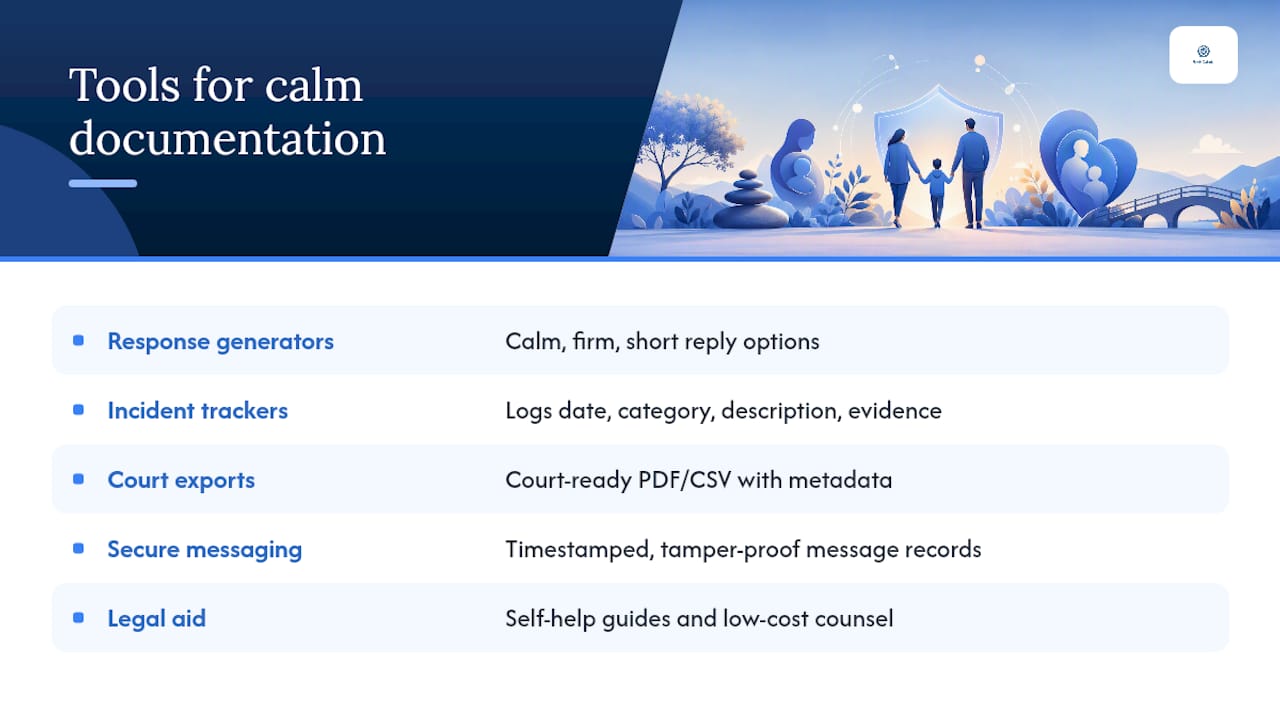
The right tools reduce the chance of a reactive reply and make documentation consistent enough to hold up in court.
Response generators. Tools that produce multiple neutral reply options from a message you paste in. Replycalmly's free co-parent response generator gives you calm, firm, and short variations so you can choose the tone that fits the situation without writing from scratch under stress.
Incident trackers. Structured logs that capture date, category, description, and attached evidence. Replycalmly's tracker tags incidents by type (custody conflict, false accusation, decree violation) and visualizes patterns over time, which is exactly what a forensic evaluator or attorney needs to see a behavioral pattern rather than a list of complaints.
Court-certified export tools. Some co-parenting platforms generate PDF or CSV exports with metadata intact. Replycalmly's report export is designed to be shared directly with counsel or submitted as a court exhibit, reducing the manual work of compiling records.
Secure messaging and co-parenting apps. Platforms like OurFamilyWizard create a timestamped, unalterable record of every message. Replycalmly integrates with existing court-mandated communication tools rather than replacing them, so your documentation layer sits on top of whatever platform the court has already approved.
Legal aid and self-help resources. Many state court websites publish self-help guides for family law matters. The American Bar Association's family law section and local legal aid organizations can connect you with low-cost counsel if cost is a barrier.
High-conflict custody disputes generate a volume of communications that is genuinely hard to track manually. Parents who document consistently from the start of a dispute are far better positioned when a case reaches a hearing than those who try to reconstruct events after the fact.
What courts typically do next and how to prepare for each outcome
Courts respond to parental alienation accusations along a spectrum, and the outcome depends heavily on the evidence presented and the pattern of behavior both parents demonstrate after the allegation.
| Likely Outcome | What Triggers It | Your Next Step |
|---|---|---|
| No immediate action | Single accusation, no corroborating evidence, no pattern | Continue documenting; demonstrate consistent compliance with the parenting plan |
| Court-ordered evaluation | Pattern of allegations, conflicting accounts, child's stated distress | Cooperate fully; prepare your documentation file for the evaluator |
| Parenting time modification (temporary) | Evidence of obstruction or harm to the child's relationship | Document every parenting exchange; comply precisely with the new order |
| Supervised visitation | Court finds credible risk to the child | Follow all supervision requirements; build a record of appropriate conduct |
| Sanctions for false allegations | Documented pattern of fabricated claims | Work with counsel to present the evidence; courts rarely sanction without clear proof |
Timeframes vary. A motion for an emergency order can be heard within days. A full custody evaluation takes months. A final hearing after a contested modification can take a year or more in some jurisdictions. Jurisdictional practice confirms that an accusation alone rarely decides custody; the full pattern of behavior after the allegation matters as much as the allegation itself.
If the court orders an evaluation, cooperate without reservation and bring your documentation file. If a temporary order changes your parenting time, comply precisely and document every exchange. Resistance to court orders, even orders you believe are unjust, damages your credibility far more than the original accusation.
If false statements have been distributed to third parties (employers, extended family, community members), the NYC Bar's guidance on defamation notes that truth is an absolute defense and that acting quickly to document publication matters. Civil defamation remedies are separate from custody proceedings, but your attorney can advise whether both tracks are worth pursuing simultaneously.
What we've learned helping parents through high-conflict custody disputes
The parents who come out of these disputes with their credibility and their relationships intact share one habit: they document before they need to. Not reactively, not after the first hearing, but from the moment the conflict becomes patterned. The ones who scramble to reconstruct a timeline six months later are always at a disadvantage, no matter how strong their underlying case.
The second thing we've noticed is how much a single poorly worded message can cost. A parent who has behaved impeccably for months can hand the other side a usable exhibit with one frustrated reply sent at midnight. The solution is not to go silent. It is to have a process: draft, pause, review, send. That process is exactly what a response generator is designed to support.
The advice in this article is consistent: stay calm, document everything, consult your attorney, and keep the child's wellbeing at the center of every decision. That is not a passive strategy. It is the most aggressive defense available in a family court context, because it builds a record that speaks for itself.
Replycalmly gives you the tools to document and respond without the guesswork
When you're in the middle of a high-conflict custody dispute, the gap between knowing what to do and actually doing it calmly at 10 PM on a Tuesday is real. Replycalmly closes that gap.
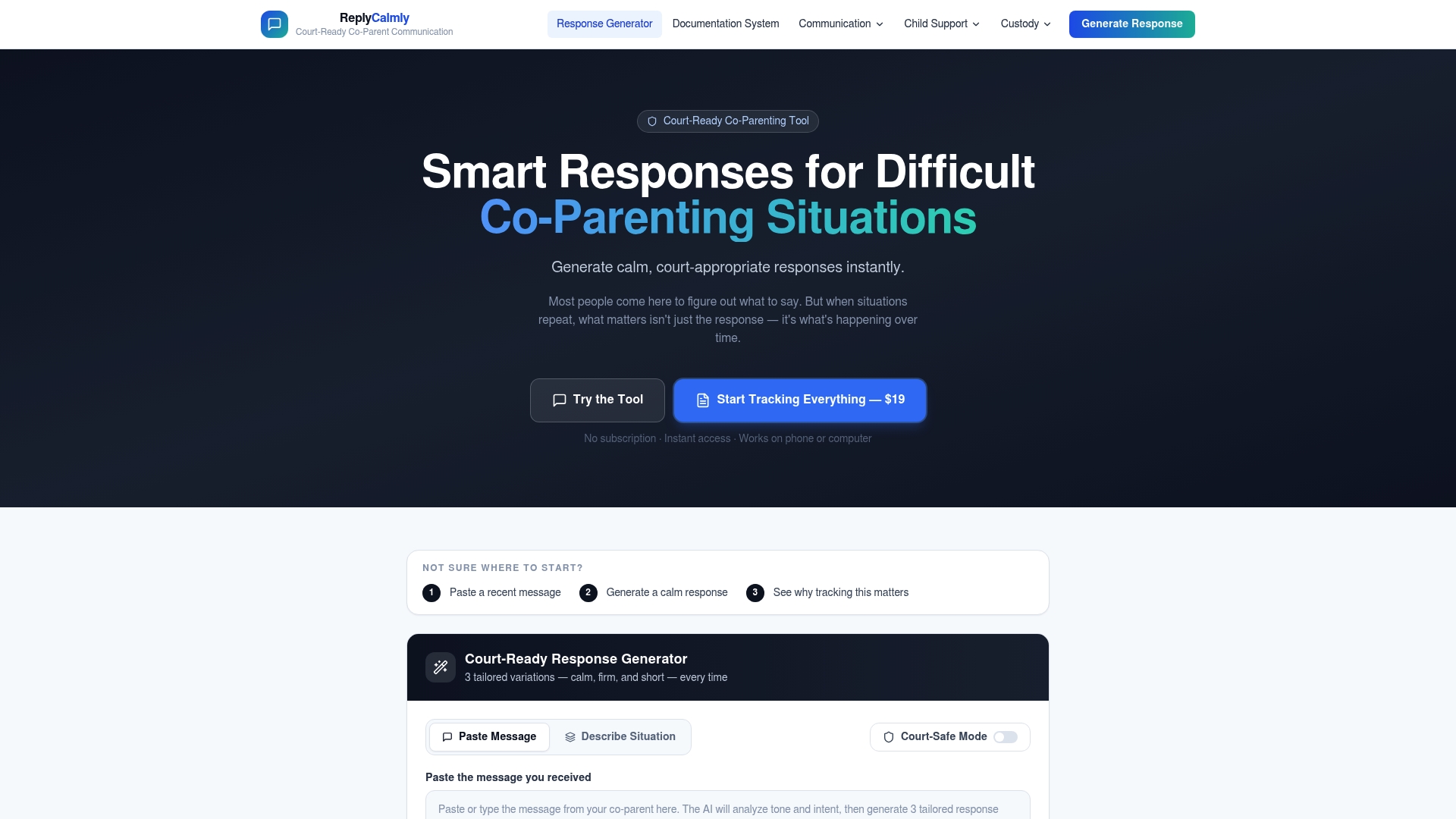
The free co-parent response generator lets you paste any message and get calm, firm, or short reply options instantly. No subscription needed to start. The full platform adds incident tracking with category tags, evidence attachments, pattern dashboards, and court-ready report exports at $19/month after a 3-day free trial. Every feature maps directly to the documentation steps in this article: log the incident, attach the evidence, export the report, share it with your attorney.
Replycalmly also integrates with OurFamilyWizard and other court-mandated platforms, so it adds a documentation layer without disrupting whatever system the court has already approved. Try the free generator today, or start your trial at Replycalmly.
This article is general information, not legal advice. Consult a licensed family law attorney for guidance specific to your case and jurisdiction.
Sources
The following sources were used to build this article and are worth sharing with your attorney or reviewing for deeper reading.
- Parental alienation and its use in family court
- How to disprove parental alienation allegations
- Parental alienation syndrome and parental alienation: a research review
- How targeted parents should respond to unfair accusations
- How To Fight Parental Alienation Accusations in NJ
- False Accusations—Defamation of Character by Libel or Slander
This article is general information, not a substitute for advice from a qualified lawyer. Consult a qualified legal professional about your own circumstances before acting on anything here.