
Every message you send to your co-parent is a potential exhibit in your case. That reality changes everything. The moment a judge reads your communication thread, the tone, word choices, and emotional temperature of your messages will shape their impression of you as a parent. As "write as if a judge will read it" has become a foundational rule for court-appropriate communication, knowing exactly how to phrase difficult responses is no longer optional. It is essential. This article gives you practical examples, proven frameworks, and a comparison guide to help you respond effectively, every time.
Table of Contents
- Understand what makes a response court-appropriate
- The BIFF model: Neutral templates for high-conflict scenarios
- Court-appropriate response examples for common custody disputes
- Comparison: Effective versus non-court-appropriate responses
- How to choose the right response for your custody situation
- Why emotionally neutral responses matter more than you think
- Need help crafting your next court-appropriate response?
- Frequently asked questions
Key Takeaways
| Point | Details |
|---|---|
| Stay neutral and factual | Always use calm, fact-based language in every co-parenting interaction. |
| Use structured templates | Rely on frameworks like BIFF to keep responses concise, informative, and court-ready. |
| Personalize your approach | Adapt each example to fit the details of your dispute and your child’s needs. |
| Avoid improper channels | Never communicate with the court directly outside formal submissions. |
| Prioritize your child’s wellbeing | Neutral communication helps reduce harmful conflict and protects your child emotionally. |
Understand what makes a response court-appropriate
Before looking at specific examples, it helps to understand what "court-appropriate" actually means in practice. The standard is not just about being polite. It is about producing communication that a neutral third party, like a judge or a guardian ad litem, would read and find reasonable, focused, and professional.
A court-appropriate response has three non-negotiable qualities. First, it is driven by facts and solutions, not emotions. Second, it uses proper channels when formal legal action is needed. Third, it avoids any language that could signal instability or bad faith.
Here is what to include and exclude:
- Include: Specific dates, times, and logistics. Proposed solutions. Neutral acknowledgment of the other parent's concern.
- Exclude: Threats, insults, guilt-tripping, and emotionally loaded language. Personal grievances unrelated to the child. Sarcasm or passive-aggressive phrasing.
- Include: Requests that are clear and specific.
- Exclude: Vague ultimatums or threats of legal action used as intimidation.
One area that trips up many co-parents is the question of contacting the court directly. Proper communication with the court follows strict protocols. Court-appropriate boundaries include avoiding any attempt at improper private communication with a judge or court staff. If you have something to say that affects your case, it must be formally filed, not emailed to chambers. That rule is absolute.
Pro Tip: Before sending any message, read it out loud as if you are a judge hearing it for the first time. If it sounds defensive, bitter, or off-topic, rewrite it. You can find legally acceptable response guidance to help you check your tone.
The BIFF model: Neutral templates for high-conflict scenarios
One of the most practical tools in high-conflict co-parenting communication is the BIFF model. BIFF stands for Brief, Informative, Friendly, and Firm. It was developed specifically for situations where one parent wants to provoke, manipulate, or escalate through their messages. BIFF guidance and sample wording help keep responses factual and legally sound.
Here is how each element works in practice:
- Brief: Keep your message short. The longer you write, the more you risk including emotional content. Aim for three to five sentences when possible.
- Informative: Every sentence should carry useful content, such as dates, times, logistics, or a direct answer to a factual question.
- Friendly: This does not mean warm or personal. It means civil and professional, avoiding sarcasm, condescension, or hostility.
- Firm: You are allowed to state your position clearly. Firm does not mean aggressive. It means clear and without apology.
Consider this scenario. Your co-parent sends a long, accusatory message blaming you for a missed pickup. Here is a BIFF response:
"I received your message. Based on our agreement, pickup is scheduled for Saturdays at 10 a.m. at the agreed address. I was present at that time and location. Please let me know if you would like to confirm pickup arrangements for next week."
Notice what is missing. There is no defense of your character. There is no reference to past conflicts. There is no emotional reaction. That is exactly the point. Structured, low-emotion communication protects children from the harmful effects of ongoing parental conflict, which courts take very seriously.
Pro Tip: Try writing your first draft without the BIFF filter, then go back and remove every sentence that does not directly help solve the problem at hand. What remains is usually your real message. You can also browse smart BIFF response examples to see how the model applies to dozens of real custody scenarios.
Court-appropriate response examples for common custody disputes
Now it is time to look at real-world templates. Sample template patterns for common custody disputes give you a starting point that you can adapt to your specific situation. The following table organizes the most frequent dispute types with example language.
| Dispute type | Situation | Sample response language |
|---|---|---|
| Schedule change request | Co-parent asks to swap weekends | "I can accommodate a swap on [date]. Please confirm by [deadline] so I can plan accordingly." |
| Last-minute cancellation | Co-parent cancels day before pickup | "I noted your cancellation for [date]. I will keep [child's name] available for the next scheduled visit on [date]." |
| Request for documentation | School or medical records asked for | "I will forward [child's name]'s most recent [records] within 48 hours. Please confirm your preferred contact." |
| Parenting style disagreement | Co-parent objects to your household rules | "I appreciate you sharing your perspective. Decisions within each household are addressed in our parenting plan. I am committed to following our agreement." |
A few notes on using these templates effectively:
- Always use the child's name, not pronouns like "him" or "her." It keeps the message centered on the child, not on your conflict.
- Set clear deadlines for responses. This protects you if the issue later becomes a court matter.
- Never respond when you are angry. Write your draft, save it, and return in an hour. Sample co-parenting responses from structured tools can bridge the gap when emotions run high.
- Confirm the facts before you respond. If a schedule is disputed, reference the actual parenting plan document.
Pro Tip: Keep a saved folder of your sent messages that follow these templates. If you ever need to demonstrate consistent, good-faith communication in court, that record will speak for itself.
Comparison: Effective versus non-court-appropriate responses
Understanding the difference between an effective and a problematic response is easier when you see them side by side. Small changes in phrasing carry major legal weight. Examples of appropriate versus inappropriate language highlight the risk of emotional escalation and potential ex parte concerns when a parent attempts to influence proceedings outside proper channels.
| Scenario | Non-court-appropriate response | Court-appropriate response |
|---|---|---|
| Co-parent is consistently late for pickup | "You are always late. This is ridiculous and proves you do not care about our child." | "Pickup has been delayed on [dates]. Per our agreement, pickup is at [time]. Please confirm your availability for the next scheduled time." |
| Co-parent disputes a medical decision | "You have no right to question my parenting. You were never involved." | "I made this medical decision following guidance from [child's] pediatrician. I am happy to share the documentation." |
| Co-parent threatens to take more time | "Try it. I will make sure the judge sees everything you have done." | "I am committed to following our current parenting plan. For any proposed modifications, please consult your attorney." |
| False accusation in a message | "You are a liar and everyone knows it." | "This is factually inaccurate. My records reflect [specific facts]. I will address this through proper legal channels if needed." |
What makes the court-appropriate column stronger is not just polite tone. It is composing effective co-parenting replies that keep the focus on facts, logistics, and the child. Every non-appropriate example either attacks the other parent's character, makes a threat, or expresses frustration that has nothing to do with solving the problem.
Three characteristics of problematic messages that you should watch for in your own drafts:
- Accusatory language: Any sentence that starts with "You always" or "You never" is a red flag.
- Threats of legal action as intimidation: Referencing lawyers or court in a threatening tone undermines your credibility.
- Irrelevant history: Bringing up events from months or years ago signals emotional reactivity, not problem-solving.
How to choose the right response for your custody situation
Having a reference bank of templates is only useful if you know how to choose the right one for your situation. The decision is not random. It follows a logical process that any parent in a high-stakes situation can use.
Here is a practical decision framework:
- Identify the core issue. Strip out any emotional content from the message you received and ask: what is the actual request or complaint? Most messages in high-conflict co-parenting contain emotion layered over a basic logistical question.
- Assess the urgency. Does this require a same-day response, or do you have 24 to 48 hours? Urgency affects your word choice. A genuinely urgent medical situation calls for a different tone than a routine schedule disagreement.
- Choose your tone level. Based on the situation, decide whether your response should be calm and brief, firm and clear, or informative with supporting documentation.
- Adapt the template to your facts. Never copy a template word for word. Insert specific dates, names, and references to your actual parenting plan. A vague response can be just as problematic as an emotional one.
- Know when to escalate through formal channels. If a message contains threats, repeated violations of the parenting plan, or concerns about child safety, your response may not be a direct reply at all. Substantive communications should use proper filing channels rather than a text or email that could be misconstrued.
Pro Tip: Create a simple checklist you run through before hitting send. Does this message contain only facts? Is it focused on the child? Would I be comfortable if a judge read this? If any answer is no, revise before sending.
The highest-conflict situations often involve a co-parent who is deliberately trying to provoke you. The best response to provocation is a calm, factual, short reply or sometimes no reply at all if the message contains no actionable content. Not every message deserves a response. That is a choice, not a failure.

Why emotionally neutral responses matter more than you think
Here is the uncomfortable truth that most advice glosses over. Emotionally neutral responses are not just a communication strategy. They are a form of self-protection that has compounding benefits over time.
When you send an angry, reactive message, you do not just risk looking bad in court once. You train the other parent to expect that reaction. You signal that provocation works. And you add one more exhibit to a growing file that a skilled opposing attorney can use to paint a picture of instability.
Destructive, emotional exchanges hurt children in measurable ways. The research is clear. Children in high-conflict separations experience anxiety, school difficulties, and emotional dysregulation when they are exposed to ongoing parental hostility. That is not just a legal risk. It is a direct harm to the people you are fighting to protect.
Judges are not naive. They have read thousands of communication threads. They recognize manufactured crises, cherry-picked messages, and deliberate provocation. A parent who consistently responds with calm, factual, solution-focused language stands out. Not because they appear saintly, but because they appear reliable. And reliability is exactly what a court wants to see in the parent who will be managing school pickups, medical appointments, and daily decisions for a child.
The deeper insight is this: neutrality is not passive. It is a deliberate choice made under pressure. Every time you resist the urge to clap back, you are making an active decision to protect your child's future and your legal standing. That takes more courage and discipline than any angry reply ever will. You can build a foundation of neutral co-parenting response strategies that make that discipline easier over time.
Need help crafting your next court-appropriate response?
Writing the right message when you are emotionally drained and under legal pressure is genuinely hard. Knowing the framework is one thing. Producing a clean, court-ready response at 11 p.m. after a triggering message is another.
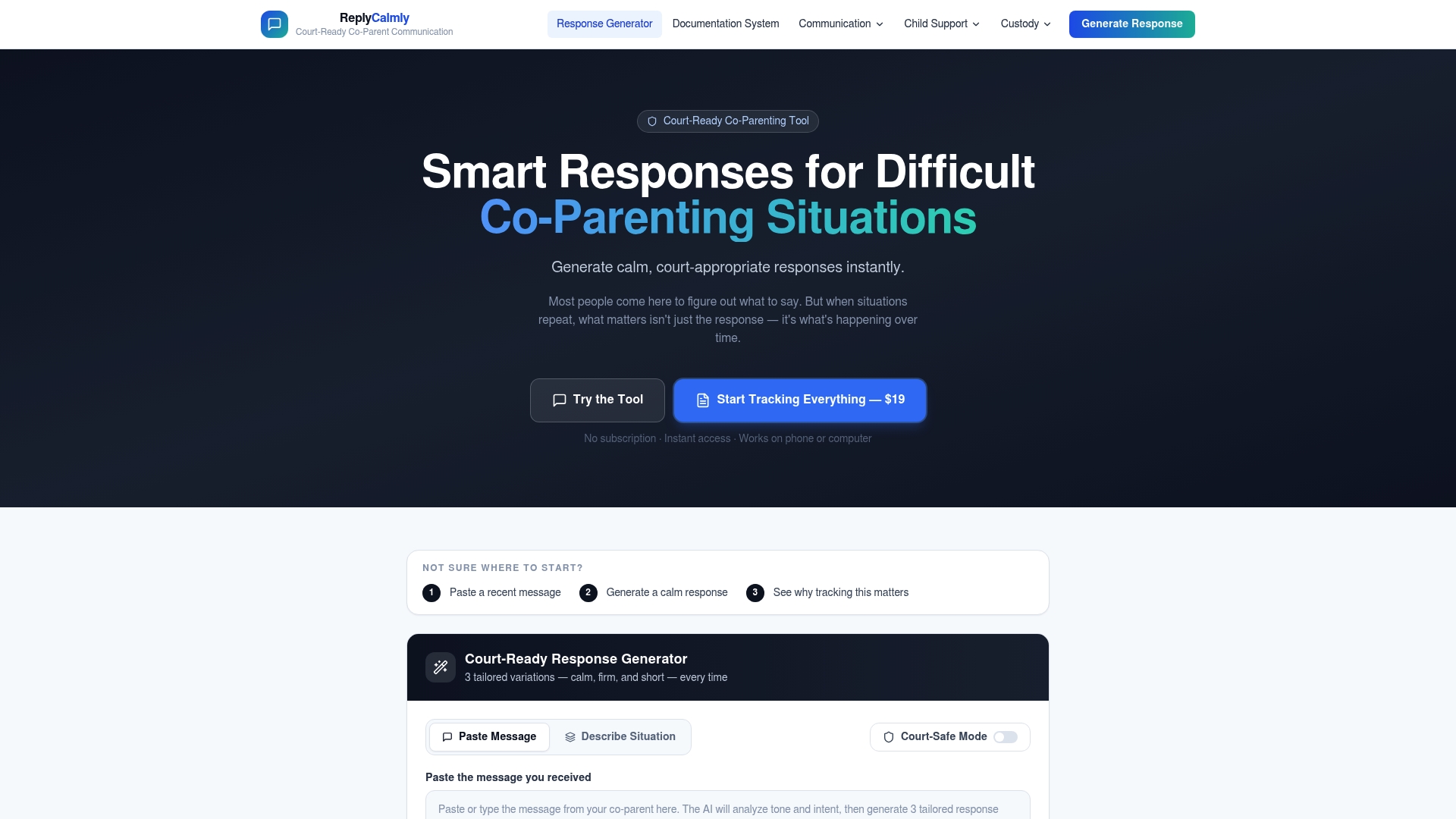
That is exactly where ReplyCalmly co-parenting tool steps in. ReplyCalmly is built for parents navigating high-conflict custody communication. The platform generates multiple response variations, including calm, firm, and short options, so you always have a starting point that protects your legal standing. Beyond individual messages, it tracks patterns in your communication history and creates organized documentation for family court. Whether you are responding to a schedule dispute or logging a series of false accusations, ReplyCalmly gives you the structure and confidence to communicate effectively every time.
Frequently asked questions
What should I avoid saying in a court-reviewed co-parenting message?
Never use threats, insults, or emotionally charged language. Keep your tone factual and solution-focused, as avoiding emotionally loaded language is the baseline standard for any message that may be reviewed by a judge.
Can I email a judge or court chamber directly about my custody dispute?
No. Any substantive or case-related communication must be formally filed through proper legal channels. Avoiding improper private communications to a judge or court staff is a firm legal boundary, not a suggestion.
How can I make sure my messages are not misinterpreted in court?
Stick strictly to the facts, remove emotional commentary, and focus on cooperative problem-solving. Messages that propose solutions factually are far less vulnerable to misinterpretation.
Why is neutrality so strongly recommended in high-conflict custody communication?
Neutral, low-drama messages reduce the emotional harm to children and lower the risk of negative court perception. Structured, low-emotion communication is consistently supported by child welfare research as the communication standard that best protects children's wellbeing during high-conflict separations.