When your co-parent sends a message loaded with blame, guilt, or bait, the safest move is almost always a short, factual, child-focused reply of two or three sentences. Save longer explanations for situations that genuinely require them. Anything involving logistics, safety, or a court order needs a response; everything else can often wait, get a one-line acknowledgment, or go unanswered entirely. The BIFF method and various response tools exist specifically to make that kind of reply automatic instead of agonizing.
TL;DR:
- Most high-conflict messages that are manipulative or baiting do not require detailed responses and can be met with brief, neutral replies that focus on logistics or safety.
- Using the BIFF method helps keep responses short, factual, and non-provocative, especially when the message involves accusations, blame, or emotional bait.
- Document all messages carefully by keeping full threads, exporting native logs, and avoiding edits or deletions to ensure court admissibility.
- Respond only when laws, court orders, or safety issues demand a reply, and avoid engaging in conflicts unless instructed by your attorney.
- Tools like response generators can assist in crafting calm, firm replies quickly, supporting both communication and documentation efforts in high-conflict co-parenting situations.
Table of Contents
- Short Response Templates for Common Co-Parenting Situations
- Should You Even Reply? A Quick BIFF Decision Checklist
- How Do You Document Messages So Courts Will Accept Them?
- How ReplyCalmly Helps You Reply Short and Document Everything
- Why Short Replies Are Legal Hygiene, Not Avoidance
- Try the Free Response Generator Before Your Next Difficult Text
- Sources
Short Response Templates for Common Co-Parenting Situations
Every high-conflict co-parent eventually builds a mental library of go-to replies. Here's a starter set organized by the situations that come up most, with a calm, firm, or shortest version depending on how much pressure the message is putting on you.
Pickup and exchange:
- Calm: "I'll have the kids ready at 5:00 PM at the usual spot."
- Firm: "The agreed time is 5:00 PM. I'll be there then."
- Shortest: "Confirmed, 5:00 PM."
Schedule change requests:
- Calm: "I can do the swap next weekend. Let's confirm the exact dates in writing."
- Firm: "I need this in writing before I can agree to any change."
- Shortest: "Not this weekend. Happy to discuss alternatives."
Medical or school updates:
- Calm: "Thanks for letting me know. I'll follow up with the pediatrician and share what I learn."
- Firm: "I need the full report, not a summary. Please forward it directly."
- Shortest: "Got it, thank you."
Boundary-setting:
- Calm: "I'm not able to discuss that over text. Let's stick to scheduling here."
- Firm: "This conversation isn't productive. I'll respond to logistics questions only."
- Shortest (or no reply at all when the message is pure bait): "Noted."
Emergencies:
- Calm: "Please call me directly. I want to make sure I understand what happened."
- Firm: "Send the details now so I can respond appropriately."
Not every message deserves a reply, but every message deserves a decision. If a text contains a false accusation or veers into custody-relevant territory, save it as evidence even if you don't respond to it. If a request touches your parenting time, medical decisions, or anything that could later matter in a modification hearing, save your reply too and consider running it past your attorney before sending, especially if the wording could be read as agreeing to something you didn't intend.
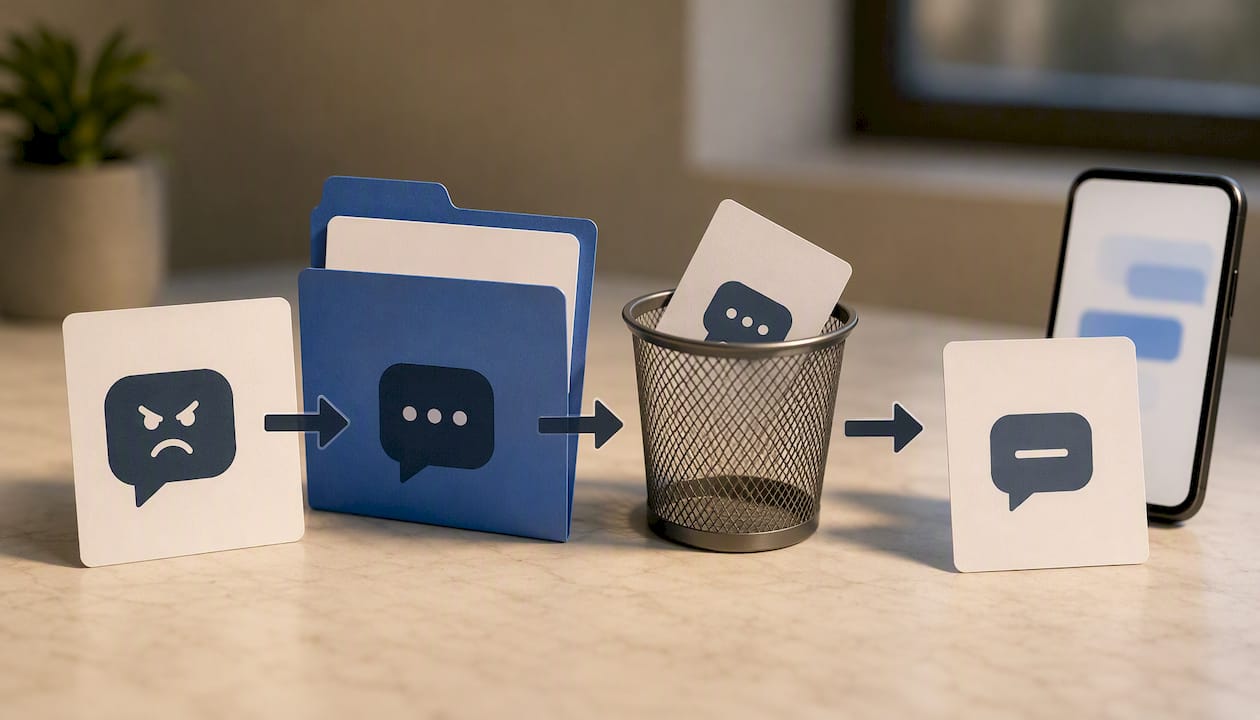
Pro Tip: Keep a "cooling draft" folder. Type the honest, angry version of your reply, then delete it and send the BIFF version instead. The venting still happens; it just never reaches your co-parent's phone.
Should You Even Reply? A Quick BIFF Decision Checklist
BIFF stands for Brief, Informative, Friendly, Firm, a framework built specifically for people who need to respond to a hostile message without escalating it further. Brief means you answer the actual question and stop. Informative means you stick to facts, not interpretations of the other parent's motives. Friendly doesn't mean warm, it means neutral, nothing that reads as a jab. Firm means you close the door on further debate rather than inviting a back-and-forth.
Before you type anything, run the message through this checklist:
- Does it involve the children's immediate safety or well-being?
- Does it involve a scheduling or logistics deadline?
- Does a court order or parenting plan require a response?
- Has your attorney specifically instructed you to respond to this type of message?
- Is this purely an accusation, insult, or attempt to provoke a reaction?
A "yes" to the first four means reply, briefly. A "yes" only to the fifth means a one-line acknowledgment or silence is often the safer route, since engaging with bait can escalate conflict without adding anything useful to the record.
Here's what a BIFF edit looks like in practice. A three-paragraph rant accusing you of "always undermining the schedule" becomes: "I have the kids Thursday through Sunday per our agreement. Let me know if you need to discuss a change in writing."
Pro Tip: Never reply while you're still angry. Draft it, sleep on it, and reread it in the morning. If your reply matches the tone of the message you received, you've already lost the exchange, even if you're right.
How Do You Document Messages So Courts Will Accept Them?
Courts generally look for two things before they'll consider a text message: relevance to the issues in the case, and authentication, meaning proof the message is real and came from who it claims to. Under evidence rules like FRE 902(11), carrier records and distinctive message characteristics can help establish that proof, and a party's own statements are typically usable against them without extra hurdles.
The practical side of preservation matters just as much as the legal theory:
- Keep entire threads intact, not isolated screenshots that lack context.
- Export native app logs rather than photos of a screen whenever the app allows it.
- Add timestamps and a brief contemporaneous note after phone calls, since confirming a verbal agreement by text immediately afterward turns a conversation into a written record.
- Back up everything off-device, in a location your co-parent cannot access.
- Never delete or edit a message, even one that makes you look bad. A one-sided, cleaned-up log reads as manufactured.
If you anticipate needing carrier records to authenticate a disputed message, plan early. Subpoenas for that kind of data commonly take 30 to 60 days to process, which is not a timeline you want to discover the week before a hearing. Judges also tend to weigh organized, balanced records more heavily than one-sided ones, since a log showing cooperation alongside conflict looks curated for accuracy, not for a lawsuit.
How ReplyCalmly Helps You Reply Short and Document Everything
Writing a calm reply while your hands are shaking is hard. That's the exact gap ReplyCalmly's response generator is built to close: paste in the message you received, and it produces calm, firm, and short variants so you're never improvising under pressure.
The platform also handles the other half of the job:
- It logs incidents and tags them by category (custody conflict, manipulation, false accusation), turning scattered texts into an organized record.
- Dashboards visualize patterns over time, which matters more to a judge than any single message.
- It's built to work alongside court-mandated apps like OurFamilyWizard, not replace them, so you can draft or archive messages in parallel with whatever system your custody order already requires.
Why Short Replies Are Legal Hygiene, Not Avoidance
Short replies get mistaken for coldness, but in a custody case they function more like flossing than fighting. A clean, factual record shows a judge you stayed cooperative while someone else escalated. Templates aren't a shortcut around hard conversations. They're insurance against sending, at 11 PM, the reply you'll regret reading back in a courtroom.
— Reply Calmly Team
Try the Free Response Generator Before Your Next Difficult Text
You don't need a subscription to see whether this approach works for your situation. Start with the free co-parent response generator, paste in the message that's stressing you out, and get calm, firm, and short options back in seconds instead of staring at a blank text box for twenty minutes.
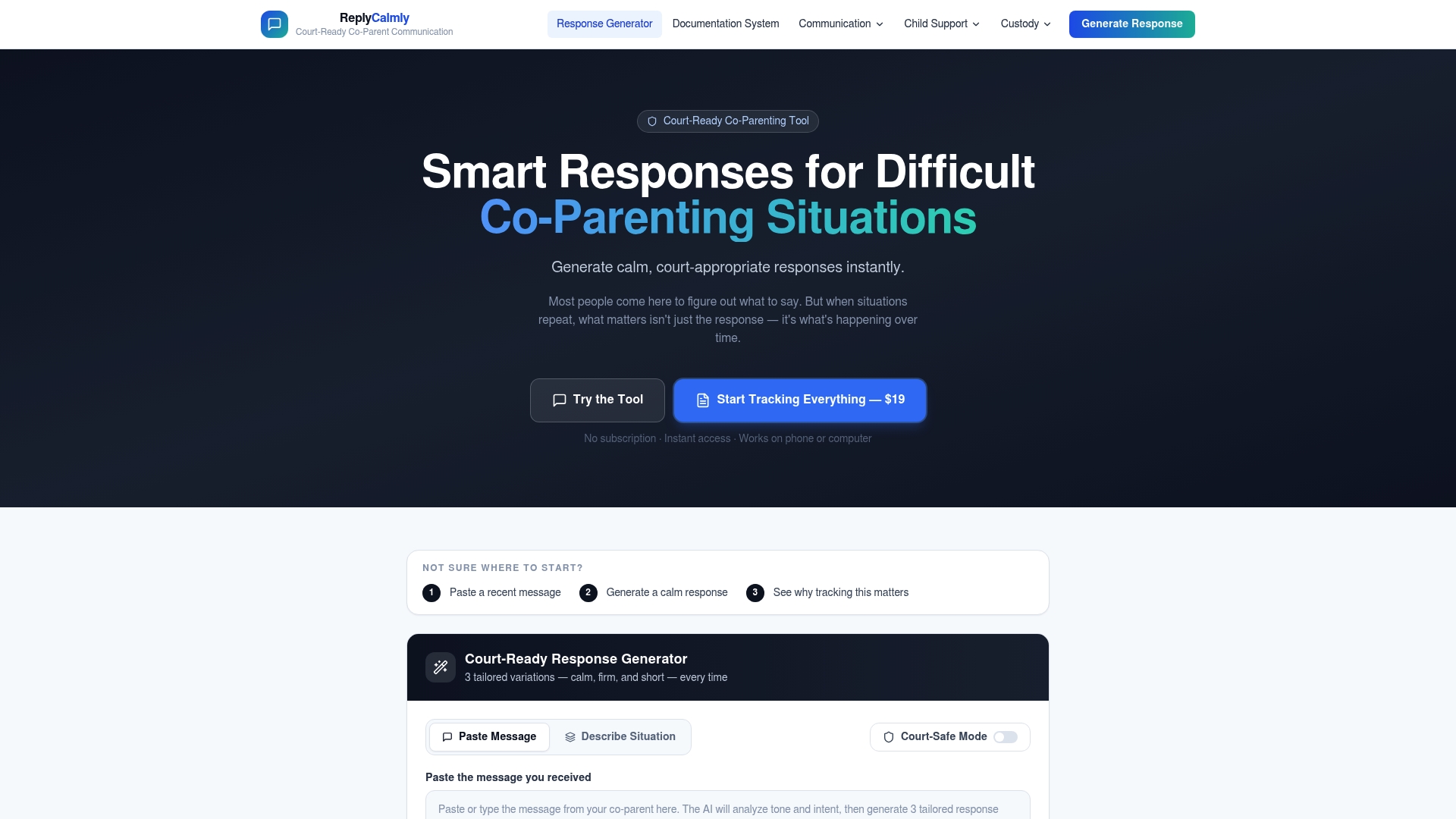
If you want a broader library to pull from, browse the co-parent message templates collection for scenarios beyond the ones covered here, or read through the step-by-step documentation guide to see how logging and exports work. The generator and template library are free to use. If you later need exportable, court-ready reports and full incident tracking with pattern dashboards, check the provider's site for current subscription details, and decide at that point whether your case needs it. Either way, the next difficult message doesn't have to start from a blank screen.
Sources
For deeper reading on admissibility and communication strategy, see TextTimeline on text message evidence, Zanderson Law on high-conflict communication, and Dentons on co-parenting through separation.
This article is general information, not a substitute for advice from a qualified lawyer. Consult a qualified legal professional about your own circumstances before acting on anything here.
- Are text messages admissible in court? — TextTimeline blog