
One poorly worded text message can change everything in a custody case. You might send it in a moment of frustration, thinking it's harmless, but opposing counsel can frame it as evidence of hostility or instability. Most co-parents navigating high-conflict situations focus on what they say rather than how they say it, and that gap creates real legal and emotional risk. Structured responses close that gap by giving you a reliable framework for every message you send, protecting your words, your record, and your children's wellbeing at the same time.
Table of Contents
- What are structured responses in co-parenting?
- Why do courts and professionals recommend structured responses?
- Pros, cons, and limitations: what should parents know?
- How to implement structured responses effectively
- Why most co-parents underestimate the power of structure
- Ready to get started? Use technology to respond calmly and stay protected
- Frequently asked questions
Key Takeaways
| Point | Details |
|---|---|
| Documentation is essential | Structured responses create clear records that protect you during disputes or court reviews. |
| Reduces emotional escalation | Neutral templates help keep co-parenting conversations focused and less likely to spiral. |
| Minor drawbacks exist | Using structured tools may require a learning period and subscription fee, but benefits surpass drawbacks. |
| Easy to adopt | You can quickly implement structured messaging with the right platform and templates. |
What are structured responses in co-parenting?
Structured responses are pre-formatted, template-driven messages designed to keep communication neutral, fact-based, and child-focused. Instead of typing a reply from scratch when you're stressed or triggered, you work from a tested framework that filters out emotional language and keeps the exchange on track. Think of them as guardrails for conversations that would otherwise veer off course.
These tools are especially useful in specific, recurring scenarios that tend to generate conflict:
- Schedule changes: Requesting or confirming adjustments to pickup or drop-off times without room for misinterpretation
- Medical decisions: Sharing doctor's appointment details, medication updates, or consent requests in clear, documented language
- School communication: Coordinating teacher conferences, permission slips, or academic concerns without emotional side conversations
- Holiday planning: Outlining holiday schedules and travel arrangements with exact dates and logistics
- Financial matters: Discussing child-related expenses in a factual, traceable format
The technology side of this has grown significantly. Co-parenting apps and platforms now offer built-in messaging tools, shared calendars, and response generators that make structured communication accessible even for parents with no legal background. As one widely cited source notes, co-parenting apps document every exchange, which reduces ambiguity and helps in legal proceedings.
"The goal of structured co-parenting communication isn't to remove the human element. It's to protect it by making sure every message serves your child's best interest, not your worst moment."
Using smart co-parenting tools means you're not just managing today's conversation. You're building a record that tells a coherent story about your conduct as a parent over time. That record matters enormously when custody disputes reach a courtroom.
Why do courts and professionals recommend structured responses?
Family law attorneys and mental health professionals who work with high-conflict co-parents consistently point to one thing: documentation. Courts don't just listen to what parents say in a hearing. They look at patterns of behavior, and those patterns are often established through message records. Structured responses create a paper trail that is organized, consistent, and easy for a judge to review.
Here's why legal and mental health professionals support this approach:
- Reduced ambiguity: Structured messages leave less room for "that's not what I meant" arguments in court
- Child-focused language: Templates keep the conversation centered on the child's needs, which aligns with how courts evaluate parental fitness
- Emotional de-escalation: Removing reactive language lowers the temperature of exchanges and reduces the chance of a conflict spiraling
- Admissible records: Messages sent through documented platforms are organized in a format that courts can review efficiently
The documentation value of these tools is widely recognized, even among reviewers who are otherwise critical of co-parenting apps.
Here's a quick comparison of unstructured versus structured communication in a typical co-parenting scenario:
| Scenario | Unstructured message | Structured response |
|---|---|---|
| Pickup time change | "You're always late, just come at 4 like I said." | "Please confirm pickup at 4:00 PM on Friday, per our agreed schedule." |
| Medical appointment | "Why didn't you tell me about the doctor?" | "Please share details of the appointment on Tuesday, including diagnosis and next steps." |
| Holiday schedule | "I already told you I have them Christmas Eve, stop arguing." | "Per our parenting plan, I have the children December 24. Please confirm." |
| School issue | "Your parenting is why they're struggling." | "I'd like to schedule a joint call with the teacher to discuss academic support options." |
The difference is stark. Structured responses keep you looking composed, cooperative, and focused on your child, which is exactly how courts want to see you.
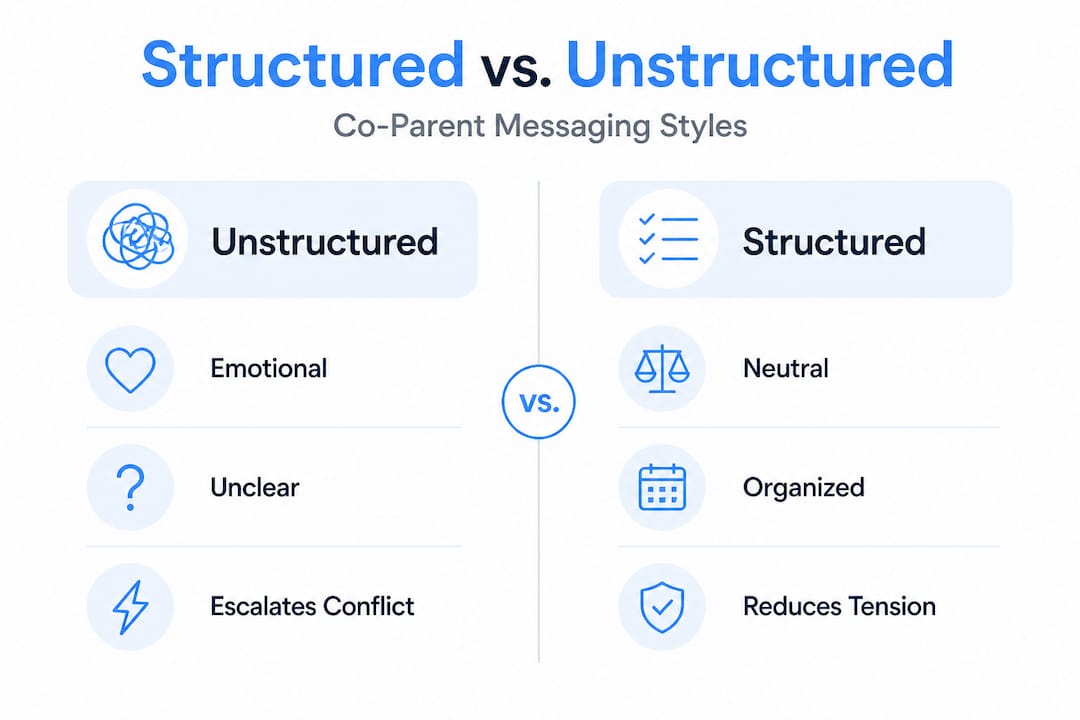
Pro Tip: Even if your co-parent communicates in an inflammatory way, your structured responses will stand out in any legal review. Judges notice the contrast, and it works in your favor.
Using structured response templates doesn't mean you're surrendering your voice. It means you're choosing which version of your voice shows up in the record.
Pros, cons, and limitations: what should parents know?
Structured response tools offer real benefits, but they're not perfect. Going in with clear expectations will help you use them more effectively and avoid frustration.
Benefits you can count on:
- Clarity and consistency: Every message follows a predictable format, reducing the chance of misunderstandings
- Legal protection: Your communication history becomes an organized, searchable record rather than a chaotic text thread
- Reduced emotional labor: Templates take the guesswork out of how to respond when you're exhausted or triggered
- Boundary enforcement: Structured tools make it easier to redirect off-topic conversations back to child-related matters
- Conflict reduction: When both parties know messages will be documented, the incentive to escalate decreases
Challenges to prepare for:
- Learning curve: New users often spend time getting familiar with templates before communication feels natural
- Subscription costs: Quality co-parenting platforms typically charge monthly or annual fees, which can feel like an added burden
- Interface limitations: Some apps have clunky designs that slow down communication rather than streamlining it
- One-sided adoption: Structured tools work best when both parties use them, but you can't force your co-parent to participate
Here's a realistic breakdown of what to expect:
| Factor | Reality check |
|---|---|
| Time to learn | 1 to 2 weeks for most users to feel comfortable |
| Cost range | $10 to $30 per month for most quality platforms |
| Legal impact | Significant, especially in disputed custody cases |
| Emotional benefit | High, particularly for reducing reactive communication |
| Effectiveness alone | Still valuable even if only one parent uses the tool |
As critical reviewers affirm, the documentation value of co-parenting tools outweighs the costs and interface frustrations that some users experience. That's a meaningful endorsement, especially coming from sources that aren't trying to sell you anything.
Pro Tip: Always review your outgoing messages before hitting send, even when using templates. A template gives you a strong starting point, but your specific situation may need a small adjustment to stay accurate and appropriate.
If you're looking for a co-parenting solutions overview that walks you through what's available, it helps to compare tools based on your specific custody arrangement and communication challenges.
How to implement structured responses effectively
Knowing why structured responses matter is one thing. Putting them into practice is where real change happens. Here's a step-by-step process that works for most co-parents in high-conflict situations.
-
Choose the right platform. Look for a tool that offers message templates, a documentation log, and ideally some form of tone guidance. Consider whether it integrates with court-mandated tools you may already be using, like OurFamilyWizard.
-
Spend time learning the basics before a conflict arises. Don't wait until you receive an inflammatory message to figure out how the platform works. Explore the templates, test the interface, and get comfortable when the stakes are low.
-
Select templates that match your most common scenarios. Most high-conflict co-parents deal with the same recurring issues: schedule changes, medical decisions, and financial disputes. Identify your top three conflict triggers and find or create templates for each.
-
Review tone before every send. Even a well-crafted template can pick up emotional language if you've edited it while upset. Read your message out loud before sending. If it sounds defensive or accusatory, revise it.
-
Save every record systematically. Don't rely on the platform alone. Export or screenshot important exchanges regularly and store them in a dedicated folder organized by date and topic. Your attorney will thank you.
-
Make it a habit, not a reaction. The real power of structured responses comes from consistency. When you use them every time, not just during conflicts, your communication record reflects a stable, cooperative parent.
A practical example: imagine your co-parent texts you at 9 PM asking to change Saturday's pickup from 10 AM to 2 PM with no explanation. An unstructured reply might be frustrated or sarcastic. A structured response would say something like: "I can accommodate a 2:00 PM pickup on Saturday. Please confirm this change so I can update our shared calendar." Short, clear, documented, and impossible to misrepresent in court.
Another example: you receive a message claiming you missed a medical appointment notification. Instead of defending yourself emotionally, a structured response might be: "I did not receive prior notification of this appointment. Please share the date, time, and provider so I can review my records and stay informed going forward." That response is calm, it requests documentation, and it creates a record of your request.

As standardized templates show, this approach streamlines legal correspondence and manages communication in high-conflict settings more effectively than improvised replies.
The ReplyCalmly platform is built specifically for this kind of structured, documented communication, offering multiple response variations so you can choose the tone that fits each situation.
Why most co-parents underestimate the power of structure
Here's the pushback we hear most often: "Structured responses feel cold. I don't want to communicate with my child's other parent like I'm writing a legal brief." It's a fair concern. But it misunderstands what structure actually does.
Structure doesn't remove empathy from co-parenting communication. It removes the noise that gets in the way of genuine cooperation. When you're not fighting through emotional static, the real conversations about your child's needs can actually happen more clearly. The irony is that structure often creates more space for warmth, not less, because neither party is constantly on the defensive.
Think about what happens in unstructured high-conflict exchanges. Every message becomes a potential landmine. You spend mental energy trying to decode tone, preparing for the next attack, and managing your own emotional response. That's exhausting, and it pulls your focus away from your children. Structure removes that burden.
Even critics of co-parenting apps ultimately approve their value for documentation and conflict reduction. That's not a ringing endorsement of any specific platform. It's an acknowledgment that the framework itself works.
The peace you gain from structured communication isn't just about legal protection. It's about mental health, stability, and modeling healthy conflict resolution for your children. Kids notice when their parents communicate calmly. That matters more than any court outcome.
Setting smart communication boundaries is one of the most effective things you can do for your family right now, not because it makes you look good on paper, but because it genuinely reduces the daily stress of co-parenting in a difficult situation.
Ready to get started? Use technology to respond calmly and stay protected
If you've been managing high-conflict co-parenting communication on your own, you already know how draining it is to craft every message from scratch while trying to stay composed.
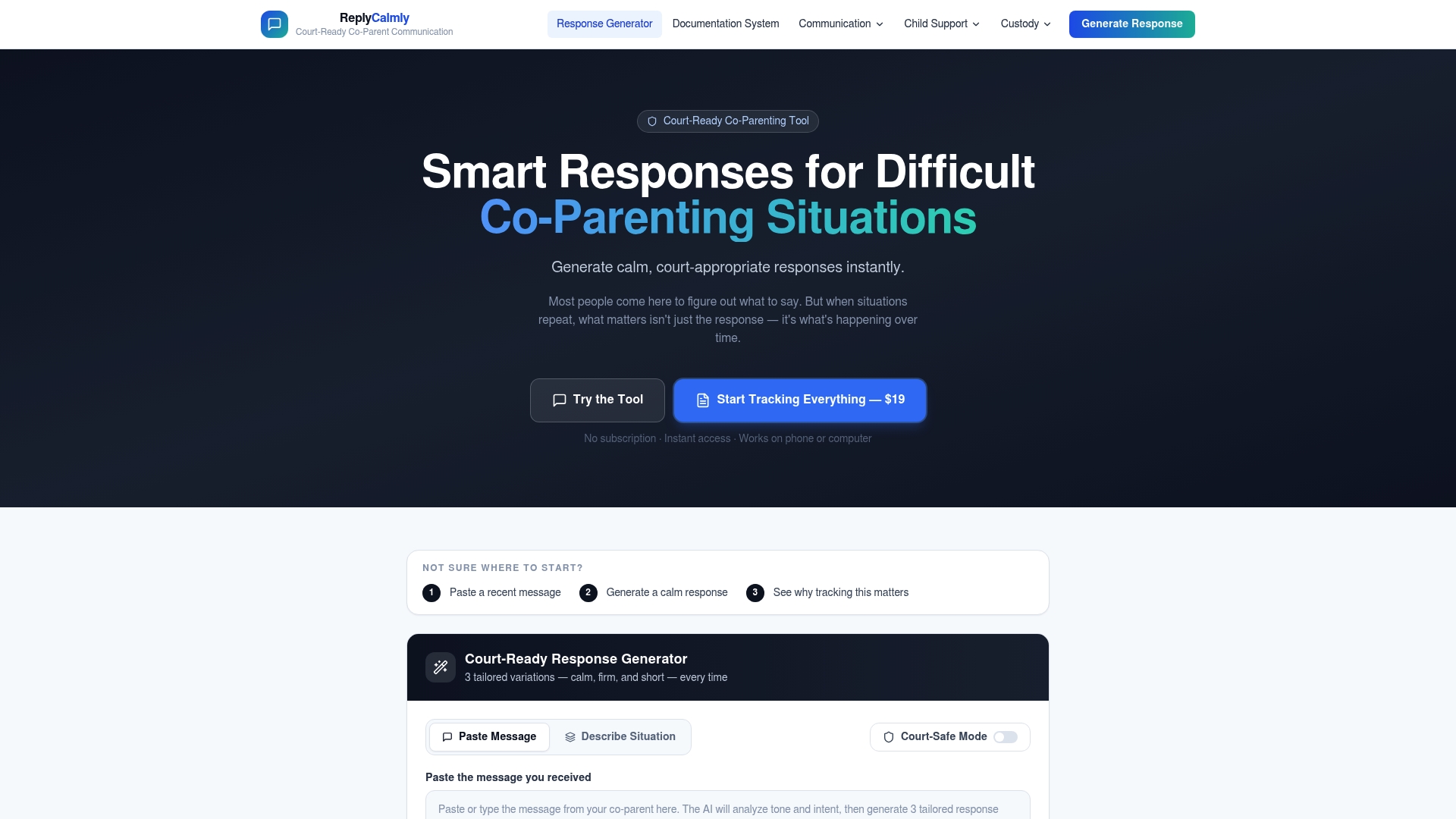
ReplyCalmly was built for exactly this situation. The platform generates multiple response variations for any message you receive, whether you need something calm, firm, or brief. It also tracks communication patterns over time, categorizes incidents, and gives you a visual dashboard of your co-parenting record. Everything is organized for legal review when you need it. Visit the ReplyCalmly platform to see how structured, documented communication can protect you and your children starting today.
Frequently asked questions
Can using structured responses really help in court?
Yes, structured responses provide organized records that are clear and admissible in family court hearings. Co-parenting apps document every exchange in a way that reduces ambiguity and supports your legal position.
What is the biggest drawback to using co-parenting apps for structured responses?
Some users report costs and interface frustrations as the main barriers, but documentation benefits consistently outweigh these concerns for parents in high-conflict situations.
How quickly can I start using structured responses?
You can start almost immediately after choosing a platform and spending a short time with its templates. Standardized templates are designed to be accessible from day one, even without legal training.