
You send a message. You meant it to be direct. The other person reads it as cold, aggressive, or dismissive. That single gap between intent and perception is where conflicts start, relationships fracture, and court records get complicated. Understanding what is message tone analysis gives you the ability to close that gap before the send button gets pressed. Whether you're navigating a tense co-parenting exchange, a difficult work email, or a personal conflict, tone shapes everything the words alone cannot carry.
Table of Contents
- Key takeaways
- What is message tone analysis
- Tone analysis techniques and how the technology works
- Why tone analysis matters most in conflict situations
- How to analyze message tone: a practical step-by-step approach
- Common misunderstandings about tone analysis
- My honest take on what tone analysis actually changed for me
- How Replycalmly helps you communicate with clarity
- FAQ
Key takeaways
| Point | Details |
|---|---|
| Tone goes beyond words | Message tone analysis reads emotional subtext, intent, and style, not just what was said. |
| Different from sentiment analysis | Sentiment tells you positive or negative; tone tells you how aggressive, passive, or urgent a message actually feels. |
| Technology keeps improving | Transformer-based AI models deliver measurably more accurate tone detection than older rule-based tools. |
| Critical in conflict situations | Tone analysis helps catch unintentional aggression and passive-aggression before they escalate exchanges. |
| Practical and accessible | Modern tools accept plain text input and return emotional climate reports with specific reply suggestions. |
What is message tone analysis
Message tone analysis is the process of evaluating a written or spoken message for its emotional content, intent, and communication style, not just its literal words. Think of it as reading between the lines at scale. Where a grammar checker tells you whether a sentence is correct, a tone analyzer tells you how that sentence will land emotionally.
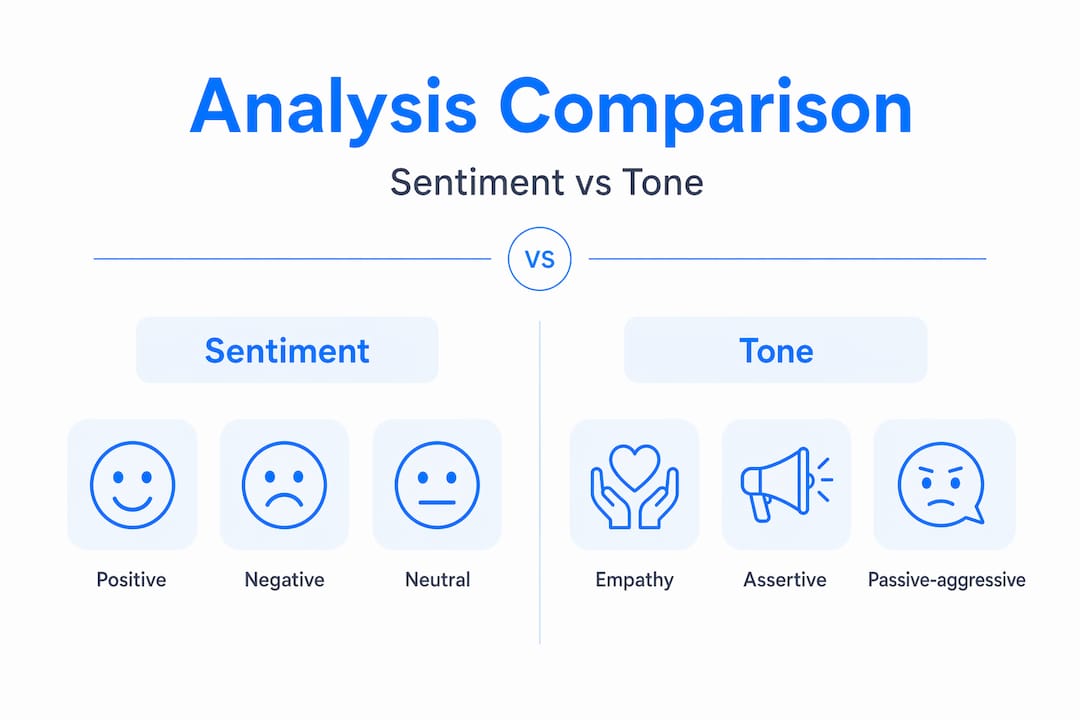
The distinction between tone analysis and sentiment analysis matters more than most people realize. Sentiment analysis produces a polarity score: positive, negative, or neutral. That is useful for categorizing product reviews but dangerously shallow for human conflict. Tone analysis goes further. It captures nuances like formality, directness, urgency, defensiveness, and emotional state. For spoken communication, tone also evaluates acoustic features like inflection, pace, and volume, dimensions that pure text tools obviously cannot access but that advanced audio-aware systems are beginning to address.
Here is a quick breakdown of how the two approaches compare:
| Feature | Sentiment analysis | Message tone analysis |
|---|---|---|
| Output | Positive / negative / neutral score | Emotional state, intent, formality, urgency |
| Depth | Surface polarity | Multi-layered emotional profile |
| Conflict usefulness | Low | High |
| Nuance handling | Often misses sarcasm, flat negativity | Detects passive-aggression, anxiety, curt authority |
| Audio capability | Rarely | Advanced systems include acoustic features |
The primary goal of modern tone analysis is to humanize digital interactions by inferring the subtle emotional cues that text strips away. A message that reads as neutral to a word-counter can feel like a threat to a real human reader. Tone analysis tries to catch that before it causes damage.
Tone analysis techniques and how the technology works
Not all tone analysis tools are built the same. Understanding the methods behind them helps you choose the right one and interpret its output accurately.
The oldest approach is the lexicon-based model. It works by matching words to a predefined emotional dictionary. "Angry" maps to anger. "Grateful" maps to appreciation. Simple, fast, and easy to explain. But rule-based tools fall short in complex or subtle conflict contexts because they cannot understand how words change meaning based on what surrounds them.
That gap is where transformer-based models like BERT step in. These models process language bidirectionally, meaning they read context before and after every word before assigning emotional weight. The results are significantly better. Large language models improve tone accuracy by 2.8 percentage points over older transformers, with error rates dropping by 8.3%. For something as high-stakes as a custody-related message, that improvement is not trivial.
A newer hybrid approach, like the EmoAtlas method, combines AI syntactic parsing with lexicon-based emotional data. This hybrid method runs 12x faster than BERT while maintaining comparable accuracy, which makes it practical for real-time communication tools.
The most useful tone analysis tools for everyday users go beyond a score. Specialized tone analyzers generate multilayered reports that include emotional climate summaries, detected intent, misunderstanding risks, and specific reply suggestions. Many allow you to input optional context, like the relationship type between sender and recipient, to sharpen accuracy.
What to look for when choosing a tone analysis tool:
- Emotional depth: Does it report on specific states like anxiety, passive-aggression, or urgency rather than just "negative"?
- Intent detection: Can it flag whether a message sounds threatening, manipulative, or dismissive?
- Reply suggestions: Does it recommend how to respond, not just what is wrong?
- Context input: Can you tell it the relationship type or communication history to improve accuracy?
- Plain-language output: Is the report something you can actually act on?
Pro Tip: Avoid tools that only return a single sentiment score. In conflict communication, a message can be technically "neutral" in polarity but dripping with passive-aggression. You need the emotional layers, not just a number.
Why tone analysis matters most in conflict situations
Digital communication strips out everything that humans evolved to use when reading each other. No facial expression. No vocal warmth. No pause that signals someone is thinking carefully rather than dismissing you. What remains is text, and text is ruthlessly easy to misread.
Tone analysis identifies the "static" in communication that corrupts meaning before it even reaches the reader. Three tone problems show up repeatedly in conflict contexts:
- Unintentional aggression: A message written quickly and efficiently reads as curt or cold. The sender was just busy. The recipient reads hostility.
- Passive-aggression: Phrases like "fine, if that's what you want" or "I'll just handle it myself" carry unmistakable emotional weight that a word-count tool would never flag.
- Anxiety projection: Over-apologizing, excessive hedging, or compulsive over-explaining can signal instability or desperation to the reader, even when the sender just felt nervous.
For co-parents in high-conflict situations, these tone problems are not abstract. They show up in documentation. Judges and attorneys read message threads. A message that feels defensive or aggressive in tone, even if technically factual, can color perceptions in ways that are hard to undo. Learning to maintain professional tone in every exchange is not about being fake. It is about making sure your real intent gets through without distortion.
Pro Tip: Before sending any emotionally charged message, paste it into a tone analyzer and check whether the emotional climate matches what you intended. A message you wrote while anxious will often read as passive-aggressive to someone already on guard.

Well-formed grammar alone does not guarantee appropriate emotional tone. Tone analysis functions as an emotional intelligence filter, catching harshness or ambiguity that grammar checkers completely miss. In conflict situations, that filter can be the difference between a productive exchange and a spiral.
How to analyze message tone: a practical step-by-step approach
Knowing what tone analysis is matters less than knowing how to use it. Here is how to build it into your communication process without overcomplicating things.
-
Copy the full message text. Do not paraphrase. Paste the exact wording into your tone analysis tool. Small word choices carry disproportionate emotional weight.
-
Add context if the tool allows. Input the relationship type, the communication history, or the purpose of the message. A firm statement reads differently from a boss than from a co-parent in a custody dispute. Context improves accuracy.
-
Read the emotional climate summary first. Before looking at specific flagged words, get the overall picture. Is the message reading as hostile, anxious, cold, or warm? That top-level read tells you what impression the recipient will form in the first few seconds.
-
Review specific flags. Look at which phrases or sentences are triggering concern. An AI tone check catches details like excess exclamation marks, overly short sentences, or passive-aggressive language that most writers never notice in their own output.
-
Apply the suggested rewrites selectively. Tone tools will suggest alternatives, but you are the human with full context. Use suggestions as starting points, not mandates. Swap out a flagged phrase when the replacement sounds natural to you.
-
Re-run the revised message. A second pass after edits confirms you have actually moved the needle. Tone can shift unexpectedly when you change multiple elements at once.
Pro Tip: If you received a message that upset you, run it through a tone analyzer before responding. Sometimes what reads as an attack is actually anxious or clumsy writing. Understanding the sender's likely emotional state changes how you frame your reply and reduces the chance of needless escalation.
For people managing high-conflict co-parenting, this workflow becomes especially powerful when combined with message logging. Tracking tone patterns over time reveals whether communication is genuinely improving or whether problems are escalating in ways that matter for legal documentation.
Common misunderstandings about tone analysis
Tone analysis is a powerful aid. It is not an oracle.
Several limitations are worth understanding before you lean on it too heavily:
- Sarcasm and irony trip up most tools. A cheerful-sounding message that is deeply sarcastic will often register as positive. Transformer models handle this better than lexicon tools, but no system is reliably accurate with sarcasm at scale.
- Domain-specific language creates context gaps. Basic lexicon models misclassify words that carry different meaning in different fields. Legal language, medical terms, or industry jargon can throw off tone readings in ways that mislead rather than inform.
- Punctuation interpretation cuts both ways. Excessive exclamation marks used to soften a message can register as insincerity or unprofessionalism, the opposite of the intended effect. But a tool that over-flags punctuation will generate noise that buries real tone problems.
- Cultural and generational differences matter. Directness reads as rude in some communication cultures and efficient in others. A tool trained predominantly on one cultural dataset will carry those biases into its output.
- Short messages are hard to read. A two-word response like "Got it" gives any tone analyzer almost nothing to work with. Output confidence drops significantly with very short text.
The practical takeaway: use tone analysis as a second opinion, not a verdict. The tool surfaces patterns and risks. You apply the judgment about what those patterns mean in your specific relationship and context.
My honest take on what tone analysis actually changed for me
I spent years thinking the problem in difficult conversations was always the other person. They were being provocative. They were twisting my words. Then I started running my own messages through tone analysis before sending them, and the results were uncomfortable.
Messages I thought were calm and factual were reading as cold and dismissive. One message I felt genuinely proud of for staying "professional" flagged three passive-aggressive phrases I had no idea I was using. The analyzer did not say I was a bad communicator. It showed me the gap between what I intended to project and what my words actually transmitted.
The real shift for me was understanding that tone is something you send, not something the other person invents. When I started treating my messages as documents that carried emotional signals I was responsible for, my conflict exchanges changed. Not because the other party got nicer. Because I stopped giving them material to misread.
The harder lesson: technology is only as useful as the emotional intelligence behind it. I have seen people use tone feedback to write messages that are technically neutral but strategically manipulative. The tool cannot stop that. What it can do is help genuinely well-intentioned people stop accidentally sabotaging themselves with words that don't match what they actually feel.
— Devin
How Replycalmly helps you communicate with clarity
If you are managing difficult co-parenting communication, Replycalmly was built for exactly this situation.
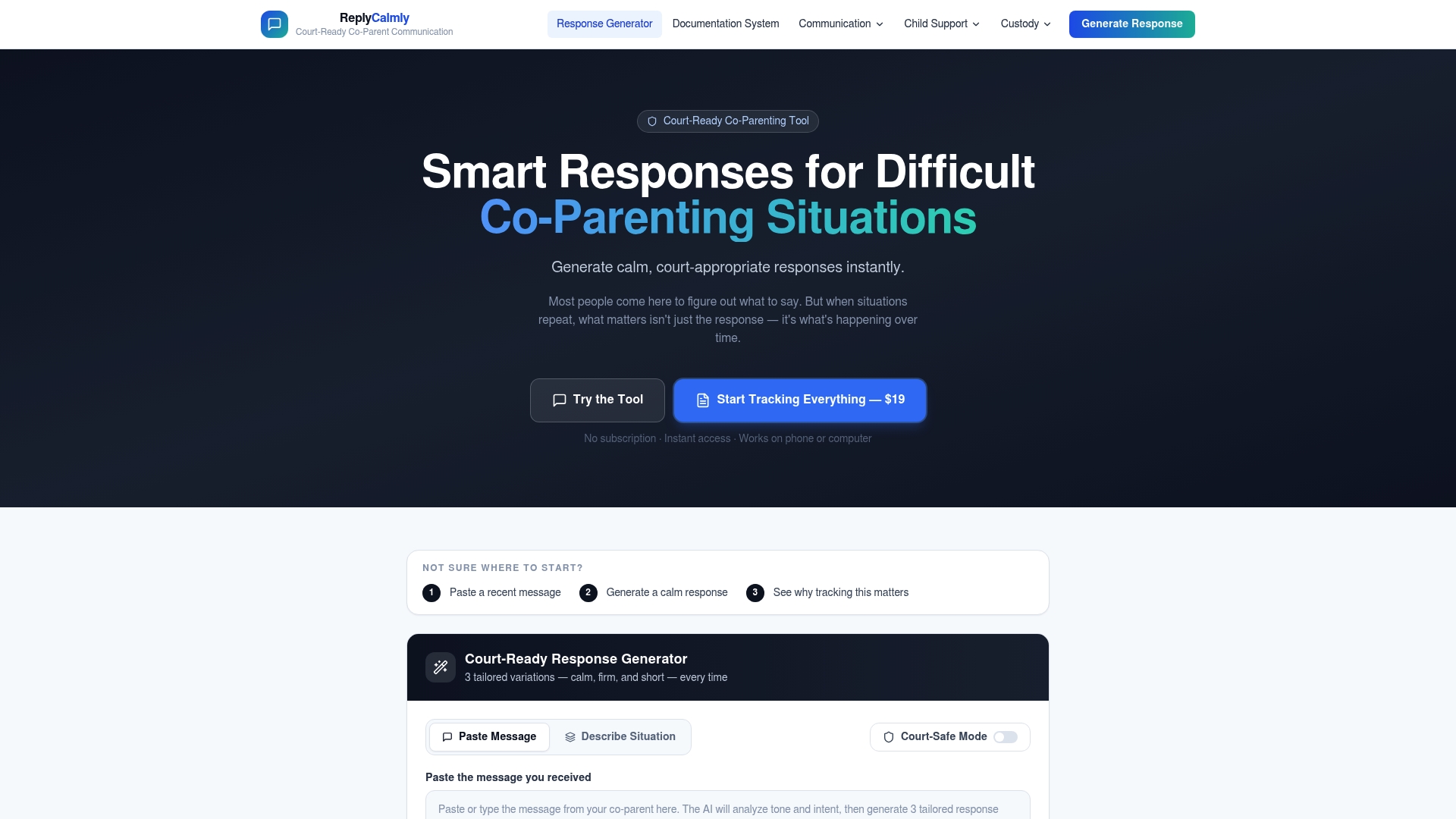
The platform takes messages you have received and generates multiple calibrated responses: calm, firm, and brief. Each one is designed to hold up in a family court review. Beyond response generation, Replycalmly tracks communication patterns over time, helping you spot escalation trends before they become legal problems. You can also use co-parent message templates to structure your outreach from the start, or explore the best documentation apps to find tools that integrate with what you already use. For a full communication structure, the co-parenting communication plan template gives you a framework to operate from, not just react from.
FAQ
What is tone analysis in simple terms?
Tone analysis is the process of reading a message to identify its emotional quality, intent, and communication style, beyond just the literal meaning of the words. It helps determine whether a message sounds hostile, anxious, professional, or warm.
How is tone analysis different from sentiment analysis?
Sentiment analysis gives a positive, negative, or neutral score. Tone analysis goes deeper, detecting specific emotional states like passive-aggression, urgency, or formality that sentiment scoring routinely misses.
Can tone analysis detect passive-aggression?
Yes. Advanced tone analysis tools specifically flag passive-aggressive phrasing, such as phrases that signal resentment or reluctance while maintaining surface-level politeness. This is one area where transformer-based models outperform simpler lexicon tools.
Is tone analysis reliable enough to use in legal communication?
Tone analysis is a useful guide, not a legal authority. It helps you catch unintended emotional signals before sending, which matters for co-parenting communication that may be reviewed by attorneys or judges. Always apply your own judgment before acting on any automated suggestion.
What are the main limitations of tone analysis tools?
The biggest limitations include difficulty detecting sarcasm, poor performance with very short messages, cultural bias in training data, and misclassification of domain-specific language. Using a context-aware tone tool reduces these risks significantly compared to basic word-matching systems.