
One emotional reply can quietly destroy months of careful legal groundwork. Family court judges review written exchanges without ever hearing the tone of voice that provoked them, and courts reward communication that appears measured, timely, and limited in scope. If you are navigating a high-conflict custody situation, the way you write back matters just as much as what you write back. This guide gives you a clear, step-by-step method to compose calm, court-appropriate responses that protect your legal standing, reduce emotional escalation, and support your children's long-term wellbeing.
Table of Contents
- Understand the stakes: Why professional responses matter
- Preparation: Gather tools and calm your mindset
- The 5-step method for professional co-parent response writing
- Verify, track, and avoid common pitfalls
- What research and experience reveal about professional response writing
- Take the next step: Tools and templates for co-parenting success
- Frequently asked questions
Key Takeaways
| Point | Details |
|---|---|
| Write with court in mind | Every message could be used as evidence, so keep responses measured, brief, and neutral. |
| Preparation supports calm | Pausing and using templates or tools before responding reduces mistakes and escalation. |
| Follow a structured process | Use defined steps—pause, evaluate, draft, edit, and record—to ensure professionalism under pressure. |
| Consistent habits protect children | Professional responses in co-parenting promote better outcomes for kids in the long run. |
Understand the stakes: Why professional responses matter
Before diving into the practical steps, it is crucial to understand why this method matters so deeply.
Every message you send in a co-parenting dispute can be printed, screenshot, and placed in front of a judge. What that judge sees is the written exchange only. They do not see the three-word insult that arrived at midnight, the false accusation that was dropped casually between schedule requests, or the pattern of gaslighting that preceded your reply. As one analysis of custody email evidence explains, judges see the written exchange without the provocation context, so a reactive reply can make you look like the aggressor even when you were clearly responding to hostility.
"Courts and enforcement processes tend to reward communication that looks measured, timely, and limited in scope, because judges review what was sent without the provocation context." — Custody Emails: What Court Sees
This is not a minor risk. A single message where you matched your co-parent's energy, used sarcasm, or included unrelated grievances can be used to paint a picture of you as volatile or uncooperative. That picture follows your case.
There is also a powerful argument for professional responses that has nothing to do with the courtroom. Research tracking coparenting communication patterns over time finds that higher-quality coparenting is linked to fewer behavior problems in children, particularly through adolescence. When you consistently keep communication calm and focused, you are not just protecting yourself legally. You are actively reducing the conflict load your children absorb.
The practical benefits of consistently professional replies include:
- Reduced risk of escalation because you are not adding fuel.
- Stronger legal positioning because your written record shows restraint.
- Better outcomes for your children because they are insulated from adult conflict as much as possible.
- Your own emotional regulation because writing professionally forces you to think before you react.
If you want to go deeper on the communication side before working through the steps below, our guide on improving co-parenting communication is a good foundation, and for situations where direct coparenting has broken down entirely, parallel parenting in high-conflict situations may be a more realistic approach.
Preparation: Gather tools and calm your mindset
Now that you understand the stakes, let's set you up for consistent, successful responses.

Professional response writing does not begin the moment you open the message. It begins much earlier, with the tools and habits you put in place before a difficult message even arrives. Research on parenting conflict interventions suggests that structured approaches to managing interparental conflict can reduce that conflict over time, especially when practiced consistently in group or guided formats. The practical takeaway: deliberate preparation reduces your reactive tendencies.
Start by confirming which documentation or communication tool you are required or expected to use. If your court order specifies a platform, make sure all exchanges happen there. If you are not court-mandated to use a specific tool, choose one that timestamps messages and creates a searchable record.
| Preparation step | Why it matters | Suggested action |
|---|---|---|
| Identify required platform | Ensures legal compliance and admissible records | Review your parenting plan or order |
| Set a reply delay | Prevents reactive responses | Wait at minimum 30 minutes before replying |
| Choose a quiet environment | Reduces emotional noise while writing | Reply only when children are not present |
| Review your co-parenting plan | Grounds your response in agreed facts | Keep a copy accessible on your phone |
| Use a drafting tool | Allows editing before you commit | Draft in notes app, then copy over |
The emotional preparation piece is just as important as the logistical setup. Before you draft anything, take a genuine pause. This is not about suppressing what you feel. It is about separating the emotional experience of reading the message from the professional task of responding to it. Effective techniques include:
- Taking a short walk before sitting down to write.
- Writing out your uncensored emotional reaction in a private document you will never send, then setting it aside.
- Reading the message a second time and asking only: "What is the one logistical point that requires an actual response?"
- Using a communication plan template to ground yourself in pre-agreed parameters before you start writing.
Pro Tip: If you feel your heart rate rise while reading a message, set a physical timer for 20 minutes before opening your drafting tool. This single habit reduces reactive language more reliably than any editing pass after the fact.
The 5-step method for professional co-parent response writing
With your mindset and tools ready, apply these five steps every time you write.
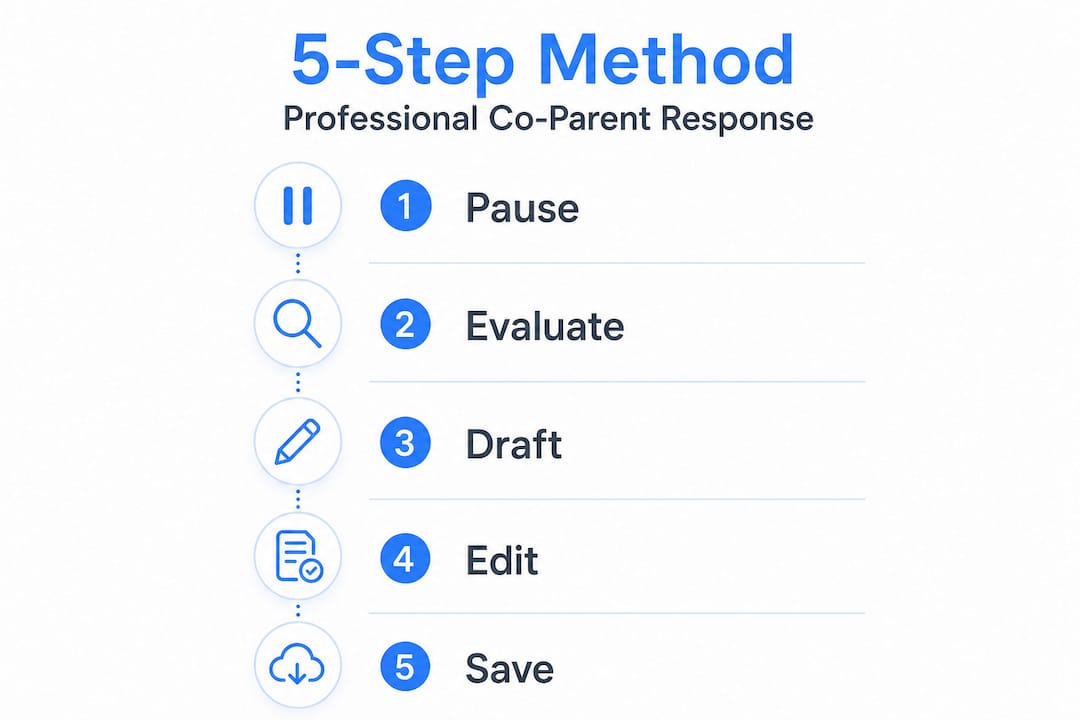
Note that frameworks for professional response writing are largely practice-based rather than tested in controlled clinical trials. That does not make them less valuable. It means their value comes from consistent application and self-awareness, not from following a script without thinking. Here is the method:
1. Pause Do not respond immediately. Ever. Even if the message seems urgent, most co-parenting messages are not genuine emergencies. Give yourself at minimum 20 to 30 minutes. If the message arrived late at night, wait until the next morning. Urgency is often manufactured to provoke a reactive reply.
2. Evaluate Read the message once and identify only the actionable content. Strip out the accusations, the insults, and the loaded language. Ask yourself: "What is the single thing this message is actually requesting or communicating?" Write that in plain language. If there is no actionable request and the message is purely inflammatory, you may not need to respond at all.
3. Draft Write your response addressing only the logistical or factual content you identified. Keep it short. Aim for three to five sentences maximum. Do not justify yourself, defend yourself against accusations, or ask rhetorical questions. State facts, confirm arrangements, or ask one clear question if clarification is needed.
4. Edit for tone and brevity Read your draft out loud. Ask three questions: Does this include anything accusatory? Does this include more information than the message required? Would a stranger who knew nothing about the situation read this as professional? Cut anything that fails those checks. Look for emotionally loaded words like "always," "never," "you claimed," or "as I have repeatedly said" and remove them. For examples of what firm but professional replies actually look like, see our firm co-parenting response examples.
5. Save for records Before you send, save a copy. Screenshot it, log it in your documentation tool, or export it. Once you send, the record exists only where it was sent. Having your own copy lets you cross-reference later and builds the pattern evidence that matters in court.
Here is what that process looks like in practice:
| Scenario | Emotional response (avoid) | Professional response (use) |
|---|---|---|
| Co-parent accuses you of missing a pickup | "You know exactly why I was late and this is completely unfair." | "I was there at 3:15 PM. Please confirm future pickup times in writing." |
| Co-parent changes plans last minute | "This is the fourth time you have done this. I am done accommodating your chaos." | "The agreed schedule is [X]. I am not available to adjust on this date. Please refer to the parenting plan." |
| Co-parent sends an accusatory message about parenting choices | "You have no right to question how I parent." | "I have noted your message. I am parenting in accordance with our agreement." |
Notice that the professional responses in this table do not explain, plead, or retaliate. They state facts and reference agreements. That is the goal.
Pro Tip: If you genuinely cannot tell whether your draft is emotionally neutral, paste it into a message to a trusted friend who is not involved in your case and ask them to read it as if they had never heard the backstory. Their reaction will tell you everything you need to know before you hit send. For situations where you are about to enter legal proceedings, the guide on communicating before court is worth reviewing alongside this method.
Verify, track, and avoid common pitfalls
To ensure your efforts pay off, always conclude with these final steps.
Writing a professional draft is only part of the task. Before you send anything, run through a short verification checklist:
- Does the message address only what was asked, and nothing extra?
- Is the tone factual and free of sarcasm, frustration, or judgment?
- Are there any words or phrases that could be read as threatening or dismissive?
- Is the message shorter than it needs to be? (If yes, that is usually a good sign.)
- Have you removed your children's names from any context that could be seen as using them as leverage?
After sending, the documentation step is not optional. Judges evaluate what was sent without the surrounding context. That means your record of what you sent, when you sent it, and what you were responding to is the closest thing you have to context in a courtroom. Log every message you send with the date, the platform, and a one-line summary of the topic.
For a structured approach to building this record over time, our resource on documenting co-parent behavior walks through what to log, how to categorize incidents, and how to use that documentation if your case goes to a modification hearing.
Common mistakes that undermine otherwise professional responses include:
- Replying to every message. Not every message requires a response. Responding to inflammatory content that has no actionable item keeps the conflict alive.
- Including "for the record." This phrase signals defensiveness and actually weakens your communication in court.
- Bringing up past events. Stay in the present timeframe. Past grievances belong in your documentation log, not your reply.
- Over-explaining. A professional response does not justify itself. If you wrote three sentences explaining why you made a parenting decision, that is two sentences too many.
- Responding on behalf of your children. Messages should address logistics between co-parents. Do not relay your child's opinions or feelings through your written communication.
Tip: Before sending any message, ask yourself, "Would I be comfortable if this exact message was read aloud in a courtroom?" If the answer is anything but a confident yes, revise.
What research and experience reveal about professional response writing
Looking beyond step-by-step instructions, what does the bigger picture really say?
Step-by-step frameworks like the one above serve a real purpose. They give you something to do when emotional flooding makes clear thinking nearly impossible. Structure is not just a communication strategy. It is a self-regulation tool. When you follow a defined process, you interrupt the automatic reactive pattern that high-conflict exchanges are often designed to trigger.
But there is an honest caveat worth naming. The specific writing frameworks used in co-parenting advice are largely practice-based. The empirical research on interparental conflict supports the broader strategy of reducing conflict and improving coparenting quality. It does not specifically validate any particular messaging template as a tested clinical intervention. This matters because it means frameworks are tools, not guarantees.
What we have seen, both in the research and in real patterns among people navigating high-conflict situations, is that rigid template-following can backfire in two ways. First, some situations are genuinely nuanced and a formula response can come across as dismissive or evasive in ways that escalate rather than de-escalate. Second, templates can become a way to avoid the harder internal work of understanding why certain messages trigger you so intensely, and that work matters for long-term emotional stability.
The most effective approach combines a reliable method with genuine self-awareness. Use the five steps as scaffolding, but stay present to the specific situation. Notice when a message is testing your boundaries in a new way. Adapt. The goal is never to sound like a robot. The goal is to communicate like someone who is completely in control of their own choices regardless of what the other person sends.
Our communication tips for dads explores this balance further, particularly for fathers navigating systems that can feel weighted against them. The same principles apply regardless of gender: consistency, restraint, and documentation compound over time.
Take the next step: Tools and templates for co-parenting success
With the strategies in hand, here's how you can make consistent success even easier.
Writing professional responses under stress is genuinely hard, and having the right tools can make the difference between a momentary lapse and a consistent record that works in your favor. ReplyCalmly.com was built specifically for this challenge.
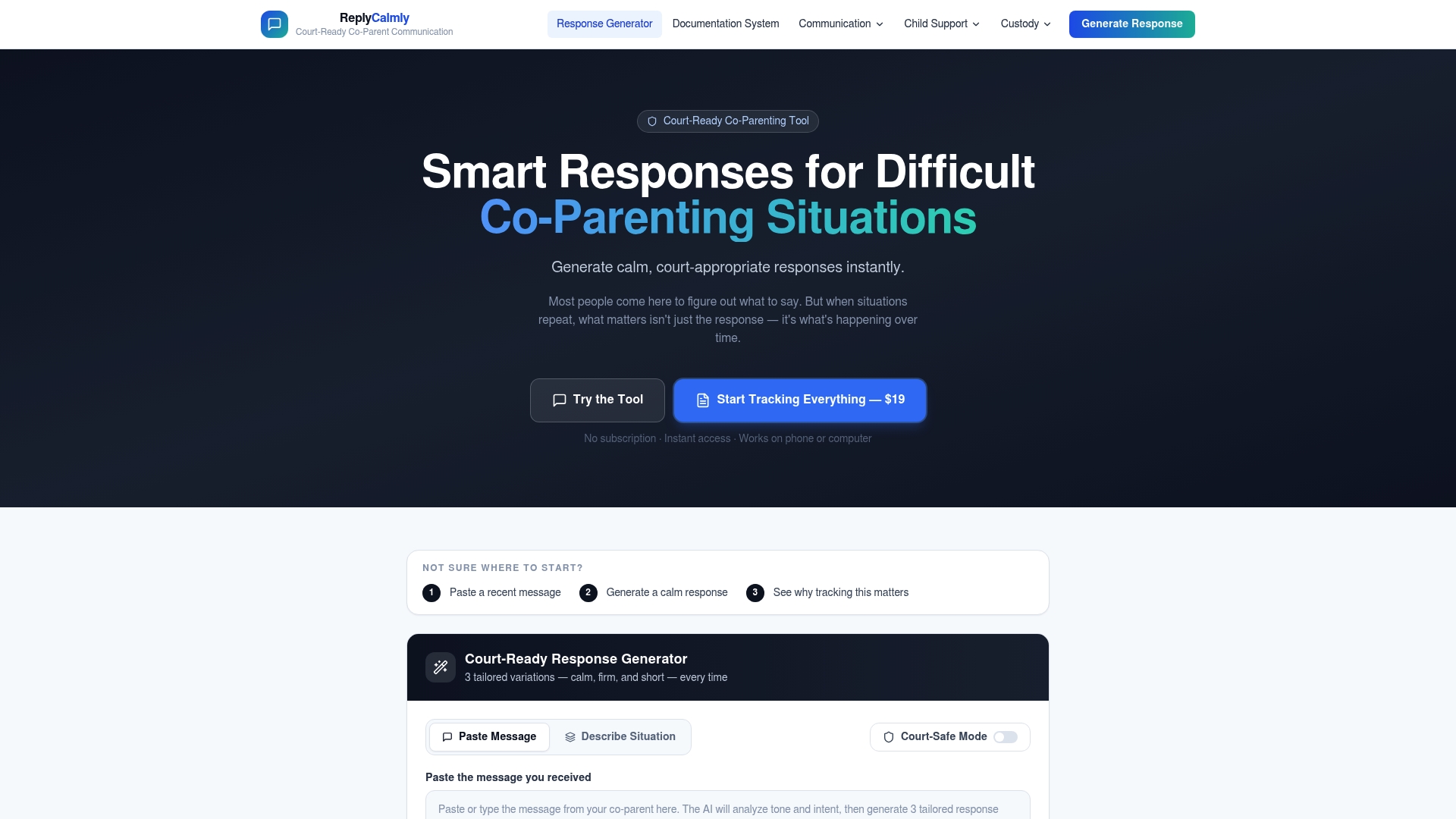
The response generator takes a message you received and produces multiple response variations, including calm, firm, and brief options, so you can choose what fits the situation without having to start from scratch. The platform also features an incident tracking system that logs your communications, categorizes issues, and visualizes patterns over time, giving you organized documentation ready for legal review. Explore the best co-parenting apps for documentation to compare your options, or start with a communication plan template to build a structure that supports every exchange going forward.
Frequently asked questions
Why is it important to keep responses brief and neutral?
Brief, neutral responses reduce the risk of escalation and present better in court. Courts reward communication that is measured, timely, and limited in scope, because that is what looks credible when reviewed without context.
What if my co-parent continues to send inflammatory messages?
Continue documenting and responding professionally regardless of what arrives in your inbox. Only your replies will be scrutinized in legal proceedings, and what judges see is the written exchange, not the provocation behind it.
Are there proven templates for professional response writing?
Most writing frameworks used in co-parenting coaching are practice-based rather than clinically tested. Evidence for writing frameworks is largely drawn from broader research on reducing interparental conflict, not from trials of specific message templates.
How do professional responses affect my child's wellbeing?
Research tracking families over time found that higher coparenting quality is associated with fewer behavior problems in children at age 15, which suggests that how you communicate now has a measurable impact on your child's long-term adjustment.