
A boundary-setting message is a clear, specific statement that defines what you will do if a limit is crossed. It is not a demand, a threat, or a plea. It is a declaration of your own future behavior, and that distinction changes everything about how co-parenting communication works.
Most co-parents struggle not because they lack boundaries, but because they lack the right words. The examples of boundary-setting messages below are drawn from current psychological research and real co-parenting scenarios. They use "I" statements, behavioral specificity, and firm but respectful language. Platforms like Replycalmly and tools like OurFamilyWizard exist precisely because this kind of structured communication reduces conflict and builds a defensible record for family court.
What makes an effective boundary-setting message?
Effective boundary assertion phrases share four qualities: they name a specific behavior, they state your response, they use "I" language, and they carry no apology. Behavioral specificity is the foundation. A message like "I need you to respect me more" is not a boundary. A message like "I will pause this conversation and continue tomorrow if name-calling continues" is.

"I" statements reduce defensiveness compared to "you" statements and help express personal impact calmly with clear consequences. "You always text me at midnight" triggers defensiveness. "I respond to texts between 8 a.m. and 8 p.m." states a fact about your behavior that no one can argue with.
Boundaries are statements of your own future actions, not demands on others' behavior. That shift matters because you can enforce your own actions unilaterally. You cannot force another person to change. You can only change what you do next.
- Behavioral specificity: Name the exact action, not a vague feeling.
- "I will" language: State what you will do, not what they must do.
- No over-explanation: One sentence is enough. Over-explaining boundaries invites renegotiation.
- Calm tone: Firm does not mean aggressive. Neutral language holds up in court.
- Clear consequence: State it once. Do not repeat or negotiate it.
Pro Tip: Write your boundary message, then cut it in half. If the meaning survives, the shorter version is stronger.
10 examples of boundary-setting messages for co-parents
These examples cover the most common co-parenting friction points. Each one follows the principles above: specific behavior, "I will" consequence, no apology.
1. Communication timing
"I respond to texts between 8 a.m. and 8 p.m. Messages outside those hours will receive a reply the next morning."
This sets a digital communication boundary without attacking the other parent. It tells them exactly what to expect and removes the pressure of late-night messages.
2. Ending an unproductive conversation
"If we continue to argue about custody via text, I will end this conversation and try again on our court app tomorrow."
This example comes directly from assertive boundary communication research. It names the trigger, states the consequence, and offers a constructive path forward.
3. Sensitive topics off-limits
"I am not able to discuss our past relationship. I will only respond to messages about the children's schedules, health, and school."
This is a topic boundary. It narrows the communication channel to child-focused content and removes the emotional bait that high-conflict co-parents often use.
4. Schedule change requests
"I need at least 48 hours' notice for schedule changes. Requests made with less notice will receive a response after I have reviewed my calendar."
This protects your time without refusing cooperation. It is firm, specific, and completely reasonable to a family court judge.
5. Emotional space before responding
"I feel overwhelmed when we discuss plans on weekends, so I respond on Monday mornings."
This is a direct example of how "I" statements work in practice. It explains your behavior without justifying it excessively or inviting debate.
6. Stopping a conversation that escalates
"I need to stop talking about this tonight. I'll text when I am ready to continue."
Direct, apology-free statements like this one promote respect and avoid guilt trips. You are not abandoning the conversation. You are pausing it on your terms.
7. Language and tone limits
"If the messages continue to include insults, I will not respond until the tone changes. I am happy to discuss the children calmly."
This addresses a language boundary. Name-calling and insults are a common trigger in high-conflict co-parenting, and this message makes your response to them predictable and consistent.
8. Pickup time boundaries
"Pickup is at 5 p.m. If you arrive more than 30 minutes late without notice, I will document the incident and contact our parenting coordinator."
This message is court-ready. It states the rule, the threshold, and the consequence. There is no ambiguity and no room for "I didn't know."
9. Third-party involvement
"I communicate directly with you about the children. I will not respond to messages sent through family members or mutual friends."
This closes a common workaround in high-conflict situations. It is not aggressive. It simply defines the channel you use.
10. Repeated boundary violations
"I have asked twice that we keep communication to the co-parenting app. Going forward, I will only respond to messages sent through that platform."
When a boundary is ignored repeatedly, this message reinforces the limit without escalating. It documents the pattern and signals consistency.
Boundary messages vs. non-boundary messages
The difference between a boundary message and a non-boundary message is specificity, ownership, and consequence. The table below shows the contrast clearly.
| Non-boundary message | Boundary message |
|---|---|
| "You need to stop texting me so late." | "I respond to texts between 8 a.m. and 8 p.m." |
| "I wish you would give me more notice." | "I need 48 hours' notice for schedule changes." |
| "You're always so disrespectful." | "If insults continue, I will end this conversation." |
| "Can we please not fight about this?" | "I will only discuss child-related topics in writing." |
| "I feel like you never listen to me." | "If this conversation continues to escalate, I will pause and follow up tomorrow." |
Non-boundary messages use "you" language and express wishes. They invite the other person to argue, dismiss, or guilt-trip you. Boundary messages state what you will do. That is the core difference in clear boundary communication.
Vague limits like "I need you to respect me more" are ineffective because they give the other person nothing concrete to follow. Behavioral specificity is what makes a boundary followable or not. The right side of the table above is enforceable. The left side is not.
How to maintain boundaries and handle violations
Setting a boundary once is not enough. Consistent follow-through is what makes a boundary real. A stated consequence you never execute is perceived as a bluff, and once that happens, the boundary collapses entirely.
When a violation occurs, your response should be short, calm, and consequence-focused. Do not re-explain the boundary. Do not apologize for enforcing it. Simply execute what you said you would do.
- Do not negotiate in the moment. A common pitfall is softening a boundary when the other parent pushes back. Prepared, firm consequences must follow boundary statements to be effective.
- Keep responses short. "As I mentioned, I will only respond through the co-parenting app" is enough. No elaboration needed.
- Document every violation. Screenshot the message, note the date and time, and log it. This record matters in court.
- Pause before you reply. Waiting 10 minutes before responding to a provocative message reduces the chance of an emotional reply you will regret.
- Use tools that support you. Replycalmly logs incidents, categorizes issues like custody conflicts and repeated violations, and generates calm, court-appropriate responses. OurFamilyWizard timestamps every message automatically.
Pro Tip: Before you respond to a boundary violation, ask yourself: "Would I be comfortable if a judge read this reply?" If not, rewrite it.
Setting personal boundaries in co-parenting is an ongoing practice, not a one-time conversation. Each time you follow through on a stated consequence, you reinforce the boundary and reduce the likelihood of future violations.
Key takeaways
Effective boundary-setting messages use "I will" language, name a specific behavior, and state a clear consequence without over-explanation or apology.
| Point | Details |
|---|---|
| Use "I will" language | State your own actions, not demands on the other parent's behavior. |
| Be specific, not vague | Name the exact behavior and consequence, not a general feeling or wish. |
| Skip the over-explanation | One clear sentence is stronger than a paragraph of justification. |
| Follow through every time | A consequence you never enforce is not a real boundary. |
| Document violations | Log every breach with dates and screenshots to build a court-ready record. |
What I have learned about boundaries the hard way
The biggest mistake I see co-parents make is writing a boundary message that is really a complaint in disguise. "I feel like you never respect my time" sounds like a boundary. It is not. It is an invitation for the other person to defend themselves, and that conversation never ends well.
The shift that actually works is moving from "you make me feel" to "I will do." That is not just a language trick. It is a fundamentally different way of thinking about conflict. You stop waiting for the other person to change and start controlling what you can control: your own response.
I have also seen people over-explain their boundaries out of guilt, and it backfires every time. Boundary leakage is the term psychologists use for giving extensive reasons or negotiating after you have already stated a limit. It signals uncertainty, and the other party picks up on that immediately.
The hardest part is not writing the message. It is following through when the other parent ignores it. That is where most people fold. But consistency is the only thing that makes a boundary credible. The tenth time you enforce it matters as much as the first.
Boundaries are not about controlling the other parent. They are about protecting yourself from emotional burnout so you can show up for your children. That reframe makes it easier to hold the line without guilt.
— Devin
Tools that help you hold the line
Writing calm, court-ready messages under pressure is genuinely hard. Replycalmly is built for exactly that situation.
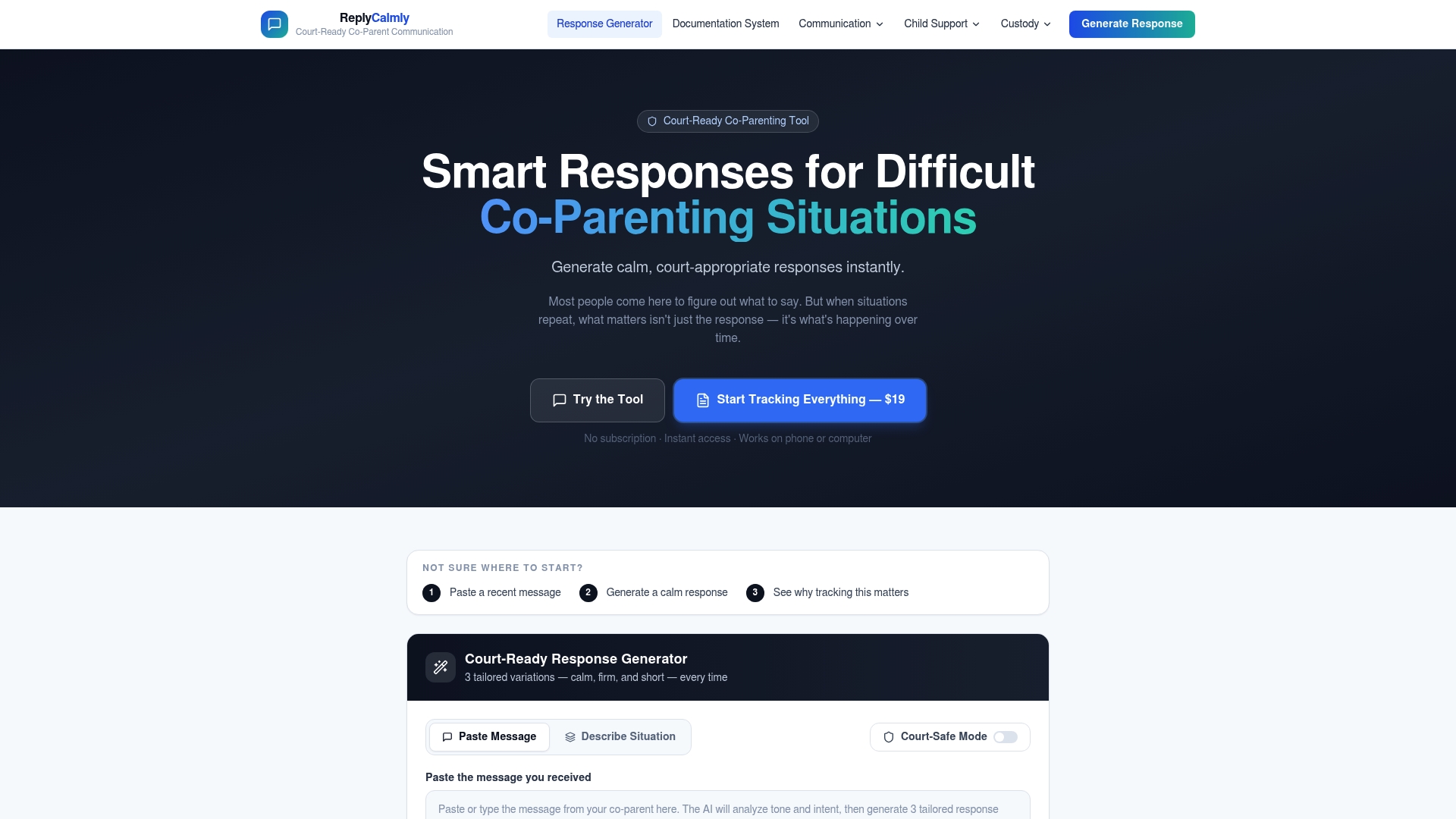
The platform generates multiple response variations (calm, firm, and short) for difficult messages you receive, so you always have a boundary-appropriate reply ready. It also logs incidents, tracks patterns over time, and builds a documentation record you can bring to court. For co-parents managing repeated violations, the best co-parenting apps for documentation page on Replycalmly compares the top tools side by side. If you want to start immediately, the co-parent response generator lets you paste a difficult message and get a calm, firm reply in seconds.
FAQ
What is a boundary-setting message?
A boundary-setting message is a clear statement that defines what you will do if a specific behavior continues. It focuses on your own actions, not demands on the other person.
How do "I" statements improve boundary communication?
"I" statements reduce defensiveness by expressing personal impact rather than accusation. They make your message harder to argue with because you are describing your own behavior, not judging theirs.
What should I avoid when setting boundaries in co-parenting?
Avoid over-explaining, apologizing for the boundary, or negotiating it when the other parent pushes back. Minimal explanation maximizes the effectiveness of any boundary statement.
How do I handle a co-parent who ignores my boundaries?
Execute the consequence you stated, document the violation, and do not re-explain the boundary. Consistency is what makes a boundary credible over time.
Can boundary messages be used as evidence in family court?
Yes. Written boundary messages sent through documented platforms like OurFamilyWizard or logged in tools like Replycalmly create a timestamped record that can support your case in family court communication.