
Co-parenting communication is defined as the structured, child-focused exchange of information between separated parents to manage custody arrangements and reduce conflict. When done well, it protects your children from the emotional fallout of parental disputes. Destructive interparental conflict raises parenting stress and increases child anxiety within six months. That finding alone makes this co-parenting communication guide worth reading carefully. Tools like the BIFF method, digital platforms like Replycalmly, and structured frameworks like parallel parenting give you real, tested ways to communicate better starting today.
What are the best practices for co-parenting communication?
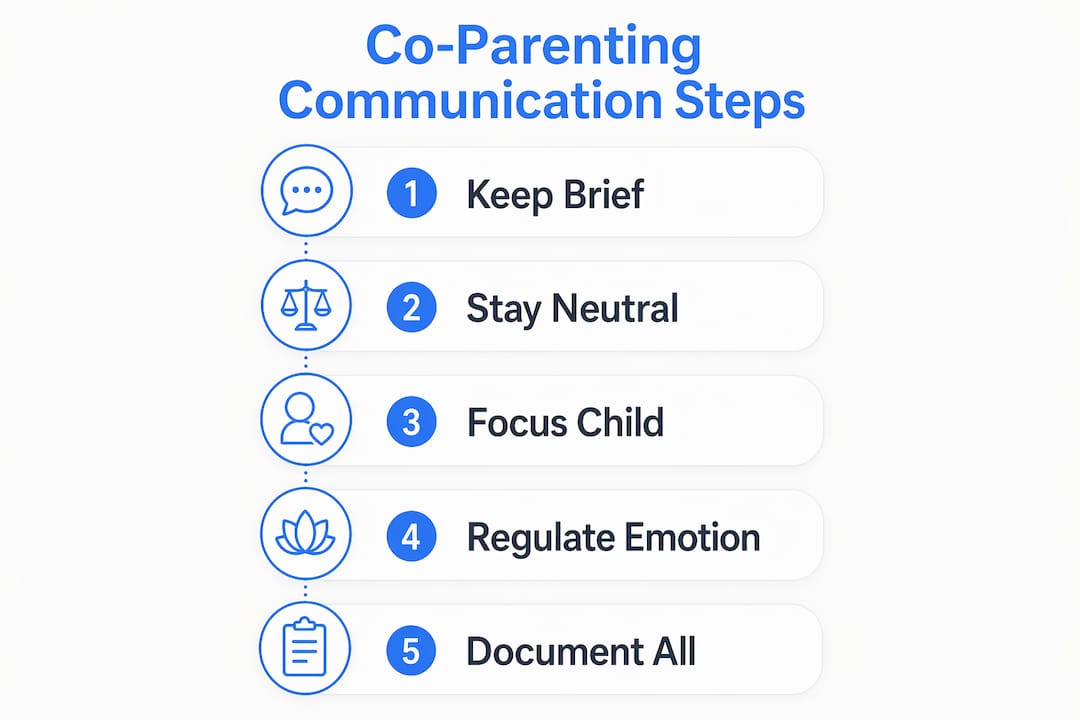
Effective co-parenting communication is built on four principles: brevity, neutrality, child focus, and emotional regulation. Every message you send should pass a simple test. Ask yourself: does this message serve my child's needs, or does it serve my frustration?

Short, factual, neutral messages strictly about your child are the single most validated approach across both research and practitioner guidance. They limit the surface area for argument. A message that says "Emma has a dentist appointment Thursday at 3 p.m." gives your co-parent nothing to escalate. A message that says "You never remember Emma's appointments, so I'm reminding you again" invites conflict.
The core principles of effective co-parenting communication:
- Keep it brief. Aim for three sentences or fewer per message.
- Stay child-focused. Every message should reference a child's need, schedule, or well-being.
- Use neutral language. Remove blame, sarcasm, and emotional commentary before sending.
- Regulate before you respond. If a message provokes you, wait before replying.
- Stick to facts. Dates, times, locations, and logistics only.
- Choose one channel. Text, email, or a dedicated app. Mixing channels creates confusion and gaps in documentation.
The BIFF method, developed by conflict resolution expert Bill Eddy, structures this approach into four words: Brief, Informative, Friendly, and Firm. BIFF responses reduce unnecessary argument by keeping replies concise and emotionally neutral. "Friendly" does not mean warm. It means free of hostility. That distinction matters in high-conflict situations.
Pro Tip: Draft your reply, then read it aloud. If any sentence sounds defensive or accusatory, delete it before sending.
Which digital tools support co-parenting communication?
Digital tools have moved co-parenting communication from reactive text threads to structured, documented exchanges. The difference is significant. A text thread is informal, easy to screenshot out of context, and hard to organize. A dedicated platform creates a timestamped, organized record that holds up in court or mediation.
The SES NXT digital intervention significantly reduces perceived post-divorce conflict among youth and parents, with medium-to-large effect sizes over 12 weeks in a randomized controlled trial of 294 youths and 467 family units. That is not a marginal improvement. It demonstrates that structured, child-oriented digital communication changes outcomes measurably.
| Tool | Primary Function | Documentation | Court-Ready Records |
|---|---|---|---|
| Replycalmly | Smart reply generation, incident tracking | Yes, timestamped | Yes |
| OurFamilyWizard | Shared calendar, messaging | Yes | Yes |
| TalkingParents | Recorded messaging | Yes | Yes |
| SES NXT | Child-focused conflict reduction program | Research-based | No |
| Standard email | General messaging | Partial | Requires export |
Replycalmly stands apart by generating calm, firm, or short reply variations for difficult messages you receive. You paste the message, and the platform produces multiple response options. That removes the emotional labor of crafting a neutral reply when you are already upset. The platform also tracks communication patterns over time, which builds a documented record of incidents, categories, and trends.
Pro Tip: Use a dedicated co-parenting app for all custody-related communication. Never mix parenting logistics with personal texts. The separation protects you legally and keeps conversations focused.
How to implement a step-by-step communication strategy
A child custody communication guide only works if you apply it consistently. Here is a practical sequence you can start using immediately.
- Choose one documented channel. Pick email, a co-parenting app, or a platform like Replycalmly. Commit to it for all custody-related communication.
- Write child-focused messages only. Every message should name a child's need. Remove anything that references your feelings about your co-parent.
- Apply the BIFF framework to every difficult reply. Keep it brief. State only the relevant information. Use a neutral tone. Be firm about logistics without being aggressive.
- Delay your response when provoked. Waiting before replying to provocative messages reduces emotional content and improves communication quality. Set a 30-minute or 24-hour rule for heated exchanges.
- Document agreements in writing. After any verbal or phone conversation, follow up with a written summary sent through your chosen channel. This creates a record.
- Review your communication monthly. Look for patterns. Are certain topics always escalating? Are responses getting longer and more emotional over time? Adjust your approach.
The table below shows how initial communication dynamics differ from ongoing ones as trust and structure develop.
| Phase | Communication Style | Primary Focus | Common Challenge |
|---|---|---|---|
| Early post-separation | Formal, minimal | Logistics only | High emotional reactivity |
| 3–6 months in | Structured, brief | Schedules and child needs | Boundary testing |
| 6+ months in | Consistent, neutral | Collaboration on child issues | Complacency or regression |
The biggest mistake co-parents make in the early phase is treating communication as a negotiation for power. It is not. It is a logistics operation with one goal: your child's stability.
What are the most common co-parenting communication mistakes?
Most communication breakdowns in co-parenting follow predictable patterns. Recognizing them is the first step to stopping them.
Common mistakes and how to correct them:
- Responding immediately when angry. Reactive replies escalate conflict fast. Apply the delay rule before sending anything written in frustration.
- Writing long messages. Length signals emotion. A five-paragraph message about a schedule change gives your co-parent five paragraphs to argue with. Keep it to three sentences.
- Bringing up past grievances. Every message should address the current issue only. Referencing old disputes derails the conversation and creates new conflict.
- Ignoring the child-focus test. If your message is really about your frustration with your co-parent rather than your child's needs, do not send it.
- Using ambiguous language. "Around 6 p.m." creates disputes. "6:00 p.m. at the school entrance" does not.
- Communicating across multiple channels. Splitting conversations between text, email, and phone calls makes documentation impossible and creates confusion.
When communication consistently breaks down despite your best efforts, parallel parenting is a structured alternative. Parallel parenting reduces direct communication needs in high-conflict situations by defining independent but coordinated parenting roles. Each parent operates autonomously in their own household, and contact is limited to written, logistics-only exchanges. It is not ideal long-term, but it protects children when direct communication causes repeated harm.
Children's adjustment after separation is strongly influenced by the level of conflict they witness. Parallel parenting, when applied correctly, removes children from the line of fire while parents work toward a more functional dynamic.
How does documentation protect you and your children?
Every message you send is a potential piece of evidence. That is not a reason to be paranoid. It is a reason to communicate with the same professionalism you would use in a workplace email to your boss.
BIFF-style messages create an objective, professional record that holds up in court or mediation. A message that is brief, factual, and neutral demonstrates to a judge or mediator that you are the cooperative parent. A message full of accusations and emotional language does the opposite. The record you build over months tells a story. Make sure it is the right one.
Replycalmly's timestamped documentation system logs incidents, categorizes issues such as custody conflicts, manipulation, and false accusations, and visualizes patterns through a dashboard. That kind of organized record is far more persuasive in a legal context than a stack of screenshots. You can learn the full process for documenting co-parenting issues step by step if you want to build a court-ready record from day one.
Pro Tip: After every significant exchange or agreement, send a follow-up message that summarizes what was decided. Keep it factual and brief. This creates a written record even when the original conversation happened by phone.
Avoid inflammatory language in every message, even when your co-parent uses it. Courts notice asymmetry. If your messages are consistently calm and theirs are consistently hostile, that pattern speaks for itself without you saying a word about it.
Key takeaways
Effective co-parenting communication requires brevity, child focus, emotional regulation, and consistent documentation to reduce conflict and protect your children's well-being.
| Point | Details |
|---|---|
| Use the BIFF method | Keep every message Brief, Informative, Friendly, and Firm to limit escalation. |
| Delay reactive responses | Wait at least 30 minutes before replying to provocative messages to reduce emotional content. |
| Choose one documented channel | Use a dedicated app or platform to create a consistent, court-ready communication record. |
| Apply parallel parenting when needed | Shift to parallel parenting in high-conflict situations to protect children from ongoing disputes. |
| Document every agreement | Follow up verbal conversations with a written summary sent through your chosen channel. |
What i've learned about co-parenting communication after years in this space
The hardest truth about co-parenting communication is that you cannot control how your co-parent communicates. You can only control yourself. That sounds simple. It is not.
Most people come to structured communication frameworks like BIFF after months of exhausting, escalating exchanges. They arrive frustrated, depleted, and convinced that nothing will work because their co-parent is impossible. What I have seen, consistently, is that when one parent commits to brief, neutral, child-focused messages, the dynamic shifts. Not always dramatically. Not always fast. But it shifts.
The emotional habit that matters most is separating your identity as a parent from your identity as someone who was wronged. Those are two different roles. When you write a message about your child's school schedule, you are a parent doing logistics. The grievances belong in a different conversation, with a therapist or a trusted friend, not in a text to your co-parent at 10 p.m.
Digital tools like Replycalmly exist because this separation is genuinely hard to do alone. Having a platform generate a calm reply when you are furious is not weakness. It is strategy. The goal is not to feel calm. The goal is to communicate calmly regardless of how you feel. That distinction is what protects your children and your legal standing at the same time.
Consistency over months is what builds a credible record and a functional co-parenting relationship. One good message does not matter. Two hundred good messages over a year does.
— Devin
Tools that make calm communication easier
If you are ready to stop reacting and start communicating with intention, Replycalmly gives you the structure to do it.
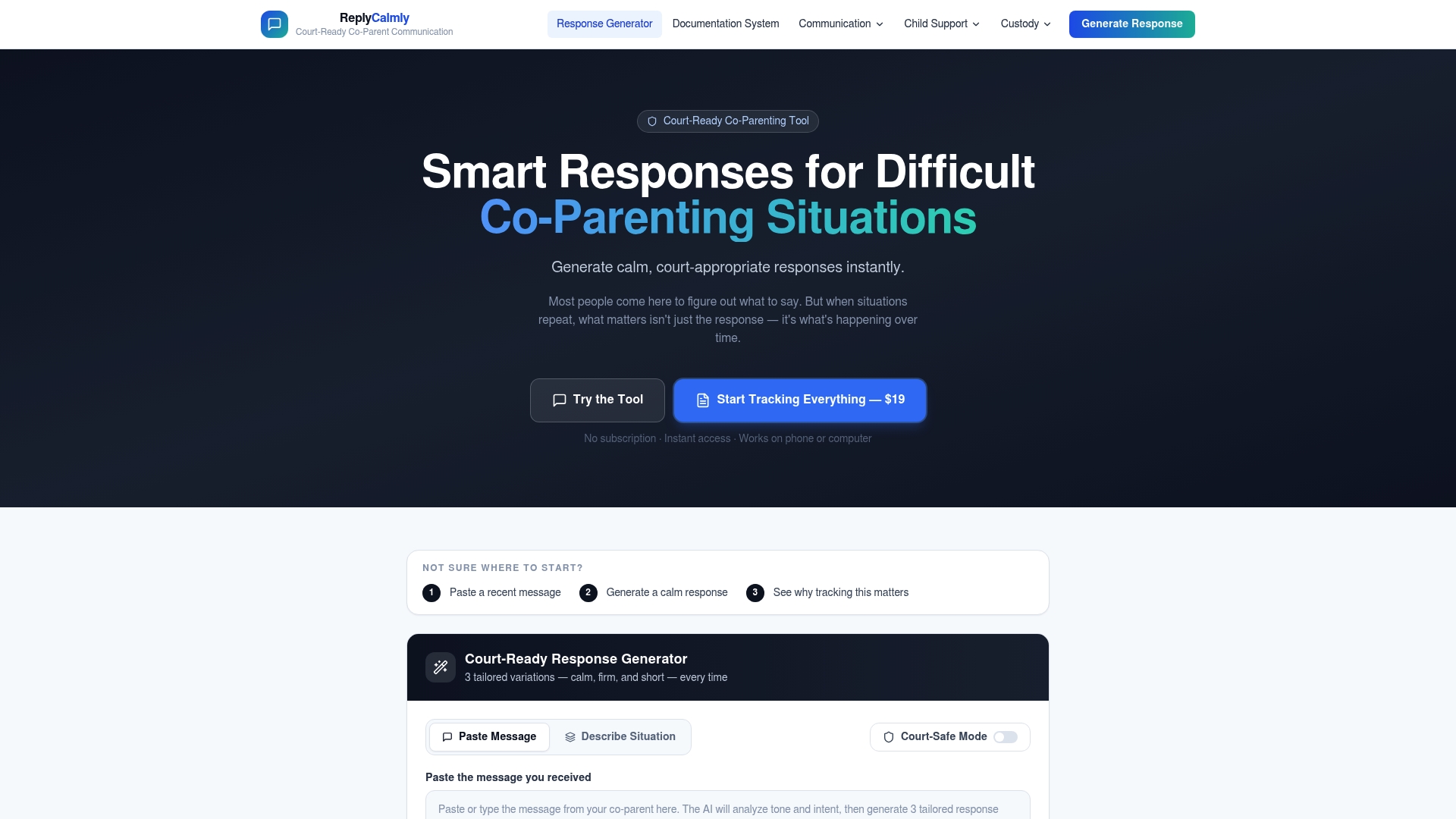
The platform's co-parent response generator lets you paste any difficult message and receive multiple reply options: calm, firm, or short. You choose the tone that fits the situation. Replycalmly also tracks your communication history, categorizes incidents, and builds a documented record you can use in court or mediation. For parents who want to compare the full range of options, the best co-parenting apps for documentation page breaks down the top platforms by feature. If you need ready-made language for common situations, the co-parent message templates library covers schedules, pickups, school events, and more.
FAQ
What is co-parenting communication?
Co-parenting communication is the structured exchange of child-focused information between separated or divorced parents to manage custody arrangements and reduce conflict. Effective communication stays brief, neutral, and strictly relevant to the child's needs.
What is the BIFF method for co-parenting?
The BIFF method, developed by Bill Eddy, stands for Brief, Informative, Friendly, and Firm. It is a structured framework for responding to hostile or provocative co-parent messages without escalating conflict.
How do digital tools help with co-parenting communication?
Digital platforms like Replycalmly provide timestamped documentation, smart reply generation, and incident tracking. The SES NXT intervention showed medium-to-large conflict reductions over 12 weeks in a randomized controlled trial, proving that structured digital tools measurably improve outcomes.
What is parallel parenting and when should i use it?
Parallel parenting is a co-parenting structure that minimizes direct communication by giving each parent independent authority in their own household. It is the right approach when direct communication consistently causes conflict that harms the children.
How does documented communication help in court?
Short, factual, neutral messages create an objective record that demonstrates cooperative behavior to judges and mediators. BIFF-style communication paired with a platform like Replycalmly produces timestamped, categorized records that are far more persuasive than informal text screenshots.