
When you are in a custody dispute, every message you send carries legal weight. One poorly worded text can be submitted as evidence, trigger a court modification request, or signal to a judge that you are the difficult parent in the room. This court appropriate message guide exists to cut through the anxiety and give you a concrete system: what courts expect, which tools to use, how to write messages that hold up under scrutiny, and how to document them so they actually work in your favor.
Table of Contents
- Key takeaways
- Your court appropriate message guide starts here
- Court-approved communication tools
- How to compose a court-appropriate message
- Documenting messages as evidence
- Common mistakes that hurt your case
- My take: professionalism is the strategy, not just the rule
- Tools that make court-appropriate communication easier
- FAQ
Key takeaways
| Point | Details |
|---|---|
| Write for the judge | Every message should be composed as if a judge will read it, using neutral tone and child-focused content only. |
| Use court-mandated tools | Courts can require specific co-parenting apps, and failing to comply risks contempt charges. |
| Skip screenshots | Metadata-rich formatted exports are far more admissible than raw screenshots in custody proceedings. |
| Tone is not enough | Apps with tone-checking features help, but courts also evaluate intent and pattern, not just word choice. |
| Document consistently | Sporadic records hurt your case; organized, chronological logs build credibility over time. |
Your court appropriate message guide starts here
Courts do not grade on a curve when it comes to communication standards in custody cases. What you write, how you write it, and where you write it all factor into how a judge perceives your cooperation as a parent. Most people assume they just need to "be nice," but the bar is more specific than that.
Judicial etiquette requires litigants to submit communications that are concise, respectful, and free of inflammatory rhetoric. That standard does not only apply to formal filings. It extends to co-parent messages that get submitted as exhibits.
Understanding appropriate court messaging means recognizing three things: what tone the court expects, what content is permissible, and what communication channels are legally recognized. Here is what those three things look like in practice:
- Tone: Neutral and businesslike. No sarcasm, no escalations, no loaded phrases like "as usual" or "you always."
- Content: Child-related logistics only. School pickups, medical appointments, schedule changes. Not relationship grievances.
- Channel: Written, documented, and ideally through a platform the court can verify.
Written communication must copy all parties and avoid ex parte contact, meaning you cannot send messages designed to reach a judge without going through proper procedure. Even if your co-parent copies a judge directly on an email, that is a procedural error that can backfire.
"Courts discern intent beyond wording. A technically polite message that is clearly designed to provoke or manipulate will not go unnoticed."
That quote captures something many co-parents miss. Checking your tone is necessary. It is not sufficient.
Court-approved communication tools
Family courts increasingly recommend or mandate co-parenting apps that store messages in an unalterable format, creating a verified record that neither party can edit after the fact. The difference between these tools and regular texting is significant.
| Feature | Standard Text/Email | Court-Approved App |
|---|---|---|
| Message editing after send | Possible | Not allowed |
| Metadata preserved | No | Yes |
| Admissibility in court | Questionable | High |
| Tone guidance | None | Some platforms include it |
| Centralized log | No | Yes |
Encrypted apps provide neutral records that are court-admissible and often include features like message tone guidance to flag language that may come across as hostile. These tools create a communication environment where both parents know everything is on record, which naturally reduces conflict.
Non-compliance is not a minor issue. Failure to use mandated apps can result in contempt of court charges. If your court order specifies a platform, use it exclusively for co-parent communication. Switching to text "just this once" creates gaps in your record and potential legal exposure.
Pro Tip: If your current order does not specify a communication platform, ask your attorney about requesting one. Proactively using a court-recognized app before being ordered to do so signals good faith to the court.
For a breakdown of which platforms offer the strongest documentation features, the best apps for documentation guide at Replycalmly covers what to look for and why it matters legally.
How to compose a court-appropriate message
This is where most co-parents need the most help. Writing messages for legal proceedings is a specific skill, and it looks nothing like how most people communicate when they are frustrated or scared.
Follow this structure for every message you send:
- State the purpose in the first sentence. "I am writing to confirm the pickup time for Saturday, March 15th." No preamble, no context-setting that edges toward grievance.
- Include only the facts relevant to the child. Address, time, which parent is responsible for transportation. Nothing about what happened last week.
- Use "I" statements, not "you" accusations. "I will bring her at 3 p.m." beats "You said 3 p.m. last time and were late."
- Close without editorializing. "Please confirm receipt." That is it. No passive-aggressive sign-offs.
- Read it back as if you are the judge. Would this message make you look cooperative? Or does it contain something that would give a reasonable person pause?
Hostile messages become evidence and can prompt custody modification requests. That is not hypothetical. Attorneys regularly use message exchanges to argue that one parent's communication style creates an unstable environment for the child.
When you receive a hostile or provocative message, the temptation to respond in kind is real. Do not. The response you give matters more to the court than the provocation you received. Your job is to stay factual and brief. If the message does not require a response, you do not have to send one.

Pro Tip: Before sending any message during a high-conflict period, draft it, wait 30 minutes, and re-read it once. Most emotionally reactive language surfaces during that second read. For ready-made response options, Replycalmly's response generator lets you paste a received message and get calm, firm, or short reply variations instantly.
For real examples of what court-compliant messages look like in practice, court-approved message examples at Replycalmly are worth reviewing before your next difficult exchange.
Documenting messages as evidence
Writing well is half the work. The other half is making sure your messages are stored and presented in a format courts will actually accept.
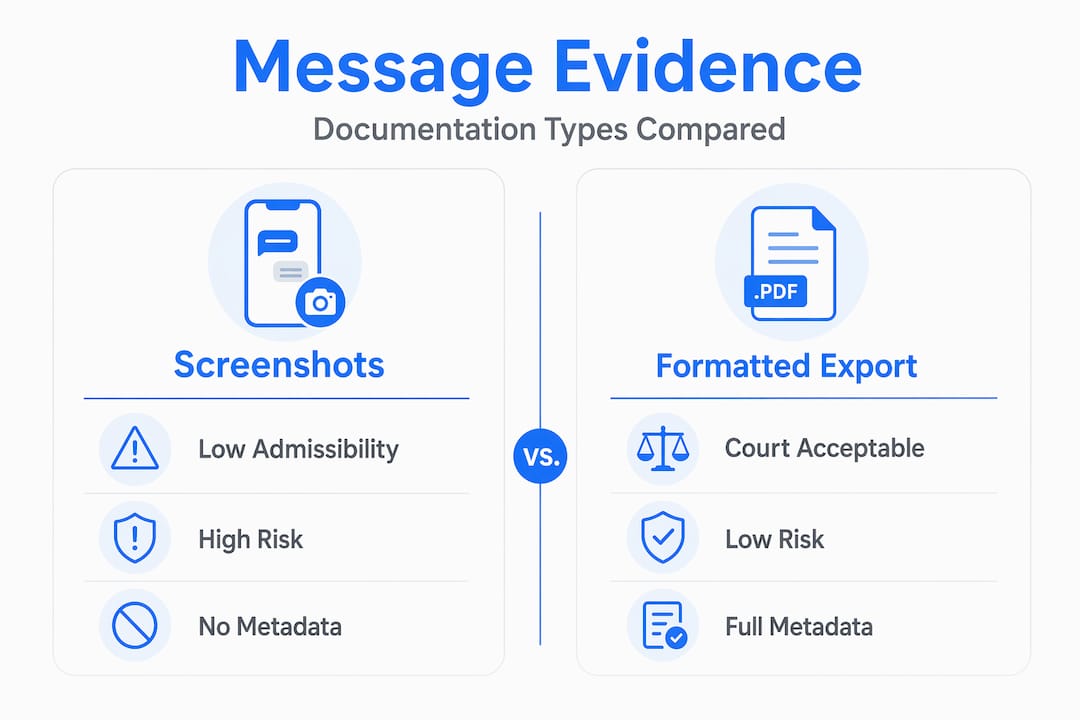
Judges prefer chronological reports with preserved metadata over raw screenshots. That preference matters because screenshots are easy to manipulate, lack authentication data, and often show messages out of context. A properly formatted export from a court-approved platform is significantly more reliable as evidence.
Here is what strong documentation looks like:
- Preserved metadata: Date, time, sender, and platform are all visible and unaltered.
- Chronological order: Messages flow sequentially so a judge or attorney can follow the narrative without reconstructing it.
- Categorized incidents: If you are logging a pattern, group messages by issue type (missed pickups, custody violations, threatening language).
- No selective editing: Present complete exchanges. Submitting only the provocative message while hiding your escalating reply will damage your credibility.
| Documentation Type | Court Admissibility | Risk Level |
|---|---|---|
| Raw screenshots | Low to medium | High |
| Formatted app export | High | Low |
| AI-formatted report with metadata | High | Low |
| Handwritten notes | Very low | Very high |
Professionally formatted exports with metadata are what legal advocates recommend when you need messages to hold up as authenticated evidence. The difference between organized documentation and a folder of screenshots can determine whether your exhibit gets admitted at all.
For a step-by-step process on organizing your communication record, how to document co-parenting issues walks through the full process in plain terms.
Common mistakes that hurt your case
Even parents who try hard to communicate appropriately make errors that undercut their position. These are the ones that come up most often.
- Using regular texts when a platform has been ordered. Every off-platform message is a compliance gap and a potential exhibit against you.
- Sending messages directly copied to the judge. Copying a judge directly is a procedural error. All communication goes through clerks or legal representatives, with all parties copied.
- Letting urgency override tone. A last-minute schedule change does not justify a terse or accusatory message. Brief does not mean rude.
- Failing to respond at all. Ignoring court-related requests or going silent on documented platforms reads as non-cooperation. If you cannot respond in time, send a brief acknowledgment.
- Mixing personal grievances with child logistics. Even one sentence about your relationship history poisons an otherwise clean message. Keep the two completely separate.
- Inconsistent documentation. Logging incidents only when things get bad means your record looks reactionary rather than thorough. Consistent documentation tells a clearer story.
The pattern you establish over weeks and months carries more weight than any single message. Courts look at communication history to assess which parent is more likely to support a healthy co-parenting relationship going forward.
My take: professionalism is the strategy, not just the rule
I've worked with enough high-conflict co-parenting situations to know that the hardest part is not understanding the rules. It's following them when you are angry, exhausted, and convinced the other parent is acting in bad faith.
Here is what I've found to be true: the co-parent who communicates professionally and consistently, over time, almost always comes out ahead. Not because courts reward sainthood, but because patterns of calm, child-focused communication signal stability. And stability is exactly what judges are looking for when they make custody decisions.
What I've seen work best is treating every message like a work email to a difficult colleague, one where HR might be reading. You stay professional not because you agree with the other person, but because the audience that matters most (the court) is always watching. The emotional satisfaction of firing off the perfect reply is never worth what it costs you in the proceeding.
The parents who struggle most are the ones who try to use messages to prove a point or win an argument. The messages are not for winning arguments. They are for demonstrating that you are a stable, cooperative parent. Keep that as your north star, and the right words tend to follow.
— Devin
Tools that make court-appropriate communication easier
Staying composed when your co-parent sends something inflammatory is genuinely hard. Having a system behind you makes it easier and more consistent.
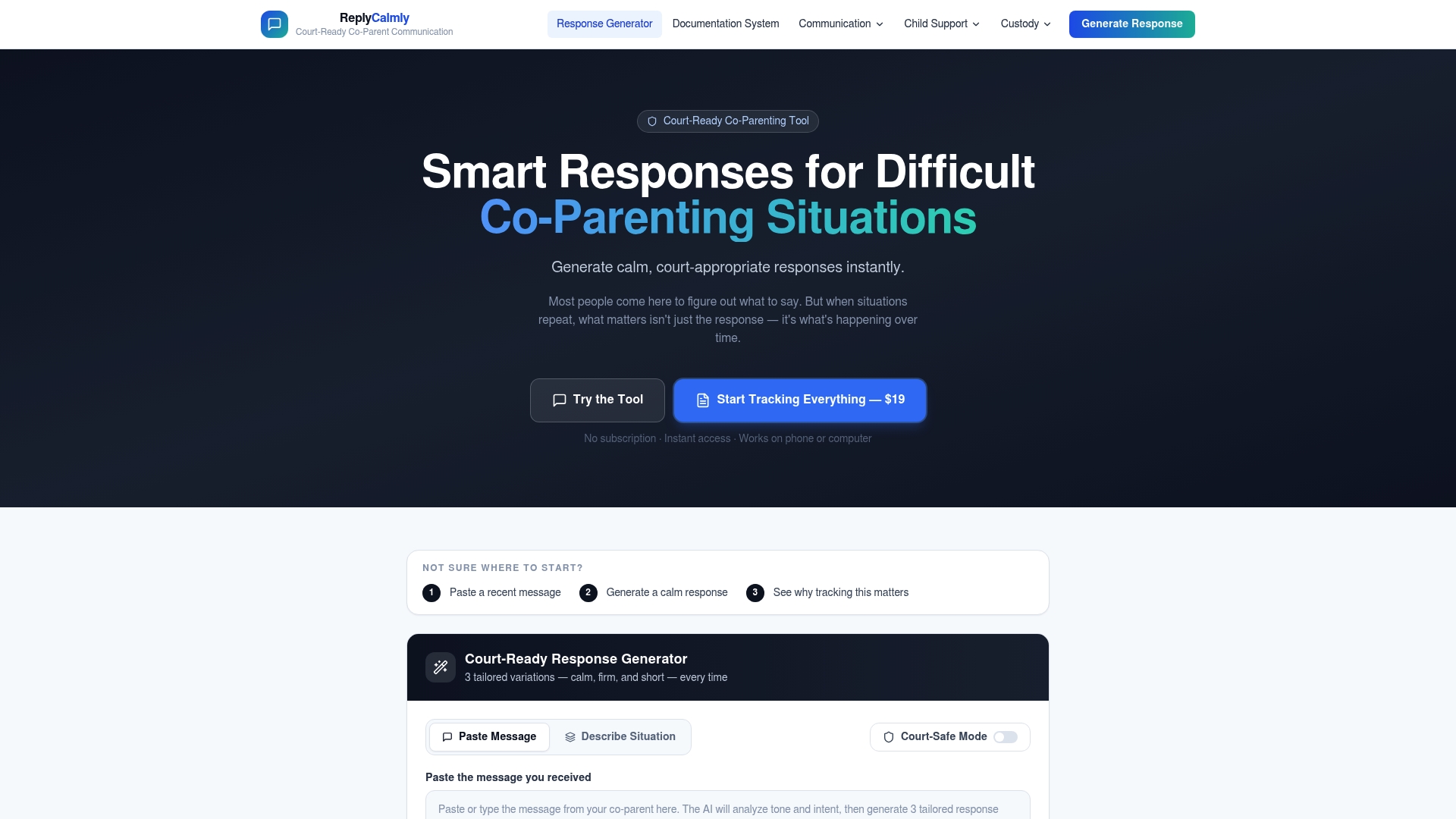
Replycalmly is built specifically for this situation. The free response generator lets you paste a difficult message and get multiple reply options: calm, firm, and short. Each one is designed to stay within court-appropriate boundaries without forcing you to figure out the wording yourself. Beyond responses, Replycalmly's tracking tools log incidents, categorize issues, and produce the kind of organized record that holds up in court. If you want to start with a structured communication framework, the communication plan template gives you a solid foundation. These are tools built for the reality of high-conflict co-parenting, not ideal-scenario advice.
FAQ
What makes a message court-appropriate?
A court-appropriate message is child-focused, neutral in tone, free of inflammatory language, and sent through a documented channel. Every message should be written as if a judge will read it.
Can courts require co-parents to use specific apps?
Yes. Courts can mandate specific co-parenting platforms that store messages in an unalterable format. Failing to comply with that order can result in contempt of court charges.
Are screenshots good enough to use as evidence?
Screenshots are often insufficient because they lack authentication metadata and can be manipulated. Formatted exports from court-approved platforms or AI-based tools are more reliable and more likely to be admitted as evidence.
Is it ever okay to ignore a co-parent's message?
If a message does not require a response, you do not have to reply. But if it relates to child logistics or a court-related matter, failing to acknowledge it can be read as non-cooperation by the court.
What should I do if I receive a hostile or abusive message?
Document it through your platform, do not respond in kind, and keep your reply factual and brief if a response is needed. The calm, professional response you send after a hostile message is often more valuable to your case than the message you received.