
Court-appropriate phrases are formal, respectful expressions used in judicial settings to communicate clearly, professionally, and without hostility. For parents in high-conflict custody disputes, knowing a solid list of court-appropriate phrases is the difference between a judge who sees you as credible and one who sees you as a problem. This guide covers the exact courtroom language you need, organized by purpose, so you can walk into your next hearing prepared and composed. Resources like eLitigant and TrialBase confirm that proper phrasing directly affects how judges perceive self-represented parents.
1. How to address a judge and court officials correctly
The single most important rule in any courtroom is how you address the judge. Formal titles are required: use "Your Honor" for most judges in American courts, and "Sir" or "Ma'am" for magistrates and district judges where applicable. Never use the judge's name directly, and never use "you" when speaking to the bench.
Correct address phrases include:
- "Your Honor, may I address the court?"
- "May it please the court..."
- "I seek the court's indulgence to clarify..."
- "With the court's permission..."
- "If it pleases the court, I would like to submit..."
These phrases signal respect and keep your submission directed at the judge, not the other parent. That distinction matters enormously in custody cases where emotions run high.
Pro Tip: Before your hearing begins, ask the court usher how the judge prefers to be addressed. Different courtrooms have different conventions, and getting it right from the first sentence sets a professional tone.

2. Essential objection phrases and when to use them
Objections are one of the most misunderstood tools available to self-represented parents. Objection phrases must be short and direct: say "Objection, relevance" or "Objection, hearsay" the moment the issue arises. Waiting even a few seconds reduces the effectiveness of the objection.
| Objection Phrase | Purpose |
|---|---|
| Objection, relevance | Challenges evidence unrelated to the custody matter |
| Objection, hearsay | Challenges secondhand statements offered as fact |
| Objection, leading | Challenges questions that suggest their own answer |
| Objection, speculation | Challenges testimony based on guessing, not direct knowledge |
| Objection, asked and answered | Stops repetitive questioning already addressed |
Over-explaining your objection backfires. Judges know the rules. Your job is to flag the issue, not lecture the court. Extended explanations disrupt proceedings and frustrate judges, which is the last thing you want in a custody hearing.
Pro Tip: If the judge asks you to explain the basis of your objection, respond with one sentence: "Your Honor, the question calls for speculation, not direct knowledge." Keep it tight and let the judge rule.
3. How to refer to the other parent in court
Addressing the other parent directly during a hearing is a common mistake that signals a lack of courtroom discipline. Courts expect all submissions to be directed at the judge, not at the opposing party. Speaking to the other parent directly can make you appear combative, which hurts your credibility.
Use third-person references at all times:
- "The respondent has stated that..."
- "The petitioner's position is..."
- "The other parent has indicated..."
- "My submission is that the respondent's claim is unsupported by the evidence."
- "I would respectfully ask the court to consider the petitioner's conduct."
These phrases keep the focus on facts and legal positions, not personal conflict. In high-conflict custody cases, visible hostility negatively impacts judicial perception. A judge who sees you staying calm while the other parent escalates will notice.
When you need to challenge a statement made by the other parent, use courteous but firm language: "My learned colleague appears to overlook the fact that..." or "With respect, the record does not support that position." Phrases like these, drawn from professional courtroom standards, let you push back without appearing aggressive.
4. How to reference documents and evidence properly
Referencing evidence clearly is a skill that separates prepared parents from unprepared ones. Structured document referencing helps the court follow your submissions and signals that you know your case file.
Use this format when directing the court to a document: "If I could take you to page 23 of the bundle, paragraph 4, Your Honor." This phrase does three things at once. It shows respect, it gives the judge a precise location, and it keeps the hearing moving efficiently.
Other useful document reference phrases include:
- "I refer the court to Exhibit A, which shows..."
- "The record at page 12 confirms that..."
- "I would draw the court's attention to the email dated march 4, which is at tab 6."
- "The evidence before the court establishes that..."
Avoid vague references like "I have proof of this" or "there's a document somewhere." Vague language signals poor preparation. Precise language signals credibility.
5. Phrases for seeking clarification without losing credibility
Admitting you do not understand something in court is not a weakness. Courts view polite requests for clarification favorably, especially from self-represented parents. Guessing at the meaning of a legal term and getting it wrong is far more damaging than simply asking.
Useful clarification phrases include:
- "I apologize, but I am not familiar with that term. Could you please explain?"
- "Your Honor, could you clarify what that procedural step requires of me?"
- "I want to make sure I understand correctly. Are you asking me to..."
- "Could the court please repeat that? I want to respond accurately."
These phrases protect you from misunderstanding a directive and then acting on it incorrectly. Knowing standard legal phrases reduces anxiety for self-represented parents and helps them navigate courtroom dynamics more confidently. Asking for clarification also shows the judge that you are engaged and taking the proceedings seriously.
6. Phrases for making submissions and presenting your position
Making a submission means presenting your argument or position to the court in a structured way. The language you use signals whether you understand courtroom procedure or not.
Strong submission phrases include:
- "My submission is that the evidence supports..."
- "I respectfully submit that..."
- "The court may wish to consider that..."
- "I would ask the court to find that..."
- "On the balance of the evidence, I submit that..."
Clarity and precision in language demonstrate preparedness and respect. Avoid lay terms that sound informal. For example, say "adduce evidence" rather than "go into evidence," and say "the matter is listed" rather than "the matter is taken up." These small word choices signal that you understand the court's language, which builds credibility with the judge.
When you need to respond to a co-parent's accusations made in court, frame your response as a submission: "Your Honor, I respectfully submit that the respondent's characterization of events is not supported by the documentation before the court."
7. Phrases for closing your argument respectfully
How you close your argument leaves a lasting impression. A clean, respectful closing tells the judge you are organized and confident in your position.
Effective closing phrases include:
- "Those are my submissions, Your Honor."
- "I am grateful for the court's time and consideration."
- "I respectfully ask the court to rule in favor of the position I have outlined."
- "I am happy to answer any questions the court may have."
- "I thank the court for the opportunity to be heard."
Never end with an emotional appeal or a personal attack on the other parent. Judges decide custody cases on evidence and the child's best interests. A calm, structured closing reinforces everything your formal language has built throughout the hearing.
Key takeaways
Using a consistent list of court-appropriate phrases builds credibility, reduces conflict, and gives judges a clear picture of which parent is prepared and professional.
| Point | Details |
|---|---|
| Address the judge correctly | Use "Your Honor" and formal submission phrases; never use the judge's name. |
| Keep objections short | Say "Objection, relevance" immediately; never over-explain your basis. |
| Use third-person references | Refer to the other parent as "the respondent" or "the petitioner," never "you." |
| Reference documents precisely | Direct the court to exact page and paragraph numbers in the bundle. |
| Ask for clarification openly | Politely requesting explanations is viewed positively by judges and prevents costly mistakes. |
Why formal language changed how I think about custody court
I used to believe that the most important thing in a custody hearing was having the right facts. After watching dozens of parents navigate high-conflict cases, I changed my mind. The facts matter. But the way you present them matters just as much.
Parents who walk in using formal courtroom language, addressing the judge correctly, referencing documents by page number, and staying calm while the other parent gets emotional, those parents consistently come across as more credible. Judges are human. They notice who is composed and who is reactive.
The hardest part is not learning the phrases. The phrases are simple. The hard part is using them under pressure, when the other parent says something infuriating and every instinct tells you to respond directly to them. That is exactly when you turn to the judge and say, "Your Honor, I respectfully submit that the respondent's statement is not supported by the record." That one sentence does more for your case than any emotional rebuttal ever could.
Practice these phrases out loud before your hearing. Say them in the mirror. Record yourself. The goal is to make formal language feel natural so that when the pressure is on, the right words come automatically. Confidence in court does not come from knowing you are right. It comes from knowing exactly what to say.
— Devin
How Replycalmly helps you stay court-ready between hearings
Courtroom language is only part of the picture. What happens between hearings, in text messages, emails, and co-parenting app exchanges, shapes the record that follows you into court.
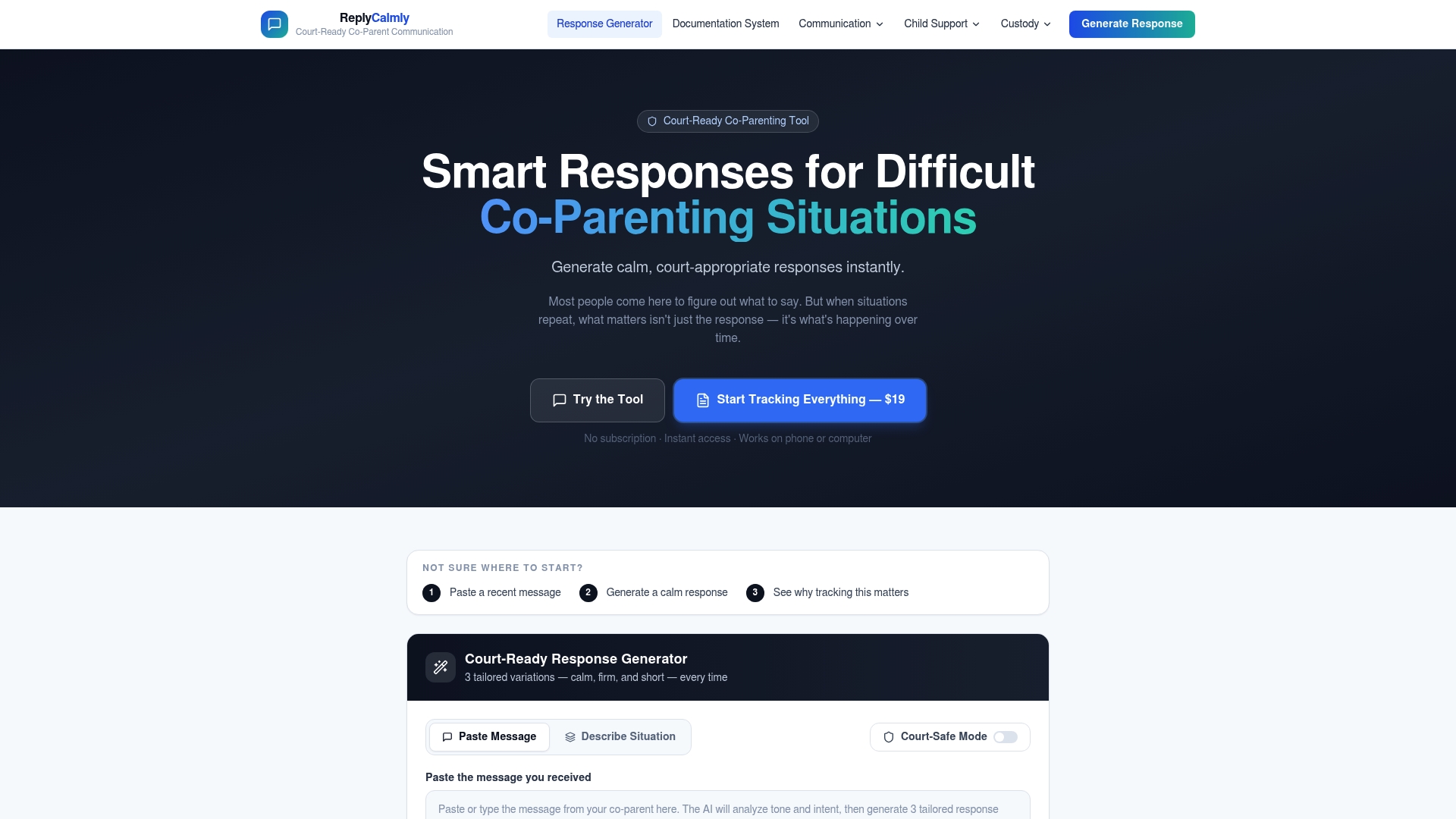
Replycalmly is built for exactly this situation. The platform generates calm, court-appropriate responses to difficult co-parenting messages, so you never send something in frustration that could be used against you. It also logs incidents and tracks communication patterns over time, giving you organized documentation when you need it most. For parents building a case, the co-parenting evidence log and the documentation step-by-step guide are two of the most practical tools available. Formal language wins hearings. Documented evidence wins cases.
FAQ
What does "court-appropriate language" mean?
Court-appropriate language refers to formal, respectful expressions used in judicial settings that address the judge directly, avoid personal attacks, and follow established courtroom etiquette. It includes phrases like "Your Honor," "I respectfully submit," and third-person references to the opposing party.
Can I object in court if I don't have a lawyer?
Yes. Self-represented parents can raise objections using short, direct phrases like "Objection, relevance" or "Objection, hearsay." Raising objections immediately is most effective, and you should avoid lengthy explanations unless the judge asks for one.
Is it okay to ask the judge to explain a legal term?
Asking for clarification is not only acceptable but encouraged. Courts view polite requests for clarification positively, particularly from self-represented parents, and it prevents costly misunderstandings.
Why should I avoid addressing the other parent directly in court?
Directing submissions at the opposing party rather than the judge signals a lack of courtroom discipline and can make you appear combative. All statements should be addressed to the judge using third-person references to the other parent.
How do I reference a document during my hearing?
Use the format: "If I could take you to page 23 of the bundle, paragraph 4, Your Honor." This approach gives the court a precise location, keeps proceedings moving, and demonstrates that you are organized and prepared.