
Child-focused communication is calm, factual, contemporaneous messaging between co-parents that keeps the child's best interests central and is documented in a way that holds up under Federal Rules of Evidence authentication principles — usable by your attorney and platforms like Replycalmly. Every message you send is a potential exhibit. Treat it that way from the start.
The single most important rule: write it the same day, stick to facts, and save the full thread.
Three things to do right now:
- After any relevant event, send a brief confirming text or app message to create a dated written record.
- Save the complete native thread — not a cropped screenshot — with timestamps intact.
- Log the date, time, what happened, and any exact quotes in a dedicated incident record before the day ends.
Table of Contents
- What does "child-focused communication" mean in a custody case?
- How judges and custody evaluators actually read your messages
- What you should be recording: an operational checklist
- How to create court-ready records, step by step
- Which communication channels hold up best in court?
- Ready-to-use message templates for court-appropriate communication
- How to prepare your records for your attorney or the court
- Key Takeaways
- What the Reply Calmly Team has learned from high-conflict cases
- Replycalmly makes this workflow practical from day one
- Useful sources
What does "child-focused communication" mean in a custody case?
In family court, child-focused communication is not a therapeutic concept. It is a legal standard. A message or log entry qualifies when it meets four criteria judges and custody evaluators actually use:
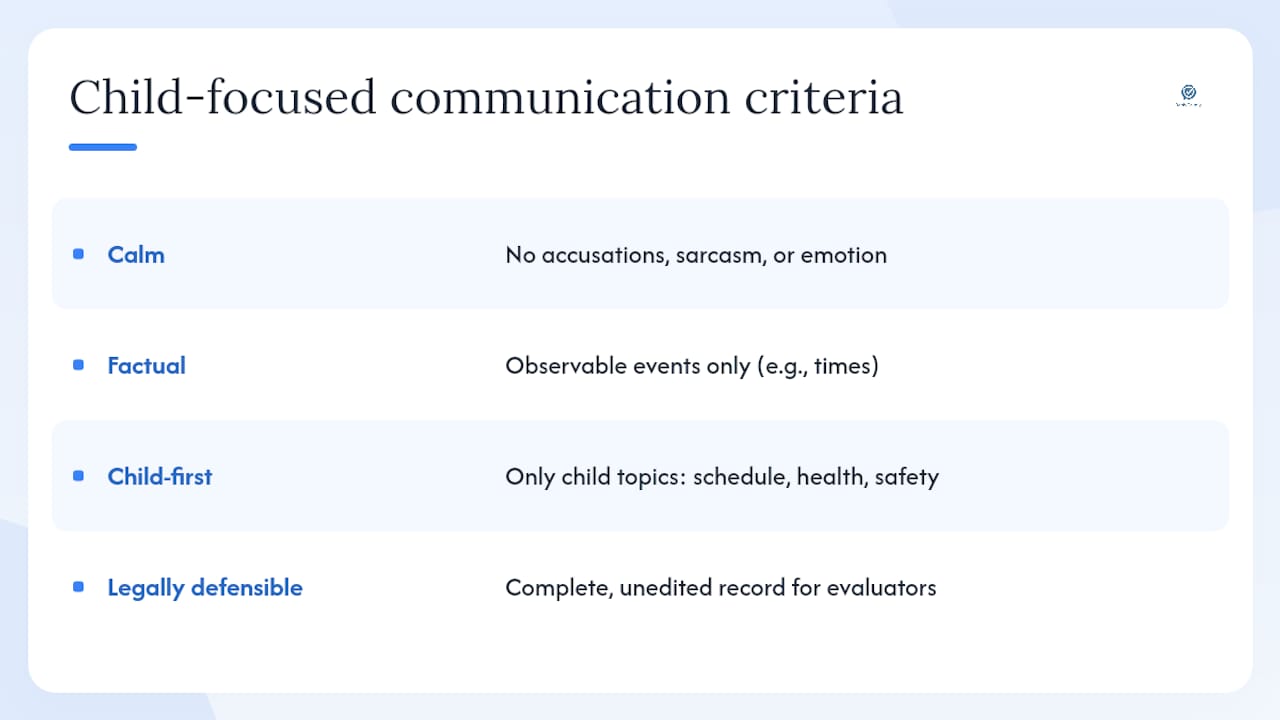
Calm. No accusations, no sarcasm, no emotional language. The tone should read the same whether you wrote it at 9 AM or 11 PM after a difficult exchange.
Factual. Observable events only. "Pickup was scheduled for 5:00 PM. The other parent arrived at 6:23 PM" is factual. "He's always late and doesn't care about our child" is not.
Child-first. Every message addresses a child-related topic: schedule, health, school, safety. Nothing else belongs in the thread.
Legally defensible. The record is complete, unedited, and stored so a guardian ad litem, custody evaluator, or judge can read it without needing your interpretation. These are the people who will actually read your logs — and they are looking for patterns, not your conclusions about those patterns.
Separating personal emotion from the child's needs produces more sustainable agreements and shields children from adult disputes. Child-centered phrasing also helps evaluators see your intent clearly, which matters when two parents give opposing accounts.
How judges and custody evaluators actually read your messages
Judges and evaluators routinely review months or years of written communications to assess patterns of cooperation, escalation, and whether a parent prioritizes the child's needs. A single good message rarely moves a case. A consistent record of calm, factual exchanges does.
Three tests every entry faces:
- Is it specific? Vague entries ("things were difficult") carry no weight. Specific entries ("child was not returned by the 6:00 PM exchange time per the December 15 order") give the court something to act on.
- Is it contemporaneous? Entries made close to the event carry far more credibility. A batch of entries added weeks later is vulnerable to challenge by opposing counsel.
- Is it factual, not argumentative? Written messages are unfiltered and can reveal admissions or tone; pattern evidence is often more persuasive than any single message. A thread full of escalating accusations tells a story — just not the one you want told.
Courts also look at cooperation patterns: how often exchanges happen on time, whether schedule changes are handled calmly, and whether a parent's messages suggest they support the child's relationship with the other parent. Authentication under principles like Federal Rule of Evidence 901 requires that records be what they claim to be — full threads with intact metadata, not selectively captured images.
Pro Tip: After a verbal exchange, send a brief confirming message within the hour: "Confirming our conversation today — Emma will be picked up Saturday at 10:00 AM." That one sentence creates a dated, neutral record that corroborates the verbal agreement without editorializing.
What you should be recording: an operational checklist
Court-appropriate documentation must be contemporaneous, specific, and factual; judges prefer short, consistent entries and balance over venting. Here is what belongs in your log:
| Record Type | What to Capture | Why It Matters to the Court |
|---|---|---|
| Schedule/exchanges | Planned time vs. actual time, location, who was present | Establishes patterns of compliance or violation |
| Verbal agreement confirmations | Date, what was agreed, follow-up message sent | Converts unverifiable verbal events into dated written records |
| Full communication threads | Complete SMS, email, or app thread with timestamps | Authentication; courts reject cropped or partial screenshots |
| Child-welfare observations | Date, observable behavior, context (no diagnosis) | Supports or counters claims about the child's wellbeing |
| Safety incidents | Date, time, what occurred, who was notified | Critical for emergency motions; requires corroboration |
| Third-party contacts | School, police, medical provider — date, name, summary | Independent corroboration that strengthens your account |
| Corroborating exhibits | Photos, receipts, school records, police reports | Ties documentary evidence to specific log entries |
Weak entry: "He was late again and the kids were upset. This always happens." Court-useful entry: "March 4, 2026, 6:41 PM — Scheduled pickup was 6:00 PM per parenting plan. Other parent arrived at 6:41 PM. Children were in the driveway waiting. No advance notice was given. See attached text thread."
The difference is not effort. It is discipline.
How to create court-ready records, step by step
A contemporaneous, dated factual record serves as a neutral tie-breaker when parents give opposing accounts. Follow this workflow every time:
- Immediate on-scene note. If something happens during an exchange, note the time and key facts on your phone before you leave the location.
- Same-day entry. Before midnight, write a formal log entry with the exact date, time, channel, and what occurred. Keep it under 150 words.
- Capture the full native thread. Export the complete SMS chain, email thread, or app conversation — not a screenshot. Metadata matters for authentication.
- Back up in two places. Cloud storage plus a local drive. Losing your only copy before a hearing is a real risk.
- Attach corroborating evidence. Link the photo, receipt, or police report number directly to the log entry.
- Add to your index. Update a running timeline so your attorney can find any entry in under a minute.
Template fields for every entry:
- Date and time (MM/DD/YYYY, HH:MM AM/PM)
- Channel (text, email, OurFamilyWizard, TalkingParents, AppClose, in-person)
- What happened (observable facts only)
- Exact quote if words are disputed
- Witnesses, if any
- Attachments referenced
- Parenting plan provision affected, if relevant
Pro Tip: Parenting apps like OurFamilyWizard, TalkingParents, and AppClose produce exports with custodian declarations that satisfy authentication requirements far more cleanly than screenshots. Ask your attorney whether the court prefers a specific export format before your next hearing.
Which communication channels hold up best in court?
Effective communication with children and co-parents depends on choosing channels that preserve evidence automatically. Not all channels are equal.
| Channel | Tamper-resistance / Export & Metadata | Court-friendliness | Ease During High Conflict |
|---|---|---|---|
| SMS/iMessage | Moderate — screenshots only unless backed up natively; no custodian declaration | Acceptable; full thread required | Easy to use; hard to export cleanly |
| Good — full headers show sender, recipient, timestamps | Strong when headers are preserved | Moderate; easy to save | |
| Parenting app (OurFamilyWizard, TalkingParents, AppClose) | High — immutable timestamps, custodian-declaration exports | Strongest option; preferred by many courts | Moderate; requires both parents to use it |
| Verbal / in-person | None on its own | Weak unless immediately confirmed in writing | High conflict; always follow up in writing |
For SMS, preserve the full native thread through your phone's backup, not a cropped photo. For email, save the raw message file with headers intact. For parenting apps, request the official export and ask your attorney whether a custodian declaration is needed for your jurisdiction.
Replycalmly integrates with this workflow by helping you draft calm, court-appropriate replies before you send them, then log the exchange as a documented incident. It works alongside platforms like OurFamilyWizard rather than replacing them.
Pro Tip: Never send a message from a verbal conversation without a follow-up written confirmation. "Per our conversation this morning, pickup will be Sunday at 11:00 AM" takes ten seconds and creates a record that a verbal exchange cannot.
Ready-to-use message templates for court-appropriate communication
Structured frameworks like BIFF (Brief, Informative, Friendly, Firm) keep messages short, factual, and reduce inflammatory exchanges. Every template below follows that principle: 2–5 sentences, one issue, no accusations.
Calm informational replies
- "Emma's next pediatric appointment is April 3 at 2:00 PM at Dr. Patel's office. Please confirm you received this."
- "The school sent home a permission slip for the May 10 field trip. I've signed it and will send a copy to your email."
- "Per the parenting plan, spring break begins April 14. I will have the children ready at 9:00 AM."
Firm but factual replies
- "Pickup was scheduled for 5:00 PM. I did not receive notice of a delay. Please confirm the revised time."
- "I am not able to agree to a schedule change on this date. The current order stands."
- For repeated late pickups: "This is the third consecutive exchange where arrival was more than 30 minutes after the scheduled time. I am documenting this and will address it with counsel."
Confirming messages (verbal to written)
- "Confirming our phone call today: you will cover school pickup on Thursday, March 12."
- For schedule change requests: "I am open to discussing the proposed change. Please send the request in writing so I can review it."
- "As discussed at drop-off, Liam has a fever. I've notified the school. Please confirm you received this update."
Pre-send checklist:
- Does this message address only a child-related topic?
- Is it one issue only?
- Is it 2–5 sentences?
- Does it include dates and times where scheduling is involved?
- Does it contain any accusation, sarcasm, or emotional language? (Remove it.)
- Have you saved the full thread after sending?
Keep messages brief, focused on one issue, avoid demands and assumptions, and do not send repeated follow-ups when the other parent does not reply immediately.
How to prepare your records for your attorney or the court
Collecting records is only half the work. Presenting them clearly is what makes them usable.
- Collect native exports. Pull the official export from each parenting app. For SMS, use your phone's full backup. For email, export raw message files with headers.
- Build a simple index. One row per entry: date, time, event summary, file name, channel, and any witness. Your attorney should be able to find any record in under a minute.
- Attach corroborating exhibits. Each log entry that references a photo, police report, or school record should name the file directly.
- Note chain of custody. For app exports, confirm who generated the report and when. For SMS, note the device and backup method.
- Share with counsel early. Do not wait until the week before a hearing. Attorneys need time to identify gaps and request additional records.
Red flags that weaken your evidence:
- Edited or cropped screenshots with missing context
- Long editorial notes explaining what the other parent "really meant"
- Batch entries added weeks after events with no contemporaneous backup
- Missing full-thread context that makes a message look different in isolation
The goal in high-conflict communication is clarity, containment, and emotional safety. Treating every message as a potential exhibit is not paranoia — it is the discipline that keeps your record credible.
Key Takeaways
Child-focused communication in high-conflict custody cases requires same-day, factual, calm records that meet the three judicial tests — specific, contemporaneous, and factual — and are preserved in formats courts can authenticate.
| Point | Details |
|---|---|
| Three judicial tests | Every entry must be specific, dated near the event, and factual — not argumentative. |
| Same-day documentation | Log incidents before midnight; late batch entries are vulnerable to challenge by opposing counsel. |
| Full-thread preservation | Export complete native threads with metadata; cropped screenshots alone are insufficient for authentication. |
| Balanced, neutral tone | Courts discount one-sided venting; consistent, calm records across months build credibility. |
| Replycalmly for drafting and logging | Replycalmly drafts calm, firm, and short replies and logs incidents with exportable reports, integrating with apps like OurFamilyWizard. |
What the Reply Calmly Team has learned from high-conflict cases
Most co-parents in high-conflict situations make the same mistake: they document to win, not to inform. Long entries full of interpretation, emotional context, and conclusions about the other parent's motives read exactly the way judges describe them — as advocacy, not evidence. A judge who sees 200 entries where every single one portrays the other parent negatively does not conclude that parent is terrible. The judge concludes that the writer lacks objectivity.
The parents whose records actually help their cases write short, boring entries. Date, time, what happened, who was there. That is it. The power is in the pattern, not the prose. Months of consistent, factual, timestamped records showing missed exchanges, unanswered communications, or safety incidents speak for themselves — and they speak far more persuasively than any editorial commentary ever could.
The American Bar Association's family law resources consistently point to the same principle: courts are looking for the parent who demonstrates stability and child-focus over time. Your documentation is that demonstration. Build it like a professional, not a litigant.
Replycalmly makes this workflow practical from day one
High-conflict co-parenting documentation is exhausting when you are doing it manually. Replycalmly is built specifically for parents who need court-appropriate replies fast and a documented record that holds up.
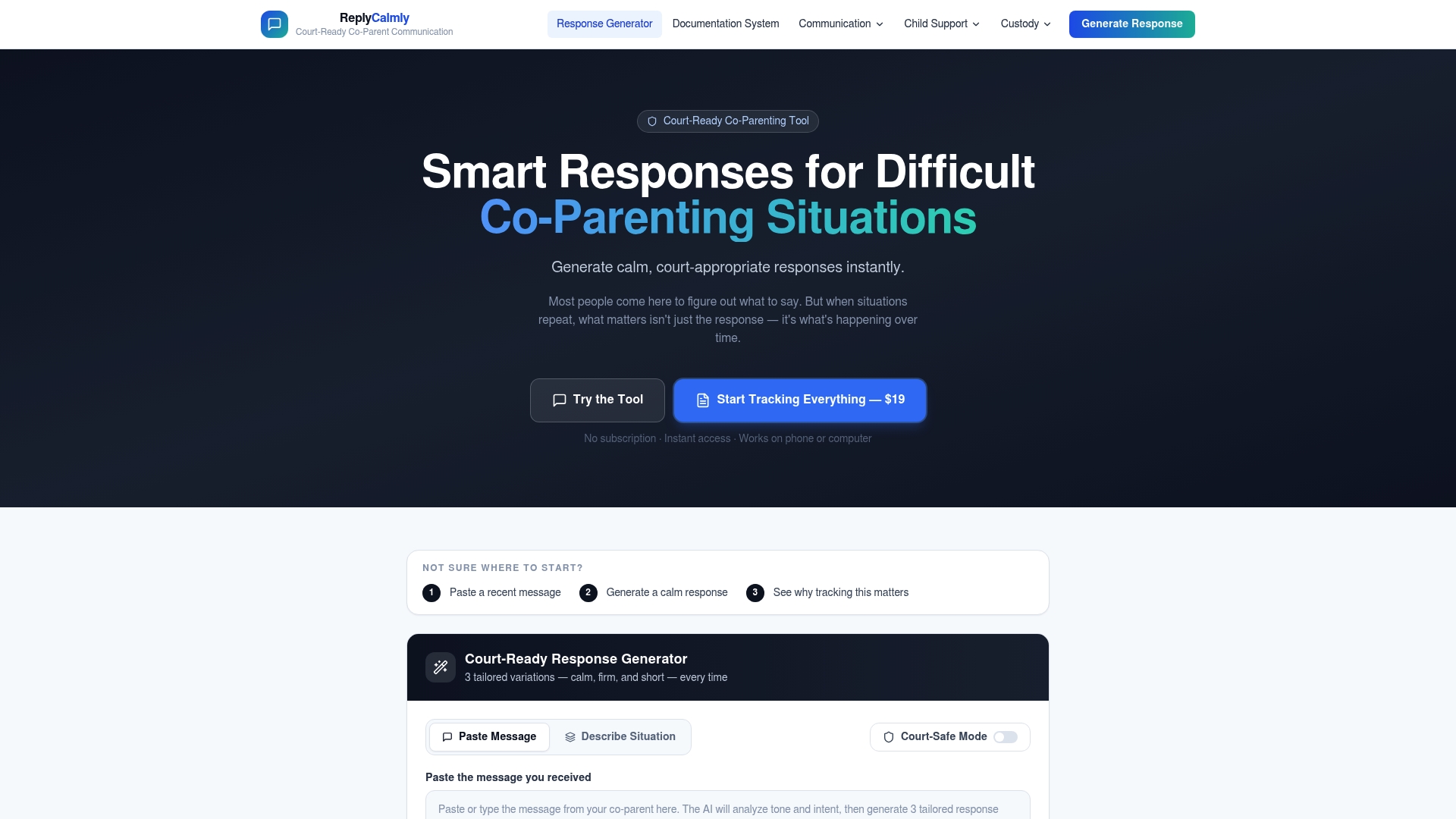
Paste a difficult message into the free co-parent response generator and get calm, firm, and short reply options in seconds — each one written to stay within the boundaries courts expect. The full platform adds incident tracking with category tags, evidence attachments, pattern dashboards, and exportable court reports. It integrates with OurFamilyWizard and TalkingParents rather than replacing them, so your existing court-mandated channel stays intact. Subscription access starts at $19/month after a 3-day free trial. Start with the free generator today and see how much easier the next difficult message becomes.
Useful sources
- Custody Journal for Court: What to Track, How to Format & What Judges Want - Co-Parenting Guide
- How to Document Co-Parenting Communication for Court - Co-Parenting Guide
- Custody Case Evidence: How To Communicate With The Other Parent - Family Law - United States
- Ask Attorney Jennifer B.: Email Evidence and Texting Trouble, How Written Communications Impact Custody Disputes - Martindale-Avvo
- Co-Parenting Communication Tips for High-Conflict Situations That Actually Work
- Navigating divorce: high-conflict co-parenting communication - Resilient LM
- Written Communication During the Divorce Process - Smith Strong PLC