
Firm parenting gets misread constantly. People confuse it with being harsh, cold, or controlling, especially in high-conflict co-parenting situations where emotions run hot and every message feels loaded. But defining firm parenting responses correctly, as a blend of clear limits, calm delivery, and emotional steadiness, is one of the most protective things you can do for yourself and your children. This article breaks down what firm parenting actually looks like in practice, how to communicate it when cooperation has broken down, and what tools help you stay consistent without escalating the conflict.
Table of Contents
- Key Takeaways
- Defining firm parenting responses and what they actually mean
- Communication strategies for firm responses in conflict
- Parallel parenting when cooperation is off the table
- Parenting response examples for common high-conflict scenarios
- Anticipating pitfalls when holding firm boundaries
- My take on what actually makes firm parenting work
- How Replycalmly helps you hold your ground
- FAQ
Key Takeaways
| Point | Details |
|---|---|
| Firm is not harsh | Firm parenting combines clear boundaries with warmth and respect, not punishment or control. |
| Written communication protects you | Limiting exchanges to written channels reduces escalation and creates a timestamped record for court. |
| BIFF is your script | The Brief, Informative, Friendly, Firm framework ends conversations professionally without fueling conflict. |
| Parallel parenting is a legal tool | When cooperation fails, a formalized parenting plan minimizes required contact and reduces conflict exposure for children. |
| Document everything systematically | Consistent, neutral documentation of issues supports firm boundary enforcement in legal settings. |
Defining firm parenting responses and what they actually mean
The clinical term behind what most people call "firm parenting" is authoritative parenting, a style identified in decades of developmental psychology research. It sits between authoritarian parenting, which relies on strict control with little warmth, and permissive parenting, which offers warmth but few limits. Authoritative parenting delivers both. Research shows that warmth combined with structure produces better outcomes for children than coercion alone, across cultures and family structures.
In a high-conflict co-parenting context, that definition gains a practical edge. Being firm does not mean lecturing, threatening, or trying to force a co-parent to comply. It means deciding what you will and will not engage with, communicating that clearly, and following through every single time. Consistency is the whole game.
Here is what firm yet nurturing parenting looks like in practice:
- Clear, non-negotiable limits stated without lengthy justification
- Warm, steady tone even when the other parent is provocative
- Predictable follow-through so your children and co-parent both know your word means something
- Respect for the child's relationship with both parents, regardless of your personal conflict
- Emotional regulation as the foundation, not an afterthought
Pro Tip: Write down your three non-negotiable parenting boundaries before your next difficult exchange. Knowing them in advance stops you from improvising under pressure.
Communication strategies for firm responses in conflict
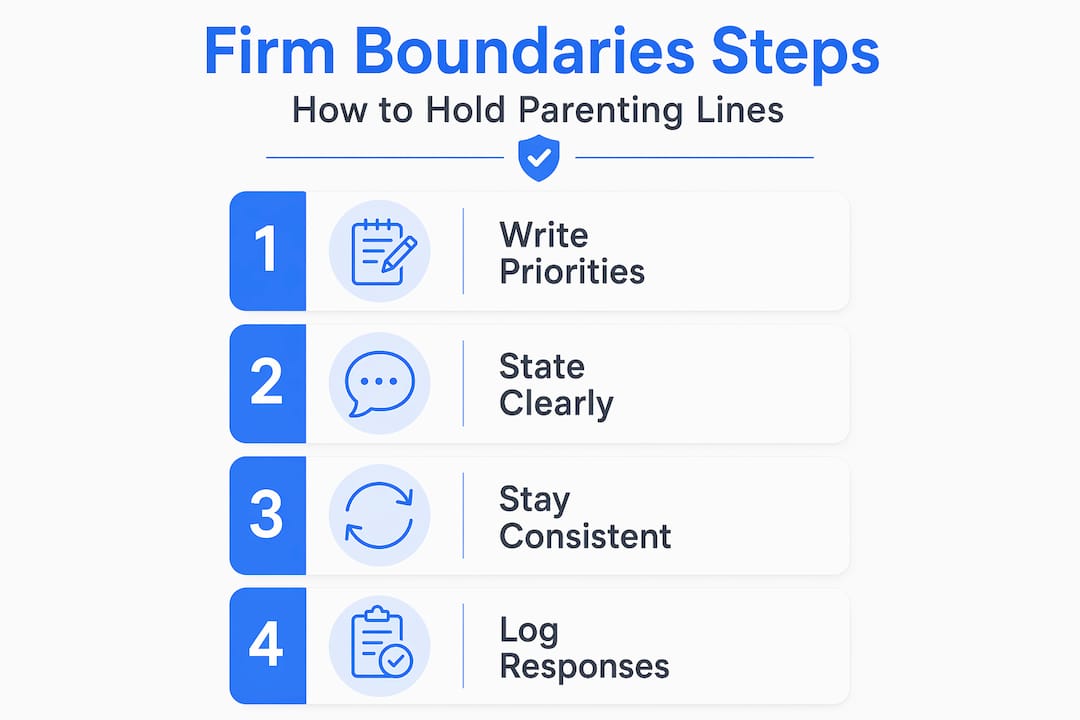
The single biggest shift most parents in high-conflict situations need to make is structural, not emotional. Moving all non-emergency communication to written channels, documented messages create a timestamped record that protects you legally and removes the volatility of phone calls or in-person confrontations.
Once you have shifted to writing, the BIFF framework becomes your default template. Developed by mediator Bill Eddy, BIFF stands for Brief, Informative, Friendly, and Firm. The BIFF method is not designed to change the other parent's mind. Its purpose is to end the conversation professionally and build a record that reflects well on you in court.
Follow these steps when crafting a firm co-parenting response:
- Read the message once, then wait. A 24-hour delay before replying to provocative messages gives your nervous system time to settle and prevents reactive replies that you will regret.
- Identify the actual logistical need. Most messages, even hostile ones, contain a factual request buried under emotional language. Respond only to that.
- Draft using BIFF. Keep it under five sentences. State the fact. Confirm your position. Close the loop.
- Avoid JADE. JADE stands for Justify, Argue, Defend, Explain. Every word you add in explanation becomes material for the other parent to challenge. Non-accusatory messages that state your intended action reduce escalation far more effectively than explanations do.
- Define your own response protocol. Set a rule for yourself: respond within 24 hours on business days, via your chosen app only, for logistics only. That is your boundary. You cannot control how the other parent communicates, but you control your own response protocol entirely.
Pro Tip: Before sending any message, ask yourself: "Would I be comfortable if a judge read this?" If the answer is no, rewrite it.
Parallel parenting when cooperation is off the table
Cooperative co-parenting assumes two adults who can communicate respectfully despite their differences. When one parent is manipulative, unpredictable, or simply unwilling to cooperate, that model breaks down. Parallel parenting is the evidence-based alternative. It minimizes conflict exposure for children by reducing the amount of required parental cooperation to near zero.

Here is how parallel parenting compares to cooperative co-parenting:
| Feature | Cooperative co-parenting | Parallel parenting |
|---|---|---|
| Communication style | Frequent, flexible, and direct | Written only, structured, minimal |
| Decision-making | Joint, ongoing discussion | Pre-determined in parenting plan |
| Schedule flexibility | Parents negotiate in real time | Strict schedule, court-documented |
| Conflict management | Mutual compromise expected | Each parent governs their own home |
| Contact at exchanges | Often direct handoffs | Third-party or curbside exchanges |
A successful parallel parenting arrangement depends entirely on a detailed, court-approved parenting plan. The plan needs to specify schedules, communication rules, and decision authority with enough detail that a judge could enforce any clause without additional interpretation. Vague plans invite disputes. Specific ones close them down.
Key elements every parallel parenting plan should cover:
- Definition of emergency communication (what qualifies and what does not)
- Response windows (e.g., 24 hours for non-emergency messages)
- Communication channel (one app, email only, no phone calls)
- Holiday and school-year schedules listed by date, not by description
- Medical and educational decision-making authority for each parent
For tools to support this, the Replycalmly guide on high-conflict parallel parenting covers how to structure these plans and what to document when violations occur.
Parenting response examples for common high-conflict scenarios
Knowing the theory is one thing. Having the actual words ready when your co-parent sends a manipulative or provocative message is another. Below are examples of firm, boundary-maintaining responses across the most common scenarios.
Logistical request (schedule change): "I received your message about changing Saturday's pickup time. Per our parenting plan, the schedule stands as written. I'll have [child's name] ready at the agreed time."
Accusation or personal attack: "I won't be responding to the characterizations in your message. If you have a specific logistics question related to the kids, I'm happy to address it here."
Parenting plan violation: "This exchange falls outside our agreed schedule. I'm documenting this message. Future schedule changes require written notice per our plan." You can find solid firm response examples for repeat situations like late pickups and unauthorized schedule changes at Replycalmly.
Pro Tip: Save your best responses as templates. When conflict spikes, cognitive load goes up and word retrieval goes down. Having a pre-written version you can lightly edit removes the pressure of composing under stress.
The goal in every case is the same: respond to facts, not feelings. State your position once. Do not repeat it in the same message. Close the exchange. That consistency is what firm parenting looks like in writing.
Anticipating pitfalls when holding firm boundaries
Most parents find the first few weeks of holding firm limits exhausting not because the responses are hard to write, but because the old pattern pulls at them. The urge to over-explain, to justify your position one more time, or to try to change the other parent's mind is powerful. It rarely works and often makes things worse.
Here are the four most common breakdowns and how to address each:
- Over-explaining. Each justification you offer becomes a new point of argument. Limiting explanations also reduces the information a difficult co-parent can use against you in court. Less is genuinely more.
- Trying to control the other parent. You cannot dictate what happens in their household during their parenting time. Focusing on your own behavior, your own responses, and your own preventive communication rules is the only strategy that actually moves the needle.
- Skipping documentation. A pattern of violations means nothing in court without a record. Use a co-parenting app or a structured system to log incidents consistently. Specificity matters: date, time, what was said or done, how it affects the children.
- Neglecting your own nervous system. You cannot write a calm, firm message when you are in fight-or-flight mode. Therapy, physical exercise, and consistent sleep are not luxuries in high-conflict situations. They are operational requirements.
"Firm parenting in a high-conflict situation is less about what you say and more about how reliably you say it. Consistency over months builds a record. That record speaks louder than any single perfect reply."
My take on what actually makes firm parenting work
I've spent years reading family law guidance, therapist scripts, and co-parenting research, and the single thing I see most often missed is this: warmth has to come first or the firmness collapses. Not warmth toward the difficult co-parent, but warmth toward the process itself. Toward your children. Toward the version of yourself that is trying to hold things together under real pressure.
I've watched BIFF and parallel parenting genuinely transform situations that felt hopeless. Not by changing the other parent, who often never changes, but by giving the parent using the tools a clear, repeatable structure to fall back on. That structure becomes its own kind of confidence.
The uncomfortable truth is that you have very little control over what the other parent does. What you have full control over is whether your communication holds up in court, whether your children see you stay steady, and whether your record of behavior is one you are proud of. Those things compound over time.
Nervous system regulation is not therapy-speak. It means: can you feel your feet on the floor when you read a hostile message? Can you wait an hour before you reply? Those physical practices are the real engine behind every calm, firm response you write.
— Devin
How Replycalmly helps you hold your ground
High-conflict co-parenting is grinding work, and you should not have to write every difficult response from scratch.
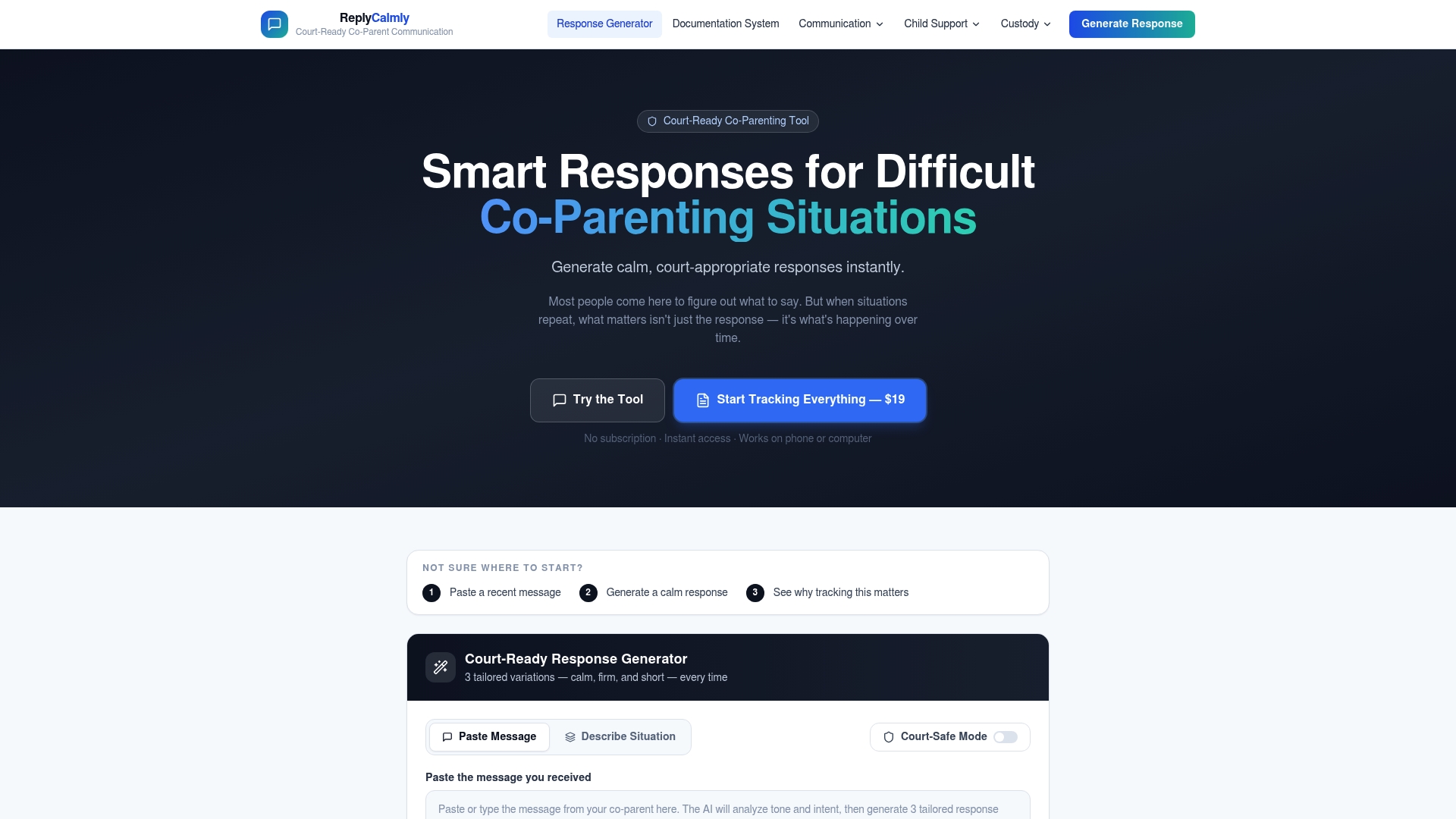
Replycalmly was built specifically for this. The platform generates multiple response options, calm, firm, or brief, based on the actual message you received. You paste the message, choose your tone, and get a court-appropriate reply in seconds. The documentation system logs every exchange with timestamps, categorizes patterns like manipulation or custody conflicts, and exports a clean record for legal use. If you are ready to stop dreading your phone every time a message comes in, the free response generator is the fastest place to start. For ongoing support, the parallel parenting guide at Replycalmly walks through how to structure your plan and what to do when it gets violated.
FAQ
What is the difference between firm and authoritarian parenting?
Firm, or authoritative, parenting combines clear limits with warmth and respect for the child's perspective. Authoritarian parenting relies on strict control and punishment with little emotional responsiveness, which research links to worse outcomes for children.
What is BIFF and how does it help in co-parenting communication?
BIFF stands for Brief, Informative, Friendly, and Firm, a framework developed by Bill Eddy to end hostile exchanges professionally. It creates a professional communication record without giving the other parent material to escalate further.
When should I switch to parallel parenting?
Parallel parenting is appropriate when direct communication consistently leads to conflict or harassment. It works through a detailed, court-approved parenting plan that limits required contact and specifies all logistics in advance.
How do I respond to false accusations from my co-parent?
Respond briefly and factually, or do not respond at all if the message contains no actionable logistics request. Document the message with a timestamp and avoid explaining or defending yourself at length, since over-explaining can be used against you in custody proceedings.
Does waiting to reply really reduce conflict?
Yes. Delaying your response by even a few hours gives your emotional state time to settle. Experts consistently recommend a 24-hour response window for non-emergency messages to prevent reactive, escalating replies.