
When you're in the middle of a meltdown, a power struggle, or a teenager's silent treatment, your words matter more than you realize. The examples of effective parenting responses in this article go beyond generic advice. They give you real phrases, grounded in how children actually develop, so you can respond with confidence instead of reacting with frustration. Whether you're parenting a defiant toddler, a struggling second grader, or a moody teen, the right words can shift the entire dynamic of the moment and build something lasting.
Table of Contents
- Key takeaways
- 1. What makes parenting responses truly effective
- 2. Effective responses for toddlers and preschoolers
- 3. Effective responses for school-age children
- 4. Effective responses for teenagers
- 5. Parenting response styles compared: what works and what backfires
- My honest take on what actually changes the dynamic
- Communication support when parenting gets complicated
- FAQ
Key takeaways
| Point | Details |
|---|---|
| Connection before correction | Build emotional safety first to reduce resistance and improve listening. |
| Age-appropriate language matters | Responses tuned to your child's development stage are far more effective than one-size-fits-all scripts. |
| Calm tone over volume | A steady, quiet voice communicates authority without triggering a fight-or-flight reaction in children. |
| Emotion coaching builds resilience | Naming and validating feelings teaches children to manage emotions long-term. |
| "When/then" phrasing reduces power struggles | Clear, conditional language helps children cooperate without feeling controlled. |
1. What makes parenting responses truly effective
Not all responses are created equal. Some calm a situation; others accidentally pour fuel on it. Understanding what separates a response that works from one that backfires is the foundation of every positive parenting technique.
Connection before correction. Reflecting and validating feelings before giving any directive increases a child's willingness to cooperate. If your child feels heard, they are far more open to guidance. If they feel attacked, they shut down.
Calm tone communicates safety. Yelling triggers fight-or-flight responses in children, which means the lesson you are trying to teach literally cannot be processed in that moment. A steady tone does the opposite. It signals safety and opens the door to learning.
Here are the core criteria that make any parenting response effective:
- Age-appropriate language. A four-year-old and a fourteen-year-old need completely different explanations for the same situation.
- Positive framing. Tell children what to do, not just what to stop. "Walk, please" works better than "Stop running."
- Empathy plus limits. Validating a feeling does not mean abandoning the boundary. You can hold both at once.
- "When/then" structure. Clear, conditional instructions reduce power struggles. "When you finish dinner, then we can have dessert" is calmer and clearer than "No dessert until you eat."
- Time in over time out. Staying close during emotional upset helps children self-regulate, while isolating them during distress can increase stress and push feelings underground.
Pro Tip: Crouch down to your child's eye level before speaking. Proximity and eye-level body language increases the effectiveness of verbal communication significantly, especially for children under seven.
2. Effective responses for toddlers and preschoolers
Toddlers and preschoolers operate almost entirely on emotion and impulse. Their prefrontal cortex, the part of the brain responsible for reasoning and self-control, is years from being functional. That means your responses need to be simple, warm, and grounded in the moment.
The CDC recommends age-specific strategies beginning in infancy, precisely because early communication patterns shape how children respond to authority and connection throughout childhood. Getting this right early pays dividends for years.
Here are examples of effective parenting responses for this age group:
- During a tantrum: "I see you're really upset right now. I'm right here with you." Sit nearby. Do not lecture. The goal is co-regulation, not correction.
- Redirecting behavior: "Hands are for hugging, not hitting. Let's use our hands to build with blocks." Redirect to an acceptable action immediately.
- Using "when/then" phrasing: "When your hands are clean, then we'll have snack time." Short, clear, non-negotiable.
- Offering choices within limits: "Do you want to put on your shoes first, or your jacket?" The child feels control; you keep the outcome.
- Validating feelings about sharing: "I see you're upset because you want that toy. It's hard to wait. Let's figure out how to take turns."
- Transition warnings: "In two more minutes, we're leaving the park. Two more minutes." Countdowns ease the shock of abrupt transitions.
The consistent thread across all of these is empathy first, boundary second. You acknowledge the feeling before you redirect the behavior. That sequence matters.
3. Effective responses for school-age children
Between ages six and twelve, children develop the ability to reason, understand cause and effect, and feel deeply about fairness. Effective communication with children this age means meeting that growing logic with explanations, not just directives.
- Logical consequence framing: "If you don't finish your homework before dinner, then screen time won't happen tonight. That's your call." This puts the outcome clearly in the child's hands without threats.
- Open-ended reflection questions: "The test was really tough. What do you think could help you feel more ready next time?" This builds problem-solving habits while validating frustration.
- Emotion validation with limits: "I know you're angry that I said no to the sleepover. It's okay to feel angry. We're still not going this weekend, and I can explain why."
- Transition countdowns for homework: "Ten more minutes of play, then we're starting homework." Give a five-minute reminder too. It prevents the whining spiral.
- Acknowledging effort, not just outcome: "I noticed you kept trying even when that math problem was frustrating. That's the kind of effort that builds skills."
Pro Tip: When a child pushes back on a rule, avoid the "because I said so" trap. Explaining the rationale behind limits builds cooperation in school-age children and lays the groundwork for trust during the teen years.
Emotion coaching at this stage, guiding children to name and understand what they feel, promotes the emotional maturity that helps them handle conflict, disappointment, and peer pressure. It is one of the highest-return investments a parent can make.

4. Effective responses for teenagers
Parenting a teenager requires a genuine shift in strategy. The goal stops being compliance and starts being relationship. Teens who feel respected and heard are far more likely to make good decisions and come to you when things go wrong.
- Listening without fixing: "Wow, that sounds really difficult. How are you feeling about it?" Resist the urge to solve immediately. Often teens just need to be heard.
- Trusting out loud: "I trust you to make good choices this weekend. I'm here if anything comes up." Expressing trust reinforces responsible behavior far more than warnings do.
- Validating without dismissing: "I know you think this rule is unfair. I get why it feels that way. Let me explain the reason behind it." Teens respond better when they understand the reasoning rather than receiving mandates with no context.
- Praising specifically: "You handled that really maturely. I noticed you stayed calm even when your friend was being difficult." Specific praise lands harder than generic "good job."
- Modeling calm during conflict: "I'm feeling frustrated right now and I need a few minutes before we keep talking. I'm not walking away from this conversation permanently." You teach regulation by demonstrating it.
- Sharing your own experience carefully: "When I was your age, I went through something similar. It was hard. I'm not going to pretend I have all the answers, but I'm listening." This builds genuine connection without minimizing their experience.
Teenagers often project indifference, but they are watching everything you do. Your calm, consistent responses teach them more about handling conflict and pressure than any lecture ever will.
5. Parenting response styles compared: what works and what backfires
Here is a quick-reference comparison of common parenting responses, the alternative approach, and the likely outcome for the child.
| Response style | Example phrase | Child outcome |
|---|---|---|
| Yelling or shaming | "How many times do I have to tell you?!" | Triggers fight-or-flight, harms self-worth, reduces receptiveness |
| Calm and clear direction | "Please put your shoes on. We leave in five minutes." | Child feels safe, processes the request, more likely to comply |
| Time out (isolation) | Sending child to room mid-meltdown | Does not teach regulation, may increase stress and resentment |
| Time in (staying close) | "I'm right here. Let's calm down together." | Builds self-regulation, emotional safety, and trust |
| Ignoring behavior entirely | No response to hitting or defiance | Misses teaching opportunity, behavior often escalates |
| Emotion coaching | "You're really frustrated. Let's figure this out together." | Names and manages feelings, builds long-term emotional resilience |
| Punitive consequence | "No TV for a week because you lied." | May trigger resentment, rarely teaches the desired lesson |
| Logical consequence | "Because trust was broken, I'll need to check in more this week. We can rebuild from here." | Connects consequence to behavior, preserves relationship |
The pattern is clear. Responses that pair empathy with firm, logical limits consistently outperform responses driven by frustration or control. Parents who integrate both empathy and boundaries see better behavioral outcomes across every age group.
My honest take on what actually changes the dynamic
I have spent years looking at communication breakdowns between parents and children, and I keep coming back to the same observation. Parents are not failing because they lack love or effort. They are failing in those charged moments because they do not have a script ready. And when there is no script, the default is usually volume.
Here is what I have found actually works. The phrase matters less than the sequence. If you connect first, the correction almost handles itself. Saying "I see you're upset" before "Here's what needs to happen" is not soft parenting. It is neurologically smarter parenting. A child who feels seen is a child who can hear you.
I have also noticed that parents who struggle most in these moments are often the ones dealing with their own unresolved emotional triggers. When your child's tantrum feels personal, it is nearly impossible to stay regulated. The most effective parents I have observed treat their own emotional response as part of the equation, not a side issue.
What I find genuinely undervalued is consistency. You can say all the right things once and get nowhere. Say them the same way, calmly and clearly, for three weeks, and you will see a real shift. Children are pattern learners. Your calm, repeated responses eventually become the pattern they internalize.
For parents navigating co-parenting in addition to everyday challenges, learning legally sound communication strategies is equally worth your attention. How you communicate about your child, not just to your child, shapes their world too.
— Devin
Communication support when parenting gets complicated
Co-parenting adds a layer of complexity that no script can fully prepare you for. When messages from a former partner are hostile, manipulative, or designed to provoke, staying calm is not just good parenting. It is a legal strategy.
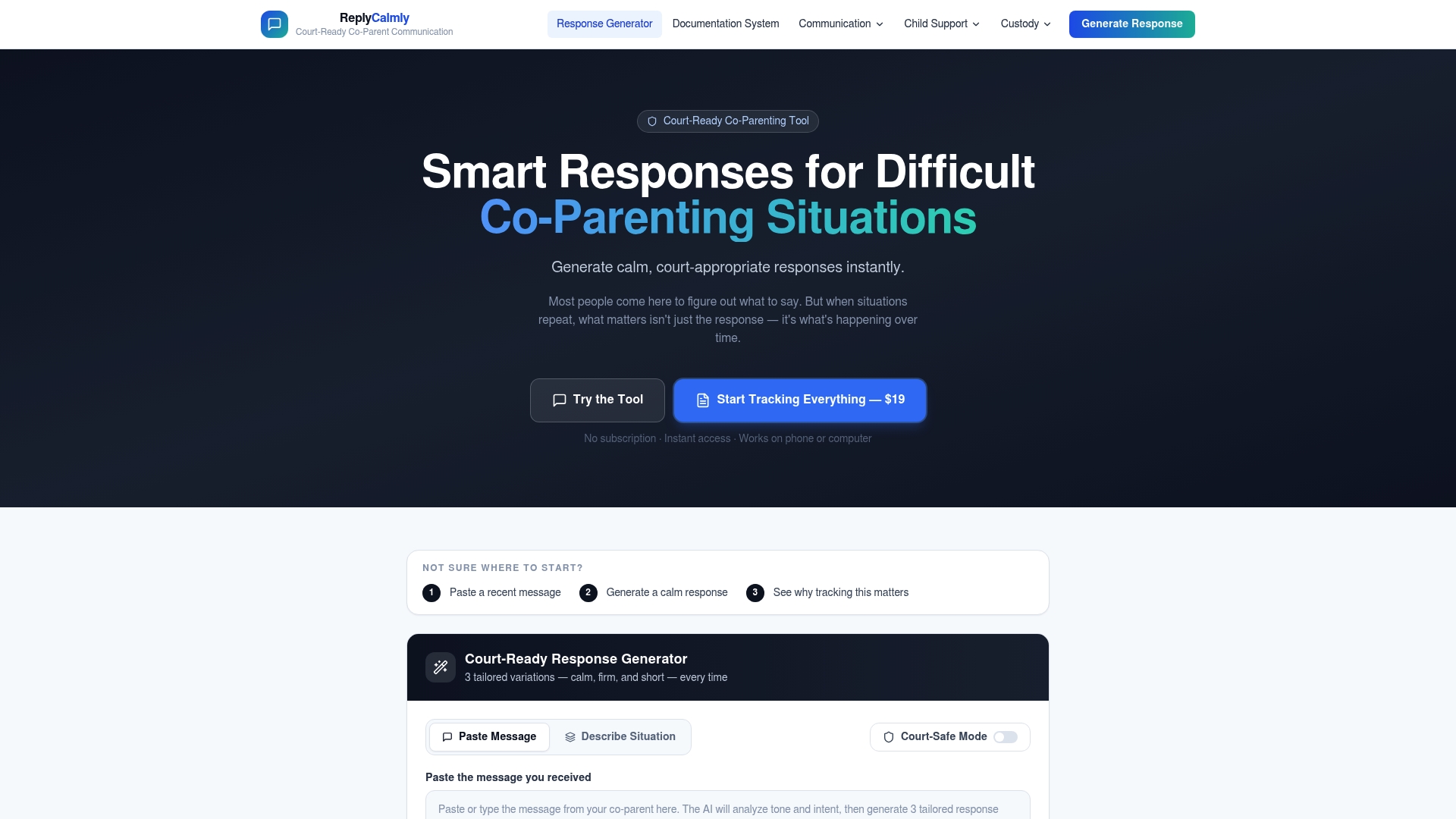
Replycalmly was built for exactly these moments. The platform's response generator helps you craft calm, firm, or neutral replies to difficult messages without losing your composure or your standing in court. You can also use the co-parenting communication plan templates to set clear boundaries and expectations between households. If you are raising children across two homes and want your communication to reflect the thoughtful parent you are, Replycalmly gives you the structure to make that happen consistently.
FAQ
What are examples of effective parenting responses during tantrums?
Effective responses during tantrums include "I see you're really upset. I'm right here with you" while staying physically close. The time-in approach, staying present rather than isolating the child, helps them regulate emotions and feel safe.
How do you respond to a child's big emotions without giving in?
Validate the feeling while holding the limit. "I know you're angry that we have to leave. It's okay to feel that way. We're still going now." Acknowledging emotion does not mean abandoning the boundary.
What is the "when/then" parenting technique?
"When/then" phrasing links a desired behavior to a reward or next step. For example, "When your homework is done, then we can watch a show." It reduces power struggles by giving children a clear, logical sequence rather than a demand.
How should parents respond to teenagers who push back on rules?
Explain the reasoning behind the rule rather than restating it louder. Teens respond better when they understand the rationale behind limits and feel respected in the conversation. A response like "I get why this feels unfair. Here's why this boundary exists" keeps the dialog open.
Why is calm tone so important in parenting communication?
A calm, steady tone communicates safety to a child's nervous system. Yelling triggers a stress response that makes children less able to process information or cooperate. A quiet voice paired with clear expectations is one of the most effective communication tools a parent has.