
A GAL communication packet is a single, organized file you hand to the Guardian ad Litem that includes a cover letter, an indexed contact log (date, time, method, participants, factual summary), labeled exhibits, and a clear delivery path through your attorney. That's the whole answer. Everything else is execution.
Before you build anything, gather what you already have:
- Every text, email, and app message thread with your co-parent, exported in full
- A running list of dates when pickups, calls, or agreements went wrong
- Any school, medical, or police records tied to a specific incident
- Contact information for anyone who witnessed a relevant event
Pro Tip: Start the file today even if the GAL hasn't asked for it yet. A packet built over weeks looks far more credible than one assembled the night before a deadline.
Give the finished packet to your attorney first. They'll review it for anything that shouldn't go to the GAL directly and handle formal delivery or filing.
Key Takeaways
A court-ready GAL communication packet succeeds when it pairs a contemporaneous, five-field contact log with labeled exhibits, an attorney review step, and calm, factual response templates.
| Point | Details |
|---|---|
| Structure the packet in order | Lead with a cover letter, table of contents, and one-page summary before logs and exhibits. |
| Log entries the same day | Record date, time, method, participants, and a factual summary immediately after each contact. |
| Label and name exhibits consistently | Use a system like Exhibit B-1 and consistent file names so anyone can find a document fast. |
| Redact before filing | Use initials for minors and strip sensitive metadata per FRCP 5.2 principles before any public filing. |
| Route delivery through your attorney | Let counsel review for hearsay and redaction, then e-file or send the packet directly to the GAL. |
| Use ReplyCalmly to speed documentation | Its automated logs, templated replies, and exportable reports map directly onto packet-building tasks. |
Where to Verify Filing and Redaction Rules
Check these before finalizing anything for court:
- Federal privacy and redaction basics via contact log admissibility guidance
- Practical documentation steps in this co-parenting communication guide
- A GAL-specific prep checklist for chronologies and witness lists from Family Private Investigator
- Your state's specific GAL rules and consent-to-record laws, which vary widely
Always confirm state-specific filing and recording-consent rules with your own attorney before submitting anything to the court.
This article is general information, not a substitute for advice from a qualified lawyer. Consult a qualified legal professional about your own circumstances before acting on anything here.
Table of Contents
- What Is a GAL Communication Packet, and When Do You Need One?
- What Goes Into a GAL Packet, in What Order
- How to Keep a Contact Log That Actually Holds Up
- Preparing Exhibits Without Getting Your Filing Rejected
- Getting the Packet to the GAL and Into the Court Record
- Writing Calm Responses the GAL Will Actually Respect
- Build Your Packet Faster With ReplyCalmly
- Sources
What Is a GAL Communication Packet, and When Do You Need One?
A GAL communication packet is a ready-to-share file parents assemble for a Guardian ad Litem containing organized message logs, incident summaries, timestamps, categorized issues, evidence attachments, and court-appropriate notes. It's not a diary and it's not a legal brief. It's a reference document that lets the GAL verify your account of events without digging through months of scattered texts.
You need one the moment a GAL is appointed to your case, and you should update it whenever one of these happens:
- The court orders discovery or the GAL requests records directly
- A hearing or trial date gets set
- Your co-parent starts a new pattern of missed exchanges, threats, or false claims
- Your attorney tells you to prepare documentation ahead of an interview
Your first move is a phone call to your attorney, not a mass export of every message you own. Ask what format they want, then start pulling threads by date range while the details are still fresh.
What Goes Into a GAL Packet, in What Order
Courts and GALs read faster when the packet follows a predictable structure. Build it in this order:
- Cover letter — one page, neutral tone, states who you are and what's attached
- Table of contents — lists every section and exhibit by name
- Executive summary — one page maximum, pointing to exhibits rather than retelling every story
- Contact log — your dated, factual record of communications and events
- Incident summaries — short, one-paragraph write-ups of specific events referenced in the log
- Primary exhibits — texts, emails, app exports, photos, school or medical records
- Witness list — names and one line on what each person can confirm
- Metadata index — a short note on where original files are stored and backed up
A short executive summary that points to exhibits works better than long narratives, according to guardian ad litem prep resources aimed at organizing a chronology and witness map. GALs and attorneys don't want your version of events retold three different ways. They want a pointer to the proof.
Label exhibits with a simple system: Exhibit A for the contact log, Exhibit B-1, B-2, B-3 for individual text threads, Exhibit C for photos, and so on. Keep file types practical: export message threads as PDFs, keep photos as JPEGs, and never send raw screenshots when a full export is available. Name files consistently, something like "ExhibitB-1_TextThread_March2026.pdf," so anyone opening the folder cold can find what they need in seconds.
Your table of contents should include: exhibit letter, description, date range covered, and page number. That's it. Four columns, no more.
How to Keep a Contact Log That Actually Holds Up
Every entry needs five things: date, exact time, method of communication, full names of everyone involved, and a factual summary. Quote exact words only when the wording itself is the point, like a threat or an admission.

Here's what one entry should look like:
March 3, 2026, 6:47 PM, text message, sender: Jamie Reynolds, recipient: you. Summary: Jamie confirmed pickup for March 5 at 5:00 PM, no other issues raised.
That's it. No commentary, no editorializing, no "as usual" or "again." Keep entries in chronological order, use one time zone consistently, and log to the minute when precision matters, like missed exchange windows.
On tools: a spreadsheet works fine for most parents and exports cleanly to PDF. Court-mandated apps like OurFamilyWizard timestamp messages automatically, which removes a step. Whatever you choose, back up exports to a second location, cloud storage plus a local drive, since a dated chronology built from lawfully gathered records is what turns a pile of screenshots into something a GAL can actually use.
Courts weigh records made "at or near the time" of the event more heavily than reconstructions written weeks later, and that timing affects whether your log qualifies under recorded-recollection or business-record exceptions to hearsay rules, per guidance on contact logs that hold up in court. This is the single biggest reason same-day entries beat a memory dump before a hearing.
Pro Tip: Set a phone reminder for five minutes after any co-parenting call or exchange. Log it immediately, before the next thing on your day pulls your attention away.
Preparing Exhibits Without Getting Your Filing Rejected
File names matter more than most parents realize. Use a format like 2026-03-05_text_reynolds_you_pickup-confirmation.pdf. Consistent naming helps your attorney, the GAL, and eventually a judge verify that what you're presenting matches what you claim it is.
Redaction is where people trip up. Federal filings generally follow privacy rules under FRCP 5.2, which require limiting personal identifiers like full Social Security numbers, financial account numbers, and minors' full names in public filings. State family courts often mirror these principles even when the federal rule doesn't apply directly, so check with your attorney on your court's local requirement.
Practical redaction rules:
- Use a child's initials instead of a full name in any document that becomes a public filing
- Never include Social Security numbers, account numbers, or full birthdates unredacted
- Keep one unredacted master copy for your attorney's file only
- Strip unnecessary metadata (device IDs, location data) from court copies, but preserve the original file separately for authentication
Keep a simple chain-of-custody note for every piece of digital evidence: who exported it, when, and where the original lives. That single habit answers most authentication questions before anyone asks them.
Getting the Packet to the GAL and Into the Court Record
Your attorney should see the packet before anyone else does. They'll flag anything that reads as hearsay, check your redactions, and may prepare a short affidavit describing how you created and maintained the log, which strengthens authentication if the packet is ever challenged.
From there, delivery typically happens one of three ways:
- Attorney-to-GAL secure email, sending a single combined PDF with exhibits attached in order
- E-filing as a formal exhibit, which puts the packet directly into the court record ahead of a hearing
- Hand delivery through the court clerk, less common now but still used in some jurisdictions for physical evidence
E-filing gives you the strongest paper trail since the court system timestamps receipt automatically. Email is faster but should always go through your attorney's account, not yours directly, to preserve the professional chain of custody.
Before you send anything, confirm: every file opens correctly, the table of contents page numbers match the actual PDF, and you have a dated record of who sent what to whom. Refusing a reasonable document request from a GAL can create a bad impression, so respond to requests promptly once your attorney has reviewed the material, based on guidance on how GALs conduct custody investigations.
Writing Calm Responses the GAL Will Actually Respect
A GAL is investigating for the court, not advocating for either parent, and what you say gets included in their report. Every message you send, and every reply in your packet, should read as though a judge is already reading over the GAL's shoulder. Because eventually, one might be.
Keep responses child-focused, factual, and short. Skip the insults, the sarcasm, and the urge to correct every inaccurate thing your co-parent says in the same message. Venting to a GAL, even indirectly through the tone of your written replies, tends to backfire far more than staying quiet ever does.
Three templates worth keeping on hand:
- Neutral confirmation: "Confirmed, I'll have [child] ready at 5:00 PM Friday."
- Firm scheduling correction: "The order specifies 5:00 PM exchanges. I'll be there at that time and will document any changes going forward."
- Safety concern: "I have a concern about [specific, factual issue]. I'm documenting this and will raise it with our attorney and the GAL."
A tool like ReplyCalmly generates calm, firm, or short variations of a reply automatically, which pairs naturally with the logging habits this whole packet depends on.
Why Organization and Tone Matter More Than People Think
A cluttered, emotional packet tells a GAL to look for the drama. A clean one tells them to look at the facts. That distinction shapes the entire investigation.
Consistent, calm records build quiet credibility over months, long before a hearing date exists. Coordinate every step of delivery with your attorney. They know your court, your judge, and your GAL's preferences better than any general guide can.
Build Your Packet Faster With ReplyCalmly
Assembling a GAL communication packet by hand, screenshot by screenshot, is the part most co-parents dread. Replycalmly cuts that work down by automating the pieces that usually eat an entire weekend: timestamped incident logs, categorized issue tracking, and calm reply drafting all in one place.
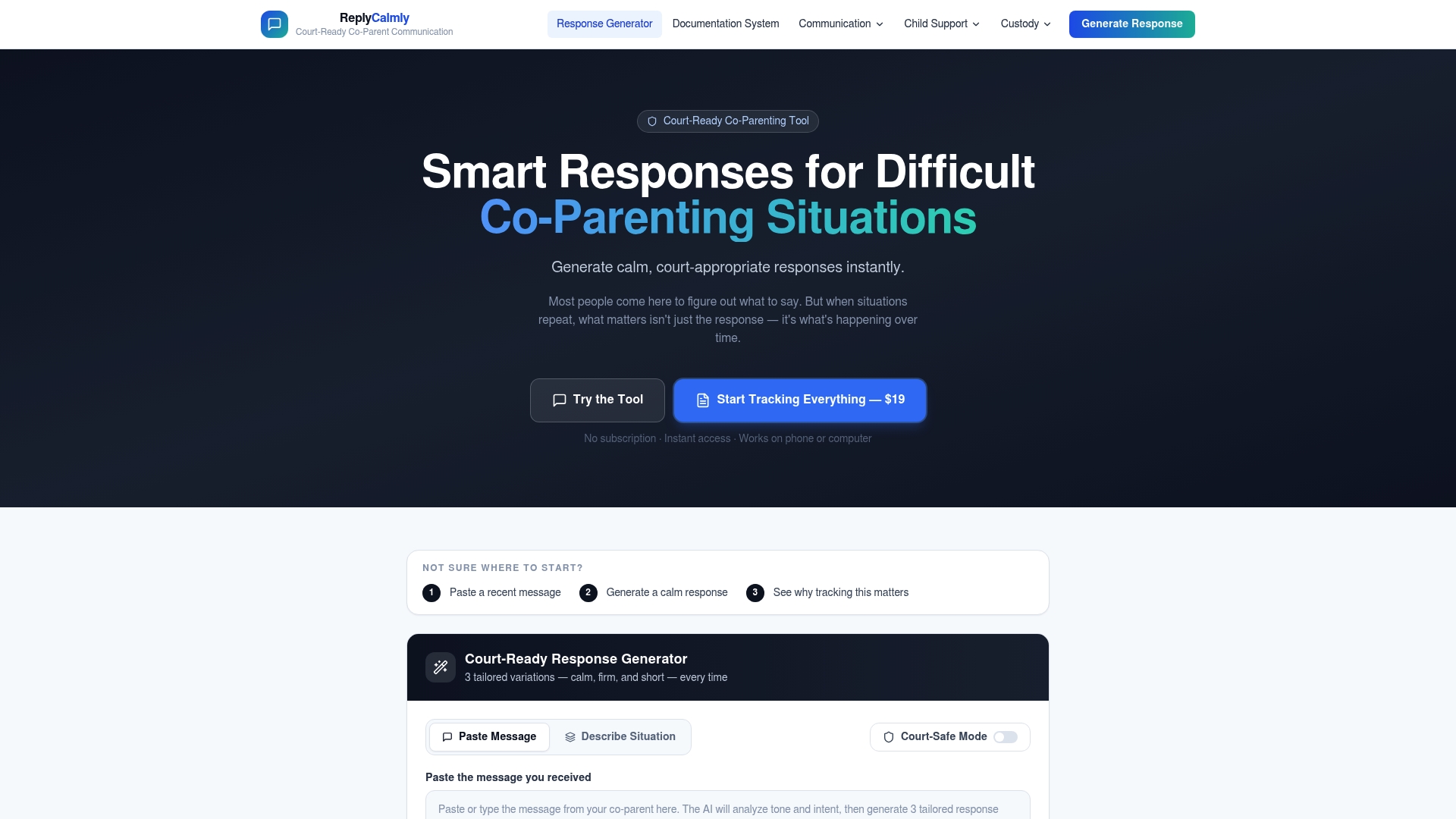
The platform generates calm, firm, or short response variations for any message you paste in, so you're never composing a reply to a provocative text at 11 PM with nothing but frustration to guide your wording. Its tracking dashboard tags incidents by category, custody conflict, missed exchange, false accusation, and exports a clean, dated report that slots directly into the exhibit structure your attorney needs. Backups save automatically, which solves the chain-of-custody problem before it starts.
This fits directly into the attorney review step described earlier: instead of handing your lawyer a folder of mismatched screenshots, you hand them an exportable, already-organized log. Start with the co-parent response generator to see how a calm reply gets drafted in seconds, or explore the full documentation and packet-building tools built specifically for cases headed to a GAL or family court.
Sources
- How to Create a Contact Log That Holds Up in Court - LegalClarity
- How to Document Co-Parenting Communication for Court - Co-Parenting Guide
- Guardian ad Litem Prep Checklist | Family Private Investigator