
When a holiday schedule conflict appears, do this first: send a written, calm proposal for a temporary swap or split arrangement, log the communication immediately, and stop all back-and-forth that isn't in writing. If the other parent refuses within 48–72 hours, contact a mediator or family law attorney about a temporary modification.
When you need a message right now: "I'm reaching out about [holiday]. Our current order has [Child] with me/you on that date. I'd like to propose [specific swap or split option] to resolve the overlap. Please let me know by [date] so we can confirm plans for [Child]. I'm happy to put any agreement in writing."
That script is neutral, child-focused, and creates a timestamped record. If the other parent ignores it or refuses without a counter-proposal, that silence is itself documentable evidence for mediation or court.
Key Takeaways
A holiday schedule conflict is best resolved through a written, documented proposal sent promptly, followed by mediation or a court modification if the other parent refuses.
| Point | Details |
|---|---|
| Act in writing immediately | Send a calm, specific proposal within 48–72 hours and log it as your first documented step. |
| Use rotating schedules | Alternate-year rotation for named holidays is the arrangement courts most consistently favor and enforce. |
| Document every exchange | Log date, event type, source, and attachments for each incident; export a PDF timeline before mediation or court. |
| Strengthen your parenting plan | Add exact times, swap-with-notice deadlines, travel rules, and violation remedies to prevent recurring disputes. |
| Replycalmly for documentation | Use Replycalmly's response generator and incident tracker to build a court-ready record and send neutral replies. |
Table of Contents
- What counts as a holiday schedule conflict in custody situations?
- Step-by-step: de-escalate, propose options, and document everything
- Which tools reduce holiday conflicts and produce court-usable records?
- How parenting plans, mediation, and court modification handle holiday conflicts
- How to build a court-ready record for holiday disputes
- How to rewrite holiday clauses to prevent future conflicts
- What the Replycalmly team has seen work in practice
- Replycalmly helps when holiday conflicts escalate
- Sources
What counts as a holiday schedule conflict in custody situations?
A holiday schedule conflict happens when two time commitments overlap and only one can happen. In custody contexts, parenting plans typically treat court-ordered holiday time as higher priority than routine activities unless the decree explicitly says otherwise. That hierarchy matters because it determines who has the legal right to the child's time and who is technically in violation if they act unilaterally.
The conflicts co-parents actually face tend to fall into a few recurring patterns:
- Court-ordered holiday vs. purchased travel plans: One parent books flights before checking the parenting plan, then discovers the dates belong to the other parent.
- School events vs. holiday blocks: A child's winter recital, graduation ceremony, or playoff game falls inside the other parent's holiday block.
- Multiple religious observances: Families observing different holidays (Hanukkah, Christmas, Eid, Diwali) may find the parenting plan doesn't account for all of them, creating gaps or overlaps every year.
- Last-minute cancellations or unilateral swaps: One parent announces a change days before the holiday without the other's agreement.
- Extracurricular schedule conflicts: A child's travel sports team, theater production, or club schedule runs through a holiday period neither parent anticipated when the order was written.
A shared calendar that both parents can see in real time reduces many of these surprises before they become disputes.
Red flags that raise the urgency:
- The holiday time is explicitly named in a court order (not just a parenting plan agreement).
- Travel has already been booked and money spent.
- The child has expressed a preference or has a commitment (a performance, a team event) that can't be rescheduled.
- The other parent has a history of unilateral changes or non-compliance.
- The conflict involves a school event with mandatory attendance consequences.
When any of these apply, treat the situation as time-sensitive. A casual text exchange won't protect you if it ends up in front of a judge.
Step-by-step: de-escalate, propose options, and document everything
The goal in the first 48–72 hours isn't to win. It's to protect the child's plans and create a written record that shows you acted in good faith.
The short process
Pause before responding. A reactive message that sounds accusatory or emotional will hurt you later. Read the other parent's message once, set it down, then draft your reply.
Propose two or three concrete options. Don't ask an open-ended question like "What do you want to do?" Give specific, fair choices. That keeps the conversation moving and shows the court you came prepared.
Document the agreement immediately. Once you reach a verbal or text agreement, follow up in writing: "Just confirming our agreement: [Child] will be with [Parent] on [dates], and we'll swap [future holiday] accordingly." Send it even if you already talked by phone.
Confirm logistics. Pickup time, location, travel details, and any school or activity handoffs should all be in writing before the holiday arrives.
Holiday scheduling options and their trade-offs
| Option | How it works | Fairness | Enforcement complexity | Court acceptability |
|---|---|---|---|---|
| Split day | Child spends part of the day with each parent | High when balanced | Moderate (requires precise handoff times) | Generally accepted; courts want exact times in writing |
| Alternate years | Each parent gets the holiday in odd or even years | High over time | Low (clear and predictable) | Strongly favored; rotation systems reduce annual disputes |
| One-off swap | Trade this holiday for a comparable future one | Moderate | Moderate (must specify the makeup date) | Accepted when documented in writing with a deadline |
| Partial handoff | Child attends an event mid-holiday, then returns | Situational | High (logistics-heavy) | Accepted when both parents agree in writing |
Sample scripts
Use these as starting points. Adjust the specifics, but keep the tone neutral and the request concrete.
Calm:
Firm:
Short:
Pro Tip: In high-conflict situations, send all proposals through a documented platform rather than standard text. A message sent through a platform that timestamps delivery and read receipts is far harder to dispute than a screenshot of an iMessage.
Which tools reduce holiday conflicts and produce court-usable records?
The right tool doesn't just help you communicate. It creates a timestamped, exportable record that holds up when a mediator or judge needs to understand what happened and when.
Real-time conflict detection at request submission is one of the most underrated features in scheduling tools. When a proposed date is already claimed or "locked," both parties see it immediately, before anyone books a flight or makes a promise to the child. That single feature prevents a significant share of holiday disputes.
Features to prioritize when choosing a tool:
- Secure, timestamped messaging (not standard SMS)
- Shared calendar with the ability to lock agreed-upon dates
- Incident and communication logging with category tags
- Exportable PDF or court-ready report generation
- Neutral swap-request workflow (so proposals don't read as demands)
| Feature category | Low-conflict co-parenting | High-conflict co-parenting |
|---|---|---|
| Messaging | Standard email or shared app | Secure, timestamped platform with read receipts |
| Calendar | Shared Google Calendar or similar | Locked shared calendar with change notifications |
| Logging | Basic notes or email threads | Categorized incident log with attachment support |
| Report export | Not usually needed | PDF timeline export for mediation or court |
| Cost profile | Free or low-cost tools | Subscription platforms with documentation features |
OurFamilyWizard is one of the most widely recognized platforms in family court settings. Judges and attorneys in many jurisdictions are familiar with its message logs and tone meter, which makes its exports particularly credible in hearings. Replycalmly integrates with existing court-mandated tools like OurFamilyWizard rather than replacing them, adding a response-generation and incident-tracking layer on top.
When you bring tool-generated evidence to mediation or court, organize it as a timeline: earliest incident first, each entry showing the date, the message or event, and the outcome. A mediator who can read a one-page chronology in three minutes is far more likely to act on it than one handed a folder of screenshots.
How parenting plans, mediation, and court modification handle holiday conflicts
Parenting plan vs. court order
A parenting plan is the written agreement between co-parents that governs custody and time-sharing. When a court approves it, it becomes a court order. The distinction matters: violating a court order carries legal consequences that violating an informal agreement does not. Clear holiday provisions in parenting plans reduce disputes, and courts favor schedules that are specific, predictable, and child-centered.
Holiday provisions in a court order typically take precedence over the regular custody rotation. If the order says Parent A has the child for Thanksgiving in odd-numbered years, that overrides the standard week-on/week-off schedule for that period.
When to choose mediation vs. court
Choose mediation when:
- Both parents are willing to negotiate but can't reach agreement on their own.
- The conflict is about a specific holiday or short-term scheduling issue, not a fundamental change to custody.
- You want a faster, less expensive resolution (mediation typically costs less than litigation and resolves in weeks rather than months).
- You want to preserve a working co-parenting relationship.
Go to court when:
- The other parent refuses mediation or repeatedly violates the existing order.
- A child's safety is at risk.
- You need an emergency temporary order to protect a specific holiday or travel plan.
- The conflict reflects a pattern that requires a formal modification to the parenting plan.
Typical timeline and cost
Mediation for a single holiday dispute can often be scheduled within two to four weeks and resolved in one or two sessions. Costs vary widely by location and mediator, but a single session typically runs in the range of a few hundred to over a thousand dollars, often split between both parents.
A formal modification through the court takes longer. Filing, serving the other parent, and getting a hearing date can take two to six months depending on the court's docket. Emergency motions for imminent holiday conflicts can sometimes be heard faster, but they require showing genuine urgency.
Key legal steps in order: Document the conflict and your good-faith attempt to resolve it → Request mediation or file for a temporary modification → Attend mediation with your documentation → If mediation fails, present your record at a court hearing → Court issues a modified order or enforces the existing one.
Practical legal note: Judges in holiday scheduling disputes pay close attention to which parent made a documented, good-faith effort to resolve the conflict before filing. A parent who shows up with timestamped messages, a written swap proposal, and a clear record of the other parent's non-response starts the hearing in a much stronger position.
Priority tiers and advance deadlines reduce perceived unfairness when both parents want the same dates. Building those tiers into your parenting plan is one of the most effective ways to prevent future disputes.
What to bring to mediation or a court hearing:
- Printed or exported communication logs with timestamps
- A copy of the current parenting plan or court order with the relevant holiday provisions highlighted
- Any written swap proposals you sent and the other parent's responses (or non-responses)
- Receipts for travel or event tickets already purchased
- School or activity calendars showing the child's commitments
How to build a court-ready record for holiday disputes
Good documentation doesn't require a lawyer. It requires consistency and the right format.
What to save
Save every communication related to the holiday conflict: texts, emails, messages through co-parenting apps, and voicemails (transcribed if possible). Also keep:
- Formal swap proposals and any responses
- Receipts for travel, event tickets, or accommodations
- School calendars and coach or teacher emails showing the child's scheduled commitments
- Any written agreements, even informal ones
- Notes from phone calls (date, time, what was said, who was present)
Keep records for at least the duration of any active court proceedings, and longer if the conflict is part of a pattern. Many family law attorneys recommend keeping documentation indefinitely while a parenting order is in effect.
Log report structure
A useful incident log entry includes these fields:
| Field | What to record |
|---|---|
| Date and time | Exact date and time of the message or event |
| Event type | Category: holiday violation, last-minute change, refusal to communicate, safety issue |
| Description | One to three sentences describing what happened |
| Source | Platform or method (OurFamilyWizard message, email, text) |
| Attachments | Screenshot, receipt, school notice, or other supporting file |
| Status | Resolved, pending, escalated |
Turning messages into a one-page timeline
Export or copy your communications in chronological order. For each entry, write one sentence summarizing the event and its outcome. Group entries by incident rather than by day if multiple messages relate to the same dispute. The goal is a document a mediator can read in under five minutes and immediately understand the pattern.

Replycalmly's incident tracker lets you categorize each entry (for example, "holiday violation" or "last-minute change"), attach evidence, and export a formatted PDF report. That structure is exactly what mediators and judges describe as useful: a clear, organized timeline rather than a stack of screenshots.
Pro Tip: Categorize incidents consistently from the start. A log that shows five "holiday violation" entries over two years tells a much clearer story than five uncategorized notes. Pattern evidence is often more persuasive than any single incident.
How to rewrite holiday clauses to prevent future conflicts
The best time to fix a vague parenting plan is before the next holiday season, not during it. Courts and mediators will approve updated language as long as it's specific, fair, and child-centered.
What stronger holiday clauses include
Rotating years with named holidays. List every holiday the family observes and assign them to Parent A in odd years and Parent B in even years (or vice versa). Don't leave any major holiday unaddressed.
Exact start and end times. "Thanksgiving" is not specific enough. "Thanksgiving Day from 10:00 AM to 8:00 PM" is.
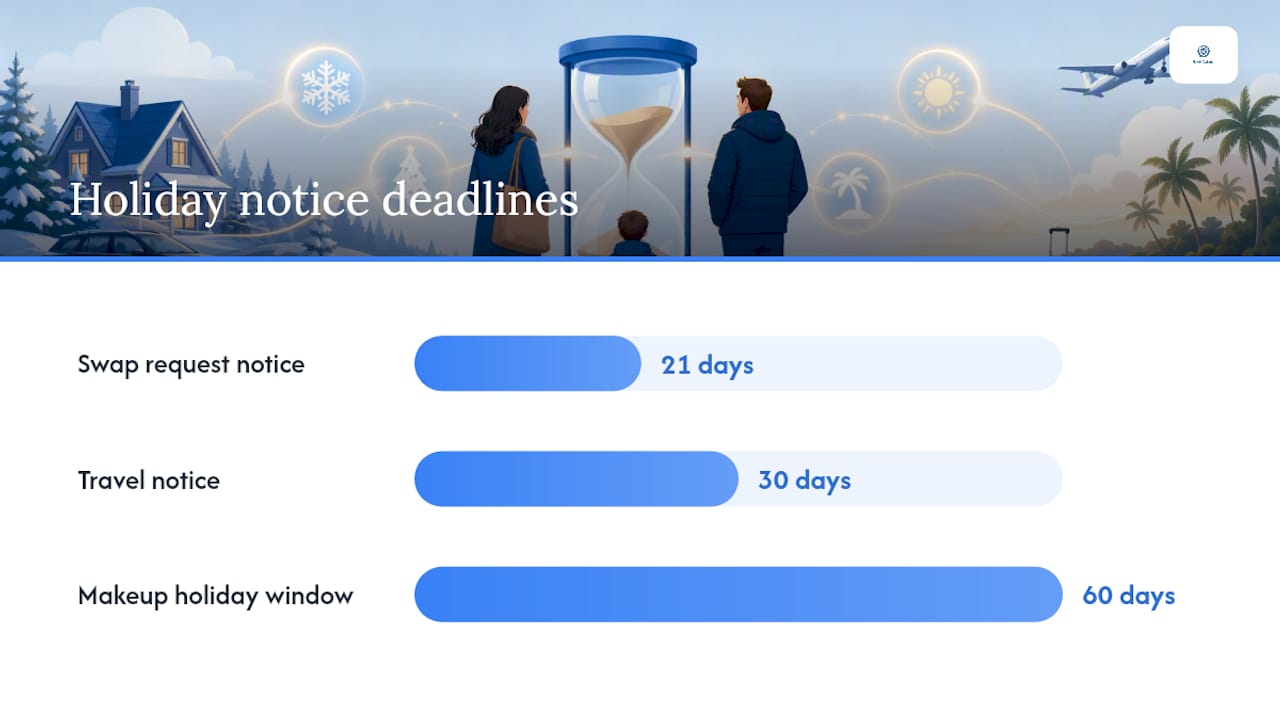
Swap-with-notice language. Allow swaps but require written notice at least 14–30 days in advance and written confirmation from both parents before the swap is binding.
Travel and out-of-state rules. Require written notice (typically 30 days) for any travel that takes the child out of state or more than a set distance from the home city. Include a requirement to share itinerary and contact information.
Priority rules for non-negotiable events. Name the categories of events that can override the standard holiday schedule (a child's graduation, a once-in-a-lifetime family event) and require mutual written agreement to invoke them.
Remedies for violations. Specify what happens if a parent doesn't comply: a makeup day within 30 days, written notice to the other parent within 24 hours, or the right to seek enforcement through the court.
Sample clause language
Rotating years: "Parent A shall have the child for Thanksgiving in odd-numbered years; Parent B shall have the child for Thanksgiving in even-numbered years. Holiday time begins at 10:00 AM on Thanksgiving Day and ends at 8:00 PM."
Swap-with-notice: "Either parent may request a one-time holiday swap by providing written notice no fewer than 21 days before the holiday. The swap becomes binding only upon written confirmation from both parents. The makeup holiday shall occur within 60 days."
Travel notice: "Any parent traveling with the child more than 150 miles from [city] or out of state shall provide the other parent with written notice at least 30 days in advance, including destination, dates, and emergency contact information."
Checklist before submitting revised language to the court or mediator:
- Every holiday the family observes is named with exact dates or a definition (e.g., "Easter Sunday").
- Start and end times are specified for each holiday block.
- A swap procedure with deadlines and written-confirmation requirements is included.
- Travel notice requirements are stated with a specific number of days.
- A tie-breaker rule exists for conflicts not covered by the schedule.
- Remedies for violations are clearly stated.
- Both parents have reviewed and initialed the revised language before submission.
A step-by-step guide to building a custody schedule can help you structure the full document before you bring it to your attorney or mediator.
What the Replycalmly team has seen work in practice
The parents who navigate holiday disputes most effectively share one habit: they treat every communication as a potential court exhibit from the very first message. Not because they're planning to litigate, but because that mindset keeps their tone neutral, their proposals specific, and their records clean.
The most common mistake we see is waiting too long to document. A parent will spend two weeks negotiating by phone, reach a verbal agreement, and then have the other parent deny it ever happened. The agreement existed. There's just no proof.
The second most common mistake is escalating too fast. Filing a motion before attempting mediation, or sending a hostile message before sending a calm proposal, signals to the court that you weren't genuinely trying to cooperate. Judges notice. Mediators notice. And it costs you credibility on the issues that actually matter.
Children handle holiday conflicts better when the adults around them stay predictable. A child who doesn't know where they'll be for Thanksgiving until three days before carries that anxiety into both households. Clear plans, communicated early, protect the child's emotional experience regardless of how the adults feel about each other. If you need guidance on parallel parenting in high-conflict situations, limiting direct contact while maintaining a documented record is often the most sustainable approach.
Replycalmly helps when holiday conflicts escalate
When a holiday scheduling dispute gets heated, the hardest part isn't knowing what to do. It's finding the right words under pressure and keeping a record that holds up later.
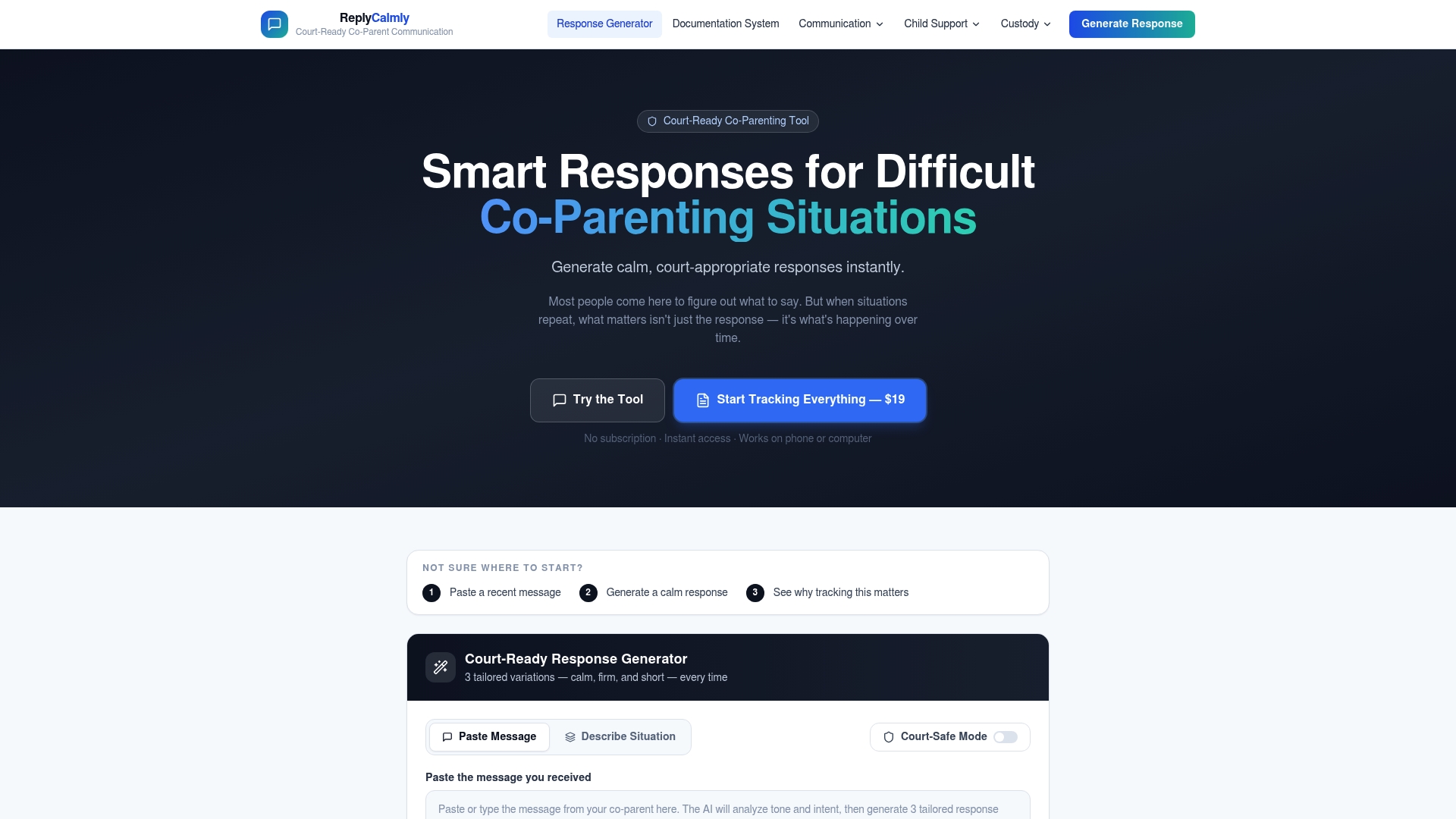
Replycalmly's co-parent response generator gives you three ready-to-send message variants (calm, firm, and short) for any message you receive, including holiday schedule disputes. Paste the other parent's message, get responses that are neutral, court-appropriate, and specific to your situation. The free version is available immediately, no account required.
The full platform adds incident logging with category tags, evidence attachments, pattern dashboards, and exportable PDF court reports. It's built specifically for the documentation workflow described in this guide: log the conflict, categorize it, attach the evidence, and export a clean timeline when you need it for mediation or a hearing. Subscription access starts at $19/month after a 3-day free trial.
Replycalmly is not a substitute for legal advice. For binding modifications to your parenting plan or court order, contact a licensed family law attorney in your state.
Sources
- Navigating holiday time-sharing conflicts: tips for parents — NJ family law firm
- Tis the season for fairer holiday scheduling — RosterLab
- How to prevent team vacation conflicts without micromanaging — BreezeLeave
- How to Handle Holiday Custody Conflicts: A Guide for Co-Parents — Drexler Law Group
- How HR handles leave conflict during festive seasons — Leaderonomics