
Co-parenting challenges are the recurring conflicts, communication failures, and logistical disputes that arise when two separated parents share responsibility for raising a child. The most common co-parenting problems fall into ten categories: scheduling, punctuality, finances, discipline, screen time, school and medical decisions, holidays, extracurriculars, new partner introductions, and emotional spillover from adult conflict. Understanding this list of co-parenting challenges is the first step toward protecting your child's stability and your own sanity. Each challenge has a known pattern and a workable fix.
1. The list of co-parenting challenges starts with scheduling disputes
Late pickups and last-minute changes are the most frequent irritants between co-parents. They create anxiety for children, erode trust between adults, and often escalate into larger conflicts. The fix is not goodwill alone. It requires structure.
A detailed parenting plan is the foundation. It should specify pickup times, drop-off locations, and a clear process for requesting changes. Shared digital calendars give both parents visibility and reduce "I didn't know" disputes. Written change requests, submitted at least 48 hours in advance, create a paper trail and slow down impulsive decisions.
- Set a default pickup window (for example, 5:00–5:30 PM) rather than a single time
- Require written notice for any schedule change, even minor ones
- Agree on a consequence for repeated late pickups, documented in the parenting plan
- Use a shared calendar app that both parents can view and update
Pro Tip: If late pickups are a recurring pattern, log each incident with the exact time and any messages exchanged. That record becomes critical if the issue reaches a family court judge.
2. Communication breakdown and conflict escalation

Common communication failures include arguing in front of children, badmouthing the other parent, using children as messengers, and withholding important information about school or health. Each of these harms children directly. Children who carry messages between parents experience loyalty conflicts that affect their emotional development.
Structured, written communication channels reduce these risks. Keeping all co-parenting exchanges in writing creates accountability and removes the heat of in-person confrontations. When direct communication has broken down completely, parallel parenting is a clinically recognized alternative. It limits contact to written, time-restricted channels and removes the expectation of cooperation where coercive control or ongoing harassment is present.
Here are the most effective steps for improving co-parenting communication:
- Commit to written-only communication for logistics and decisions
- Respond to messages within an agreed window, such as 24 hours
- Keep every message focused on the child, not adult grievances
- Avoid forwarding or showing messages to the child
- Use a neutral third party or family mediator when direct dialogue fails
Pro Tip: Replycalmly's Co-Parent Response Generator produces calm, firm, and short reply options for difficult messages. It helps you respond without reacting, which is exactly what courts and counselors recommend.
3. Disagreements over discipline and house rules
Different rules across two households are normal. Most co-parenting conflicts arise from communication collapse during family transitions, not from a lack of love. Parents often misread routine differences as deliberate sabotage. Recognizing that the other parent simply runs a different household reduces a significant amount of friction.
Children are more adaptable than most parents give them credit for. They learn quickly that "Dad's house has different bedtimes" and "Mom's house has different screen rules." The goal is not identical households. The goal is agreement on a small set of non-negotiables.
| Area | What to align on | What can differ |
|---|---|---|
| Safety | Car seat use, medication, emergency contacts | Bedtime routines |
| Behavior | Hitting, bullying, respect for adults | Chore expectations |
| School | Homework completion, attendance | Study environment |
| Health | Medical appointments, dietary restrictions | Snack choices |
Never criticize the other parent's rules in front of your child. That puts the child in the middle and undermines both households. If a rule at the other home genuinely threatens your child's safety, that is a legal matter, not a dinner-table conversation.
4. Financial disputes and shared expenses
Money is one of the most persistent challenges in co-parenting. Disagreements arise over who pays for school supplies, medical copays, sports fees, and clothing. Without a written agreement, every expense becomes a negotiation.
The most effective approach is to define shared expense categories in the parenting plan before conflict arises. Many co-parents use a proportional split based on each parent's income, which courts often formalize in child support orders. The key is clarity upfront.
- List all anticipated shared expenses in the parenting plan: medical, dental, school, extracurriculars
- Agree on a dollar threshold above which both parents must approve a purchase
- Use a shared expense tracking method so both parents can see what has been paid
- Keep receipts and payment records for every shared cost
For extracurricular activities, agree on which activities the child can join and how costs will be split before enrollment. A child signed up for competitive soccer without the other parent's input creates both a financial and scheduling conflict. Joint decision-making on cross-home activities prevents that problem entirely.
5. Holiday and special occasion conflicts
Written holiday custody schedules set well in advance significantly reduce conflicts around holidays and special occasions. Vague agreements like "we'll figure it out" reliably produce standoffs in november and december. Specificity is protection.
A solid holiday schedule addresses:
- Which parent has the child on which holidays each year, or whether holidays alternate annually
- Start and end times for each holiday period
- Travel rules if one parent plans to take the child out of state
- How school breaks are divided, including spring break and summer
The child's best interests are the guiding principle. That means the child gets to experience both families' traditions, not just the parent who pushes hardest. When parents treat holidays as a competition, children feel the weight of that conflict directly.
6. New partners and emotional spillover
Disagreements over new partner introductions are among the most emotionally charged challenges in co-parenting. A new partner changes the household dynamic and can trigger jealousy, insecurity, or genuine concern about the child's exposure to a stranger.
The clearest way to manage this is through agreed-upon guidelines, ideally written into the parenting plan. Many plans specify that neither parent introduces a new partner to the child until the relationship has reached a defined level of seriousness, such as six months of dating. New partners should stay outside co-parenting decisions and communication entirely.
- Agree on a timeline before introducing new partners to the child
- Keep new partners out of custody-related conversations and exchanges
- Never ask the child to report on the other parent's new relationship
- If the child expresses discomfort, take it seriously and address it directly with the co-parent
Pro Tip: If you need to communicate with your co-parent about a new partner situation, Replycalmly has a dedicated guide on responding to new partner messages that keeps the conversation child-focused and legally appropriate.
Adult conflict that spills into the child's daily life is one of the most damaging patterns in separated families. Children who witness repeated parental conflict show higher rates of anxiety, behavioral problems, and academic difficulty. Protecting children from that exposure is not optional. It is the primary obligation of both parents.
Key Takeaways
The most effective way to handle co-parenting challenges is to address each conflict category with a written plan, structured communication, and a consistent focus on the child's well-being rather than adult grievances.
| Point | Details |
|---|---|
| Schedule disputes need structure | Use a detailed parenting plan with written change requests and shared calendars. |
| Written communication reduces conflict | Keep all co-parenting exchanges in writing to create accountability and reduce heat. |
| Household differences are normal | Agree only on safety and core behavior non-negotiables; let routines differ. |
| Financial clarity prevents arguments | Define shared expense categories and approval thresholds in the parenting plan. |
| New partners require agreed boundaries | Set written guidelines on timing and keep new partners out of co-parenting decisions. |
What I've learned about co-parenting challenges after years of watching them play out
The advice that sounds simplest is usually the hardest to follow: keep your integrity intact and refuse to respond in kind when the other parent behaves badly. Clinical experts call this the strongest protective factor for children in high-conflict separations. I call it the hardest thing most people will ever do.
What I've seen consistently is that co-parents who treat the relationship like a business partnership, not a personal grudge match, get better outcomes. That means responding to messages like a professional, not a wounded ex. It means accepting that the other household runs differently and that your child will survive it. It means picking your battles and documenting the ones that actually matter.
Technology helps more than most people expect. Tools that log incidents, generate calm responses, and track patterns over time remove the emotional labor from the process. When you are not spending energy on how to word a message or whether to respond at all, you have more left for your child. That is the whole point.
The conflict resolution strategies that work are not complicated. They are consistent. Show up on time. Communicate in writing. Keep the child out of adult problems. Do it even when the other parent does not. Especially when the other parent does not.
— Devin
How Replycalmly helps co-parents manage these challenges
Co-parenting communication is hard enough without having to craft every difficult message from scratch. Replycalmly is built specifically for this situation. It generates calm, court-appropriate responses to difficult messages, tracks incidents by category, and gives you a documented record that holds up in family court.
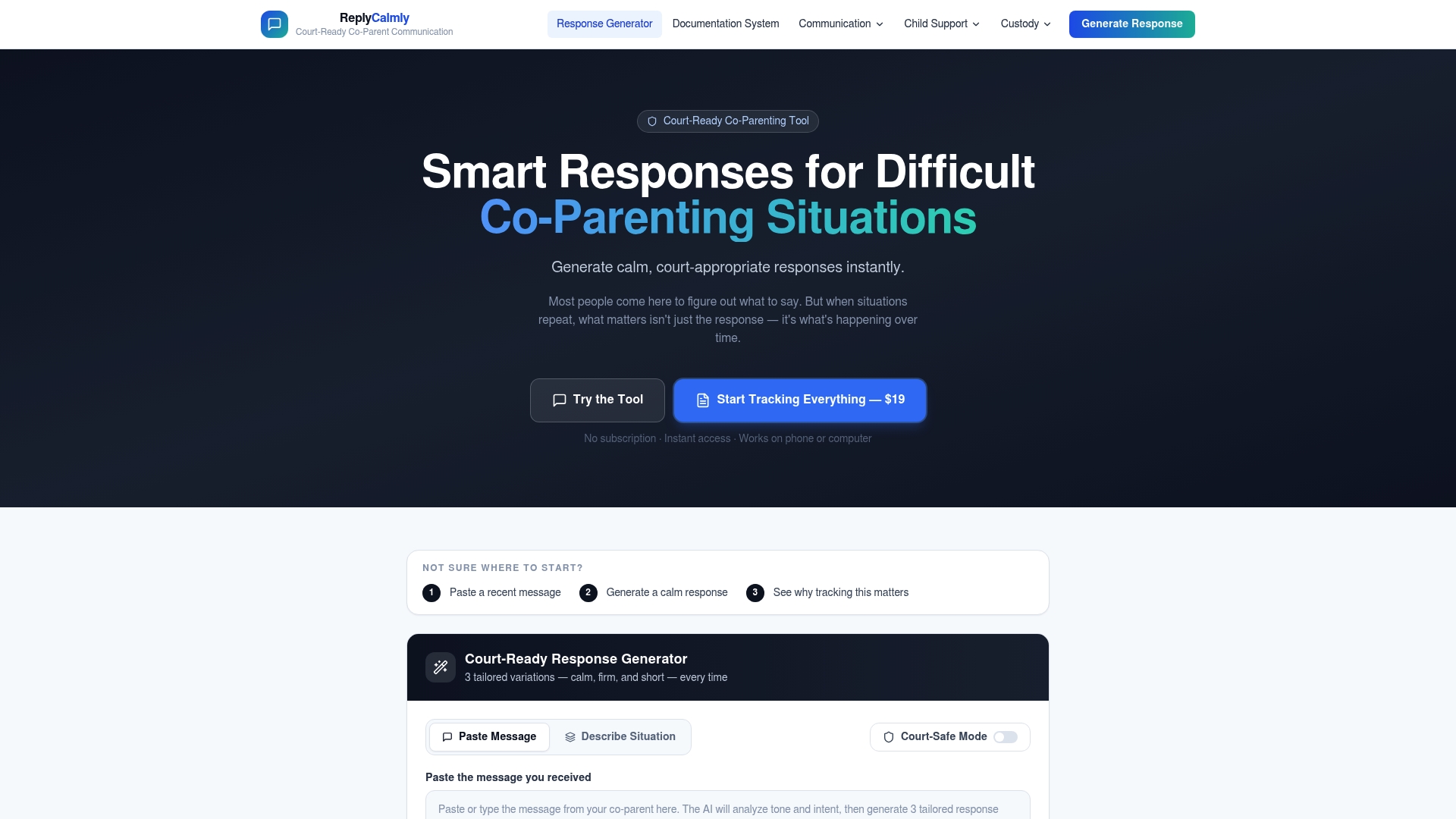
The Co-Parent Response Generator is free to use and produces multiple response options, including calm, firm, and short versions, so you can choose the tone that fits the moment. For co-parents who need to build a documented record of repeated issues, the best co-parenting apps for documentation guide walks through what to look for and how Replycalmly fits into that process. If you are managing a high-conflict situation, having the right tools in place before your next court date matters.
FAQ
What are the most common co-parenting challenges?
The top co-parenting challenges are scheduling disputes, communication breakdowns, financial disagreements, discipline inconsistencies, and conflicts over holidays and new partners. These ten areas account for the vast majority of conflicts that require intervention.
How do you handle co-parenting communication breakdowns?
Switch to written-only communication and keep every message focused on the child. When direct communication has failed entirely, parallel parenting limits contact to written, time-restricted channels and is recommended by practitioners for high-conflict situations.
What should a co-parenting plan include to prevent conflicts?
A solid parenting plan covers pickup times, holiday schedules, shared expense categories, rules for schedule changes, and guidelines for introducing new partners. Specificity in each area prevents the vague agreements that produce standoffs later.
How do you protect children from co-parent conflict?
Keep adult disputes out of the child's presence and never use the child as a messenger or informant. Minimizing children's exposure to parental conflict is the single most important thing both parents can do for the child's emotional health.
When should co-parents consider using a third-party tool or mediator?
Use a third-party tool or mediator when direct communication consistently escalates or when one parent refuses to engage. Third-party communication tools provide a neutral record of exchanges and reduce the emotional charge that leads to court-worthy incidents.