
Parental conflict resolution is the process of using cooperative techniques and legal tools to settle co-parenting disputes while keeping children's well-being at the center. The most effective parenting dispute resolution methods in 2026 family law include negotiation, mediation, collaborative law, and parenting coordination. Collaboration yields the most durable agreements in parent conflicts, according to Harvard negotiation research, because it focuses on underlying interests rather than fixed positions. This parental conflict resolution list gives you a practical, prioritized framework you can apply right now.
What is the top parental conflict resolution list for co-parents?
Every co-parent needs a clear map of strategies ranked by intensity and formality. The five core approaches below cover the full range, from a calm conversation to a courtroom order.
- Collaboration. This is the gold standard. Both parents work together to find a solution that genuinely serves the child, not just one parent's preference. Collaboration focuses on interests, not positions, which produces agreements that hold up over time.
- Compromise. Each parent gives a little to gain a little. This works well for lower-stakes disagreements, like adjusting a holiday schedule by a day or two.
- Accommodation. One parent yields to preserve the relationship. Use this sparingly and intentionally, not out of fear or exhaustion.
- Avoidance. Temporarily stepping back when emotions are running high is not weakness. It prevents a minor disagreement from becoming a legal incident.
- Mediation. A neutral third party guides both parents toward a written agreement. Most custody disputes resolve outside court through negotiation and mediation, which saves time, money, and emotional energy.
Pro Tip: Do not lock yourself into one style. Strategic flexibility means switching between collaboration, compromise, and avoidance based on the conflict's intensity. Rigid adherence to a single approach is one of the most common mistakes co-parents make.
How does mediation work in custody disputes?

Mediation is a confidential, voluntary process led by a neutral third party trained in family law. The mediator does not decide anything. The mediator helps both parents communicate clearly and move toward a written agreement they both accept.
Courts increasingly require it before litigation. Illinois Supreme Court Rule 923(a)(3) mandates mediation when parents cannot agree during initial case management. That mandate exists because structured early problem-solving consistently reduces the need for adversarial court hearings.
Preparing well makes mediation far more productive. Follow these steps before your session:
- Write down your child's specific needs. Think about school schedules, medical appointments, extracurricular activities, and daily routines.
- Identify your non-negotiables. Know the two or three things that matter most to you and why they serve your child.
- Gather documentation. Bring any relevant records: school reports, medical notes, or a log of communication issues.
- Leave the past at the door. Bringing up past relationship trauma wastes session time and signals to the mediator that you are not ready to focus on the child.
- Avoid pre-session negotiations. Do not try to settle things through texts or emails right before the session. It muddies the process.
Pro Tip: Mediation agreements have no legal force until a judge signs and files them. Mediated agreements become enforceable only after court approval. Never act on a mediated agreement as though it is final until that step is complete.
Mediation does have limits. When there is a history of domestic violence, a significant power imbalance, or one parent refuses to engage in good faith, other methods become necessary.
What communication techniques reduce co-parenting conflict daily?
The way you communicate between formal sessions determines whether conflicts escalate or stay manageable. Small habits compound over time.
- Use "I" statements. "I am concerned about the pickup time because it affects her homework routine" lands differently than "You are always late." The first invites problem-solving. The second invites defensiveness.
- Focus every message on the child. Before you send anything, ask: does this message serve my child's needs, or does it serve my frustration? If it is the latter, wait.
- Keep language neutral and court-appropriate. Assume every message you send could be read by a judge. Court-appropriate language protects you legally and keeps the tone professional.
- Document everything. Written records of agreements, schedule changes, and incidents create clarity and protect you if disputes escalate. A structured log is far more credible in court than memory.
- Do not seek to win. Releasing the need to win preserves your energy and removes the adversarial dynamic that blocks progress. The goal is a workable relationship, not a scorecard.
Technology helps here. Dedicated co-parenting communication platforms create a documented, timestamped record of every exchange. Replycalmly integrates with court-mandated communication tools to add structure and accountability without replacing the systems your court already requires.
What formal dispute resolution options exist beyond mediation?
When informal communication and mediation are not enough, structured legal options provide a clear path forward. Each method suits a different level of conflict and a different stage in the dispute.
Direct negotiation is the starting point. Both parents communicate directly, with or without attorneys, to reach an agreement. It costs the least and preserves the most control. It works best when conflict is low and both parents communicate in good faith.
Collaborative law brings attorneys into the process but keeps it out of court. Each parent retains a collaboratively trained attorney, and all parties sign an agreement to resolve the dispute without litigation. If the process breaks down, both attorneys must withdraw, which creates a strong incentive to reach agreement.
Arbitration hands decision-making to a private arbitrator rather than a judge. It is faster than litigation and more private, but you give up control of the outcome. It suits parents who cannot agree but also cannot afford the time and cost of a full trial.
Parenting coordination is the right tool for ongoing, high-conflict situations after a court order is already in place. Parenting coordinators manage post-order conflicts and can make binding decisions on minor issues without returning to court. This is more practical for long-term conflict management than mediation, which focuses on initial agreements.
Litigation is the last resort. A judge decides. You lose control of the outcome, costs rise sharply, and the adversarial process often damages the co-parenting relationship for years. Courts prefer parents who have genuinely attempted every other method first.
| Method | Control | Cost | Best for |
|---|---|---|---|
| Direct negotiation | High | Low | Low-conflict disputes |
| Collaborative law | High | Moderate | Moderate conflict with attorneys |
| Mediation | Moderate | Low to moderate | Most custody disputes |
| Parenting coordination | Low to moderate | Moderate | Ongoing high-conflict post-order |
| Arbitration | Low | Moderate to high | Impasse without full trial |
| Litigation | None | High | Safety concerns or bad faith |
One rule applies to every method except litigation: any agreement you reach requires court approval to become legally binding. Until a judge signs it, it is an understanding, not an order.
For parents in high-conflict situations, parallel parenting is worth considering alongside these formal methods. It reduces direct contact while keeping both parents involved in the child's life.
Key Takeaways
The most effective co-parenting conflict resolution combines collaborative negotiation, structured mediation, and consistent court-appropriate communication to protect the child's well-being and your legal standing.
| Point | Details |
|---|---|
| Collaboration outperforms all other styles | Harvard research confirms it produces the most durable agreements by focusing on interests, not positions. |
| Mediation is often legally required | Rules like Illinois Supreme Court Rule 923(a)(3) mandate mediation before litigation in many jurisdictions. |
| Agreements need court approval | A mediated agreement has no legal force until a judge signs and files it. |
| Communication style matters daily | Neutral, child-focused language protects you legally and prevents minor disputes from escalating. |
| Parenting coordinators handle ongoing conflict | They are the practical choice for high-conflict situations after a court order is already in place. |
What I have learned watching parents fight the wrong battles
The single biggest mistake I see co-parents make is treating conflict resolution like a competition. They spend enormous energy trying to prove the other parent wrong instead of solving the actual problem in front of them. That energy is finite. Every hour spent building a case against your co-parent is an hour not spent on your child.
The parents who resolve disputes fastest share one habit: they keep the child's needs as the only real priority in every conversation. Not their feelings about the divorce. Not the history of the relationship. Just the child's schedule, health, and stability. When you make that shift, the conversation changes completely.
I have also noticed that the parents who struggle most are the ones who pick one conflict style and never adjust it. The parent who always avoids never resolves anything. The parent who always pushes for collaboration in a high-conflict situation gets steamrolled. Strategic flexibility is not indecision. It is skill.
Finally, do not wait for a crisis to build good communication habits. The time to establish clear, documented, neutral communication is before the next dispute, not during it. The parents who improve co-parenting communication proactively are the ones who rarely end up back in court.
— Devin
Replycalmly helps you communicate when it is hardest
High-conflict co-parenting situations do not leave much room for careful word choice. When a message arrives that triggers frustration or fear, the instinct is to respond immediately and emotionally. That is exactly when a calm, court-appropriate response matters most.
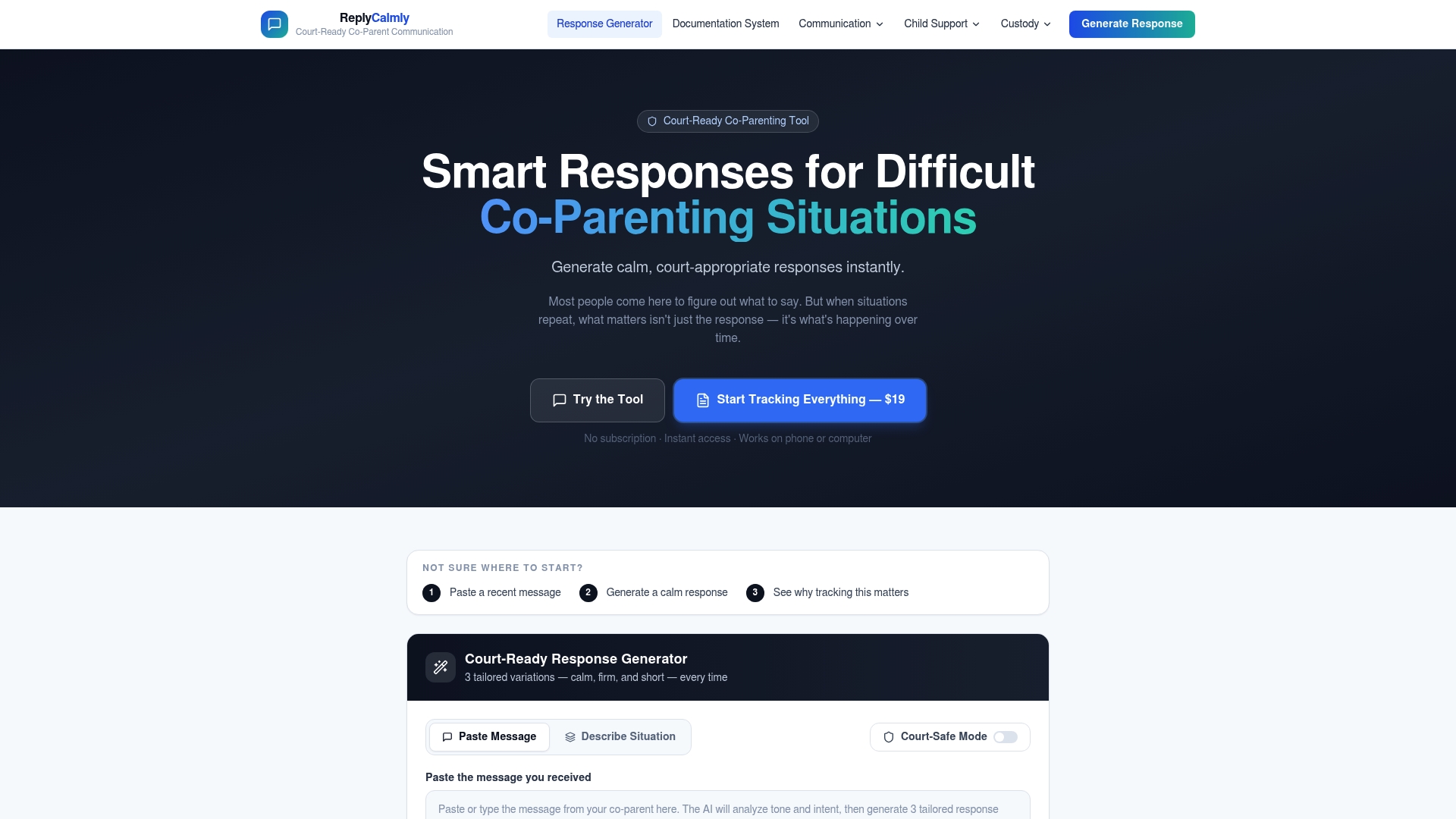
Replycalmly gives you a co-parent response generator that produces calm, firm, and short response variations for any message you receive. You stay within legal boundaries. You keep the focus on your child. You build a documented record of every exchange that holds up in court. The platform also helps you document co-parenting issues step by step, so nothing important gets lost when disputes escalate. Try it free at Replycalmly.
FAQ
What is the most effective parental conflict resolution strategy?
Collaboration is the most effective strategy because it focuses on the child's interests rather than each parent's position. Harvard negotiation research confirms it produces the most durable long-term agreements.
Is mediation mandatory in custody disputes?
Mediation is mandatory in many jurisdictions when parents cannot reach an agreement on their own. Illinois Supreme Court Rule 923(a)(3) is one example of a court rule that requires mediation before litigation proceeds.
Are mediation agreements legally binding?
A mediation agreement is not legally binding until a judge approves and files it with the court. Until that step is complete, it is an unenforceable understanding between the two parents.
When should a parenting coordinator be used instead of a mediator?
A parenting coordinator is the better choice for ongoing, post-order disputes in high-conflict situations. Unlike mediators, parenting coordinators can make binding decisions on minor issues without returning to court.
How do I keep communication calm during a custody dispute?
Use neutral, child-focused language in every message and assume a judge could read it. Tools that generate court-appropriate responses and log communication patterns help you stay consistent under pressure.