
Court-mandated communication tools are legally required platforms or methods that a family court orders co-parents to use for all child-related interactions during and after custody proceedings. These are not optional suggestions. Judges impose them when direct communication has broken down, when there is a history of conflict or abuse, or when the existing record of exchanges is unreliable. Platforms like OurFamilyWizard, TalkingParents, and AppClose are the most commonly ordered options, and understanding what they require of you is the first step toward staying compliant and protecting your position in court.
What are court-mandated communication tools and why do courts order them?
Court-mandated communication tools are specialized digital platforms or structured methods that a judge formally orders parents to use as their exclusive channel for co-parenting communication. The industry term for this broader category is "court-ordered electronic communication," a phrase codified in statutes across multiple states. These tools exist because unstructured communication between high-conflict parents frequently harms children, corrupts the evidentiary record, and wastes court resources on he-said-she-said disputes.
Courts have clear legal authority to issue these orders. Florida law, for example, authorizes electronic communication orders with specific safeguards and treats them as supplements to face-to-face parenting time rather than replacements. Similar statutes exist in California, Texas, and most other states, all anchored to the same standard: the best interest of the child.
Before ordering a specific tool, judges weigh several factors:
- The level of conflict between parents and whether direct contact escalates it
- Any documented history of domestic violence, substance abuse, or harassment
- Each parent's access to technology and ability to use digital platforms
- Whether prior communication attempts have produced reliable, usable records
Judges consider child welfare and each family's specific circumstances before ordering any tool, which means no two orders look exactly alike. One parent may be ordered to use a specific app with read-only attorney access. Another may be required to communicate only through a neutral third party. The order is tailored to the problem the court is trying to solve.
Non-compliance carries real consequences. Violations can result in contempt orders that include fines, modified custody schedules, and attorney fee awards. Repeated violations signal to the court that a parent is unwilling to prioritize the child's stability, which can shift the custody balance significantly.
Pro Tip: Read your court order word for word before using any platform. The order will specify which tool, what topics are permitted, and in some cases, required response times. Assumptions about what is "close enough" are how parents end up in contempt hearings.
What types of court-mandated communication tools are available?
The range of court-ordered communication methods is wider than most parents expect. Courts do not always mandate a specific app. Sometimes the order specifies a category of tool, and sometimes it designates a human intermediary instead of a digital platform.
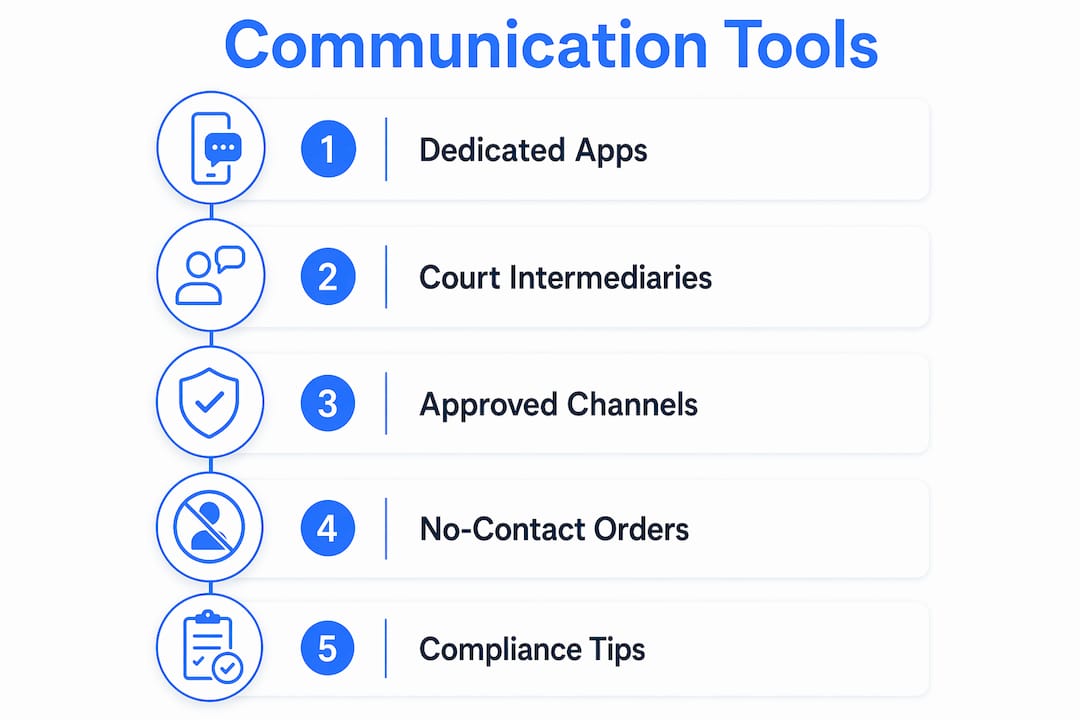
Dedicated co-parenting apps
These are the most commonly ordered tools in high-conflict custody cases. Each platform is purpose-built for legal documentation and monitored communication.
| Platform | Key features | Best suited for |
|---|---|---|
| OurFamilyWizard | ToneMeter, read-only attorney access, certified court records | High-conflict cases needing tone monitoring and legal admissibility |
| TalkingParents | Tamper-proof message logs, shared calendar, call recording | Cases requiring unalterable communication records |
| AppClose | Encrypted messaging, expense tracking, court-ready records | Cases involving Los Angeles County Superior Court or similar jurisdictions |

OurFamilyWizard's ToneMeter flags emotionally charged language before you send a message, which is a feature no standard texting app offers. Court-approved platforms provide unalterable records of messaging, calendars, and expenses, all timestamped and admissible in court. That admissibility is the core reason judges trust these tools over screenshots of text messages, which can be cropped or altered.
AppClose signed a 3.5-year extension with Los Angeles County Superior Court as its approved co-parenting platform. That kind of institutional endorsement reflects how seriously courts now treat these tools as part of the formal legal process.
Court-appointed intermediaries
When digital tools are not viable or when a no-contact order is in place, courts sometimes appoint a neutral intermediary or parenting coordinator. Intermediaries relay only child-related information between parents, removing all direct contact. This option is more expensive than an app and less scalable, but it is the appropriate solution when one parent's safety is at risk or when digital literacy is a genuine barrier.
No-contact orders with approved channels
Some orders prohibit all direct communication and require that all messages pass through approved channels only, with no indirect contact through children, relatives, or mutual friends. Courts treat indirect contact as a violation even when the message itself is benign. The channel restriction is the point, not the content of the message.
How to comply effectively with court-ordered communication requirements
Compliance is not just about using the right app. It is about using it correctly, consistently, and within the exact scope the order defines. Many parents violate their orders without realizing it because they treat the mandated platform as one option among several rather than the only option.
Follow these steps to stay fully compliant:
-
Use only the designated platform for all child-related communication. If your order names OurFamilyWizard, every message about school, medical appointments, and schedule changes goes there. Not by text. Not by email. Not through your child.
-
Notify the other parent within 7 days if your access details change. Florida law requires this notification as a specific legal obligation. Failing to update access information can be used against you in enforcement actions, even if the underlying communication was fine.
-
Keep every message focused on the child. Avoid personal grievances, financial disputes unrelated to child expenses, and any language that could be characterized as harassment. Courts and attorneys can access these records at any time.
-
Understand what counts as an emergency exception. Most orders allow direct contact in genuine emergencies involving the child's immediate safety. Document the emergency and follow up on the platform immediately afterward.
-
Respond within any timeframe the order specifies. Some orders require responses within 24 or 48 hours. Silence can be treated as non-cooperation.
-
Document violations by the other parent immediately. If the other parent contacts you outside the mandated platform, do not respond through that channel. Screenshot the attempt, note the date and time, and report it to your attorney.
Pro Tip: Treat every message you send as if a judge will read it tomorrow morning. That single mental shift changes the tone of almost every message and keeps you well inside the boundaries of your order.
Strict adherence to the specific terms of the court order is necessary because misunderstanding exceptions or scope can lead to violations even when your communication intentions are good. Good intentions do not override contempt findings.
What benefits do court-mandated communication tools provide?
The benefits of these tools extend well beyond keeping you out of trouble. Used correctly, they actively strengthen your legal position and reduce the daily stress of co-parenting in a high-conflict situation.
Dedicated co-parenting platforms reduce disputes about who said what and provide reliable, court-admissible evidence. That reliability matters enormously when a custody modification hearing is approaching and the other parent claims you were unresponsive or aggressive.
The practical advantages include:
- Unalterable records. Every message, calendar entry, and expense log is timestamped and locked. Neither parent can edit or delete entries after the fact, which eliminates the credibility battles that consume so many court hearings.
- Reduced direct confrontation. Structured platforms naturally slow down communication. You cannot receive a message and fire back instantly the way you can with a text. That friction reduces escalation.
- Coordinated scheduling and expense tracking. Shared calendars and expense logs inside platforms like AppClose and OurFamilyWizard create a single source of truth for both parents, reducing disputes over who agreed to what.
- Attorney and court access. Read-only access for your attorney means your legal team can monitor communication patterns without you forwarding every message. Courts can also review records directly, which speeds up enforcement proceedings.
- Support for parenting coordinators. When a parenting coordinator is involved, a complete platform record gives them the context they need to make informed recommendations without relying on each parent's selective account of events.
These tools also protect you from non-compliance risks that arise through side-channel communication. When everything is on the platform, there is no ambiguity about whether you violated the order.
Key takeaways
Court-mandated communication tools are legally binding orders requiring specific platforms or methods, and full compliance protects both your custody position and your child's wellbeing.
| Point | Details |
|---|---|
| Legal authority is clear | Courts in most states can order specific platforms under child welfare statutes, with contempt penalties for violations. |
| Top platforms differ by feature | OurFamilyWizard, TalkingParents, and AppClose each offer tamper-proof records but vary in tone monitoring, expense tracking, and court partnerships. |
| Compliance means exclusivity | Using the mandated platform for every child-related message, not just most of them, is what the order requires. |
| Notification deadlines matter | Parents must update access details within 7 days of any change or risk enforcement action under statutes like Florida's. |
| Records work in your favor | Unalterable, timestamped logs reduce he-said-she-said disputes and provide admissible evidence in custody hearings. |
What I've learned watching parents navigate these tools
Most parents approach court-mandated communication tools as a punishment. That framing is a mistake, and it leads to the most common compliance errors I see: minimal engagement, passive-aggressive tone, and the temptation to handle "small" issues by text because the app feels like overkill.
The parents who use these tools most effectively treat them as a professional communication system, the same way you would use a work email account. You would not send a hostile message to a colleague through a monitored company system. The same logic applies here, and the stakes are considerably higher.
The second mistake is assuming that being technically on the platform is enough. I have seen parents use OurFamilyWizard for every message and still end up in contempt hearings because their messages contained veiled threats, financial pressure, or attempts to discuss topics the order restricted. The platform is not a shield. The content still matters.
What actually works is pairing the mandated tool with a disciplined approach to message drafting. Before you send anything, ask whether the message is about the child, whether it is factual, and whether it could be read as hostile by someone who does not know you. If the answer to any of those questions is uncertain, revise before sending. Tools like Replycalmly are built specifically for this step. They help you draft responses that stay within the tone and scope your order requires, which is exactly the kind of support that keeps you out of enforcement hearings and focused on your child.
The parents who treat these tools as a long-term record-building strategy rather than a short-term compliance burden are the ones who show up to modification hearings with clean, professional communication logs. That record speaks for itself.
— Devin
How Replycalmly supports your court-ordered communication
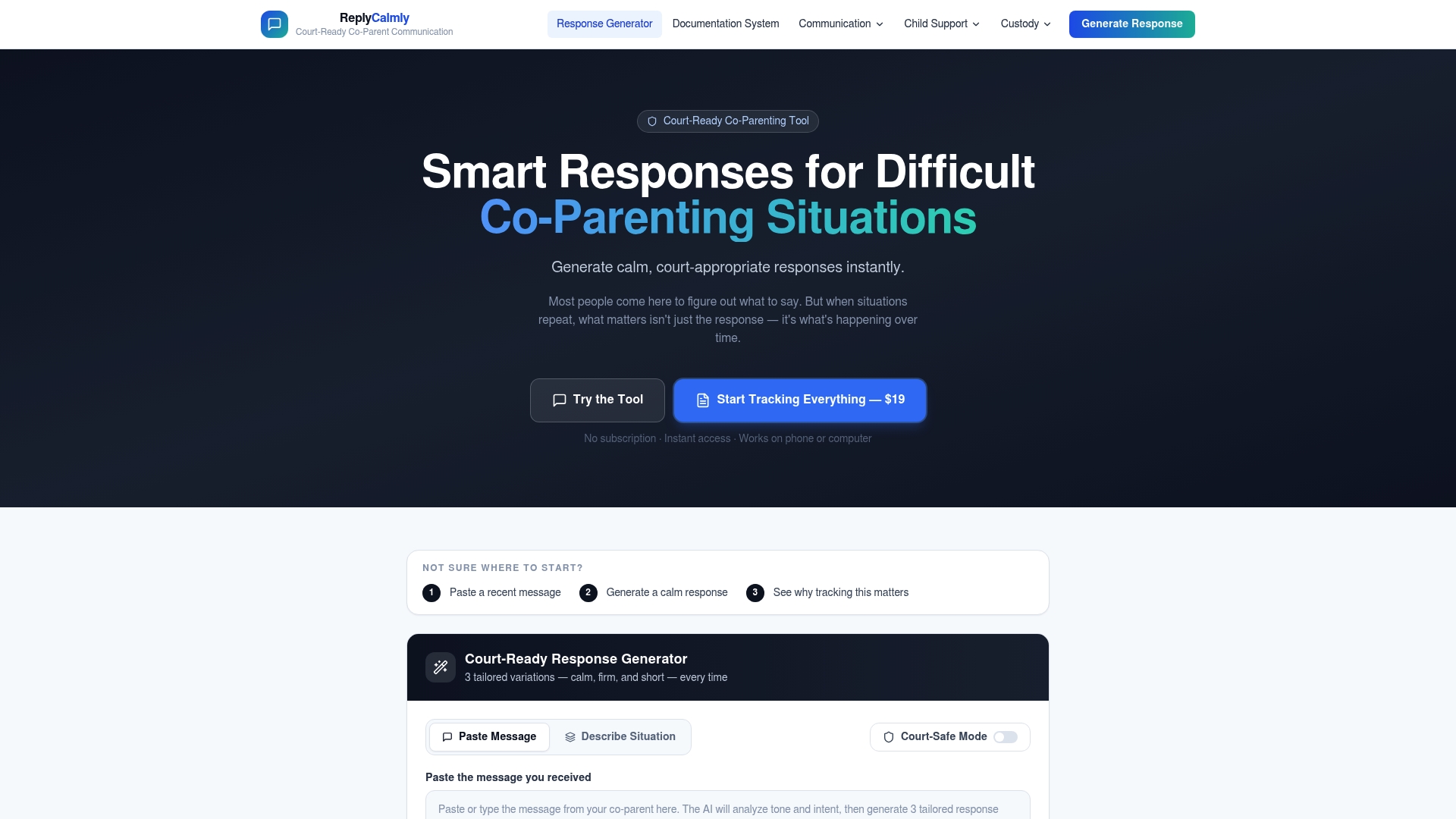
Using a court-mandated platform is the legal requirement. Knowing what to say inside it is the practical challenge. Replycalmly is built for exactly that gap. The platform generates calm, court-appropriate response variations for difficult messages you receive, so you can reply professionally without spending an hour managing your emotions first. It also tracks communication patterns over time, categorizing incidents like custody conflicts, manipulation attempts, and false accusations into a visual dashboard you can share with your attorney.
Replycalmly integrates with existing tools like OurFamilyWizard rather than replacing them, adding a layer of documentation and response support on top of your mandated platform. Start by reviewing the best apps for documentation to understand which court-approved platforms pair well with Replycalmly's tracking features. You can also use the co-parenting communication plan template to map out exactly how your court order requires you to communicate, so nothing falls through the cracks.
FAQ
What is a court-mandated communication tool?
A court-mandated communication tool is a platform or method that a judge formally orders co-parents to use for all child-related communication. Common examples include OurFamilyWizard, TalkingParents, and AppClose, all of which provide tamper-proof, court-admissible records.
Can a judge really require a specific app?
Yes. Courts have statutory authority in most states to order specific platforms as part of a custody arrangement. Court orders can require all communication through a named platform, with contempt of court as the penalty for using any other channel.
What happens if I text instead of using the mandated app?
Texting outside the mandated platform is a violation of the court order, even if the message content is appropriate. Side-channel communication like direct texting can be treated as contempt when orders require exclusive platform use, which may result in fines or custody modifications.
Do these tools cost money?
Most dedicated co-parenting apps charge a monthly or annual subscription fee. OurFamilyWizard, TalkingParents, and AppClose all offer paid plans, though some courts and legal aid organizations provide fee waivers for low-income parents. Check your court order to see if the cost allocation between parents is specified.
How do I get a co-parenting app added to my court order?
You or your attorney can file a motion requesting that the court add a specific platform to your custody order. Courts are most likely to grant this request when you can document a pattern of communication problems, harassment, or unreliable records from prior exchanges.