
If your family court order requires you to use a specific communication app, your first instinct might be to see it as the judge watching your every text. That's a common reaction, and it's worth challenging. Court-mandated co-parenting tools are not designed to punish you or put you under a microscope. They exist because unstructured communication in high-conflict custody situations creates confusion, escalates arguments, and leaves parents without reliable records when disputes land back in front of a judge. Understanding how these tools actually function can shift your entire experience from defensive to strategic.
Table of Contents
- Why do courts mandate communication tools?
- Core features of court-approved co-parenting tools
- How do these tools impact conflict and litigation?
- How to choose and use the right court-mandated tool
- What most guides miss about court-mandated co-parenting tools
- Take the next step: Smarter co-parenting with ReplyCalmly
- Frequently asked questions
Key Takeaways
| Point | Details |
|---|---|
| Court-mandated tools explained | Court-ordered co-parenting tools provide clear records and support smoother, safer family communications. |
| Choose features carefully | Select tools offering robust documentation, message filters, and calendar sharing for compliance and efficiency. |
| Apps aid, don't replace skills | Technology helps, but consistent respectful communication and emotional awareness matter just as much as features. |
| Combine for best results | Combining mandated tools with classes or coordinators maximizes peace and legal protection. |
Why do courts mandate communication tools?
Courts don't require specific apps on a whim. The push toward mandated co-parenting technology comes directly from patterns judges see repeatedly in high-conflict custody cases: missed handoffs blamed on vague texts, disputed agreements with no written record, and inflammatory messages that derail mediation sessions before they even begin.
Courts in multiple states, including Washington, New York, and jurisdictions like Spokane, are increasingly incorporating co-parenting apps directly into custody orders. This isn't a niche trend. It's a response to the reality that informal communication channels, think personal texts and emails, are too easy to misrepresent, delete, or take out of context when parents are already in conflict.
Here's why courts increasingly favor these mandates:
- Admissibility: Messages sent through court-approved platforms carry stronger evidentiary weight because the system timestamps and stores them in a tamper-proof environment.
- Accountability: When both parents know every message is logged, the tone of communication often improves without any court intervention.
- Child-focused outcomes: Judges prioritize the child's best interest above all else, and these tools reduce the risk that adult conflict bleeds into parenting decisions.
- Faster dispute resolution: When a dispute arises, attorneys and mediators can pull exact records instead of sorting through conflicting accounts.
"The goal isn't surveillance. The goal is consistency. When communication lives in one structured place, children experience fewer disruptions and parents spend less time in courtrooms."
Thinking of these tools as protective infrastructure rather than monitoring devices changes how you use them. The parents who benefit most are those who approach every message as court-approved messages, written with clarity and without emotional reactivity.
Core features of court-approved co-parenting tools

Not every app qualifies as court-approved. The ones courts trust share a specific set of features designed to support clear documentation, child-focused planning, and legal compliance.
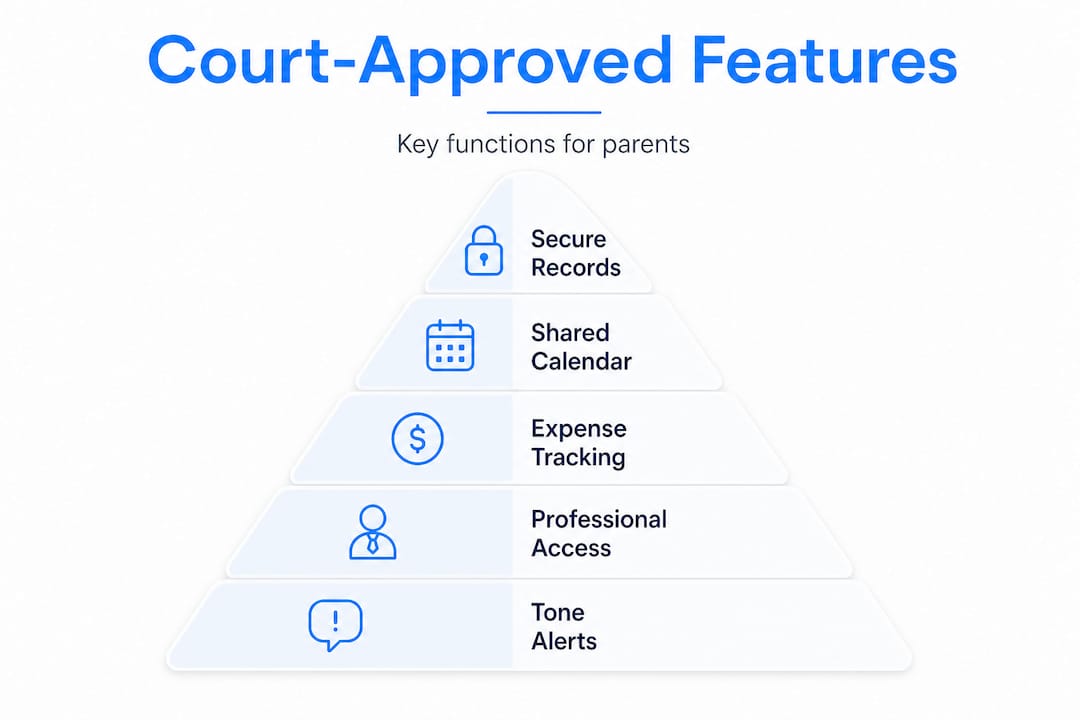
OurFamilyWizard is among the most widely recognized platforms, offering shared calendars for custody schedules, expense tracking with receipt uploads, professional access for attorneys and mediators, and AI tools like ToneMeter that flag emotionally charged language before you send a message. Platforms like BestInterest take a similar approach, using message filtering to promote calm, child-focused communication.
Here's a side-by-side look at how leading apps compare on core features:
| Feature | OurFamilyWizard | TalkingParents | Our Family Wizard Basic |
|---|---|---|---|
| Shared calendar | Yes | Yes | Yes |
| Expense tracking | Yes | Limited | Limited |
| Attorney access | Yes | Yes | No |
| AI tone tools | Yes (ToneMeter) | No | No |
| Message archiving | Yes | Yes | Yes |
| Free tier | No | Yes | No |
The most valuable features for a high-conflict situation go beyond scheduling:
- Document sharing: Upload school records, medical forms, and legal documents directly in the platform so neither parent can claim they "never received" something.
- Expense logs with receipts: Reduces financial disputes by attaching proof to every shared cost claim, whether it's a co-pay or a school activity fee.
- Professional read access: Your attorney or parenting coordinator can monitor communications and intervene when necessary, without either parent needing to forward screenshots.
- Message filtering and tone tools: These features don't block messages but they do prompt you to reconsider language that reads as hostile or accusatory before it goes through.
Pro Tip: Enable professional access for your attorney from day one, even if you aren't currently in active litigation. Having a real-time record your lawyer can access makes any emergency motion much faster to prepare.
Using structured response strategies alongside these app features creates a communication approach that is both legally sound and practically sustainable. Apps give you the format. Structured responses give you the content.
How do these tools impact conflict and litigation?
Here's where the real picture gets more nuanced. Court-mandated tools are powerful, but they are not magic.
The documentation capabilities of platforms like TalkingParents are genuinely superior. Every message is timestamped, archived, and exportable as a PDF for court. If your co-parent sends a message at 11 p.m. that violates the custody order, you have an exact record with no risk of it being edited or disputed. Apps excel in litigation documentation but may not prevent conflict, especially when one party refuses to engage constructively or finds workarounds through phone calls and third parties.
Consider these real dynamics that play out for co-parents using mandated tools:
- When both parents comply: Communication becomes measurably more civil because both parties know the record exists. Disputes about "what was agreed" drop significantly.
- When one parent refuses: The refusing parent typically faces court consequences, but enforcement still takes time. Your documentation of their non-compliance becomes its own form of evidence.
- When conflict is deeply emotional: Apps structure the format of communication but can't address the emotional triggers underneath. A parent who is determined to be difficult will find ways to be difficult within the platform's rules.
- When finances are contested: Expense tracking features reduce disputes by roughly half in practice because the paper trail is undeniable.
"TalkingParents documents rather than filters. If you need a platform that intervenes before a hostile message is sent, that's a different tool set entirely."
Cost is also a real consideration. OurFamilyWizard runs approximately $144 per year, and the platform does not offer a meaningful free tier. For parents with limited income following a divorce, that's a genuine barrier. Free platforms like TalkingParents exist, but they typically offer fewer features and no AI-assisted tone moderation.
If you're evaluating whether a mandated tool is the right fit or exploring court-recommended app alternatives, understanding what the court's specific order requires is the essential first step. Not all orders name a specific app. Some require only that communication be "documented in a court-accessible platform," which gives you flexibility.
How to choose and use the right court-mandated tool
Choosing the right tool starts before you open any app store. Your court order is the primary document, and the language matters more than any review you'll read online.
- Read your court order carefully: Look for specific app names, required features, or language like "secure messaging platform." Some orders require professional access for a parenting coordinator, which immediately narrows your options.
- Consult your attorney before choosing: Attorneys familiar with your jurisdiction often know which platforms local judges prefer, and some courts have informal preferences even when they don't mandate a specific app by name.
- Evaluate export capabilities: A platform is only as useful in court as its ability to produce clean, printable records. Test the export function before you commit.
- Consider support and accessibility: If your co-parent is not tech-savvy, a platform with a steep learning curve creates an excuse for non-compliance. Simpler platforms reduce that friction.
- Review cost against your budget: If cost is a concern, ask your attorney whether the court will accept a free platform, or whether the order can be modified to specify a more affordable option.
Apps reduce litigation costs by improving accountability and providing clear records, but only when both parties use them consistently. Consistent use means logging every relevant communication on the platform, not just the ones that support your position. Courts notice selective documentation, and it undermines credibility.
For severely contested cases, combining a mandated app with a parenting coordinator or court-ordered parenting class is often the most effective approach. The app handles logistics and documentation. The coordinator or class addresses the communication breakdown underneath the surface conflict.
Pro Tip: Set a weekly calendar reminder to review your platform's records. Catching a pattern of missed pickups, late responses, or financial disputes early gives you time to address it with your attorney before it becomes a hearing issue.
AI-powered communication tools have made it significantly easier to draft messages that are firm, factual, and free of the emotional charge that typically invites escalation. Pairing those tools with a court-mandated platform creates a layered system of protection that works on both the documentation and the communication quality side of the equation.
What most guides miss about court-mandated co-parenting tools
Most articles on this topic stop at the feature comparison table. That's useful, but it misses the harder truth that the parents who struggle most with these tools aren't struggling because they chose the wrong app.
Here's the uncomfortable reality: court-mandated tools set a structure, but they cannot supply the emotional intelligence to use that structure well. You can have the most sophisticated platform available and still send a message that reads as hostile, passive-aggressive, or accusatory. The app logs it perfectly. The court sees it perfectly. And it works against you.
The parents who get the most out of mandated tools are the ones who treat them as a discipline practice, not just a compliance requirement. Every message becomes an opportunity to demonstrate the kind of co-parent you are. Judges read patterns, not just individual messages. A consistent record of calm, child-focused communication is one of the most powerful things you can bring into a custody hearing.
There's also a temptation to use these platforms for evidence-gathering in a way that actually hurts your case. Deliberately provoking your co-parent through messages to generate a hostile response is visible to any experienced attorney or judge. The structured responses method works precisely because it keeps your communication on record looking exactly as it should, clear, direct, and focused on the child, regardless of what the other parent sends.
Technology sets the table. You still have to show up prepared to eat without creating a scene. The co-parents who thrive in high-conflict situations are those who use mandated tools as a genuine behavioral reset, not just a legal formality.
Take the next step: Smarter co-parenting with ReplyCalmly
Navigating court-mandated communication tools is one piece of the puzzle. Knowing what to say when a difficult message lands is the other piece most parents don't have support for.
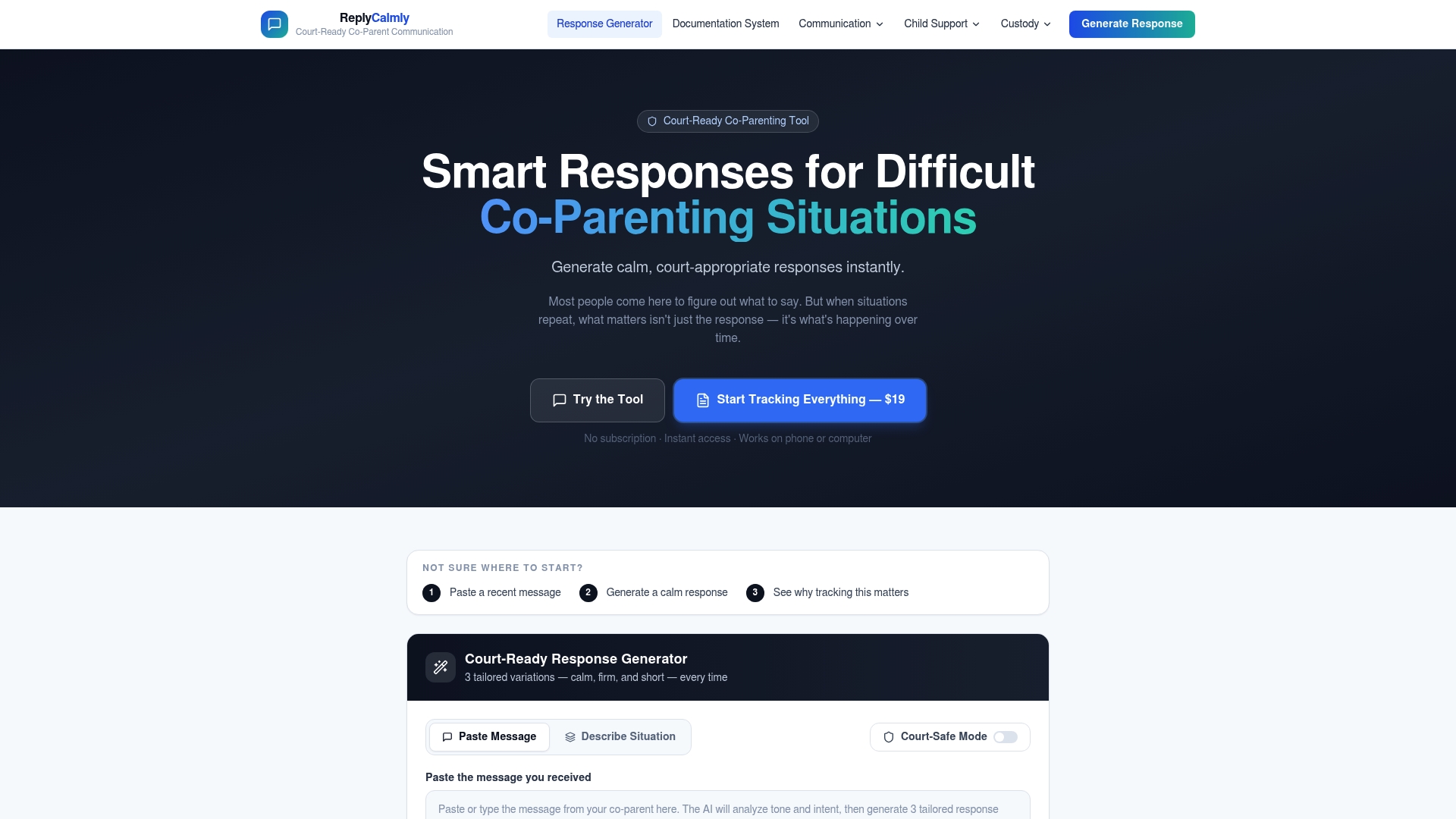
ReplyCalmly is built specifically for this challenge. The platform generates calm, firm, and court-appropriate response variations for any message you receive, so you're never staring at your phone trying to figure out how to respond without making things worse. It also tracks communication patterns over time, categorizes incidents by type (custody conflicts, false accusations, manipulation), and gives you a visual dashboard your attorney can actually use. ReplyCalmly integrates with tools like OurFamilyWizard rather than replacing them, adding a layer of communication intelligence to whatever platform your court requires.
Frequently asked questions
What makes a co-parenting tool court-approved?
Tools earn court approval when they offer secure, documented records including shared calendars, expense tracking, and professional access that support transparent, verifiable co-parenting communication.
Can a mandated app reduce parent conflict, or just document it?
Some apps include conflict-reducing features like tone alerts, but documentation is the primary function for most platforms. Actual conflict reduction still depends on both parents committing to constructive communication.
How much do court-approved co-parenting apps cost?
Costs vary widely, with premium apps like OurFamilyWizard running approximately $144 per year, while free alternatives like TalkingParents exist but typically offer fewer features.
What if my co-parent refuses to use the mandated tool?
Document your own consistent compliance and report the refusal to your attorney immediately. Non-compliance enforcement varies by jurisdiction, but your good-faith record strengthens your legal position considerably.
Should I combine court-mandated apps with other tools or help?
Yes, especially in highly contentious situations. Combining apps with parenting coordinators or court-ordered classes addresses both the logistical and emotional dimensions of high-conflict co-parenting more effectively than any single tool alone.