
Third-party communication tools are specialized platforms that let co-parents exchange messages, share schedules, and build tamper-proof records that courts can use as evidence in custody disputes. Platforms like OurFamilyWizard and TalkingParents have become the standard in high-conflict custody cases because they solve a problem that texts and emails cannot: they create timestamped, unalterable archives that neither parent can delete or manipulate. Understanding why use third-party communication tools matters because every message you send or receive in a custody dispute is potential evidence. The right platform protects you. The wrong communication channel can be used against you.
What benefits do third-party communication tools offer co-parents?
The core benefit is simple: structured records replace "he said, she said." Judges reviewing custody cases may look at months or years of communication history to determine what arrangement serves the child's best interests. When that history lives on a dedicated platform, it is organized, searchable, and ready to present.
The advantages of external communication platforms go well beyond record-keeping:
- Tamper-proof message logs. Co-parenting apps prevent edits and deletions after a message is sent, creating a neutral archive accessible to both parties and their attorneys. Text messages can be deleted or altered before a screenshot is taken.
- Tone monitoring. OurFamilyWizard's ToneMeter feature flags hostile language before you send it, reducing the chance that frustration turns into a message that damages your case.
- Centralized scheduling and expenses. Shared calendars, expense tracking, and document storage replace the scattered back-and-forth of email chains and keep all co-parenting logistics in one place.
- Read receipts. Knowing when the other parent opened a message removes the excuse of "I never saw that" and creates an additional layer of accountability.
- Conflict reduction. When both parents know every message is logged and visible to attorneys and judges, the incentive to send inflammatory messages drops significantly.
Pro Tip: Set up your chosen platform before conflict escalates. Starting from day one gives you a longer, cleaner record that carries more weight in court than a few weeks of messages collected right before a hearing.
The third-party communication advantages here are not just legal. Parents who use dedicated platforms report fewer direct confrontations because the tool itself acts as a buffer. You respond to a message on your own schedule, in writing, with a record attached.

How do third-party tools support legal evidence in court?
Communication itself becomes evidence in custody disputes. The question is whether that evidence is credible, organized, and admissible. This is where dedicated platforms have a clear edge over traditional channels.
Courts in jurisdictions like Virginia and Colorado have recognized that app exports qualify under authentication and business records exceptions, which simplifies the evidentiary foundation in custody trials. A printed screenshot of a text message requires the submitting party to authenticate it, explain how it was preserved, and prove it was not altered. A platform-generated export carries built-in metadata that does much of that work automatically.
| Communication Method | Tamper Resistance | Court Export | Authentication Burden |
|---|---|---|---|
| Standard text messages | Low | Manual screenshot | High |
| Personal email | Low | Manual export | High |
| OurFamilyWizard / TalkingParents | High | Built-in export | Low |
| Court-ordered app records | High | Formatted for court | Minimal |
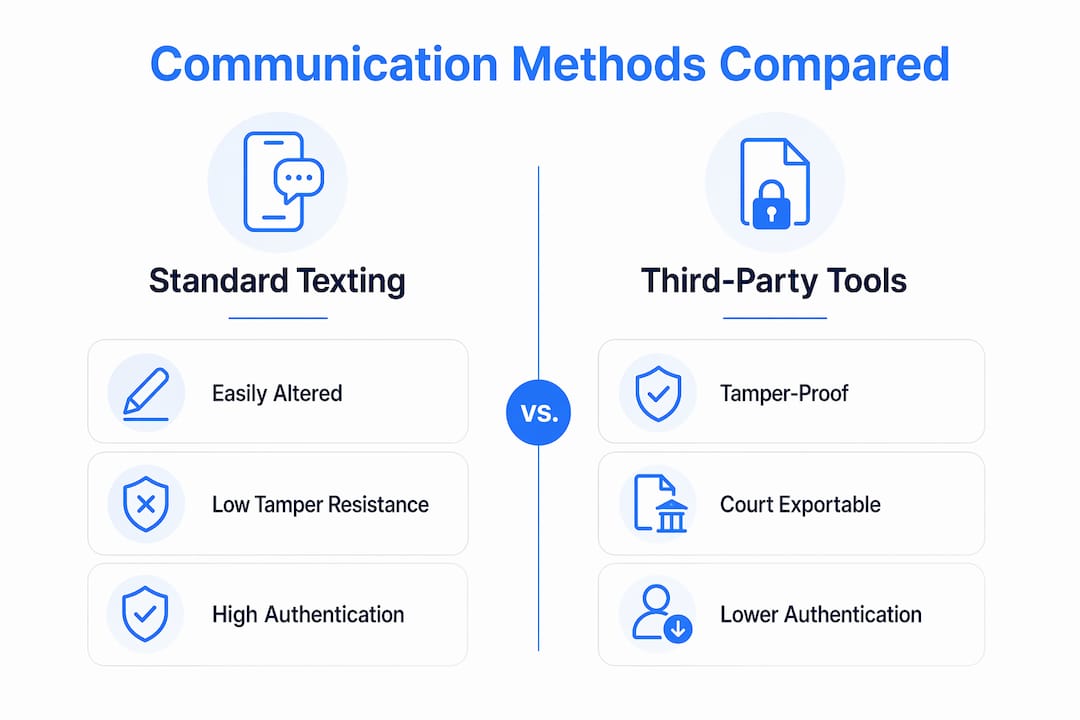
Court orders frequently require that all non-emergency co-parenting communication happen through a designated platform only. This prohibition on routine texts and calls is not punitive. It is designed to create a single, reliable record that protects both parents and the child.
One detail most parents miss: custody trials may involve 50–200 individual messages as exhibits. Organized platform logs make that volume manageable for a judge. A folder of screenshots does not. Consistent, chronologically organized logs demonstrating patterns of violations or compliance persuade courts far more effectively than isolated incidents pulled from a phone.
Pro Tip: Even if the other parent refuses to activate the platform, document that refusal. The invitation record and their non-response is itself evidence of noncompliance that your attorney can present.
It is worth noting that platform records ease authentication but do not guarantee automatic admissibility. Courts still evaluate evidence for relevance and credibility. A well-organized record improves your odds. It does not replace legal strategy.
What features should co-parents look for in these platforms?
Not every co-parenting app is built the same way. The right choice depends on your custody arrangement, your level of conflict, and what your court order requires. Here are the features that matter most.
Non-negotiable features:
- Secure, encrypted messaging with timestamps
- Tamper-evident message archives
- Court-ready export formats (PDF or formatted logs)
- Shared parenting calendar
- Expense tracking and payment records
- Attachment support for documents and photos
Features that add real value in high-conflict cases:
- Tone monitoring (OurFamilyWizard's ToneMeter is the most recognized example)
- Read receipts with timestamps
- Third-party access for attorneys and guardian ad litems
- Activity logs showing when each parent logged in
Key app features including message export, shared calendars, expense tracking, and tone-checking tools vary significantly between platforms. Before you commit to one, check whether your court order names a specific platform. Some judges in high-conflict cases mandate OurFamilyWizard by name. Using a different app, even a good one, could put you out of compliance.
Cost is a real consideration. OurFamilyWizard charges an annual subscription fee per parent. TalkingParents offers a free tier with limited features and a paid tier with full court-ready exports. If cost is a barrier, ask your attorney whether fee waivers are available through the platform or the court. You can also review a comparison of documentation apps to find the option that fits your situation and budget.
What strategies optimize these tools in high-conflict co-parenting?
Using a third-party platform is not enough on its own. How you use it determines whether it helps or hurts your case. These strategies make the difference.
-
Start immediately and stay consistent. Starting preservation and logging from day one builds a longer, more credible record. Courts respond to patterns, not isolated incidents. A single message showing bad behavior is easy to dismiss. Six months of documented patterns is not.
-
Keep all co-parenting communication on the platform. Avoid side conversations via text, email, or social media about anything related to custody, schedules, or the child. Every off-platform conversation creates a gap in your record and an opportunity for dispute.
-
Document invitations and unanswered messages. Recording invitations and unresponded message attempts proves your compliance even when the other parent is uncooperative. Courts notice when one parent is consistently trying to communicate and the other is not responding.
-
Write messages as if a judge will read them. Because a judge might. Keep messages factual, child-focused, and free of accusations. Replycalmly's co-parent response generator helps you draft calm, court-appropriate replies when emotions are running high.
-
Log incidents systematically, not sporadically. Sporadic documentation looks reactive. Systematic logs look credible. Use your platform's built-in tools or a supplemental tracking system to categorize issues by type, such as schedule violations, missed pickups, or hostile messages, and record them as they happen.
Pro Tip: Before any court hearing or modification proceeding, export your full communication log and review it with your attorney. Patterns you have stopped noticing may be exactly what the judge needs to see.
Replycalmly integrates with court-mandated platforms like OurFamilyWizard to add a layer of response support and incident tracking. You can read more about parallel parenting strategies for high-conflict situations where direct communication has broken down entirely.
Key takeaways
Third-party communication tools are the most reliable way for co-parents to build court-admissible records, reduce direct conflict, and demonstrate compliance with custody orders.
| Point | Details |
|---|---|
| Tamper-proof records matter | Platform archives cannot be deleted or altered, making them far stronger evidence than texts or screenshots. |
| Courts prefer organized logs | Judges reviewing custody cases respond to documented patterns, not isolated incidents pulled from a phone. |
| Start early and stay consistent | Beginning your record from day one builds the long, credible history that carries weight in modification hearings. |
| Match features to your case | Court orders may name a specific platform; verify compliance before choosing an app. |
| Off-platform conversations hurt you | Any custody-related message sent outside the designated tool creates gaps that the other parent can exploit. |
The uncomfortable truth about communication in custody cases
I have seen parents lose ground in custody hearings not because they did anything wrong, but because they could not prove they did anything right. That is the part no one tells you upfront. The burden of demonstrating cooperation, compliance, and good-faith communication falls on you, and it falls on you every single time.
The parents who fare best in contested custody cases are not always the ones with the strongest legal arguments. They are the ones with the cleanest records. A parent who has 14 months of calm, child-focused messages on OurFamilyWizard walks into a modification hearing with a fundamentally different position than a parent who has a folder of screenshots and a memory of what was said.
What I find most underestimated is the conflict-reduction effect. When both parents know the record is permanent and visible to attorneys, the tone of communication shifts. Not always immediately, but over time. The platform itself becomes a behavioral guardrail. That is not a side benefit. That is one of the most practical things a co-parenting tool does.
The common mistake I see is waiting. Parents start using a platform after things get bad, which means their early record is missing or lives in a text thread that is hard to authenticate. If you are reading this before a dispute escalates, start now. If you are already in the middle of one, start today and document everything going forward, including the fact that you started.
— Devin
Tools and resources to protect your co-parenting record
Managing communication in a custody dispute is one of the hardest things you will do. Having the right tools makes it survivable.
Replycalmly is built specifically for this situation. The platform helps you generate calm, court-appropriate responses to difficult messages and tracks communication patterns over time through a structured incident log. It works alongside court-mandated tools like OurFamilyWizard rather than replacing them. Start with the best co-parenting apps for documentation to find the right platform for your case. If you need help responding to a difficult message right now, the co-parent response generator gives you calm, firm, and short reply options in seconds. Your record starts with your next message. Make it count.
FAQ
Why use third-party communication tools instead of texting?
Text messages can be deleted, altered, or taken out of context before they reach court. Third-party platforms create tamper-proof, timestamped records that are far easier to authenticate as evidence.
Can co-parenting app messages be used in court?
Yes. Courts in states like Virginia and Colorado accept platform exports under business records exceptions, though admissibility still depends on relevance and how the evidence is presented.
What if the other parent refuses to use the platform?
Document the refusal. Recording invitations and unanswered messages proves your compliance and demonstrates the other parent's noncompliance to the court.
Are co-parenting apps required by court order?
In many high-conflict cases, yes. Court orders often mandate a specific platform and prohibit routine texts or calls for non-emergency communication. Check your order before choosing an app.
How do i choose between OurFamilyWizard and TalkingParents?
Check your court order first, since some judges name OurFamilyWizard specifically. If you have flexibility, compare features like tone monitoring, export formats, attorney access, and subscription cost against your specific custody situation.