
Memory lies. Not maliciously, but reliably. When you're navigating a custody dispute, what you remember a co-parent saying and what you can prove they said are two completely different things in a courtroom. Understanding why document communication history matters is not a legal formality. It is your front-line protection against misrepresentation, shifting narratives, and credibility attacks. This article breaks down what communication documentation actually means in custody cases, why courts require it, and how to build records that hold up when it counts.
Table of Contents
- Key Takeaways
- Why document communication history in custody cases
- Legal weight of proper documentation
- Everyday co-parenting benefits beyond court
- Practical methods for tracking communication
- Common mistakes that can hurt your case
- My take: documentation changed what I thought I knew
- How Replycalmly helps you build stronger records
- FAQ
Key Takeaways
| Point | Details |
|---|---|
| Memory alone is not evidence | Courts need verifiable records, not recollections, to resolve disputed custody communication. |
| Authentication requires specifics | Digital messages must show sender, recipient, timestamps, and context to meet legal standards. |
| Full threads beat selected screenshots | Cropped or selective messages invite credibility challenges and can harm your case. |
| Consistency is what makes logs credible | Records written close to the event are treated as more reliable than reconstructed summaries. |
| Tools exist to make this manageable | Dedicated apps and structured templates reduce the burden while strengthening your legal position. |
Why document communication history in custody cases
In the context of custody disputes, communication history refers to the full, organized record of every exchange between co-parents that relates to the child. Professionals in family law often call this an incident log or communication log, and it is treated as contemporaneous documentation when recorded close to the time of the event.
What gets documented spans more than text messages. You should capture:
- Text messages and messaging app threads: Full conversations with timestamps and contact names, never individual screenshots
- Emails: Complete threads, not forwarded summaries, preserving original headers and reply chains
- Phone call logs: Date, time, duration, and a written note of what was discussed or agreed upon
- In-person exchanges: Handwritten or typed notes created immediately after the conversation, including any witnesses present
- Missed communications: Unanswered calls, ignored messages, and deleted content (if you can capture it before it disappears)
The details that matter most are the ones that establish context. Who said what, when they said it, and what decision or outcome followed. Courts do not evaluate fragments. They evaluate patterns.
Pro Tip: After any significant in-person exchange with your co-parent, send yourself an email summarizing what was discussed within the hour. It creates a timestamped record you did not manufacture later.
Legal weight of proper documentation
This is where the stakes become real. Courts operate on evidence, and evidence has to meet specific legal standards before a judge considers it.
Under Federal Rule of Evidence 901(a), any digital record you want to introduce in court must be authenticated. That means you must show it is what you claim it is. A text screenshot that cuts off the sender's name, lacks a date, or shows only one side of a conversation will not clear that bar cleanly. The opposing attorney will challenge it, and the judge may discount it entirely.
Here is how proper documentation protects you at each stage of a custody proceeding:
- It eliminates "he said/she said" standoffs. When both parents dispute what was agreed upon, the parent with a timestamped, complete thread wins that argument. The parent relying on memory loses it.
- It demonstrates a pattern. A single incident looks like conflict. Ten documented incidents with consistent content reveal a behavioral pattern a judge can act on.
- It protects your credibility. Courts scrutinize how evidence is presented. Contemporaneous records act as legal insurance because they reflect decisions and communications as they happened, not as you recalled them months later under pressure.
- It reduces your legal costs. Organized evidence lets your attorney prepare strategy efficiently instead of spending billable hours reconstructing a timeline from your memory.
"Courts consider undocumented communication as if it did not happen. Absence of records is not neutral. It actively weakens your position."
Think of documentation as risk management, not busywork. When records are absent, the opposing party controls the narrative. Your silence becomes their story.
Everyday co-parenting benefits beyond court
Legal protection is the most urgent reason to track communication history, but it is not the only one. The benefits of communication records show up every week, not just on court dates.

Structured communication logs create searchable, organized records that let you pull context fast. When your co-parent claims they never received a school schedule you sent three weeks ago, you are not digging through an inbox. You pull up the log entry and the sent confirmation in seconds.
Beyond retrieval, consistent records help you:
- Spot recurring patterns: Does your co-parent consistently cancel weekend pickups during school vacations? Documentation makes that pattern visible and provable, not just a feeling you carry around.
- Reduce conflict in real time: When both parties know communications are logged, it naturally shifts behavior toward more careful, accountable exchanges.
- Support parenting coordination: If a court-appointed parenting coordinator is involved in your case, organized logs allow them to review disputes quickly and make informed recommendations without relying on competing stories.
- Protect your child: Clear records of agreed-upon decisions about medical care, schooling, or extracurriculars reduce the chance your co-parent can unilaterally revise what was established.
Pro Tip: Use a co-parenting evidence log to categorize incidents by type, such as custody violations, schedule disputes, or inappropriate communication. This makes pattern identification far easier when you need to present a case.
The documentation habit also changes how you communicate. When you know every message is part of a permanent record, you write more clearly and respond more deliberately. That discipline protects you twice: once in court, and once in the daily friction of co-parenting.
Practical methods for tracking communication
Good intentions without a system produce incomplete records. Here is how different approaches compare when you actually need to rely on them.
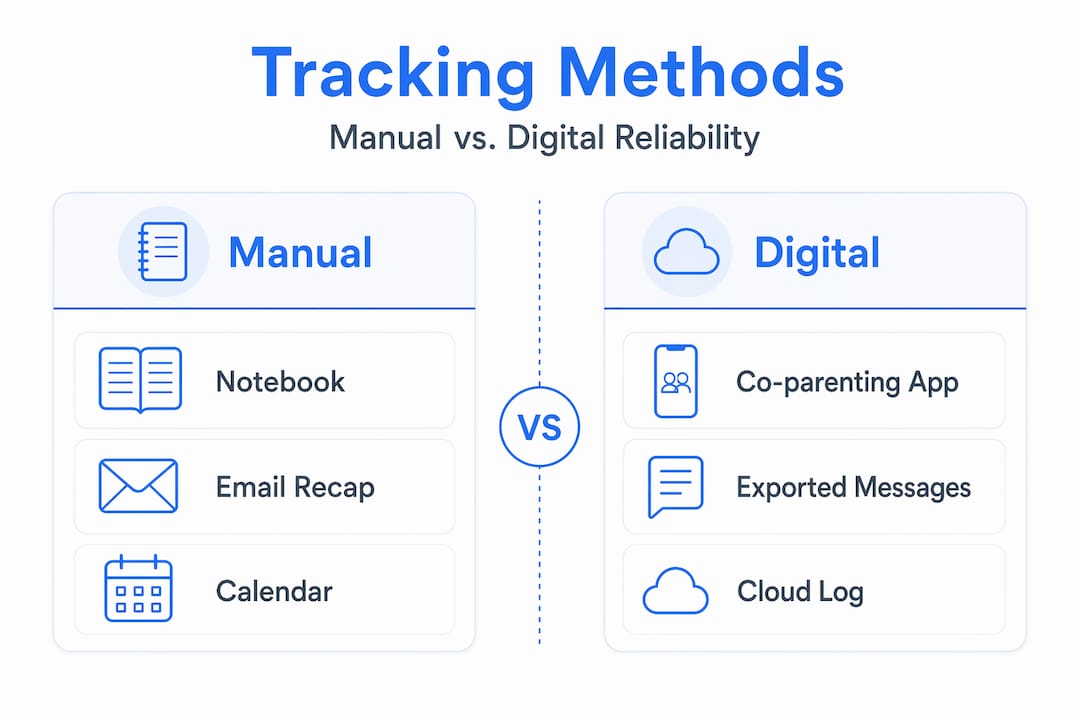
| Method | Ease of use | Legal reliability | Recommended for |
|---|---|---|---|
| Manual written journal | Moderate | High when contemporaneous | In-person exchanges, phone calls |
| Email with yourself | Easy | High (built-in timestamps) | Quick summaries after verbal conversations |
| Screenshot folders | Easy | Medium (risk of cropping errors) | Text threads, but requires full thread capture |
| Dedicated co-parenting app | Easy | High (unalterable, court-ready) | All ongoing digital communication |
| Cloud backup of messages | Moderate | High | Full message thread archiving |
Dedicated apps built for co-parents often include unalterable logs and metadata preservation that meet court evidence standards. They remove the guesswork about whether your screenshots captured the right information.
A few non-negotiable habits regardless of which method you use: record events as close to the time they happen as possible, since logs written near the event date are perceived as significantly more credible than reconstructed notes. Back up everything to at least two locations. Never delete messages, even ones that seem insignificant at the time.
Common mistakes that can hurt your case
Knowing what to do is only half the equation. Knowing what not to do is where many parents lose ground they did not expect to lose.
- Cropping or editing screenshots. Selective screenshots that omit surrounding context invite the opposing attorney to argue misrepresentation. Always capture the full thread, including messages that do not favor your position. A judge trusts someone who shows complete records more than someone who shows only the convenient parts.
- Recording calls without consent. Many states require all parties on a call to consent to being recorded. Recording without consent can be a criminal offense and will likely make the recording inadmissible anyway. Know your state's consent laws before you press record.
- Allowing auto-deletion. Many messaging apps delete conversations after a set period. Once litigation is foreseeable, deleting relevant electronic communication can result in sanctions under Rule 37 of the Federal Rules of Civil Procedure. Turn off auto-delete and back up threads immediately.
- Relying on your child's statements. Children's accounts of what one parent said are hearsay and carry little evidentiary weight. Your records need to be direct, first-hand documentation, not filtered through your child's memory.
- Waiting until conflict escalates to start logging. Courts value consistent records far more than a sudden flood of documentation that coincidentally begins the week before a hearing.
My take: documentation changed what I thought I knew
I've spent years watching custody cases hinge on paper trails, or the absence of them. The parents who come in with organized logs, complete threads, and consistent entries look credible. The ones who come in with fragmented screenshots and memory-based narratives look unprepared, even when they're telling the truth.
What I've learned is that most parents dramatically underestimate what thorough documentation actually does. They think of it as something you need "if things get really bad." But the parents who waited for "really bad" are the ones who had no usable records when they needed them most.
The cases that turned on documentation were rarely dramatic. It was often something simple: a text showing a co-parent agreed to a schedule change, or a handwritten log showing three consecutive months of late pickups. Small, consistent, boring documentation. That is what moved judges.
Start now, even if things feel manageable today. A step-by-step co-parenting log you build over months is worth far more than a panicked record assembled in a week. You don't need to document every mundane exchange, but every agreement, conflict, violation, or significant decision deserves a record. Start small. Stay consistent. It adds up.
— Devin
How Replycalmly helps you build stronger records
If you've recognized the need to track communication history and want a system that does more than a folder full of screenshots, Replycalmly was built for exactly that situation.
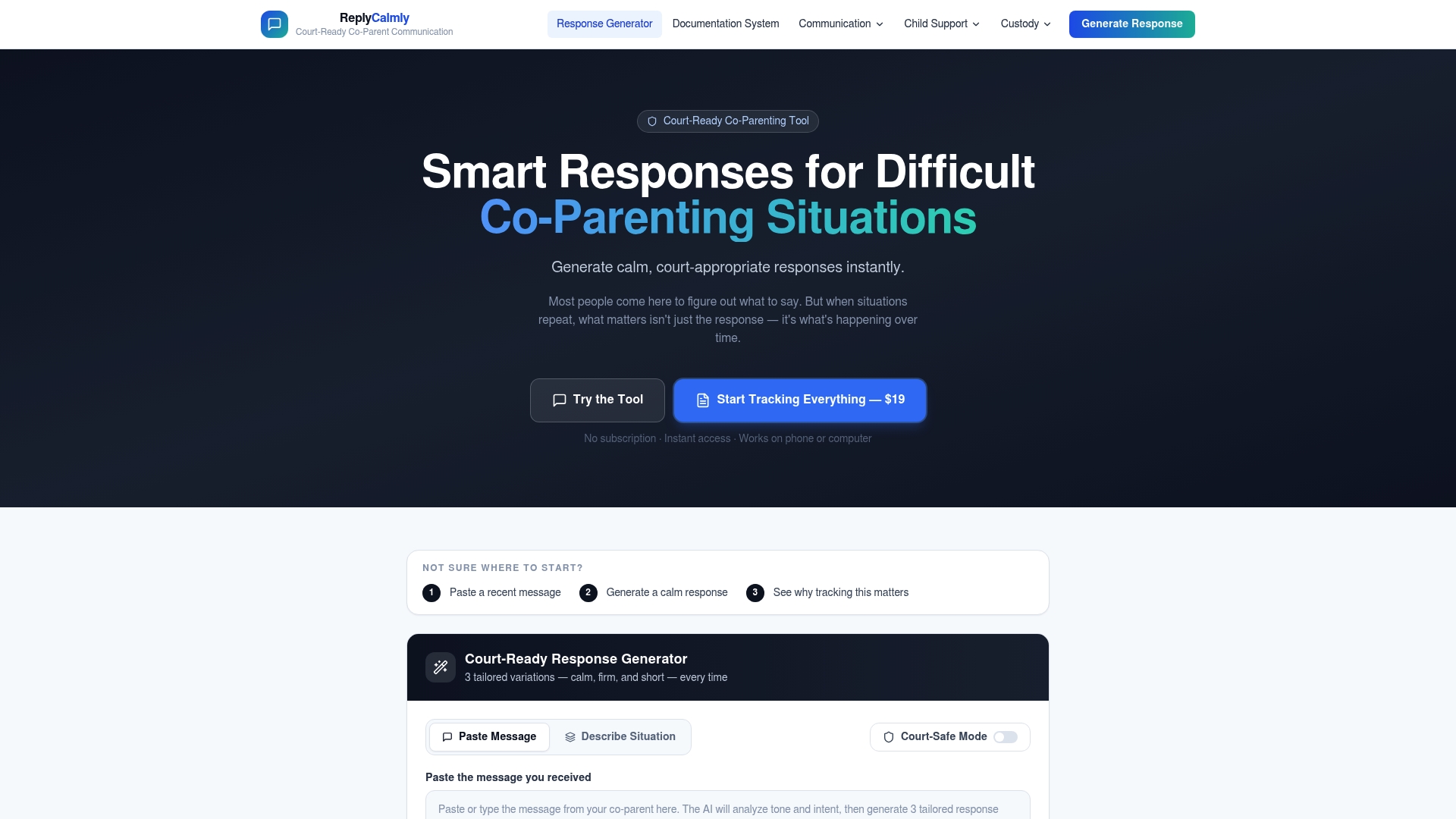
Replycalmly's platform lets you generate calm, court-appropriate responses to difficult messages, then automatically logs those exchanges with timestamps and context. The incident tracking dashboard categorizes issues by type, so you can see patterns across weeks or months at a glance. For parents who need structure from the start, the co-parenting communication plan template creates a shared framework that reduces ambiguity before disputes start. Well-organized communication evidence reduces attorney time and strengthens your legal position. Replycalmly puts that evidence within reach, without requiring a law degree to operate it.
FAQ
What is communication history in a custody case?
Communication history in a custody case refers to the organized, timestamped record of all exchanges between co-parents regarding the child, including texts, emails, call logs, and written notes of in-person conversations.
Why do courts care about how messages are documented?
Courts require authentication under Federal Rule of Evidence 901(a), meaning digital records must show who sent them, who received them, and when, to be treated as credible evidence.
Can I record phone calls with my co-parent for documentation?
It depends on your state. Many states require all parties to consent to a recording, and recording without that consent can be illegal and inadmissible in court.
What happens if I delete messages during a custody dispute?
Once litigation is foreseeable, deleting electronic records can trigger sanctions under Federal Rule of Civil Procedure 37(e), including penalties that damage your case.
How soon should I start documenting co-parent communication?
Start immediately, before conflict escalates. Courts value consistent records built over time far more than documentation that begins right before a court date.