
When you're in a high-conflict custody dispute, memory is not evidence. Courts increasingly rely on documented co-parenting messages to assess which parent communicates responsibly, who violates the parenting plan, and what the actual pattern of behavior looks like over time. If your co-parent denies sending a threatening message or claims a pickup was never scheduled, your recollection alone will not settle it. A timestamped record will. This guide explains why document co-parenting messages, how courts use them, and what it takes to build a record that actually holds up.
Table of Contents
- How courts use documented co-parenting messages as evidence
- What effective co-parenting communication looks like in messages
- Tools and methods to document co-parenting messages effectively
- Common pitfalls and best practices when documenting co-parenting communication
- How documented messages support your custody case and co-parenting stability
- Why documentation is your anchor, not your weapon, in high-conflict co-parenting
- How ReplyCalmly supports high-conflict co-parents with documentation and communication tools
- Frequently asked questions
How courts use documented co-parenting messages as evidence
Family courts are pattern recognition institutions. A judge reviewing your custody case is not making a decision based on one bad text or one missed pickup. They are looking at the full picture of how both parents communicate, cooperate, and prioritize the child. This is exactly why documentation matters so much, and why a single screenshot rarely wins anything.
Family courts accept text messages, emails, and co-parenting app messages as admissible evidence when properly authenticated and relevant to the legal issues at hand. Authentication typically means showing the message came from a specific phone number or account, that it was not altered, and that it connects to the parent in question. Courts across multiple states have upheld this standard.
What courts are specifically watching for includes:
- Missed pickups or drop-offs with no prior communication or explanation
- Canceled parenting time that was not made up or compensated
- Hostile, threatening, or manipulative messages that undermine the child's relationship with the other parent
- Violations of court-ordered communication protocols
- Failure to inform the other parent about medical or school matters
A single missed pickup can be explained away. A log showing 14 missed pickups over six months, with timestamps and your documented responses, tells a very different story.
"Documentation is not about winning arguments. It is about giving the court an accurate, verifiable account of what has actually happened between two parents."
Understanding how to document co-parenting effectively starts with recognizing what courts actually need: organized, authenticated, pattern-level evidence, not a jumbled folder of screenshots.
What effective co-parenting communication looks like in messages
Knowing why courts want documentation is one thing. Knowing what they want to see in that documentation is another conversation entirely.
Judges evaluate communications based on tone and content, favoring evidence that a parent remains calm, brief, child-focused, and solution-oriented, even when the other parent is hostile. This matters because both your messages and your co-parent's messages will be reviewed. If you responded to a hostile text with something equally hostile, that reflects poorly on you regardless of who started it.
Effective co-parenting messages share these qualities:
- Factual and specific: "Emma has a pediatrician appointment on Thursday at 3:00 PM" rather than vague references or emotional commentary
- Child-focused: Every message should clearly connect to your child's needs, not to grievances about the other parent
- Free of sarcasm or loaded language: Courts can read tone even in text, and judges notice it
- Timely: Responding within a reasonable window shows cooperation; ignoring messages can look like obstruction
One overlooked strategy is documenting positive interactions. If your co-parent agreed to a schedule change cooperatively, log it. If they communicated calmly about a school issue, note that too. Balanced documentation shows the court you are tracking reality, not building a one-sided case. Parents who only document negatives often appear vindictive, which undermines credibility.
Pro Tip: Before hitting send, ask yourself whether a judge would be comfortable reading this message in open court. If the answer is no, rewrite it. Your co-parenting communication plan template can help you set tone expectations from the start.
Tools and methods to document co-parenting messages effectively
Knowing what to document is only half the equation. Without a system, your records will be disorganized, incomplete, and difficult for anyone, including your own attorney, to navigate.
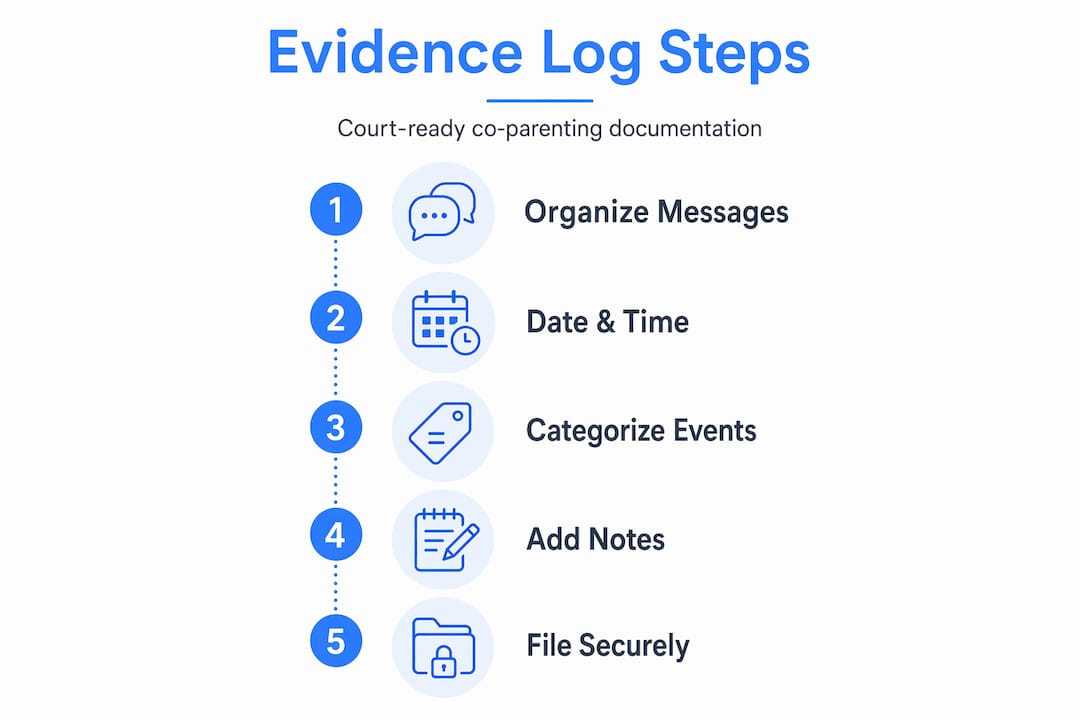
Here is a practical sequence for building a documentation system that holds up:
- Choose a primary communication channel. Co-parenting apps like OurFamilyWizard and Talking Parents create neutral, timestamped records that are immutable, meaning neither party can edit or delete messages after sending. Courts frequently order their use in high-conflict cases precisely because they eliminate the "that's not what I wrote" argument.
- Maintain a written log. For every significant incident or communication, create a log entry that includes the date, time, a factual description, the type of evidence (text, email, app message), and where it is stored.
- Screenshot with context. Never screenshot a single message in isolation. Capture the thread above and below it so the full context is visible. A message that looks threatening on its own might be a response to your message, and a judge will want to see that.
- Organize by category. Group your records by issue type, such as parenting time violations, hostile communication, school-related decisions, or medical matters.
- Back everything up. Store copies in at least two locations, such as a secure cloud folder and an external drive. Courts have seen evidence lost to phone damage or account lockouts.
Here is a simple comparison to illustrate what organized documentation looks like versus unorganized:
| Documentation type | What the court sees | Practical impact |
|---|---|---|
| Organized log with dates, categories, and linked evidence | A parent who tracks facts methodically | Stronger credibility |
| Folder of unsorted screenshots | A parent who is emotional and reactive | Weaker credibility |
| Co-parenting app record | Neutral, uneditable, timestamped | Highest evidentiary weight |
| Memory-based verbal account | Unverifiable and subjective | Easily challenged |
Your co-parenting evidence log is the backbone of this system. Knowing how to organize co-parenting evidence from the beginning saves significant time when legal proceedings require you to produce records quickly.
Pro Tip: Check your state's laws on recording phone calls before using audio recordings as documentation. Consent requirements vary significantly, and using an illegal recording can hurt your case more than help it.
Common pitfalls and best practices when documenting co-parenting communication
The instinct in high-conflict situations is to document everything, and that instinct, taken too far, creates its own problems. Over-documentation looks like obsession. Courts notice when a parent has logged every meal their child ate at the other household or tracked every minute of a parenting schedule down to seconds.
Documentation should protect the child and maintain the parenting plan, not micromanage or control the other parent in real time. When your records cross into surveillance-level detail on irrelevant matters, it signals to the court that you may be more focused on conflict than on your child.
Common mistakes to avoid:
- Deleting messages, even ones that do not favor you. Courts and opposing counsel can often recover deleted messages, and deletion implies consciousness of guilt.
- Adding commentary or interpretation to your logs. Write what happened, not why you think it happened or what it reveals about your co-parent's character.
- Documenting only negatives. A log with zero positive entries looks manufactured and biased.
- Waiting too long to log incidents. Memory fades fast in high-stress situations. Log within 24 hours of an incident.
- Sharing your documentation strategy with your co-parent. They do not need to know what you are tracking or why.
Knowing how to document co-parent behavior with restraint is as important as knowing what to record. The parents who hurt their own cases most are often the ones who document aggressively without discipline or focus. For a structured approach to documenting co-parent conflict specifically, it helps to have a framework that filters relevant from irrelevant.
How documented messages support your custody case and co-parenting stability
The practical impact of well-organized documentation goes beyond winning a single motion. It creates a factual timeline that becomes harder to challenge the longer it runs.

Documentation gives courts and guardians ad litem the facts they need to form accurate assessments of parenting, helping build a credible, factual case over time. A guardian ad litem reviewing six months of organized, balanced, child-focused records will form a very different impression than one handed a stack of emotional screenshots from a single bad week.
Here is how strong documentation affects your case across multiple dimensions:
| Benefit | What it looks like in practice |
|---|---|
| Credibility with the judge | Consistent, organized records over time outweigh emotional testimony |
| Reduced litigation time | Clear evidence shortens disputes and reduces legal fees |
| Influence on custody terms | Demonstrated de-escalation can support expanded parenting time |
| Protection from false claims | Timestamped records refute gaslighting and misrepresentation |
| Child well-being | Less courtroom conflict means less instability for your child |
A well-organized co-parenting documentation template structures each entry so nothing critical is missing. If you are actively in proceedings or anticipate returning to court, maintaining consistent records now makes your attorney's job easier and your case stronger. For parents seeking broader high-conflict co-parenting help, documentation is always the foundation everything else is built on.
Why documentation is your anchor, not your weapon, in high-conflict co-parenting
Here is something most articles about documentation get wrong. They frame it as ammunition. They talk about catching the other parent, building a case, proving you are right. That framing will make your documentation less effective, not more.
The primary reason to document is not to "win" arguments but to provide courts with an objective factual narrative that bridges emotional memory and verifiable evidence. The moment you start documenting to punish or control your co-parent, the tone of your records shifts. Judges feel that shift. Attorneys see it immediately.
The parents who benefit most from documentation are the ones who treat it the way a surgeon treats a medical chart: factual, consistent, emotionally neutral, and kept for the benefit of the patient, in this case your child. When your co-parent lies, manipulates, or gaslights, your records are what anchor you to reality. That is a psychological benefit that goes well beyond any courtroom outcome.
Balanced documentation is also more credible. If your co-parenting documentation system shows that your co-parent cooperated on back-to-school decisions in September but violated the holiday schedule in December, that specificity and balance is far more persuasive than a record that only ever captures failures.
The most powerful thing documentation does is this: it removes uncertainty. You stop second-guessing what was said, when it happened, or how you responded. That clarity reduces anxiety, keeps you focused on your child, and gives you something solid to stand on when the conflict feels overwhelming.
How ReplyCalmly supports high-conflict co-parents with documentation and communication tools
Keeping calm and organized records while managing a high-conflict co-parent is genuinely hard. ReplyCalmly was built specifically for this.
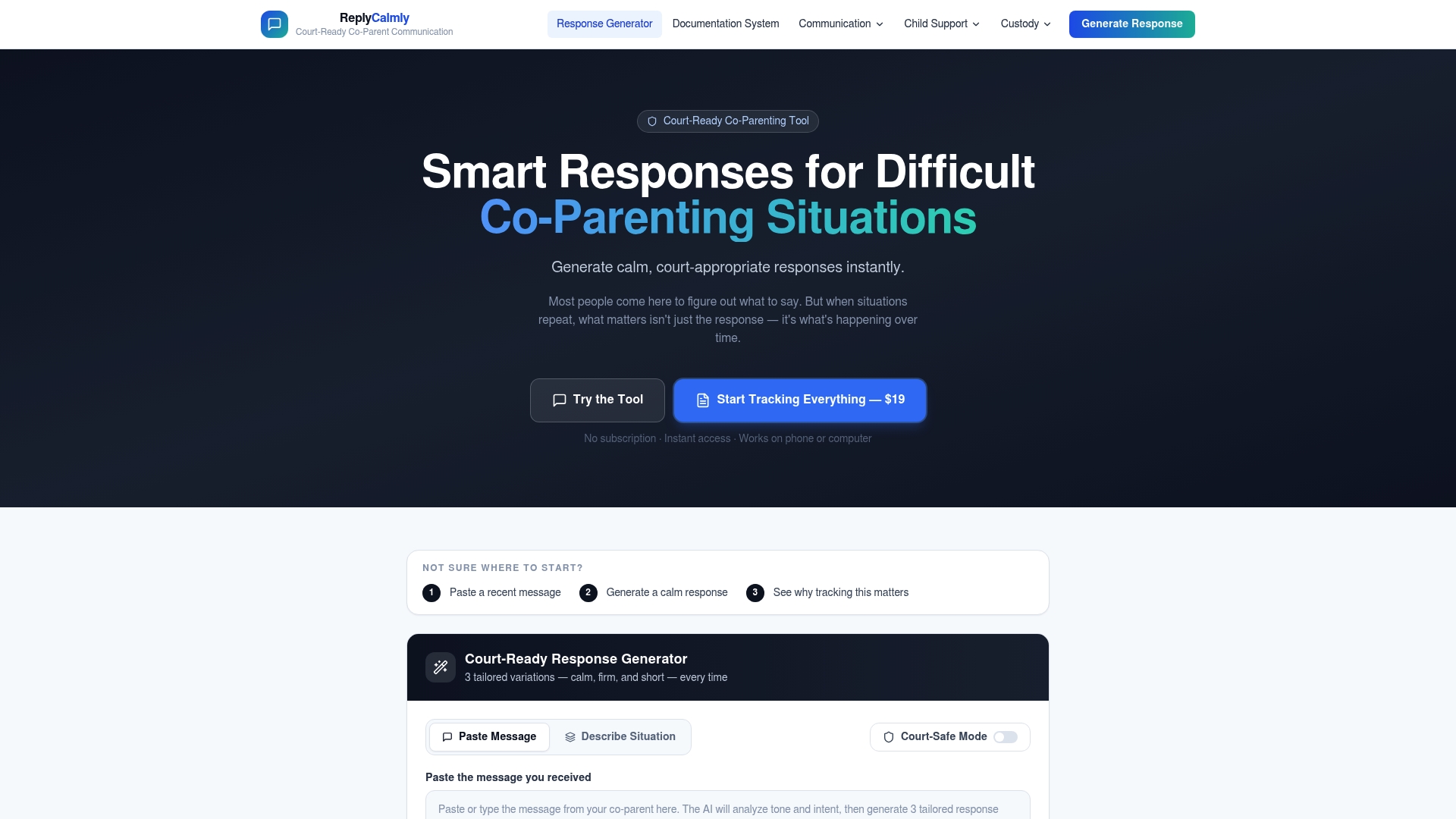
ReplyCalmly's platform gives you tools to generate calm, court-appropriate responses when your co-parent sends something hostile or manipulative, so you never have to wonder if your reply will hurt your case. The best co-parenting app for documentation works alongside court-mandated tools like OurFamilyWizard to strengthen your records without replacing them. You can use the co-parenting communication plan template to set expectations and keep exchanges child-focused from the start. Whether you need help organizing evidence, logging incidents by category, or simply staying composed under pressure, ReplyCalmly's tools give you the structure to do it effectively.
Frequently asked questions
Why is it important to document co-parenting messages in a custody dispute?
Documenting messages creates objective, timestamped evidence that courts rely on to assess parenting patterns and communication, helping prove your co-parenting reliability and protect your child's interests. Courts accept texts and emails as evidence to demonstrate parenting plan compliance and communication patterns.
What kind of communication should I document with my co-parent?
Document all messages related to scheduling, parenting time changes, child health or education, and any hostile or cooperative exchanges to show a complete and balanced pattern of interaction. Documentation should include logistical details, positive interactions, and any conflicts to demonstrate credibility and balance.
How can I avoid making documentation look like micromanagement?
Focus your records on facts affecting your child's well-being and parenting plan adherence, and avoid logging minor irrelevant details or attempting to control the other parent's daily decisions. Effective documentation protects the child and maintains the parenting plan, rather than controlling every detail of the other parent's actions.
Are co-parenting apps recommended for documentation?
Yes. Co-parenting apps like OurFamilyWizard or Talking Parents provide neutral, timestamped, and uneditable records that are often ordered by courts in high-conflict cases to reduce disputes. Dedicated co-parenting apps are a primary strategy to reduce conflict and create reliable communication logs accepted by courts.