
Communication logs are detailed, chronological records of co-parent interactions that serve as primary evidence in custody court and as a tool for emotional clarity during high-conflict disputes. Judges review months or even years of these records to assess parental cooperation and determine what arrangement serves the child's best interests. Whether you use OurFamilyWizard, TalkingParents, or a structured spreadsheet, the role of communication logs extends far beyond simple record-keeping. They are the paper trail that can define the outcome of your case.
How communication logs are used as evidence in custody court
Judges rely on communication logs as a direct window into how parents interact, cooperate, and resolve disputes. Written messages between co-parents become court exhibits, and a judge reviewing six months of hostile, unresponsive, or manipulative exchanges will draw conclusions that no oral testimony can easily undo. This is why the role of communication logs in court is not passive. Every message you send is potentially part of your legal record.
Courts do not accept just any message thread. Records must be relevant, authenticated, and legally obtained to be admitted as evidence. This means incomplete screenshots, cropped threads, or messages pulled out of context risk exclusion entirely. A judge needs to see the full conversation, not a curated highlight reel.
"Courts act as gatekeepers for evidence, so communication logs must be maintained as complete, provable records to withstand legal scrutiny."
The tone of your messages matters just as much as their content. Respectful, solution-focused communication reflects positively on your character as a parent and co-parent. A log filled with calm, child-centered messages tells a very different story than one full of accusations and ultimatums. Judges notice both.
Here is what courts specifically look for when evaluating communication logs:
- Consistency: Are messages sent and responded to in a timely, cooperative manner?
- Tone: Does the language reflect a parent focused on the child's welfare?
- Completeness: Are full threads preserved, including dates, times, and participants?
- Authenticity: Can the records be verified as unaltered originals?
The importance of communication logs in custody proceedings cannot be overstated. They often carry more weight than witness testimony because they are contemporaneous, objective, and difficult to fabricate when properly preserved.
Best practices for creating and maintaining effective communication logs

Effective communication tracking starts on day one of a custody dispute, not the week before a hearing. Attorneys advise building dated, systematic logs from the beginning, including backing up communications outside your phone to prevent data loss. A deleted message or a crashed device can cost you critical evidence at the worst possible moment.
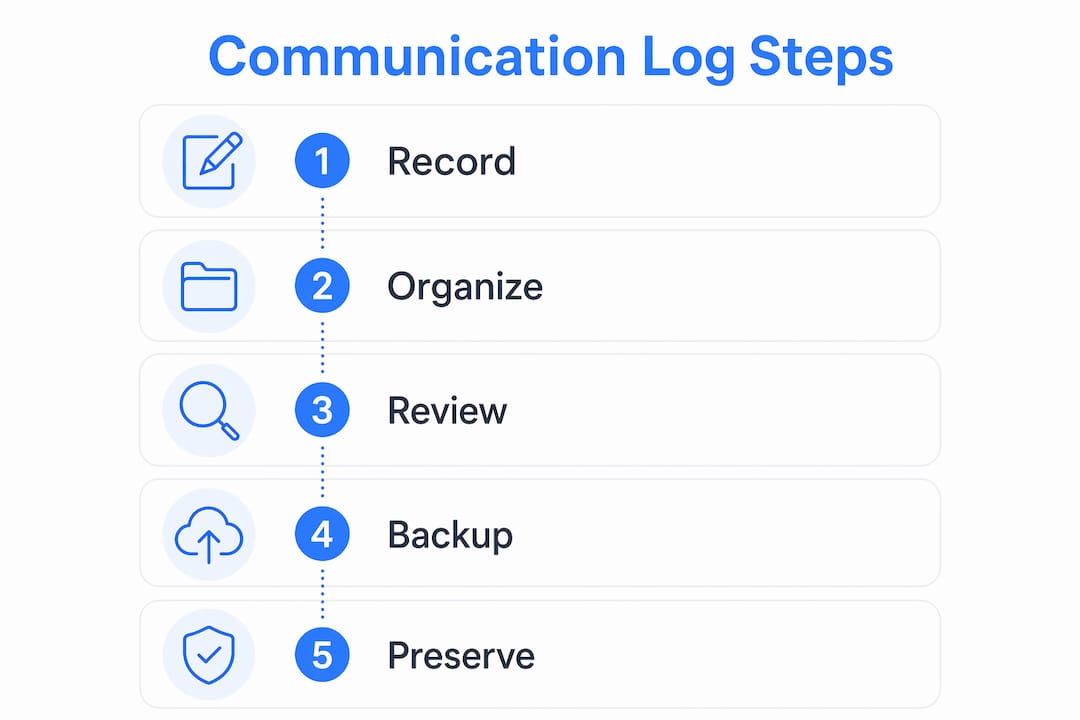
Follow these steps to build a log that holds up in court:
- Record every interaction with full context. Log the date, time, platform used (text, email, OurFamilyWizard), and the exact content of the message. Never paraphrase.
- Separate your communication log from your incident log. Communication logs record exchanges and timestamps; incident logs record effects on your child or specific dispute events. Mixing the two creates narrative confusion for attorneys and judges.
- Preserve complete conversation threads. Screenshots alone are unreliable. Saving complete conversation threads is the preferred practice because cropped images risk exclusion and raise authenticity questions.
- Document your chain of custody. Note which device or app you used to export the data, the date and time of export, where it is stored, and what anti-tampering measures are in place. A clear, unbroken digital chain of custody is the foundation of evidence authentication in US courts.
- Back up to multiple locations. Save copies to a secure cloud service, an external drive, and share relevant records with your attorney regularly.
- Use factual, emotionless language in your own notes. Write "Co-parent did not respond to school pickup confirmation sent at 3:14 PM on March 4" rather than "Co-parent ignored me again."
Pro Tip: Create a weekly review habit. Every Sunday, export your communication logs, verify the backup, and flag any exchanges your attorney should see. Consistency in preservation is what separates admissible evidence from a folder of questionable screenshots.
One of the most common and damaging mistakes parents make is deleting messages they consider irrelevant or embarrassing. Deleting messages expected to be relevant for litigation can lead to adverse inference rulings, where a judge assumes the deleted content was harmful to your case. When in doubt, preserve everything and let your attorney decide what to use.
Paper logs vs. digital tools: what works best for co-parents?
The format of your communication log directly affects its reliability and admissibility. Paper logs are accessible and require no technology, but they are vulnerable to loss, damage, and accusations of alteration. Digital logs, particularly those created through purpose-built co-parenting apps, offer timestamped, tamper-evident records that carry significantly more weight in court.
Here is a comparison of the most widely used options:
| Tool | Format | Key strength | Limitation |
|---|---|---|---|
| Paper log / spreadsheet | Manual | No cost, full control | Vulnerable to tampering claims |
| OurFamilyWizard | Digital app | Court-accepted, timestamped | Subscription cost |
| TalkingParents | Digital app | Uneditable message archive | Limited incident tracking |
| Replycalmly | Digital platform | Response generation + pattern tracking | Designed for high-conflict cases |
| Email archives | Digital | Easy to export | Requires manual organization |
Purpose-built apps like OurFamilyWizard and TalkingParents create records that are inherently harder to dispute because neither party can edit messages after sending. Replycalmly goes a step further by helping you document co-parent behavior and categorize incidents over time, giving you a structured dashboard rather than a disorganized folder of exports.
When selecting a tool, prioritize these features:
- Automatic timestamps on all messages
- Tamper-evident or read-only message archives
- Easy export to PDF or printable formats for court submission
- Incident categorization to separate communication records from behavioral patterns
Pro Tip: If your custody order or mediator specifies a communication platform, use it exclusively for all co-parent contact. Mixing platforms creates gaps in your record and makes it harder to present a clean, complete log to the court.
Emotional and practical benefits of communication logs beyond legal use
The benefits of communication records extend well past the courtroom. A well-kept communication log replaces unreliable memory by providing a consistent sequence of information in a clear format, so nothing important is lost over time. This matters enormously when you are managing the emotional weight of a custody dispute alongside the practical demands of parenting.
When you know every interaction is logged, your own behavior shifts. You become more deliberate, more measured, and less reactive. That shift is not just good for your legal record. It is good for your child. Parents who improve co-parenting communication through structured documentation report lower stress levels and fewer escalating conflicts over time.
Logs also provide emotional clarity in moments of confusion or self-doubt. When a co-parent insists a conversation happened differently than you remember, you do not have to rely on memory or emotion. You open the log. That single capability reduces the psychological toll of high-conflict co-parenting more than most people expect before they experience it.
The practical benefits compound over time:
- Pattern recognition: Logs reveal recurring issues, such as consistent late pickups or ignored medical consent requests, that might not be obvious in the moment but become clear across weeks of records.
- Objective communication: When both parties know a record exists, conversations tend to stay more factual and less personal.
- Attorney efficiency: A well-organized log saves your attorney hours of work, which translates directly to lower legal fees.
- Child-focused framing: Reviewing your own logs periodically helps you stay focused on your child's needs rather than the conflict itself.
The importance of communication logs is not just about winning a court case. It is about creating a structure that lets you parent effectively under pressure.
Key takeaways
Consistent, well-preserved communication logs are the single most reliable tool a co-parent has for both legal protection and emotional stability in a custody dispute.
| Point | Details |
|---|---|
| Logs are primary court evidence | Judges review full message histories to assess cooperation and determine the child's best interests. |
| Completeness is non-negotiable | Cropped screenshots risk exclusion; full conversation threads with metadata are required for admissibility. |
| Separate log types for clarity | Keep communication logs and incident logs distinct to avoid narrative confusion for attorneys and judges. |
| Digital tools outperform paper | Apps like OurFamilyWizard and Replycalmly create tamper-evident, timestamped records that carry more legal weight. |
| Logs reduce emotional reactivity | Systematic documentation shifts your focus from conflict to facts, benefiting both your case and your child. |
What I've learned from watching co-parents win and lose on their logs
I have reviewed enough custody communication records to know that the parents who struggle most in court are not always the ones who behaved worst. They are often the ones who documented inconsistently. A parent with a genuinely cooperative record loses credibility when their log has three-week gaps, mixed platforms, and a handful of deleted threads. A parent with a difficult co-parent but a meticulous, unbroken log often walks into a hearing with the stronger position.
The mistake I see most often is treating documentation as reactive rather than proactive. Parents start logging after something goes wrong, which means the early pattern of behavior, often the most revealing part, is gone. Start on day one. Log everything. Decide later what matters.
I also think people underestimate how much tone in their own messages affects judicial perception. You can document every violation your co-parent commits, but if your own messages are hostile or dismissive, a judge will notice. The log works both ways. Write every message as if a judge will read it tomorrow, because in a custody case, that is exactly what may happen.
My practical advice: work with your attorney to review your logs before any hearing. Attorneys know what judges in your jurisdiction look for, and they can help you organize and present records in the format most likely to be persuasive. A box of screenshots is not a legal strategy. A structured, categorized, authenticated log is.
— Devin
How Replycalmly helps you build a stronger communication record
Managing a high-conflict custody situation while maintaining a clean, court-ready communication log is genuinely hard. Replycalmly is built specifically for this challenge.
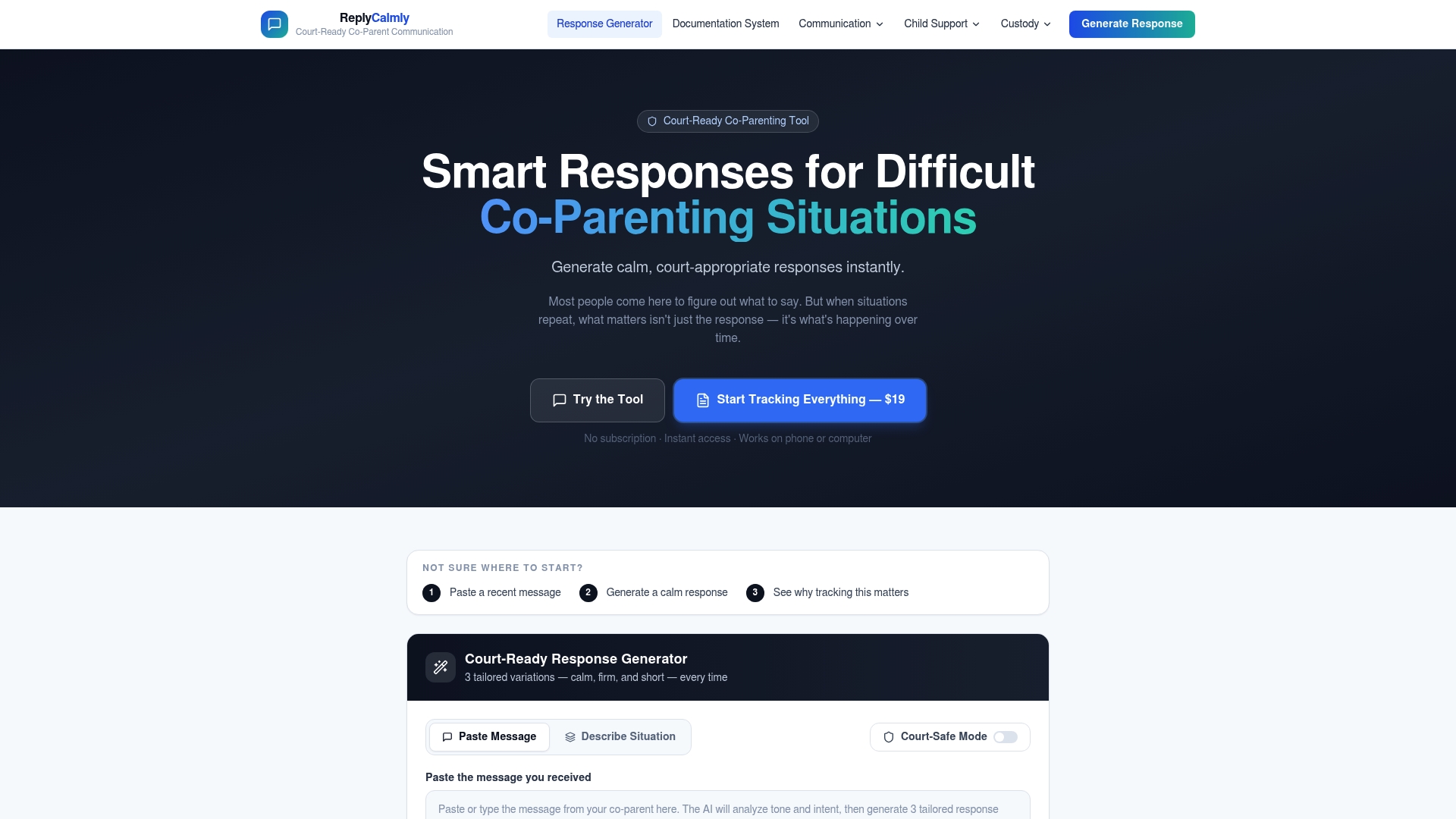
The platform generates calm, court-appropriate responses to difficult messages, so you never send something in the heat of the moment that damages your record. Its incident tracking system categorizes issues like custody conflicts, missed pickups, and false accusations, then visualizes patterns over time through a dashboard. You can review the best co-parenting apps for documentation to see how Replycalmly compares to other tools, or use the free response generator to start building better communication habits today. Your log is only as strong as the messages in it.
FAQ
What is the role of communication logs in custody cases?
Communication logs serve as primary evidence in custody court, giving judges a direct record of how co-parents interact, cooperate, and prioritize their child's needs. Courts review these records to assess parental behavior over time, often weighing them more heavily than oral testimony.
Can text messages be used as evidence in custody court?
Text messages are admissible as evidence when they are relevant, properly authenticated, and legally obtained. Complete conversation threads are required. Cropped or partial screenshots risk exclusion because they cannot be verified as unaltered.
What should a co-parenting communication log include?
Every entry should include the date, time, platform used, participants, and the exact content of the message or interaction. Keeping a separate incident log for events affecting your child prevents narrative confusion and makes both records clearer for attorneys and judges.
What happens if I delete messages during a custody dispute?
Deleting messages that are relevant to litigation can result in an adverse inference ruling, where the court assumes the deleted content was harmful to your case. Preserve all communications and let your attorney determine what is relevant.
How do co-parenting apps improve communication documentation?
Apps like OurFamilyWizard and TalkingParents create timestamped, tamper-evident message archives that neither party can edit after sending. This makes the records significantly more credible in court than manually assembled logs or standard text message exports.