
Getting a hostile message from your co-parent at 10 p.m. before a school pickup is one of the most stressful moments in high-conflict custody. Your instinct is to defend yourself, correct every false statement, and fire back before you lose your nerve. But that reaction is exactly what courts are trained to notice, and not in a way that helps your case. This guide walks you through the calm response process step by step, covering the method itself, the tools you need, how to build a legally defensible record, and how to avoid the mistakes that even well-intentioned parents make under pressure.
Table of Contents
- What is the calm response process in high-conflict co-parenting?
- What you need to start: Tools and requirements
- Step-by-step calm response process: BIFF method in action
- Common pitfalls and troubleshooting: What to do when the process isn't working
- How to verify and maintain defensible records
- The uncomfortable truth: Why logic alone doesn't win custody wars
- How ReplyCalmly supports calmer, court-ready co-parenting
- Frequently asked questions
Key Takeaways
| Point | Details |
|---|---|
| Use the BIFF method | Brief, Informative, Friendly, Firm messages reduce escalation and protect your record. |
| Document everything | Apps and templates make your messages court-ready and defensible. |
| Stay consistent | Even if the other parent doesn't cooperate, your calm approach sets the legal tone. |
| Review for legal readiness | Test every message as if a judge will read it and keep records organized. |
What is the calm response process in high-conflict co-parenting?
With the stakes of co-parenting communication in mind, let's clarify what the calm response process actually is and why it's a game-changer in high-conflict custody dynamics.
The calm response process refers to a structured approach to replying to difficult or hostile co-parent messages in a way that is short, factual, and free of emotional language. The most widely used framework within this process is the BIFF method, developed by Bill Eddy of the High Conflict Institute. BIFF stands for Brief, Informative, Friendly, and Firm, and it was specifically designed for de-escalating hostile communications while preserving a clean, usable legal record.
Here is what each element of BIFF actually means in practice:
- Brief: Keep messages to two to five sentences when possible. Long messages give the other party more material to misinterpret or attack.
- Informative: Stick to facts about schedules, logistics, children's needs, and parenting plan terms. Avoid interpretations or opinions about behavior.
- Friendly: A neutral, respectful tone is not weakness. It signals to any reader, including a judge, that you are the steady, cooperative parent.
- Firm: State your position clearly and do not leave room for unnecessary back-and-forth. End the message when the topic is covered.
Why do hostile co-parent messages escalate so fast? Because legal defensibility depends on clean records, not emotional venting, and when one parent vents, it invites the other to vent back. That cycle creates a record of conflict that no judge wants to see from either side.
"The BIFF approach does not require the other parent to change. One person's calm, structured communication can shift the entire dynamic of an exchange." — Bill Eddy, High Conflict Institute
Some people confuse BIFF with a different acronym sometimes called CALM (Center, Acknowledge, Listen, Mindful), which is more of a personal emotional regulation tool. CALM helps you manage your internal state before responding. BIFF governs the actual words you put in the message. Both have value, but only BIFF produces the kind of written record that protects you in court. If you are co-parenting with a high-conflict ex, BIFF is the tool that matters most in writing.
The good news is that you do not need the other parent's cooperation to start. Even if they continue to send long, aggressive, emotionally loaded messages, you can apply BIFF entirely on your own. Over time, many parents find that a one-sided shift in tone does affect the overall pattern of communication, because the other party loses the emotional reaction they were looking for. Learning how to handle a high-conflict co-parent starts with controlling the one variable you actually own: your own words.
What you need to start: Tools and requirements
Knowing what the calm response process is, it's important to assemble the right foundation for seamless and legally compliant communication.
You cannot document something you cannot track. Before you write a single BIFF message, you need a system that captures every exchange with timestamps, prevents message deletion, and organizes records in a format courts can actually use. Co-parenting apps designed specifically for high-conflict situations are the most reliable solution, and courts increasingly encourage their use.

According to high-conflict co-parenting research, tools like TalkingParents, OurFamilyWizard, Servanda, and Coflo provide timestamped records, shared calendars, and expense logs that ensure compliance in legal proceedings.
| Tool | Best for | Key feature |
|---|---|---|
| OurFamilyWizard | Court-mandated situations | Tamper-proof message logs |
| TalkingParents | Accessible, affordable use | Recorded calls, message archive |
| Servanda | Pattern tracking and reports | AI-assisted documentation |
| Coflo | Expense and schedule disputes | Shared financial logs |
Here is what you need to get started:
- A verified account on at least one court-compatible co-parenting app
- Stable internet access on your primary device
- A basic documentation template for logging incidents outside the app (in-person exchanges, phone calls, missed pickups)
- A consistent habit of reviewing and exporting records monthly
Pro Tip: Set a recurring reminder on the last day of each month to export your message logs from whichever app you use. Save them to a secure, dated folder. If your case goes back to court unexpectedly, you will have a clean record without scrambling.
A proper co-parenting documentation system does not have to be complicated. The key is consistency. A sporadic record with gaps is far less useful in court than a steady, boring log of every exchange, even when most of them are routine.
Step-by-step calm response process: BIFF method in action
With your tools in place, here is exactly how to carry out the calm response process, one step at a time, for rock-solid, defensible communications.
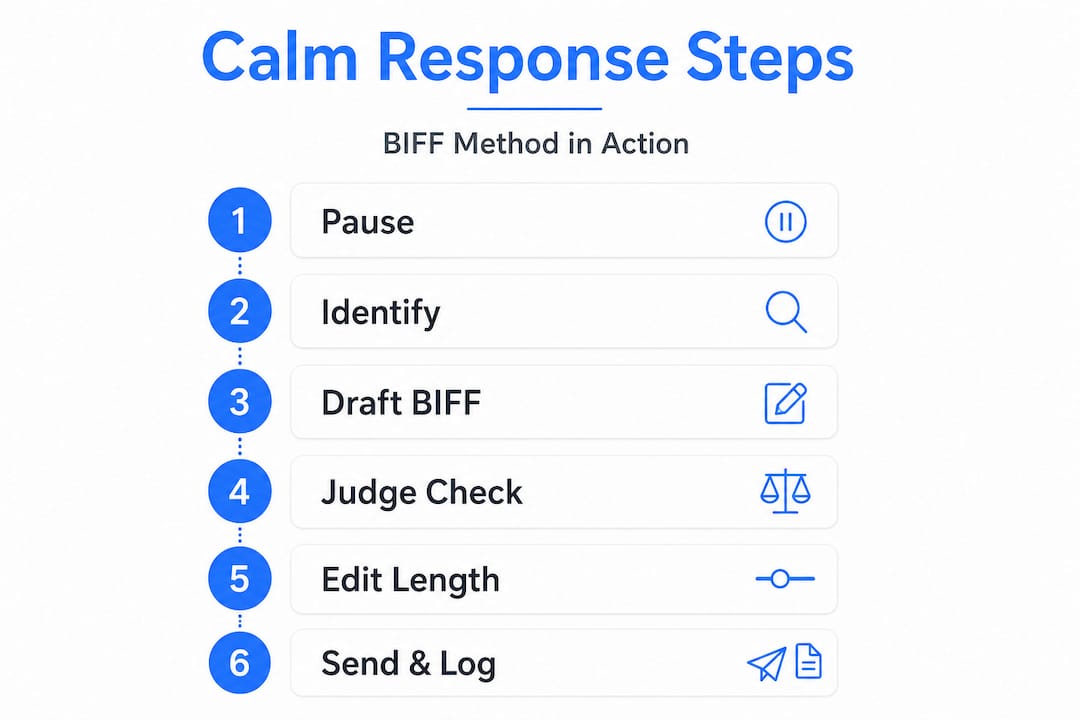
Step 1: Read the message once, then step away. Do not respond immediately. High-conflict messages are often designed to provoke a fast, emotional reaction. Give yourself ten to twenty minutes before you draft anything.
Step 2: Identify the actual request or information in the message. Strip away the insults, accusations, and exaggerations. Most hostile messages contain one or two factual points buried inside the emotional language. Find those points. That is all you are responding to.
Step 3: Draft your BIFF reply. Write two to four sentences. State the relevant fact or your position. Use neutral language. Do not defend yourself against attacks or explain your reasoning at length.
Step 4: Apply the judge-read test. Before you send anything, ask yourself: If a judge read this message tomorrow morning, would I be comfortable? Courts encourage apps and a judge reviewing test messages for tone is a real scenario you should always plan for. If any sentence feels defensive, sarcastic, or emotional, cut it.
Step 5: Check the length. If your draft is more than five sentences, you have almost certainly included material that does not belong. High-conflict personalities exploit long and emotional replies because they provide more surface area for attack. BIFF starves that dynamic.
Step 6: Send and log. Send the message through your co-parenting app so it is automatically timestamped and archived. If you must use standard text or email, take a screenshot immediately and save it to your documentation folder.
Here is a direct comparison of typical versus BIFF-compliant messages:
| Situation | Typical message | BIFF-compliant message |
|---|---|---|
| Disputed pickup time | "You always do this. I told you 3 PM and now you're changing it again just to mess with me." | "The parenting plan states 3 PM pickup on Fridays. Please confirm you will be there at that time." |
| School decision conflict | "You never tell me anything about school because you want to cut me out of their life." | "I did not receive the school event notice. Please copy me on all school communications going forward." |
| Missed medical appointment | "You forgot the appointment on purpose. You don't care about the kids." | "The pediatric appointment on Tuesday was missed. I've rescheduled for Thursday. Please confirm your availability." |
You can review real-world message examples and court-approved message examples to build a stronger instinct for tone before you need it under pressure.
Pro Tip: If the same issue keeps coming up despite your BIFF responses, look into SLIC (Set Limits, Impose Consequences). SLIC is a follow-up strategy for repeated violations where you clearly state what the limit is, what the consequence will be, and then follow through. It pairs directly with your documentation for court purposes. Learn more about documenting for court to use SLIC effectively.
Common pitfalls and troubleshooting: What to do when the process isn't working
Even with a proven process, obstacles can arise. Here is how to spot and solve problems that can derail calm communications.
The most common mistake parents make is responding to the attack rather than the content. When your co-parent says something false or hurtful, the instinct is to correct it immediately and at length. That is the trap. Every sentence you spend defending yourself is a sentence that does not help your legal position and probably hurts it.
Other common pitfalls include:
- Venting in writing: Even one emotional sentence can undermine an otherwise solid message record.
- Inconsistent documentation: Logging incidents only when things get bad creates a record that looks reactive rather than systematic.
- Replying too quickly: Speed is the enemy of calm. There is almost never a co-parenting message that genuinely requires a response within minutes.
- Over-explaining: Detailed justifications feel satisfying to write but signal insecurity to anyone reading the record later.
What happens if your co-parent keeps escalating no matter what you do? Unilateral adoption by one parent often de-escalates the overall dynamic, and app platforms enforce structure even without the other parent's cooperation. The record you build protects you regardless of their behavior.
"There are no robust randomized controlled trials on the BIFF method specifically, but it aligns with established de-escalation principles and is supported by expert consensus and practitioner reports across family law settings."
If escalation continues and your co-parent begins sending messages that constitute harassment or parenting plan violations, consult your attorney about bringing the documented record to court. You can also explore what to say during a custody conflict and whether a parallel parenting guide approach is more appropriate for your situation. Parallel parenting is specifically designed for cases where direct co-parenting communication is not safe or productive.
How to verify and maintain defensible records
Finally, to ensure your communication efforts are fully protected, here is how you can verify and maintain documentation that stands up in legal settings.
A record that exists but is disorganized is almost as unhelpful as no record at all. Courts want to see a clear, chronological, exportable history. Here is how to build and maintain one that works.
Step 1: At the end of each week, review all messages sent and received in your co-parenting app. Flag any that involve a parenting plan issue, missed obligation, or threatening language.
Step 2: Export your message logs monthly and save them in a clearly labeled folder, organized by month and year.
Step 3: Maintain a separate incident log for anything that happens outside the app, such as in-person exchanges, phone calls, or missed transitions. Note the date, time, what was said, and who was present.
Step 4: Back up all records to a secure cloud location that is not shared with your co-parent.
Step 5: Before any court hearing, review the last six to twelve months of records and compile a summary timeline with your attorney.
Here is a practical overview of what to save and how often to verify it:
| Record type | Where to store | Review frequency |
|---|---|---|
| App message logs | App archive and exported PDF | Monthly export |
| Shared calendar entries | App or screenshot | Weekly review |
| Expense records | App log or spreadsheet | After each transaction |
| Incident notes | Private document or app log | Within 24 hours of incident |
| Court-related communications | Secure email folder | Before and after each hearing |
App platforms like OurFamilyWizard already provide timestamped records and shared calendars that satisfy many court standards. But your own parallel records add a layer of protection, especially for anything that happens off-platform. Courts encourage structured apps precisely because they make the review process faster and more objective. Your documentation system for court is only as strong as your commitment to keeping it current.
The uncomfortable truth: Why logic alone doesn't win custody wars
Stepping back from the how-tos, let's look honestly at what really makes a difference when every word is under a microscope in custody court.
Most parents going through a high-conflict custody dispute believe, at some level, that if they just present the right facts clearly enough, justice will follow. That belief is understandable, but it misses something important. Courts are not only evaluating what happened. They are evaluating how each parent communicates, how each parent handles stress, and which parent is more likely to support the child's relationship with the other parent over time.
This is where handling a high-conflict ex through calm, documented communication becomes more powerful than any argument you could make out loud. A two-year record of BIFF-compliant messages tells a judge something that a courtroom speech cannot: that you are consistent, that you prioritize your child over conflict, and that you can be trusted to co-parent professionally even under pressure.
High-conflict personalities exploit long and emotional replies because they reveal reactivity. Every time you over-explain, justify yourself, or respond to an insult in kind, you hand the other party material they can use. Staying brief and factual is not just polite. It is strategically sound.
The parents who struggle most are often the ones who are genuinely right about the facts but cannot stop themselves from proving it in every single message. Over-explaining is not persuasion. It is a pattern that reads as defensiveness, and defensiveness reads as instability in family court. Small habits, applied consistently over months, reshape how a judge perceives your case. That is the uncomfortable truth that no one tells you at the start of a custody dispute.
How ReplyCalmly supports calmer, court-ready co-parenting
If you want to make these strategies automatic and easier, here is how ReplyCalmly can help.
Applying the BIFF method under emotional pressure is genuinely hard. ReplyCalmly was built specifically for this moment, when you have a hostile message in front of you and you are not sure how to respond without making things worse.
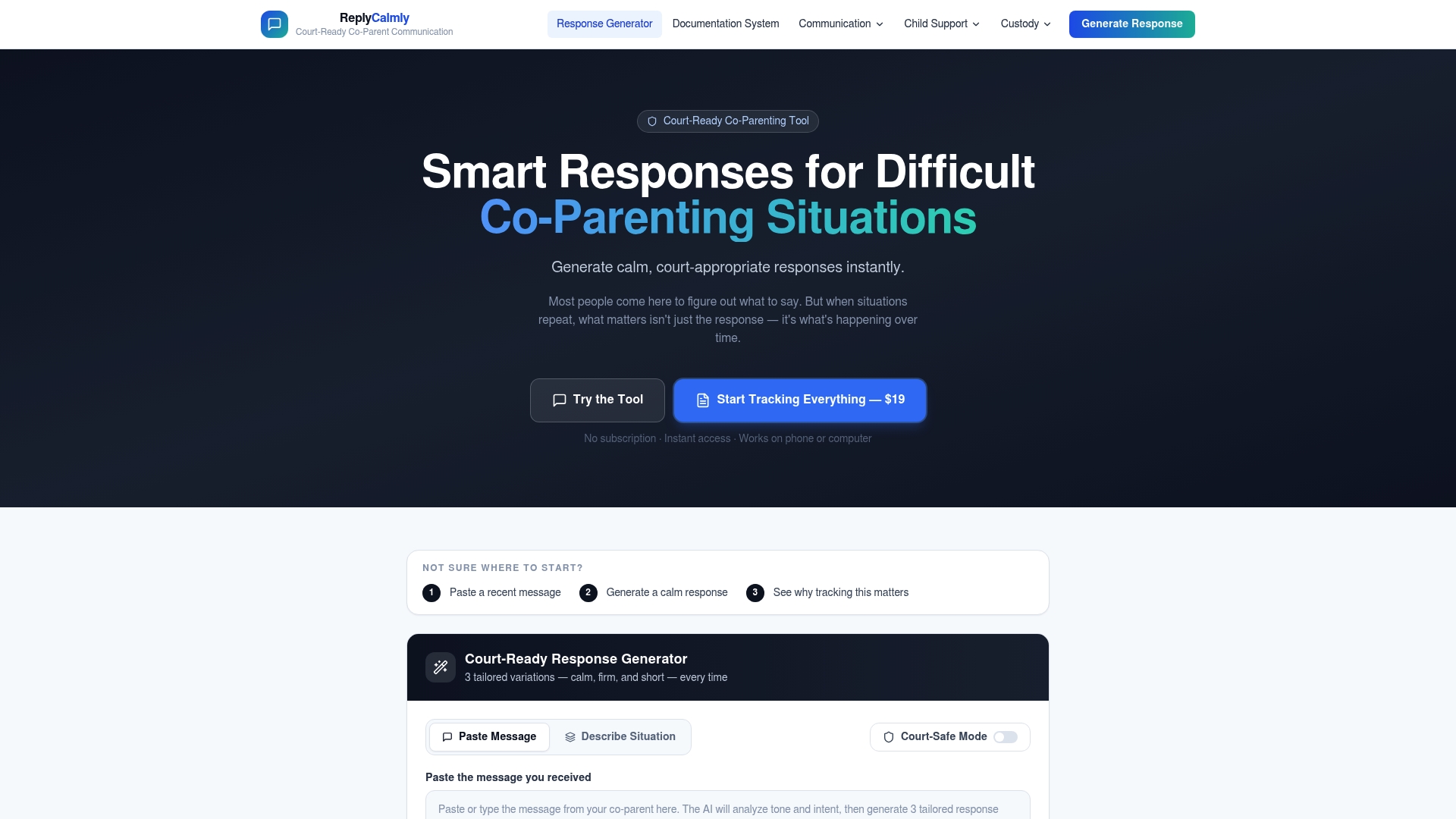
The platform's co-parent response generator takes the message you received and produces multiple BIFF-compliant response options, including calm, firm, and short variations, so you can choose the tone that fits your situation. It also tracks patterns over time, categorizes incidents by issue type, and visualizes your communication history through a dashboard designed for legal clarity. You can explore co-parenting app integrations and connect ReplyCalmly with platforms like OurFamilyWizard for even stronger accountability. If you are ready to build a record that protects you, start with how to document for court using ReplyCalmly's tools and templates.
Frequently asked questions
What should I do if my co-parent refuses to use a co-parenting app?
You can still document your own communications and apply BIFF on your own. Unilateral use of structured communication often shifts the dynamic, and courts can request app adoption from either party at any time.
Do judges really read every co-parent message?
Not always, but any message presented in court should be brief, factual, and emotion-free. Courts encourage structured apps precisely because they make message review faster and more objective for judges.
How do I keep my ex from baiting me into emotional messages?
Respond using the BIFF framework and pause before hitting send. High-conflict personalities starve when they do not get emotional reactions, so consistency is your most powerful tool.
Is the calm response process backed by research?
There are no robust clinical trials, but the method is supported by expert consensus and aligns strongly with established de-escalation principles used across conflict resolution and family law settings.