
A parallel parenting plan is a structured custody arrangement built for high-conflict parents who cannot communicate or coordinate without friction, letting each parent run their own household on their own terms with minimal direct contact. If your co-parent turns every text into an argument, or every handoff into a scene, this is the model designed for exactly that situation.
The benefits show up fast once a plan is in place:
- Fewer confrontations, because there's less direct contact to spark them
- Clearer boundaries, since each household sets its own rules without needing sign-off from the other
- Protected relationships between children and both parents, even when the adults can't get along
A workable plan needs four load-bearing pieces: a detailed custody schedule, exchange procedures that avoid face-to-face conflict, decision-making authority split by topic, and a communication protocol that specifies exactly how and when parents contact each other.
Key Takeaways
Parallel parenting reduces conflict by limiting direct contact between high-conflict parents while protecting each child's relationship with both households.
| Point | Details |
|---|---|
| Define the model correctly | Parallel parenting minimizes parent-to-parent contact through independent households and strict protocols. |
| Nail down four core pieces | Every plan needs a detailed schedule, exchange procedure, decision-authority split, and communication protocol. |
| Specificity wins in court | Judges favor plans with exact times, named locations, and defined response windows over vague language. |
| Document everything in writing | Written, timestamped records protect both compliance proof and evidence if the plan gets violated. |
| Use Replycalmly for daily execution | The free response generator and incident tracker help you follow the communication protocol and build court-ready records. |
Table of Contents
- What Makes a Parallel Parenting Plan Work
- Parallel Parenting vs. Co-Parenting: How Do You Choose?
- Is Parallel Parenting Right for Your Situation?
- What Should a Parallel Parenting Plan Include?
- How Do You Formalize or Change a Parallel Parenting Plan?
- What Do Real Parallel Parenting Plan Clauses Look Like?
- What Mistakes Undermine a Parallel Parenting Plan?
- Why Documentation and the Right Tools Matter
- What Reply Calmly Team Has Learned About Parallel Parenting
- How Replycalmly Supports Your Parallel Parenting Plan
- Sources
What Makes a Parallel Parenting Plan Work
Parallel parenting rests on three principles, and skipping any one of them tends to unravel the whole arrangement. First, each parent is accountable only for their own household. Second, both households operate autonomously, meaning your co-parent's bedtime rules, screen-time limits, or meal choices are not up for debate. Third, routine parenting decisions are not subject to justification to the other parent.
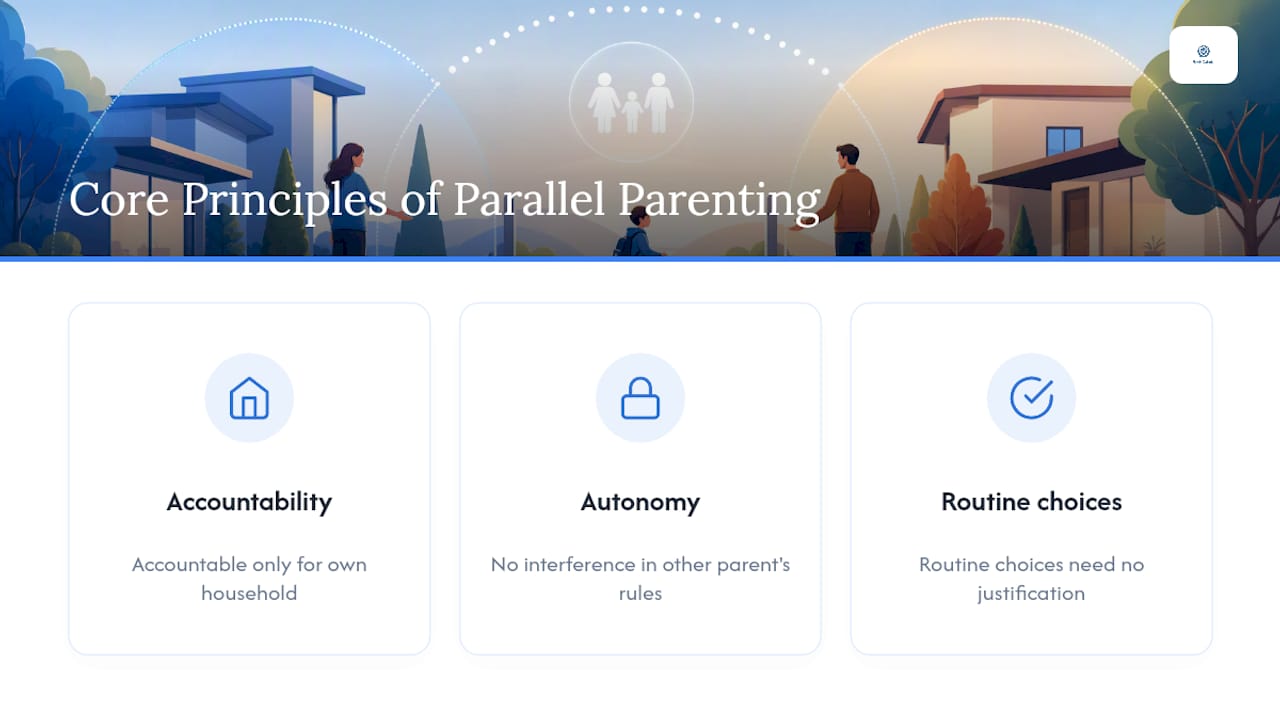
That third principle is the hardest one for most parents to accept, and also the one that does the most conflict-reduction work.
Clinical guidance on parallel parenting points to research showing children generally do best when they spend substantial time with both parents, even when those parents can't cooperate directly. The model exists precisely because kids don't need their parents to get along. They need reliable time with each of them, protected from the fallout of adult conflict.
Parallel parenting is not automatically permanent. Family law attorneys often describe it as a firewall for the early, volatile period after separation, when tempers are highest and trust is lowest. As conflict cools and both parents demonstrate consistency, some families gradually shift toward a more cooperative model. Others stay parallel for years, particularly when one parent's behavior never really changes. Mediators and evaluators frequently recommend starting parallel and revisiting the structure at a defined interval, rather than assuming either permanence or a quick return to full cooperation.
Parallel Parenting vs. Co-Parenting: How Do You Choose?
Co-parenting assumes ongoing collaboration. Parents talk regularly, adjust plans together, and present a united front on discipline and schedules. Parallel parenting assumes the opposite: that collaboration itself is the risk factor, and reducing contact is what protects the children.
The practical differences come down to three things:
- Communication volume. Co-parenting involves frequent, often informal contact. Parallel parenting limits contact to scheduled, written channels covering only child-specific logistics.
- Flexibility. Co-parents can swap weekends on a whim. Parallel parenting plans favor rigid schedules precisely because flexibility becomes a weapon in high-conflict dynamics.
- Decision-making. Co-parents make joint calls. Parallel plans assign specific domains, like medical decisions or school choices, to one parent or split them by category to avoid deadlock.
Courts and clinicians evaluating which model fits a family typically look at conflict history, not personality mismatch. A rocky divorce isn't automatically a parallel parenting case. Repeated litigation, documented manipulation, or children caught relaying messages between households are the signals that tip the recommendation toward parallel structure over traditional co-parenting.
Is Parallel Parenting Right for Your Situation?
Parallel parenting fits a specific profile: parents dealing with a genuinely high-conflict ex, a history of manipulative behavior, or a documented pattern of coercive control, sometimes including a protective order. It's not the default for every difficult divorce.
Watch for these red flags:
- Conflict that escalates every time you try to negotiate directly
- Your co-parent using your child to relay messages, complaints, or demands
- Repeated court filings or emergency motions over routine scheduling disputes
- Any history of harassment, threats, or violations of existing orders
If two or more of these describe your situation, it's worth consulting a family law attorney, mediator, or custody evaluator about formalizing a parallel structure. Professionals can assess whether the conflict pattern meets the threshold courts typically expect before ordering limited-contact arrangements, and they can help translate your specific history into enforceable plan language.
What Should a Parallel Parenting Plan Include?
Vague plans fail. Family law commentary on high-conflict custody cases consistently notes that judges favor plans with high specificity because ambiguity is exactly what triggers new litigation. Every component below needs to be nailed down in writing, not left to "we'll figure it out."
-
Custody schedule. Specify exact start and end times for each period, not just "weekends" or "alternating weeks." Name every holiday, including start/end times and which year applies to which parent. Define make-up visit procedures for missed time, including how much notice is required and how the make-up time gets scheduled.
-
Exchange procedures. Identify a neutral handoff location, such as a school, daycare, or a public spot like a police station lobby. Specify whether direct contact is required at all, since some plans route exchanges through a third party or eliminate face-to-face handoffs entirely by using school drop-off as the transition point.
-
Decision-making authority. Break authority down by category rather than granting blanket joint custody. Medical decisions might go to one parent, schooling to the other, with a defined threshold for what counts as an emergency requiring immediate notice to both.
-
Communication protocol. Name the exact channel (a co-parenting app, email, or written text) and ban phone calls if verbal exchanges tend to escalate. Set a response window, commonly 24 to 48 hours, and restrict content strictly to child-related logistics.
-
Transportation and expense allocation. State who drives which leg of each exchange and how shared costs like extracurricular fees or medical copays get split and reimbursed, including a deadline for reimbursement requests.
-
Emergency and health notification procedures. Define what qualifies as an emergency, who must be notified, and within what timeframe, typically immediate notice for anything requiring urgent medical care.
-
Dispute resolution mechanism. Name a parenting coordinator, mediator, or a specific court process for unresolved disagreements, with a timeline for escalation so disputes don't fester for months.
Pro Tip: Draft the communication protocol clause first, before anything else. It's the piece that prevents the most day-to-day friction, and once it's in writing, both parents have something concrete to point to when a conversation starts drifting off-topic.
A foundational overview of parallel parenting structures breaks down how these components typically get incorporated into a final custody order.
How Do You Formalize or Change a Parallel Parenting Plan?
Three paths lead to a formal, enforceable plan. Parents can draft an agreement together and file it with the court for approval using tools like the Free Uncontested Wizard & Court-Ready Docs, work through mediation to hammer out terms with a neutral third party, or, in more contentious cases, have a judge impose the plan directly after a custody evaluation.
Specificity matters more here than almost anywhere else in family law. A plan that says "parents will communicate about medical decisions" gives a judge nothing to enforce. A plan that says "Parent A has final authority on non-emergency medical decisions, with 48-hour written notice to Parent B before any elective procedure" gives the court, and both parents, a clear standard to measure compliance against.
- Mutual agreement filed with the court works when both parents can agree on terms even if they can't communicate well day-to-day.
- Mediation helps when parents need a neutral facilitator to reach agreement without a full custody trial.
- Judge-ordered plans happen when parents can't agree at all, often after a custody evaluation documents the conflict pattern.
Modifications require showing a substantial change in circumstances, not just frustration with the current setup. Courts typically want documented evidence: a pattern of violations, a change in a child's needs, or a parent's relocation. For entrenched conflict that persists even with a plan in place, a parenting coordinator can handle ongoing disputes without repeated court filings, and supervised exchanges become an option when safety, not just conflict, is the concern.
What Do Real Parallel Parenting Plan Clauses Look Like?
Sample language beats vague intentions every time. Here's how the core pieces typically read in an actual plan:
-
Schedule clause: "Parents shall follow a week-on/week-off schedule, exchanges occurring Fridays at 5:00 PM." Families with younger children sometimes use a 2-2-3 rotation instead, since long stretches away from either parent can be harder on toddlers. A 7-7-7 split, alternating full weeks, tends to fit school-age kids better once routines matter more than constant contact.
-
Exchange clause: "Exchanges shall occur at [child's school] during regular drop-off hours. No verbal communication between parents is required or expected during exchange."
-
Communication clause: "All communication shall occur through [a designated co-parenting app] or email. Parents shall respond within 48 hours. Content shall be limited to matters directly concerning the child."
-
Decision-authority clause: "Parent A shall have final decision-making authority over medical care. Parent B shall have final decision-making authority over extracurricular activity enrollment. Routine day-to-day decisions rest with whichever parent has physical custody at that time."
What Mistakes Undermine a Parallel Parenting Plan?
The plan usually fails for the same handful of reasons. Vague wording tops the list, since "reasonable communication" or "flexible scheduling" gives a hostile co-parent room to argue every single interaction. Oral-only changes are the second killer: any modification not put in writing has a way of getting disputed later. And emotional replies to provocative messages hand your co-parent exactly the ammunition they were fishing for.
- Avoid responding in the moment when a message is designed to provoke you
- Document every deviation from the plan, even small ones, with dates and specifics
- Escalate through the defined dispute resolution process rather than confronting your co-parent directly
Pro Tip: Keep a shared calendar for logistics only, and a separate private incident log for anything that might matter later. Mixing the two turns a scheduling tool into a conflict archive your co-parent can see.
Why Documentation and the Right Tools Matter
Courts and mediators consistently favor archived, timestamped communication over "he said, she said" disputes, which is why written-only channels aren't just a de-escalation tactic. They're evidence.
- Messages, shared calendars, receipts, and incident logs each map to a specific plan provision and prove compliance or violation
- A dedicated co-parenting app keeps every exchange in one searchable, unalterable record
- Tools that generate calm, neutral replies reduce the odds of a provocative message triggering the kind of response you'll regret in front of a judge
- Keeping child-related messages in a single dedicated channel, separate from personal texts, makes court reports far faster to compile
What Reply Calmly Team Has Learned About Parallel Parenting
Parallel parenting reliably delivers what it promises: less court escalation, more predictable routines, and children who stay connected to both parents even when the adults barely speak. The Reply Calmly Team works daily with high-conflict co-parents building exactly these structures, and the pattern is consistent. Families that write down one clause and document one incident this week are already ahead of families still arguing about principles.
— Reply Calmly Team
How Replycalmly Supports Your Parallel Parenting Plan
Replycalmly gives you a faster, calmer alternative to drafting every response from scratch or stewing over a provocative message before you reply. Instead of guessing whether your reply sounds too defensive or too cold for a judge to read later, you get calm, firm, or short response options generated in seconds, built to stay inside the communication protocol your plan already spells out.
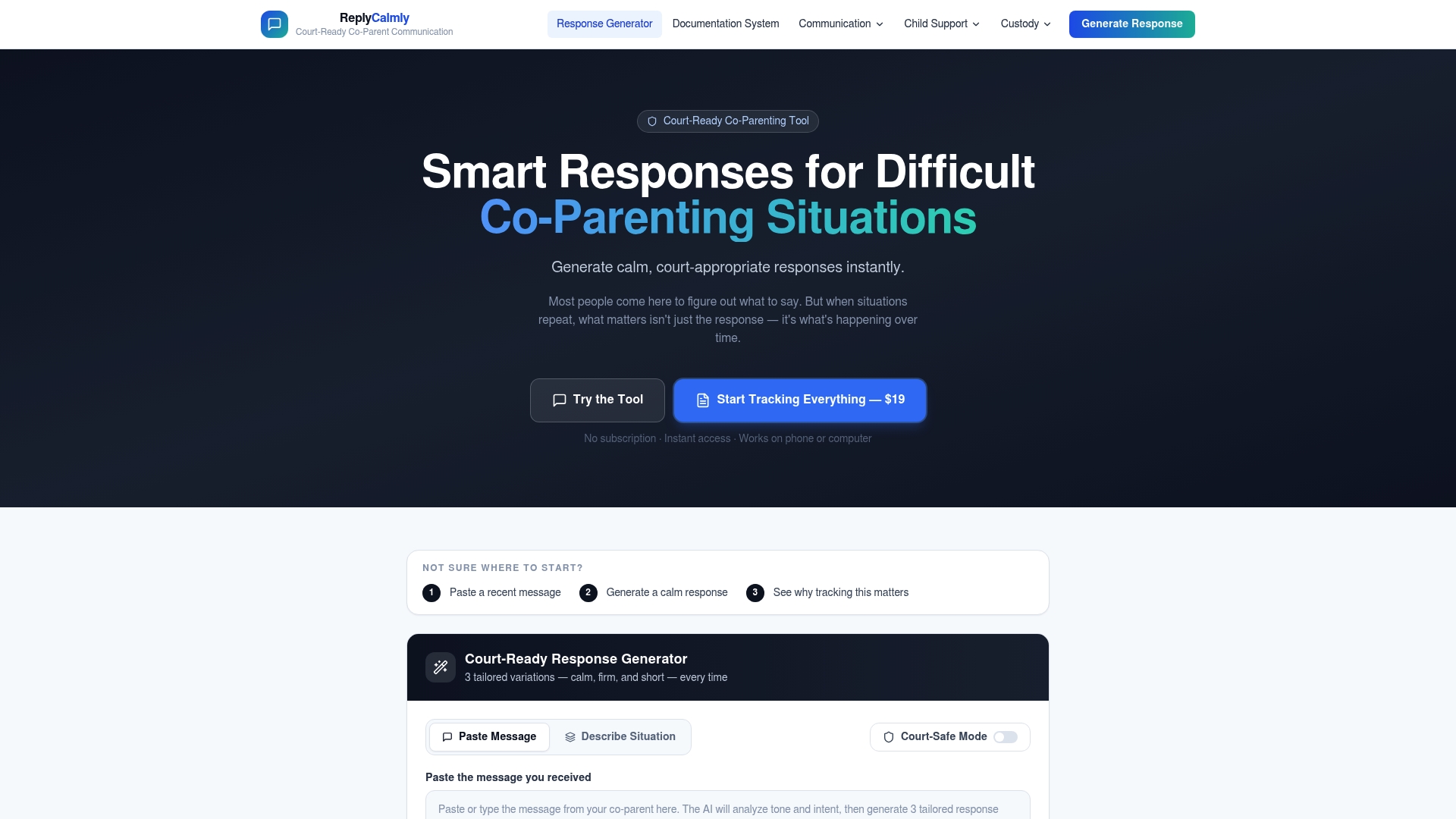
The platform's free response generator handles the moment-to-moment messages, while the incident tracker logs disputes by category (custody conflicts, manipulation, false accusations) and builds dashboards that show patterns over time. When mediation or a court date approaches, that history exports into a court-ready report instead of a folder of screenshots you have to reconstruct from memory. If your co-parent floats a schedule change and you're not sure how to respond without opening a door you'll regret, there's a neutral, ready-to-send template built for that exact scenario. For a step-by-step approach to gathering evidence your attorney can actually use, see how to document co-parenting issues for court. Start with the free generator on your next difficult message and see how much friction it removes.
Sources
- Parallel Parenting in High-Conflict Custody Matters (All in the Family — Bowditch & Dewey)
- What Is Parallel Parenting? (Cleveland Clinic)