
The role of short responses in conflict is to reduce escalation by acknowledging emotion, narrowing the issue, and providing a clear next step without giving the other party new material to argue against. The Crisis Prevention Institute (CPI), the BIFF communication method developed by Bill Eddy, and UC Berkeley Haas research all confirm that brevity is not rudeness. It is strategy. For co-parents managing high-conflict exchanges, this distinction is the difference between a message that defuses tension and one that feeds it.
How do short responses reduce perceived threat and prevent escalation?
De-escalation, the recognized professional term for what most people call "calming things down," has three core goals: reduce perceived threat, narrow the issues in dispute, and clarify the next concrete step. The CPI's de-escalation guidance recommends simple language, validating emotion, and not rushing to fill silences. Each of those recommendations points directly toward shorter, not longer, replies.
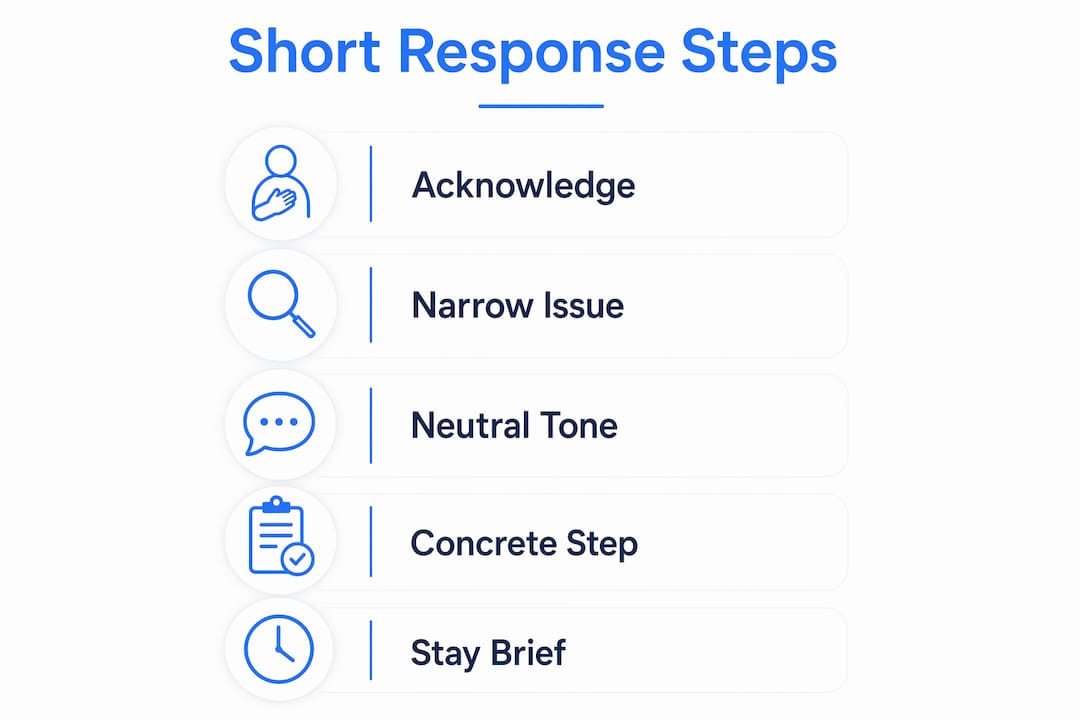
When you send a long message explaining your reasoning, defending your position, and addressing every accusation, you are doing the opposite of narrowing issues. You are expanding them. The other person now has five new points to respond to instead of one. Short, acknowledgment-first replies work because they give the other party nothing new to argue against while still signaling that you heard them.

Acknowledgment does not mean agreement. "I understand you're frustrated about the schedule change. I'll confirm the pickup time by 5 p.m." is nine words of acknowledgment and one concrete next step. That structure, according to multiple de-escalation frameworks, lowers defensiveness because people respond better when feelings are validated before problem-solving begins.
Here is what short responses accomplish in practice:
- They prevent the "circular argument trap," where adding rationale invites counter-rationale indefinitely.
- They keep the emotional temperature lower by removing the perception of attack or lecture.
- They protect your legal record by keeping messages factual and focused.
- They reduce your own cognitive load during an already stressful interaction.
Pro Tip: Draft your reply, then cut it in half. If the second half contains any explanation of why you made a decision, delete it. The "why" is almost always the part that escalates.
What pitfalls exist with short responses in conflict communication?
Brief replies are not automatically safe. The impact of brief replies in disputes depends heavily on tone, and tone is the variable most people underestimate. A study of 683 participants at Vrije Universiteit Amsterdam found that message tone has a stronger effect than message content on whether a conflict feels personal. A short reply sent in a cold or dismissive tone escalates conflict just as effectively as a long defensive one.
The most common failure modes for short responses in high-conflict co-parenting situations are:
- Negative tone without acknowledgment. "Fine." or "Whatever you want." reads as contempt, not conciseness.
- Multiple topics in one short message. Packing three issues into two sentences creates a compressed argument substrate, not a resolution.
- Blame embedded in brevity. "I'll pick up the kids since you forgot again." is short but destructive.
- Silence used as punishment. Not responding at all to a co-parenting logistics message is not a short response. It is a provocation.
Digital communication amplifies every one of these risks. Text messages and emails strip out vocal tone, facial expression, and timing cues. What feels neutral to you when you type it can read as hostile to someone already primed for conflict.
"The circular argument trap springs when you add 'why' to your reply. High-conflict individuals treat your rationale as an invitation to debate, not a path to resolution." — Court Safe Co-Parenting
The fix is not to avoid short responses. The fix is to pair brevity with a neutral or warm tone and a single, clear focus. One topic per message. No blame. No sarcasm. No trailing questions that invite argument.
How do communication channels impact the effectiveness of short responses?
Not every conflict belongs in a text thread. UC Berkeley Haas research shows that spoken conversation increased mutual understanding by nearly half a point and reduced conflict by a quarter point on a 7-point scale compared to text-based exchanges. Receptive language and voice tone humanize the communicator in ways that written words simply cannot replicate. That finding matters for how you choose your channel, not just how you write your message.
| Situation | Recommended channel | Why it works |
|---|---|---|
| Logistics (pickup time, school events) | Email or co-parenting app | Creates a written record; short replies are effective |
| Sensitive topics (health, discipline) | Phone or video call | Voice tone reduces misreading; follow up in writing |
| Legal or court-related matters | Written only (email/app) | Documentation protects both parties |
| Emotional escalation in real time | Delay response; do not reply immediately | Prevents impulsive escalation |
For co-parents specifically, parallel parenting communication strategies recommend strict channel discipline: use written formats for non-emergencies, delay responses to avoid reactive replies, and reserve calls for situations where tone genuinely matters for resolution. The goal is not to avoid communication but to match the channel to the stakes.
Pro Tip: When a message makes your chest tighten, do not reply in the app. Draft your response in a notes app, wait 30 minutes, then review it before sending. The version you send after 30 minutes is almost always better than the version you wanted to send immediately.
What practical frameworks make short responses work in conflict?
The BIFF method, developed by Bill Eddy at the High Conflict Institute, is the most widely applied framework for concise communication in negotiation and high-conflict situations. BIFF stands for Brief, Informative, Friendly, and Firm. Each element serves a specific function in reducing escalation while maintaining clarity.
Here is how to apply BIFF in a co-parenting exchange:
- Brief. Keep the message to two to four sentences. Anything longer invites counter-argument.
- Informative. Include only the facts relevant to the immediate issue. No history, no grievances.
- Friendly. Use a neutral to warm opener. "Thanks for letting me know" costs nothing and reduces defensiveness significantly.
- Firm. End with a specific next step, not an open question. "I'll confirm by Thursday" is firm. "What do you think we should do?" is not.
The firm component of BIFF is the most frequently misapplied. People interpret "firm" as assertive tone, but it actually means a specific next action that removes ambiguity and prevents needless renegotiation. De-escalation success is not just calming language. It is restoring clarity and a clear path forward to coordinated action.
Here is a practical comparison of the same message written two ways:
| Version | Message | Outcome |
|---|---|---|
| Unstructured | "I can't believe you're changing the schedule again. This is the third time this month and it's really affecting the kids. You need to be more consistent." | Invites defense, counter-accusation, and emotional escalation |
| BIFF | "Thanks for the heads up. I can do the Thursday pickup instead. Please confirm by Wednesday evening." | Closes the loop, creates a record, no new argument material |
The difference is not politeness for its own sake. The BIFF version ends with a concrete next step, which is what actually moves the situation forward. Structured co-parenting communication also benefits from improving co-parenting communication practices over time, not just in individual messages.
Pro Tip: Read your message aloud before sending. If it sounds like a lecture or a complaint, it will read that way too. If it sounds like a logistics update, you are on the right track.
Key takeaways
Short responses reduce conflict escalation when they combine acknowledgment, neutral tone, and a single concrete next step rather than explanation or defense.
| Point | Details |
|---|---|
| Brevity is strategy, not avoidance | Short replies give the other party nothing new to argue against while still moving the situation forward. |
| Tone outweighs content | A dismissive short reply escalates conflict just as much as a long defensive one, per Vrije Universiteit Amsterdam research. |
| Channel choice matters | Spoken conversation reduces conflict more than text for sensitive topics; written channels work best for logistics and documentation. |
| BIFF ends with a next step | The "Firm" in BIFF means a specific action, not assertive tone. Ambiguity invites renegotiation. |
| Delay before sending | Drafting in a notes app and waiting 30 minutes before sending prevents impulsive escalation in high-conflict exchanges. |
Why short responses are harder than they look
I have worked with enough high-conflict communication situations to say this plainly: short responses are one of the hardest skills to actually execute under pressure. The instinct when you are accused of something false, or when a co-parent sends a message designed to provoke, is to explain yourself. Thoroughly. With evidence. That instinct is completely understandable and almost always counterproductive.
What I have found is that the people who get the best outcomes in high-conflict co-parenting situations are not the ones who win arguments in text threads. They are the ones who stop having arguments in text threads. A two-sentence reply that acknowledges, confirms, and closes does more for your legal record and your mental health than a paragraph that proves you are right.
That said, short responses are not a cure-all. De-escalation training research shows that communication strategies regulate behavior but do not guarantee outcomes. When the other party is determined to escalate, your brevity will not stop them. What it does is keep your side of the record clean and deny them the fuel they need to sustain the conflict.
The real skill is knowing when a short response is enough and when you need to shift channels, involve a mediator, or de-escalate a co-parent argument through a different approach entirely. Brevity is a tool. Like any tool, it works best when you know its limits.
— Devin
How Replycalmly helps you respond with less conflict
High-conflict co-parenting communication is exhausting, and knowing the right framework does not always make it easier to write the right message in the moment.
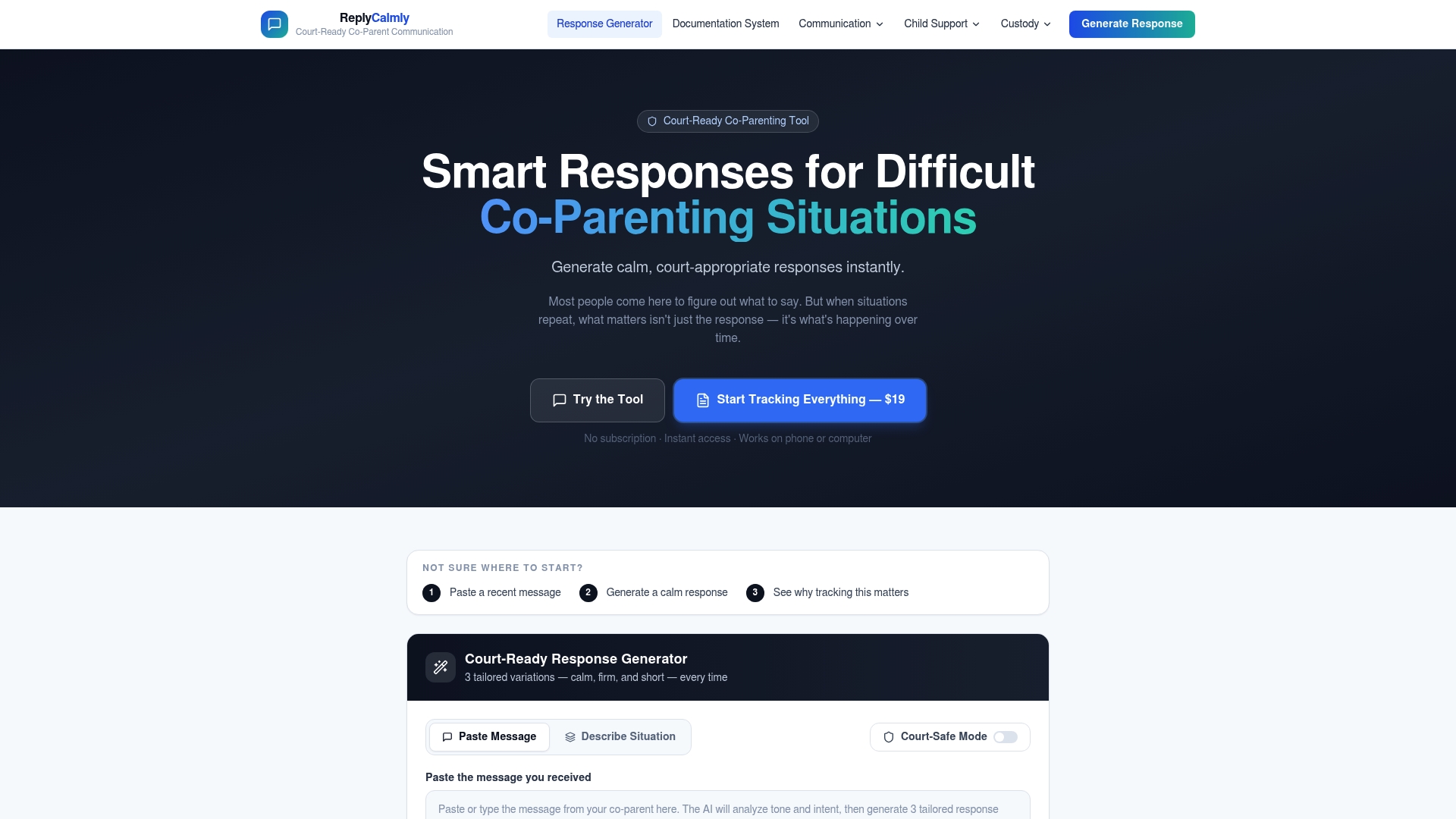
Replycalmly is built specifically for this problem. The platform's AI response generator takes the message you received and produces multiple BIFF-style reply options: calm, firm, and short. You choose the version that fits the situation. The platform also logs communication patterns over time, so you have a documented record if issues escalate to family court. For co-parents who want to build a structured approach from the start, the communication plan template gives you a framework that sets channel rules, response timing, and topic boundaries before the next difficult message arrives. Visit Replycalmly to see how structured, concise communication can protect both your relationship with your child and your legal standing.
FAQ
What is the role of short responses in conflict?
Short responses in conflict reduce escalation by narrowing the issue, acknowledging emotion, and providing a concrete next step without giving the other party new material to argue against. The CPI and BIFF frameworks both identify brevity combined with acknowledgment as a core de-escalation tool.
Can a short reply make conflict worse?
Yes. A short reply with a dismissive or cold tone escalates conflict just as effectively as a long defensive message. Vrije Universiteit Amsterdam research found that tone has a stronger effect on conflict personalization than message content.
When should I use a phone call instead of a short text?
Use a phone or video call for sensitive topics where tone matters for resolution, such as health decisions or discipline disagreements. UC Berkeley Haas research shows spoken conversation reduces conflict more than text for contentious topics. Follow up in writing to create a record.
What does BIFF stand for in conflict communication?
BIFF stands for Brief, Informative, Friendly, and Firm. Developed by Bill Eddy at the High Conflict Institute, it is a structured method for writing concise, de-escalating messages that end with a specific next step rather than an open question.
How long should a co-parenting message be?
Two to four sentences is the target for most co-parenting messages. Anything longer risks introducing multiple topics, which creates new argument material. One topic, one next step, and a neutral tone covers the vast majority of co-parenting logistics effectively.