
Supervised visitation documentation is a factual visit record, usually written by a trained monitor, that logs who showed up, what happened, and whether anything went wrong. Courts treat these reports as objective evidence, and consistent, incident-free records are what actually move a judge toward loosening restrictions. Parents strengthen their own position by keeping a parallel, time-stamped log of each visit and never using the visit itself to pass messages.
TL;DR:
- Routine visit reports typically include case details, date, duration, activities, safety concerns, cancellations, and signatures, with no custody recommendations.
- Monitors document visits factually, noting behavior, rule violations, and safety issues without offering opinions or custody advice, ensuring neutrality in court.
- Parents should keep a detailed, timestamped log of each visit, avoid using the child or monitor as messengers, and attach supporting evidence for best legal support.
- Critical incidents involving safety, aggression, or violations are reported immediately, with repeated or serious violations potentially leading to visit termination or legal consequences.
- Building a consistent, organized record with precise details and attachments enhances your case for modifications and helps your attorney prepare evidence efficiently.
Table of Contents
- What Official Supervised-Visit Records And Reports Include
- The Monitor's Role, Limits, And How They Document Visits
- How Parents Should Prepare And Keep Their Own Visitation Documentation
- How Courts Use Visitation Records To Decide Modification Requests
- Common Violations, Documentation Triggers, And What Follows
- Templates And Examples You Can Adapt For Your Own Log
- How ReplyCalmly Supports A Documentation Workflow
- Reply Calmly Team's Take On Getting This Right
- Turn Your Visit Logs Into A Court-Ready Record
- Where To Go For The Official Standards
- Sources
What Official Supervised-Visit Records And Reports Include
Not every report from a supervised visitation program looks the same, and knowing the difference matters when you're trying to figure out what will actually land in front of a judge. Programs generally produce several kinds of paperwork, each with a different author and a different level of detail.
Summary reports are short, routine overviews, often covering a set period like a month or a quarter. Observation notes are the detailed, contemporaneous accounts a monitor writes during or immediately after a visit. Critical incident reports get triggered by something specific, a safety concern, a rule violation, a canceled visit, and go out faster than routine paperwork. Evaluation reports are a different animal entirely: they contain professional opinions and recommendations, and only a licensed clinician can write one, typically under a separate court order.
Supervised visitation programs following Supreme Court standards for supervised visitation keep visit records that identify the case, note who supervised, list everyone present, and record the date, time, and duration of the visit. Those same standards specify that visit notes should stay factual. A monitor's job is to record what happened, not to tell the court what to do about it, unless a formal evaluation has been ordered.
A well-built visit record typically includes:
- Case or client identifier and the names of the supervising monitor and all participants
- Date, start time, end time, and total duration of the visit
- A description of activities during the visit (games played, homework help, meals shared)
- Any safety concerns, rule violations, or unusual behavior observed
- Cancellations, no-shows, or late arrivals, with the reason if one was given
- Signatures or sign-off from the monitor confirming the record's accuracy
Programs don't hand these records over on demand. Most operate under a program agreement with the court that sets a reporting rhythm, often a periodic summary every few months, with critical incidents reported immediately regardless of the regular schedule. Outside of that rhythm, a parent or attorney generally needs a court order or subpoena to pull the full file.
Retention periods vary by program and by state, but most centers hold records for the duration of the custody order and potentially longer if litigation is ongoing. If you're not sure how long your local program keeps records, ask them directly. The SVN Standards for Supervised Visitation set a practice baseline that many programs use to build their own record-keeping policies, so it's a reasonable place to start if your provider seems vague about the rules.
One distinction worth remembering: a program's routine reporting will almost never include a recommendation about custody or parenting time. If you want a professional opinion in the file, that requires a separate evaluation, ordered by the court and completed by a qualified clinician, not the visit monitor.
The Monitor's Role, Limits, And How They Document Visits
A monitor's job is narrower than most parents expect. They watch, they listen, and they write down what they observe. They are not there to referee disputes, coach either parent, or weigh in on who should get more time. Unless a monitor also holds a separate clinical credential and the court has specifically ordered an evaluation, their reports stay in observer mode: no diagnoses, no custody opinions, no recommendations.
That neutrality is what makes their notes useful in court, and it's also what protects both parents. A monitor's factual record can just as easily clear a parent of a false allegation as it can document a real problem.
Here's how that plays out during an actual visit:
- Continuous observation. Standards require the monitor to keep the child within sight and hearing for the entire visit, no exceptions for bathroom breaks or "just a minute alone." Attempts to whisper or step out of earshot get documented, regardless of intent.
- Real-time intervention. If something unsafe or against the rules happens, the monitor steps in immediately, redirecting the conversation or ending the activity before it escalates.
- Warnings for rule violations. A first offense, like bringing up the other parent negatively, usually gets a verbal warning that still makes it into the written record.
- Termination when necessary. Repeated or serious violations end the visit early, and that always triggers a written report.
- Critical incident documentation. Anything involving safety, aggression, or a clear violation of the visitation order gets its own report, separate from the routine visit notes.
Certain behaviors show up in monitor notes more than parents realize. Using the child to relay a message ("tell your mom I need the car seat back") is one of the most common triggers, and Bridging Families' guidance on communicating during supervised visits notes that even casual, seemingly harmless comments passed through a child are frequently logged as violations. Discussing the court case, disparaging the other parent, physical discipline, and steering conversation toward topics the order prohibits all land in the report too.
Language matters here. A monitor writing "Father raised his voice and said, 'Your mother is a liar,' at 3:42 PM" is doing the job correctly: specific, timestamped, no editorializing. A note that says "Father was clearly trying to manipulate the child" crosses into opinion territory that weakens the record's credibility. The best reports read like a transcript, not a review.
How Parents Should Prepare And Keep Their Own Visitation Documentation
Monitor reports carry real weight, but they aren't the only record that matters. Your own log, kept consistently and kept boring in the best sense, backs up what the program reports and gives your attorney something concrete to work with.
Build a habit around a simple entry for every visit. Note the date and exact time of drop-off and pickup, who transported the child, the total duration, and a plain description of what happened. If your child says something worth preserving, write it down as close to verbatim as you can remember, in quotation marks, with the time it was said. Note any monitor intervention, any lateness or cancellation, and attach whatever supporting material exists, screenshots of scheduling texts, a photo of a late arrival, receipts for supervision fees you paid.
Format discipline is what separates a useful log from a liability. Stick to what you observed, not what you assume someone meant. "He arrived 22 minutes late and didn't explain why" holds up. "He was clearly trying to sabotage the visit" does not, and an attorney on the other side will use that kind of language against you. Keep your originals, don't edit screenshots, and store everything somewhere secure and backed up, not just on a phone that could get lost, cracked, or synced to a shared family account.
The single rule that trips up more parents than any other: do not use the visit, the child, or the monitor as a messenger. If you need to communicate about scheduling, fees, or logistics, use whatever court-approved channel your order specifies, or go through counsel. If the other parent tries to pass a message through the child anyway, log the attempt with a timestamp rather than responding through the same channel.
A quick checklist to keep near your log:
- Date, start time, end time, transporting parent
- Monitor's name and any interventions or warnings issued
- Direct quotes from your child, kept verbatim
- Screenshots or copies of any scheduling communication
- Fee receipts and payment confirmations
- Notes on lateness, cancellation, or early termination
Pro Tip: Write your log entry within an hour of the visit ending, while details are fresh. A note jotted the next day almost always loses the specific wording that makes a record credible in court.
A sample entry might read: "March 4, 2026. Visit began 10:03 AM, ended 12:00 PM at Sunrise Family Center. Monitor: J. Alvarez. Child stated at 11:15 AM, 'Dad said I should tell you he wants the weekend back.' No interventions. No incidents." That's it. No conclusions, no accusations, just what happened and when. If you want help drafting a response to a scheduling message without violating that no-messenger rule, ReplyCalmly's guide to documenting co-parenting issues walks through the workflow in more detail.
How Courts Use Visitation Records To Decide Modification Requests
Reports don't usually reach a judge in real time. Under most program agreements with the court, routine summaries go out on a set schedule, often every few months, while critical incident reports get sent as soon as something serious happens. Outside that rhythm, getting the full case file usually takes a court order or a subpoena.
What judges actually look for is pattern, not a single good visit. A judge reviewing a modification request wants to see months of consistent, uneventful reports, completed treatment or classes if any were ordered, and no critical incidents. One pleasant Saturday afternoon rarely moves the needle. Several months of consistent, compliant visits generally carry more weight.
If you're building toward a motion to modify, structure it the way an attorney would expect:
- A written summary of the record, covering the relevant time period in plain language
- Chronological attachments: monitor reports, your own visit logs, and any incident documentation, arranged by date
- Supporting letters showing completed treatment, parenting classes, or other court-ordered services
- A clear, specific statement of what you're asking the court to change
If a monitor's factual reports aren't enough because you or the other side wants a professional opinion on parenting capacity, that requires a formal evaluation report from a licensed clinician, ordered separately by the court. That's a different process from the program's routine reporting, more expensive, more time-consuming, and reserved for situations where the court decides an expert opinion is genuinely needed rather than just a factual record.
Common Violations, Documentation Triggers, And What Follows
Some behaviors get flagged so often that most programs treat them almost as a checklist. Knowing what triggers a report helps you avoid accidentally generating one against yourself.
- Message passing through the child. Even a casual "tell your mom" gets logged as a violation of the no-messenger rule.
- Discussing the case or the other parent negatively in front of the child. This includes complaints about custody, court dates, or the other parent's character.
- Physical discipline. Any physical correction, even mild by the parent's own standard, typically triggers immediate documentation and often intervention.
- Repeated lateness or no-shows. Chronic tardiness gets tracked as a pattern, not just a one-off inconvenience.
- Unapproved guests or items. Bringing someone or something the order didn't authorize, a new partner, a phone, a gift the other parent hasn't cleared, gets noted.
Program responses scale with severity. A first, minor issue usually gets a verbal warning that still lands in the written notes. Repeated or serious violations can end the visit on the spot, and anything involving safety generates a critical incident report that may go straight to the court, and in some cases to a child-protection agency if mandatory reporting laws apply.
Downstream, the legal consequences can range from a motion for contempt to extended supervision or a requirement to complete additional services before unsupervised time is even discussed again. If you're on the receiving end of an incident, or you're the one who triggered it, the smart move is the same either way: preserve every record you have, get legal advice before your next scheduled visit, and request written copies of whatever report the incident generated.
Templates And Examples You Can Adapt For Your Own Log
A useful visit log doesn't need to be complicated. It needs fields that map to what a judge actually cares about, and language that stays factual under scrutiny.
Standard fields worth including every time: date and time, transporting parent, monitor's name, activities during the visit, direct quotes from the child, any interventions, and attachments like screenshots or receipts. Each field earns its place because it answers a question a court will eventually ask: when did this happen, who was present, what exactly occurred, and can you prove it.
A neutral incident note might read: "At 2:15 PM, monitor observed Father raise his voice. Monitor intervened at 2:16 PM. Visit resumed at 2:18 PM without further incident." Compare that to "Father lost his temper and scared the child," which sounds worse but proves less, because it states a conclusion instead of an observation.
When you're ready to hand records to an attorney, organize them the way legal teams already do. Attorneys assembling evidence for a motion often build a short exhibit index, a simple list pairing each document (monitor report, log entry, receipt) with a one-line note on what it supports. Pre-sorting your own records into that format before your attorney ever sees them saves billable time and makes your file look organized before anyone opens it.
- Visit log entries, in date order
- Monitor reports, matched to the same dates
- Screenshots of scheduling messages or attempted contact through the child
- Receipts for supervision fees, since local programs commonly charge the visiting parent under a published fee schedule
- A one-page summary tying the exhibits to your requested relief
If you want a deeper walk-through of what a checklist like this looks like fully filled out, ReplyCalmly's custody documentation checklist covers the full list of fields attorneys typically ask for.
How ReplyCalmly Supports A Documentation Workflow
Keeping a court-ready record while you're also managing custody stress isn't easy, and most parents don't have a system until after they've already lost track of a few details. ReplyCalmly builds toward that gap with time-stamped incident tracking, category tagging for things like scheduling conflicts or communication violations, and a response generator that drafts calm, firm, or short replies when a co-parent's message tempts you into exactly the kind of reactive language that undermines a good record.
A practical workflow looks like this: draft your reply to a difficult message using the response generator so your tone stays neutral and court-appropriate, log the incident the same day while details are fresh, attach the relevant monitor report or screenshot, and export the full chronological record when your attorney needs it. That export mirrors the exhibit-index structure attorneys already expect, which means less time spent explaining your own paperwork.
If missed visits are part of your situation, ReplyCalmly's guide to documenting missed visitation covers that scenario specifically, and the broader incident-logging workflow guide walks through building the daily habit that makes all of this sustainable.
Reply Calmly Team's Take On Getting This Right
The parents who come out ahead in these cases aren't the ones with the most dramatic story. They're the ones with the most boring, consistent, timestamped paper trail. If we had one piece of advice, it's this: stop trying to prove the other parent is unreasonable and start proving you're reliable. Log everything, route every request through the right channel, never the child, and let your attorney see a record that speaks for itself. Read through ReplyCalmly's templates and try the free response generator before your next difficult message arrives.
— Reply Calmly Team
Turn Your Visit Logs Into A Court-Ready Record
A shoebox of screenshots and half-remembered incidents doesn't help your attorney, and it definitely doesn't help you in front of a judge. ReplyCalmly is built specifically for parents documenting supervised visitation and high-conflict custody communication: every incident gets a timestamp, a category, and a place for attachments, so what used to be scattered across texts and photo albums becomes one organized, exportable file.
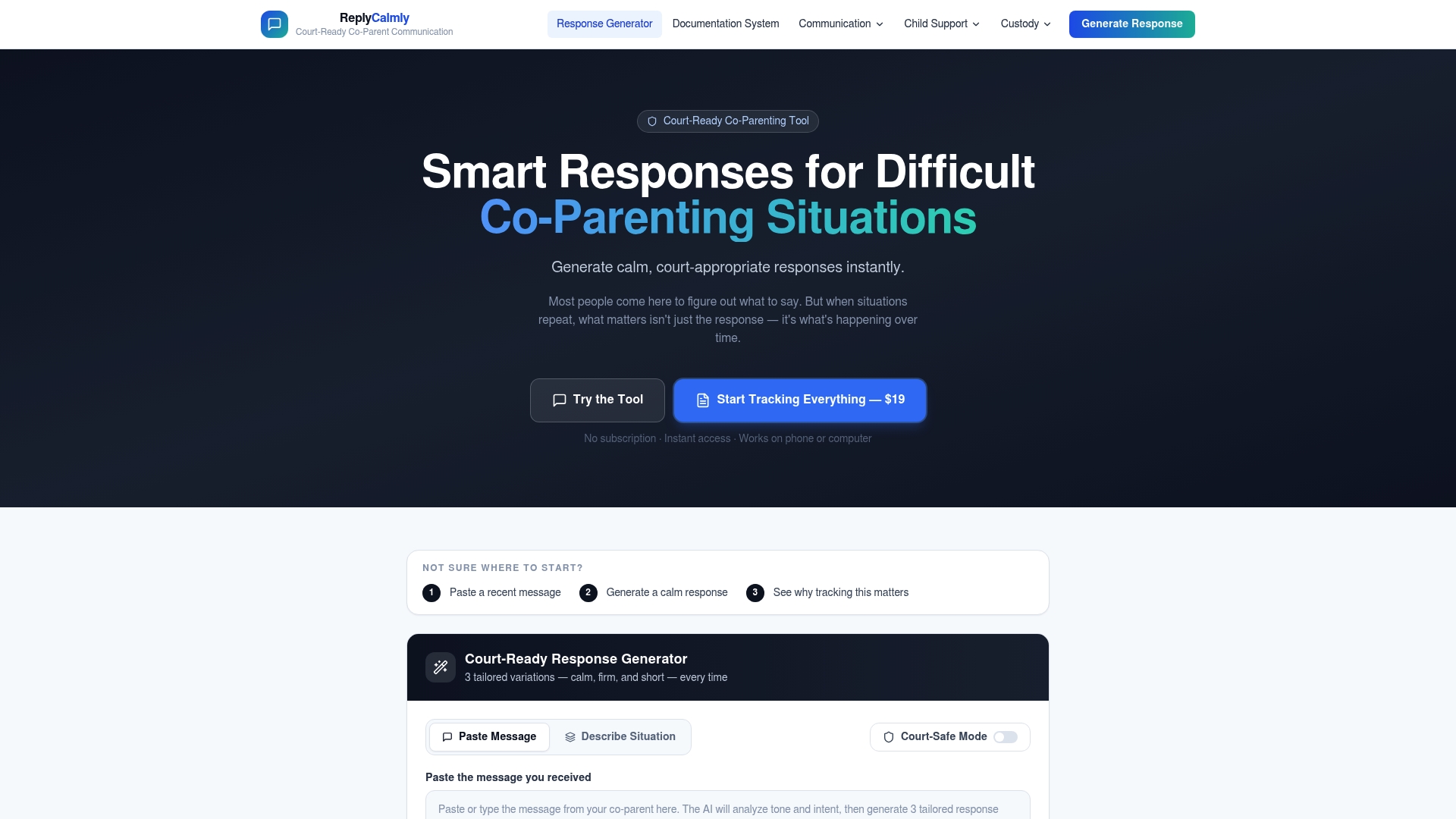
The free response generator lets you draft a calm, firm, or short reply to a difficult co-parenting message right now, no subscription required, which matters most in the exact moment you're most tempted to fire back. When you're ready for the full incident tracker, pattern dashboards, and court-ready exports, a paid plan runs $19 a month after a 3-day free trial. Start by seeing what the platform actually looks like on ReplyCalmly's co-parenting app page, or jump straight into drafting your next reply with the free response generator.
Where To Go For The Official Standards
Bring these to your attorney or read them before your next hearing:
- SVN Standards for Supervised Visitation, the practice baseline most programs build their policies around
- Supreme Court standards for supervised visitation programs
- Your local program's own agreement with the court, since fee schedules and reporting timelines vary by county
- A family law attorney's explanation of how reports get used, such as Foley Family Law's overview of supervised visitation
This article is general information, not a substitute for advice from a qualified lawyer. Consult a qualified legal professional about your own circumstances before acting on anything here.
Sources
- Supreme court standards for supervised visitation (ITRS/FSU)
- Bridging Families — Communication guidance for supervised visits
- Tarrant County Community Supervision Agreement (example fee and scheduling rules)