
A documenting parental incidents workflow is the process of consistently recording, organizing, and reporting co-parenting incidents to protect your parental rights and support custody proceedings. Family courts and child protection agencies treat documentation as evidence. What you record, how you record it, and when you record it can determine the outcome of a custody dispute. This guide covers the essential data elements, the right tools, a step-by-step process, and the legal weight your records carry when they are done correctly.
What essential information should you document in parental incident records?
Thorough parent incident documentation starts with capturing the right data fields every time. Missing a single element, like the time of day or the name of a witness, can undermine an otherwise solid record.
Every incident report should include:
- Date and time of the incident, recorded immediately
- Location where the incident occurred
- Participants present, including children, the co-parent, and any witnesses
- Verbatim descriptions of what was said or done, not your interpretation
- Actions you took in response, including calls made or messages sent
- Reference numbers for any official contact, such as a police report or a child services case number
- Names of officials consulted, including caseworkers, attorneys, or school staff
Effective incident documentation requires verified facts, precise timelines, and a clear distinction between observations and assumptions. That distinction matters because courts read your records looking for bias. A record that says "He arrived 45 minutes late" is evidence. A record that says "He arrived late again because he doesn't care" is an opinion, and it weakens your credibility.
Recording communications is equally critical. Log every text message, email, voicemail, and in-person exchange related to custody. Note the method of communication, the time, and the content. If you spoke with a school official or a pediatrician about a concern, document that contact with the same detail you would apply to a co-parent exchange.

Pro Tip: Keep a dedicated notebook or digital log for incidents only. Mixing incident notes with personal journaling creates confusion and can expose unrelated private information if records are subpoenaed.
What tools support an organized workflow for documenting incidents?
The right tool depends on your situation, your tech comfort level, and what your custody order requires. Each category has trade-offs worth understanding before you commit.
| Tool category | Key strengths | Key limitations |
|---|---|---|
| Paper journal | No tech required, private | No timestamps, easy to lose or damage |
| General notes app | Fast entry, syncs across devices | No audit trail, editable after the fact |
| Dedicated co-parenting app | Timestamped, locked edits, audit trail | Requires both parties to use it in some cases |
| Court-mandated platform | Legally recognized, admissible | May require court order to access |
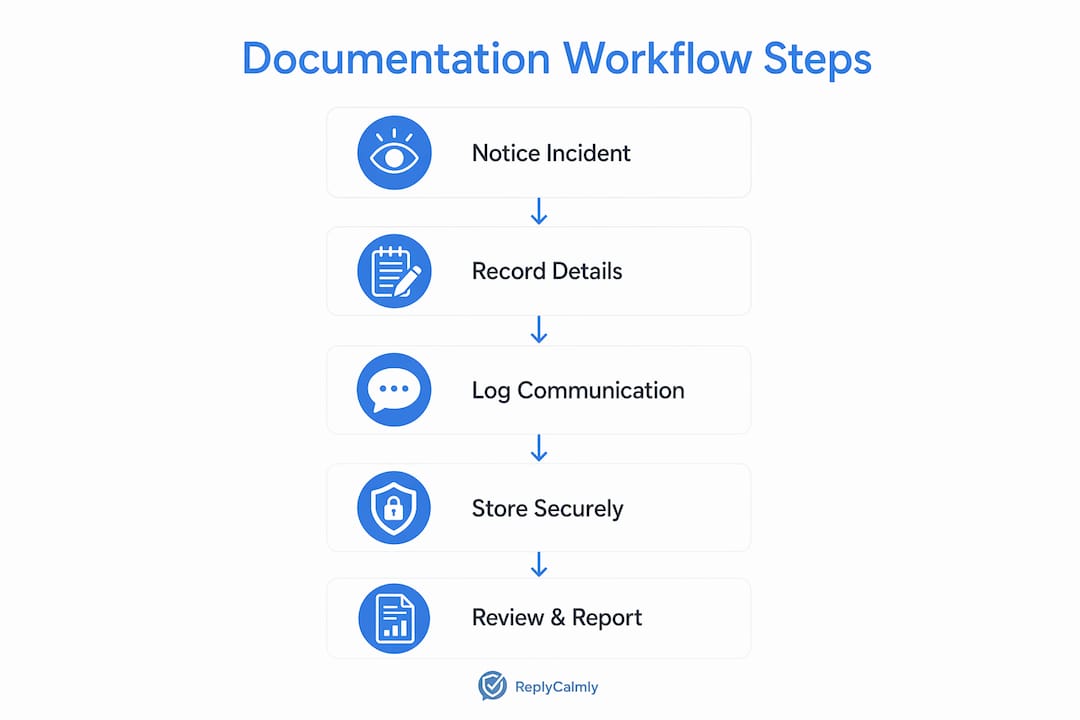
Ongoing documentation workflows that timestamp entries, lock edits, and preserve audit trails produce stronger evidence in custody disputes. That is the core advantage of a dedicated platform over a general notes app. An edit-locked record proves you did not alter the entry after the fact.
Specialized co-parenting platforms also categorize incidents automatically. You can tag an entry as a custody conflict, a missed exchange, or a communication boundary violation. That categorization lets you pull a pattern report quickly when your attorney needs it. Replycalmly offers this kind of structured incident logging alongside a communication archive, which means your records and your message history live in one place.
For parents who use court-mandated communication tools, Replycalmly integrates with those systems rather than replacing them. That keeps your documentation consistent with what the court already recognizes.
How to establish a step-by-step workflow for reporting parental incidents
A repeatable process removes the guesswork from incident reporting. When you follow the same steps every time, your records become consistent, and consistency is what courts look for.
-
Prepare your tools and know your thresholds. Set up your documentation system before an incident occurs. Understanding your legal rights and reporting thresholds is critical, especially when deciding whether to contact child protection agencies. Know what rises to the level of mandatory reporting in your state.
-
Document immediately. Record the incident as close to the moment it happens as possible. Memory degrades fast, and courts favor records made at the time of the event. Include every detail listed in the first section of this guide.
-
Capture evidence. Attach screenshots of relevant messages, photos of injuries or property, or copies of official correspondence. Label each piece of evidence with the date and a brief description.
-
Organize records systematically. File each entry by date and category. Use folders or tags so you can retrieve a specific incident within seconds. Your attorney should be able to find any record without asking you to search for it.
-
Follow consistent communication protocols. After documenting an incident, communicate with your co-parent in writing when possible. Written communication creates its own record. If you must speak by phone, follow up with a written summary sent by text or email.
-
Review and update regularly. Set a weekly time to review your records, add any missing details, and confirm that your backup is current. Store records in at least two locations, one digital and one physical or cloud-based.
Pro Tip: Never delete an entry, even if you think it is minor. Patterns of small incidents often carry more weight in court than a single dramatic event. A judge looking at six months of consistent late pickups sees a pattern. A single late pickup looks like an accident.
Maintaining an audit trail of all actions, including dates, times, communication methods, reference numbers, and names of officials consulted, helps verify compliance with child protection authorities. That audit trail is your proof that you followed the process correctly.
What are common challenges in documenting parental incidents?
High-conflict co-parenting creates specific obstacles that can derail even a well-designed documentation system. Knowing these pitfalls in advance helps you avoid them.
Emotional pressure is the most common challenge. When a co-parent sends a hostile message or violates a custody order, the instinct is to respond immediately and emotionally. That response often ends up in your own record as evidence of your state of mind rather than theirs. Write the record first. Respond to the co-parent second, and only after you have calmed down.
Conflicting accounts create a different problem. Your co-parent may document the same incident with a completely different version of events. The solution is to separate observed facts from assumptions in every entry. A record that sticks to what you saw and heard is far harder to dispute than one that includes your interpretation of motives.
Common documentation mistakes to avoid:
- Recording opinions or emotional reactions as facts
- Waiting days to document an incident from memory
- Storing records only on a device the co-parent has access to
- Using informal language that sounds biased or aggressive
- Failing to document positive co-parenting interactions, which courts also notice
"Legal experts emphasize that maintaining calm, objective incident documentation empowers parents and supports court processes even in high-conflict cases. The tone of your records reflects your credibility as a witness."
Incomplete information is another frequent problem. You may not know all the details of an incident right away. Document what you know immediately, then add a follow-up entry when you learn more. Label the follow-up clearly with the date you added it. Never go back and edit the original entry.
Privacy is a real concern too. Keep records password-protected and stored separately from shared family accounts. Child protection reporting should include formal tracking of contact details and communications, not just the incident itself. That means your record-keeping extends beyond the incident to every related communication.
How does proper documentation support legal and custody proceedings?
Courts evaluate incident reports based on four standards: they must be contemporaneous, authentic, specific, and continuous. A record written the day of the incident outweighs one written three weeks later. A record with a locked timestamp outweighs one that could have been edited.
| Documentation standard | What it means | Why courts care |
|---|---|---|
| Contemporaneous | Written at or near the time of the incident | Reduces the risk of memory distortion |
| Authentic | Unedited, with a verifiable timestamp | Proves the record was not altered |
| Specific | Names, times, locations, verbatim quotes | Gives the court concrete facts to evaluate |
| Continuous | Maintained over time, not just during disputes | Shows a pattern rather than a single event |
Timestamped records that separate observations from interpretation increase the reliability of parental incident evidence. That reliability is what moves a judge from skepticism to confidence in your account.
Communication logs serve a specific legal function. They show not just what happened but how each parent responded. A parent who consistently responds in writing, calmly, and within a reasonable time frame looks cooperative. A parent whose communication record is full of hostile messages, gaps, or contradictions looks unreliable. Your communication records in custody disputes are as important as your incident records.
Knowing your rights before you report also matters. Understanding legal reporting thresholds minimizes disruption when you interact with child protection agencies and ensures you report at the right level. Under-reporting and over-reporting both carry consequences in custody proceedings.
Key Takeaways
A consistent, fact-based documenting parental incidents workflow is the single most effective tool a co-parent can use to protect their rights and build a credible legal record.
| Point | Details |
|---|---|
| Document immediately | Record every incident at the time it happens to preserve accuracy and court credibility. |
| Separate facts from opinions | Stick to what you observed; interpretations weaken your record and invite challenge. |
| Use audit-trail tools | Platforms that lock edits and timestamp entries produce stronger evidence than editable notes. |
| Maintain communication logs | Written co-parent exchanges are evidence; document them with the same care as incidents. |
| Know your legal thresholds | Understanding when and how to report to authorities protects both your rights and your child. |
What I have learned from watching parents document everything and still lose
I have spent a lot of time reading through custody documentation that parents were certain would protect them. Some of it did. A lot of it did not. The difference was almost never the quantity of records. It was the quality and the tone.
Parents in high-conflict situations tend to document reactively. Something bad happens, they write it down in a fury, and the record reads like a complaint rather than a report. Judges are experienced readers. They can tell the difference between a parent who is building a case and a parent who is keeping a record. The first looks adversarial. The second looks credible.
The parents whose documentation actually helped them shared one habit: they treated every entry like a professional filing a workplace incident report. No drama, no editorializing, just facts with timestamps. That discipline is hard to maintain when you are exhausted and angry. But it is the only version of documentation that holds up.
Technology helps, but only if you use it consistently. A platform that logs incidents and archives communication is only as good as the parent who opens it after every relevant event, not just the dramatic ones. The small, repeated violations, the late pickups, the missed calls, the schedule changes without notice, build the pattern that courts find persuasive. One dramatic incident rarely changes a custody order. Six months of documented small violations often does.
Treat your documentation practice as a form of self-protection, not as a weapon. That shift in mindset changes how you write, what you include, and how your records read to a judge.
— Devin
How Replycalmly helps you build a complete co-parenting record
Replycalmly is built for exactly the situation this article describes. It combines incident logging with a communication archive so your records and your message history stay in one place.
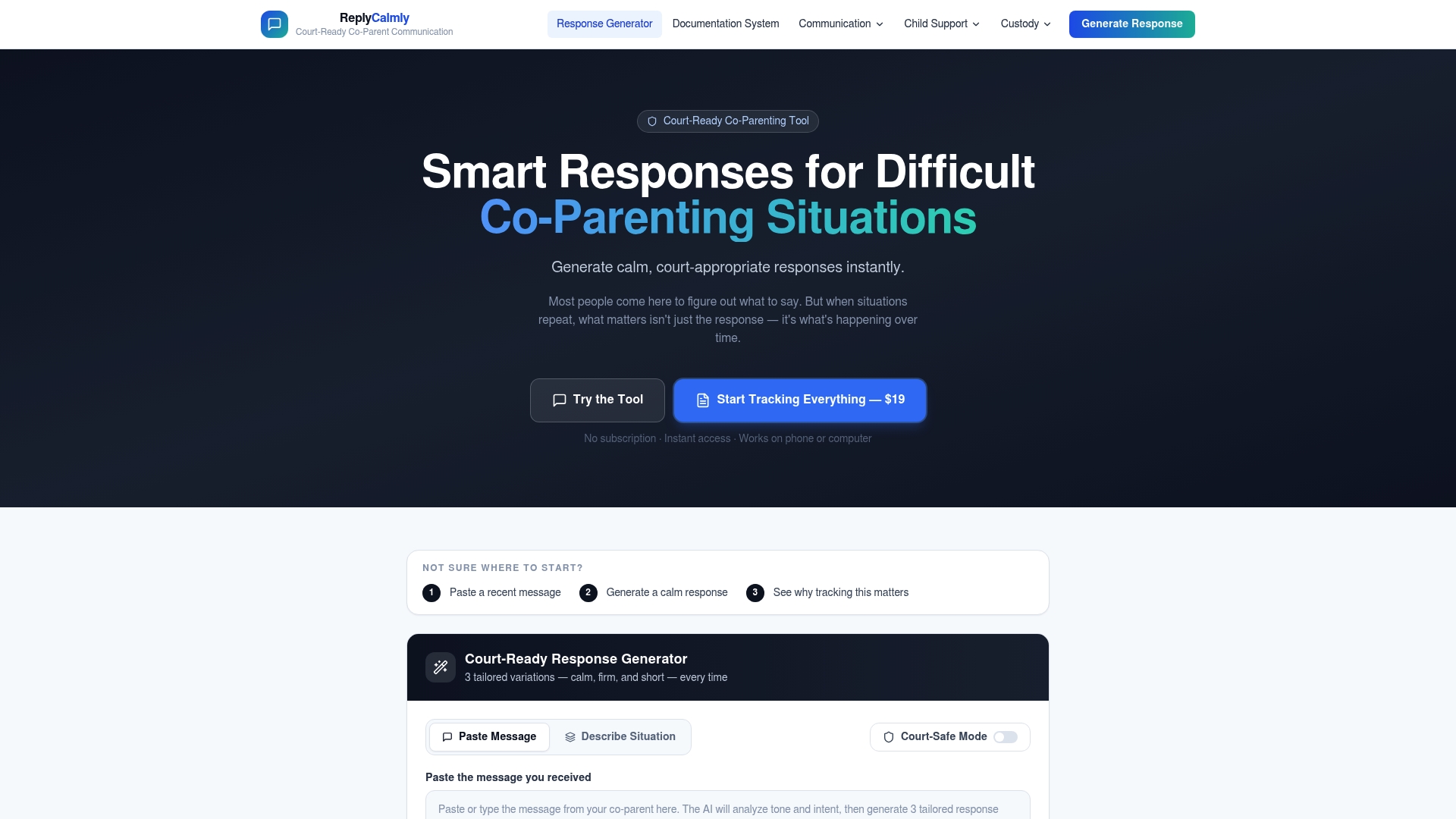
The platform's incident tracking system lets you log events by category, including custody conflicts, missed exchanges, and communication violations, and visualizes patterns over time through a dashboard your attorney can review. The co-parent response generator produces calm, firm, and short reply options for difficult messages, so your communication record reflects the tone courts want to see. For parents who want a structured starting point, the best co-parenting apps for documentation page on Replycalmly walks through what to look for in a documentation tool and how to get started.
FAQ
What is a documenting parental incidents workflow?
A documenting parental incidents workflow is a repeatable process for recording, organizing, and reporting co-parenting incidents with enough detail to support custody proceedings. It includes data fields like date, time, location, participants, and verbatim descriptions, along with a system for storing and retrieving records.
How soon should I document an incident?
Document every incident immediately, ideally within minutes of it occurring. Courts treat contemporaneous records as more reliable than entries written from memory days later.
What makes incident documentation admissible in custody court?
Courts look for records that are contemporaneous, authentic, specific, and continuous. Timestamped entries that separate observed facts from interpretations carry the most evidentiary weight.
Should I document positive co-parenting interactions too?
Yes. Courts notice when a parent's record contains only negative entries. Documenting cooperative exchanges shows you are keeping an honest record rather than building a one-sided case.
Can my communication logs be used as evidence?
Written communication logs, including texts, emails, and platform messages, are regularly admitted as evidence in custody proceedings. Maintaining a complete, unedited archive of co-parent exchanges strengthens your overall documentation record.