
High-conflict co-parenting is exhausting enough without scrambling to reconstruct what happened three weeks ago before a court hearing. A parenting incident tracking checklist changes that. It gives you a structured, legally credible record of events, communications, and patterns that holds up when it matters most. Whether you're dealing with missed pickups, concerning messages, or violations of your custody agreement, the way you document those incidents determines whether they help or hurt your case. This article walks you through exactly what to capture, which tools to use, and how to build a system you'll actually maintain.
Table of Contents
- Criteria for an effective parenting incident tracking checklist
- Top tools and formats for documenting parenting incidents
- Comparing common parenting incident tracking checklists and apps
- How to customize your parenting incident tracking checklist for legal strength
- Why typical incident tracking fails and how to fix it
- How ReplyCalmly supports your parenting incident tracking and communication
- Frequently asked questions
Key Takeaways
| Point | Details |
|---|---|
| Factual records matter | Document incidents with exact dates, times, witnesses, and observable facts, not opinions or emotions. |
| Context is crucial | Include full conversation threads and annotate key entries to avoid isolated evidence doubts. |
| Original evidence is best | Preserve original devices and unaltered records to meet legal authentication rules. |
| Routine improves reliability | Create a weekly system to update your incident log and organize documentation consistently. |
| Use specialized tools | Leverage co-parenting apps and templates designed for high-conflict situations to ensure accuracy and reduce disputes. |
Criteria for an effective parenting incident tracking checklist
To build a reliable incident tracking tool, you first need to understand the essential criteria it must meet. Not every log is created equal, and courts can tell the difference between documentation built for legal credibility and notes jotted down out of frustration.
Documentation is strongest when it covers patterns, precise timing, and sticks to observed facts: date, what happened, and who witnessed it. That framing is your baseline. Every entry in your checklist should pass a simple test: could a stranger read this and understand exactly what happened, when, and why it matters?
Here's what a legally credible parenting incident tracking checklist must include:
- Exact date and time of the incident, not estimates. "Around 6 PM" weakens your record.
- Factual, emotion-free description of what occurred. Write what happened, not how it made you feel.
- Evidence type and storage location, such as screenshot in Google Drive folder labeled "Custody 2026/June."
- Witnesses or corroborating parties, including names and their relationship to the situation.
- Impact on the child, described in observable, behavioral terms (not your interpretation of their emotional state).
- Your response, including any messages sent or actions taken immediately after.
- Pattern context, noting whether this is a repeat of prior incidents and referencing earlier entries.
That last point is where most parents fall short. Single incidents rarely move courts. Patterns do. Your checklist needs to connect the dots across multiple entries rather than treating each event in isolation. Review the legal standards for documenting incidents before you finalize your format, because jurisdiction-specific rules can affect what counts as admissible.
Top tools and formats for documenting parenting incidents
With criteria set, let's look at the best tools and formats that meet those requirements and practical tips for using them. The format you choose matters less than your consistency, but some options give you a significant structural advantage.
Spreadsheets remain one of the most flexible options for incident documentation for parents. A simple spreadsheet with columns for date, description, evidence type, and storage location builds a timeline courts can follow. You can add conditional formatting to flag repeat incident types, filter by date range before hearings, and share read-only access with your attorney.

Screenshots are useful but require care. Screenshots are strongest when taken immediately after exchanges, timestamped, with surrounding message context included, and messages should never be deleted. Deleting a message you think is irrelevant can destroy the conversational thread that proves context.
Communication logs act as a central reference connecting incidents, messages, and responses in one place. Think of them as the narrative layer sitting above your raw evidence. They explain the "so what" that a screenshot alone cannot.
Key practices across all formats:
- Keep original devices where messages are stored. Devices contain metadata that screenshots lack.
- Save full conversation threads, not just the offensive or concerning message.
- Never delete messages, even ones that show you in a neutral or unfavorable light. Selective preservation looks like manipulation.
- Use consistent file naming conventions so evidence is retrievable quickly.
- Cross-reference your behavior incident record with calendar entries, school records, or medical appointments when relevant.
Pro Tip: Set a recurring phone alarm labeled "Document" every Sunday evening. Five minutes of consistent logging beats a rushed two-hour reconstruction the night before a court date.
For a deeper breakdown of what to include in each entry, see this guide on incident log formats and data points and review screenshot best practices for court before you store your next image.
Comparing common parenting incident tracking checklists and apps
Now that you know the tools, let's compare popular checklists and apps to identify what fits your needs best.
| Format | Strengths | Weaknesses | Legal suitability |
|---|---|---|---|
| Spreadsheet | Customizable, free, attorney-shareable | Manual updates, easy to neglect | High, if consistently maintained |
| Communication app (e.g., OurFamilyWizard) | Timestamped, uneditable, court-accepted | Subscription cost, requires both parents | Very high |
| Physical notebook | Simple, always available | No authentication, easy to dispute | Low |
| Phone notes app | Fast to update | Editable, no metadata trail | Low to moderate |
| Dedicated co-parenting platform | Built-in structure, pattern dashboards | Learning curve, cost | High |
Structured communication apps like OurFamilyWizard create timestamped, uneditable message records courts readily accept and often recommend in high-conflict cases. That neutrality is the key advantage. When both parents communicate through the same platform, neither side can claim messages were altered.
The tradeoff is dependency. If your co-parent refuses to use the app or uses it selectively, gaps appear in the record. That's why a coordinated system often works best: use a court-accepted communication app for all messages and a private spreadsheet or dedicated platform for your incident log, pattern tracking, and evidence storage.
Physical notebooks still come up in conversations about parenting observation checklists, but they carry a significant risk. Opposing counsel can argue entries were written after the fact. Digital entries with metadata are harder to dispute.
For a full breakdown of which apps serve documentation needs best, see this review of top co-parenting documentation apps and this guide on organizing co-parenting evidence for court.
How to customize your parenting incident tracking checklist for legal strength
Understanding tools and comparisons helps, but customizing your checklist for legal strength ensures it will hold up in court. Generic templates are starting points. Your final checklist should be shaped by your jurisdiction's evidentiary rules and your attorney's input.
A key friction point for screenshots is authentication under evidentiary Rule 901 (the legal standard requiring you to prove evidence is what you claim it is). Preserving originals and full message threads is core to preventing evidence challenges. That means the original device is your primary evidence. Screenshots are secondary support, not the foundation.
Here's a practical step-by-step approach to building a legally strong checklist:
- Start with your jurisdiction's rules. Ask your attorney which evidentiary standards apply in your county or state. Rules on digital evidence vary widely.
- Build your entry template. Include date, time (exact), factual description, child impact (observable only), witnesses, evidence type, and storage location.
- Add contextual annotations. A short, objective note explaining where this fits in a larger pattern prevents an isolated entry from appearing cherry-picked.
- Preserve original devices. Designate one device per communication platform and keep it backed up but intact.
- Establish a weekly documentation routine. Review communications, log new incidents, organize files, and check the upcoming custody schedule every Sunday.
- Review with your attorney quarterly. Courts evolve. Periodic reviews keep your system aligned with current standards.
Pro Tip: Create a folder structure that mirrors your checklist categories: "Missed Pickups," "Communication Violations," "Child Welfare Concerns." When you need to pull evidence for a specific claim, you'll find it in under 60 seconds.
Your step-by-step documentation checklist is most useful when it reflects real events, not just the worst ones. Document neutral exchanges too. Courts notice when a record contains only damaging incidents and nothing routine. For a deeper look at what crosses legal lines in documentation, review these rules for incident evidence.
Why typical incident tracking fails and how to fix it
Here's the uncomfortable truth most documentation guides skip: the majority of parents doing incident tracking are doing it in a way that courts find unconvincing. Not because they're dishonest, but because they're building a collection of screenshots instead of building a case.
Raw screenshots are legally fragile if they appear out of context or isolated. Including surrounding conversation and annotating with objective notes is what transforms them from weak exhibits into persuasive evidence. A screenshot of one hostile message, stripped of the 40 messages before it, tells a very different story than the full thread.
The second failure is inconsistency. Parents document heavily during disputes and go quiet during calm periods. Courts read that pattern as emotional documentation, not factual. A behavior incident record that runs continuously through both calm and difficult stretches is far more credible than a log that spikes around court dates.
The third failure is conflation. When incident notes include phrases like "he clearly did this to hurt me" or "she's obviously trying to alienate the kids," the entire document loses credibility. Courts cannot verify intent. They can verify facts. Your job is to report what happened and let the pattern speak.
The fix is also the habit: write every entry as if a judge you've never met will read it tomorrow. No predictions. No motives. Just dates, times, facts, observable impact, and your measured response. That discipline, applied consistently, is what makes a documentation system work. See these advanced incident tracking insights for a deeper look at building pattern-based evidence that holds up under scrutiny.
How ReplyCalmly supports your parenting incident tracking and communication
After mastering checklist strategies, consider how ReplyCalmly's tools can simplify and strengthen your incident tracking and co-parent communication.
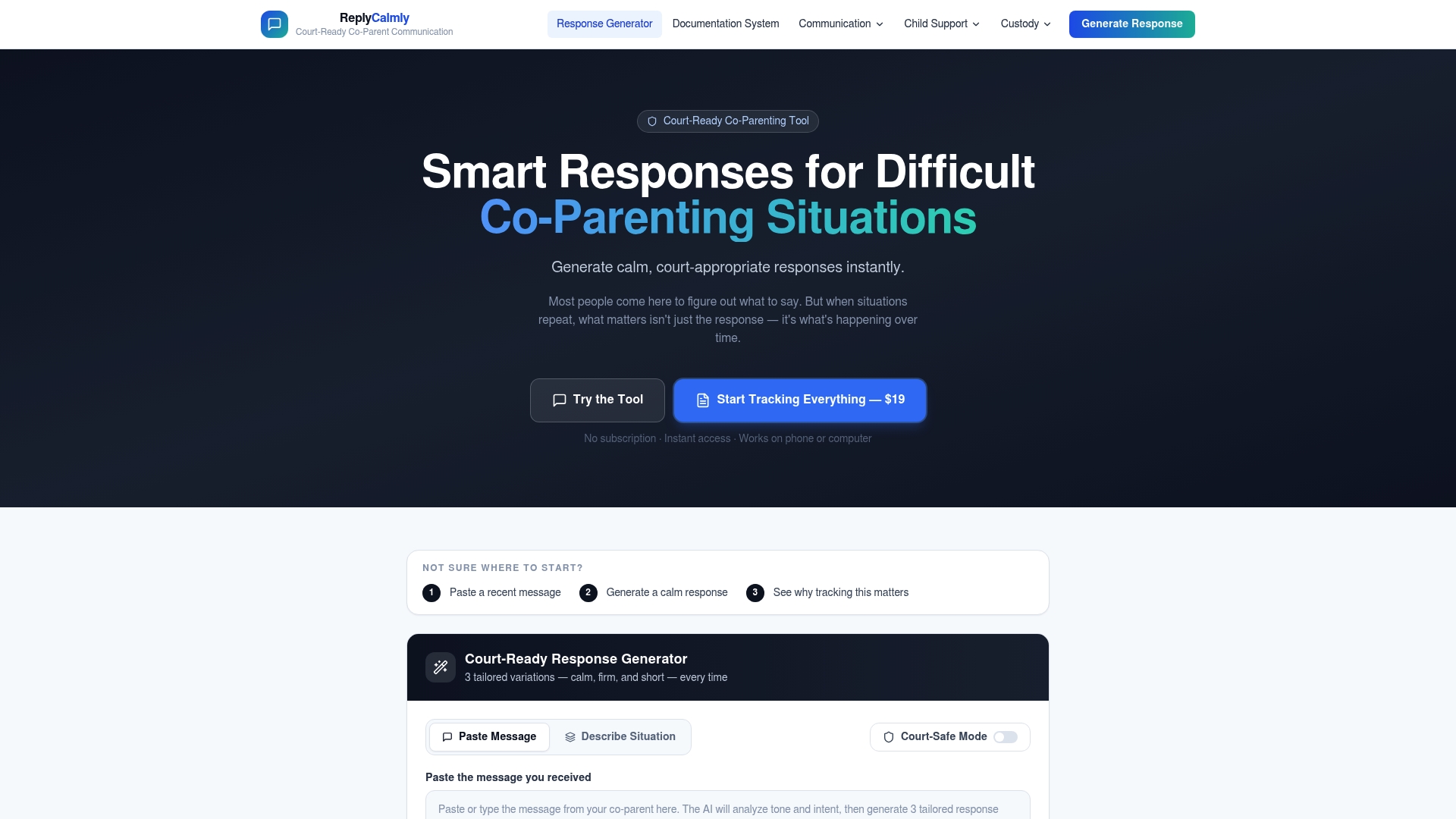
ReplyCalmly is built specifically for high-conflict co-parents who need more than a blank spreadsheet. The platform combines structured incident logging with a response generator that keeps your communication calm, factual, and court-appropriate, even when the messages coming in are anything but. Every log entry captures the details that matter legally, and the dashboard visualizes patterns over time so you and your attorney can see the case clearly.
The best co-parenting app for documentation is one that fits your actual workflow. ReplyCalmly's built-in reminders prevent the documentation backlog that kills most systems, and the communication plan template gives you a framework for every exchange. Start building your co-parenting evidence log today and go into your next hearing prepared.
Frequently asked questions
What should I include in a parenting incident tracking checklist?
Include the date, time, factual description, impact on the child, witnesses, evidence type, and storage location. Documentation covering patterns and precise timing, grounded in observed facts, gives your checklist the legal credibility it needs.
How do I properly save screenshots for custody evidence?
Take screenshots immediately after key exchanges with date and time stamps, include surrounding message context, and never delete messages. Screenshots with full context and original devices preserved are the strongest form of this evidence.
Can I use a co-parenting app to document incidents for court?
Yes. Apps like OurFamilyWizard create timestamped, uneditable records that courts widely accept. Many courts encourage co-parenting apps that log all messages and provide neutral records accessible to both parents and the court.
Why is preserving original devices important for custody evidence?
Original devices store metadata and full conversation threads essential for authenticating evidence under evidentiary rules. Screenshots may lack metadata needed for authentication, making the original device your strongest primary source.
How often should I update my parenting incident log?
A weekly routine works best. A sustainable system includes weekly screenshot review, incident log updates, calendar checks, and a quick scan of upcoming custody events to keep documentation current and court-ready.