
Incident documentation is the practice of creating precise, contemporaneous records of events that affect custody arrangements or co-parenting dynamics. In family court, these records serve as the foundation for legal claims, pattern recognition, and credibility. Judges rely on documented evidence, not memory, to evaluate the best interest of the child. Tools like OurFamilyWizard and platforms like Replycalmly exist specifically because courts reward parents who track behavior consistently. If you are in a high-conflict custody situation, understanding what incident documentation is and how to do it correctly is one of the most protective steps you can take.
What is incident documentation and why does timing matter?
Incident documentation is the structured recording of specific events, behaviors, or communications that are relevant to a custody dispute or co-parenting conflict. The standard industry term for this practice in legal contexts is "contemporaneous record-keeping." Both terms describe the same core activity: writing down what happened, when it happened, and who was present, as close to the moment as possible.
Entries made within hours preserve memory accuracy and avoid hearsay dismissal in court under Federal Rule of Evidence 803(5), the recorded recollection exception. That legal standard exists because human memory degrades fast. Details blur, sequences shift, and emotional bias fills the gaps. A log written the same evening carries far more legal weight than a summary written three weeks later.
Consistency matters just as much as timing. Judges use pattern recognition to differentiate isolated incidents from sustained behavior, which directly impacts custody rulings. A single entry about a missed pickup looks like a complaint. Twelve entries over four months, each with dates and exact times, looks like a pattern. Courts respond to patterns.
What every incident entry must include
Each log entry should contain the following elements:
- Date and exact time of the incident
- Location where it occurred
- Direct quotes from the other parent, using their exact words
- Names of any witnesses, including children if age-appropriate
- Observable facts only, such as what you saw or heard, not what you assumed
- Effects on the children, described in behavioral or physical terms
Pro Tip: Write your entries in the third person if it helps you stay objective. "The child arrived without a coat at 6:14 p.m." reads as fact. "He clearly doesn't care about our son" reads as opinion and can undermine your credibility.
Screenshots, voice memos, and same-day notes carry more weight than recaps written weeks later. An exact text message screenshot with a visible timestamp is stronger evidence than a paraphrase written from memory.
How does incident documentation differ from legal evidence?
Documentation and evidence are not the same thing. This distinction trips up many parents in custody disputes, and misunderstanding it can cost you in court.
Documentation is raw material. It includes your notes, screenshots, voice memos, photos, and written logs. Evidence is what happens after that raw material has been organized, authenticated, and aligned with legal standards. A folder of screenshots on your phone is documentation. That same folder, organized chronologically, labeled with context, and submitted through your attorney with a proper chain of custody, becomes evidence.
The path from documentation to admissible evidence involves four steps:
- Collection: Capture the raw incident data, including photos, messages, and written notes, on the day it occurs.
- Organization: Sort entries by date, category, and relevance to specific legal claims such as parental alienation, missed visitation, or substance use.
- Authentication: Preserve metadata on digital files. Screenshots should retain timestamps. Emails should show full headers. This proves the records were not altered.
- Legal alignment: Your attorney frames the organized records against the "best interest of the child" standard, which is the primary legal test in family court custody decisions.
Skipping any of these steps weakens your position. A judge cannot admit a document that cannot be verified. Proper categorization and metadata preservation are not optional steps. They are what separate a credible record from a dismissed complaint.
Pattern documentation matters more than isolated incidents in showing coercive control or sustained behaviors that influence custody outcomes. A single authenticated incident may support one claim. A chronological record of thirty authenticated incidents, all properly categorized, can reframe the entire custody narrative.
What are the best tools for incident logging in high-conflict cases?
The right documentation method depends on your specific situation, your state's laws, and your legal strategy. No single tool works for everyone, but the differences between options are significant.
| Method | Legal reliability | Privacy level | Best use case |
|---|---|---|---|
| Private written journal | High (if dated and consistent) | High | Daily incident logs, emotional safety |
| Google Docs or Notes app | High (with timestamps) | Medium | Accessible, searchable digital records |
| OurFamilyWizard | High (court-monitored) | Low (shared) | Formal communication records |
| Replycalmly | High (structured logging) | High | Pattern tracking, response management |
| Voice memos | Medium (requires transcription) | High | Immediate capture after verbal incidents |
| Screenshots | High (with metadata intact) | High | Text and email evidence |
OurFamilyWizard is a court-monitored co-parenting platform that many judges require. It creates a shared, timestamped record of communications. That visibility is its strength for formal exchanges and its weakness for private legal strategy. Keep private incident logs separate from court-monitored platforms to maintain legal strategy and avoid exposing your process to the other parent.
Recordings are a separate category. Federal law allows one-party consent for recording conversations, but eleven states require two-party consent with limited exceptions. Always confirm your state's law before recording any conversation. Using an illegal recording in court can backfire severely, discrediting your entire case.
Pro Tip: Back up your documentation in at least two locations, such as a secure cloud folder and an encrypted external drive. Losing records to a device failure or account lockout is a preventable disaster.
For co-parenting incident logging that combines pattern tracking with response management, purpose-built platforms give you a structural advantage over generic note-taking apps.
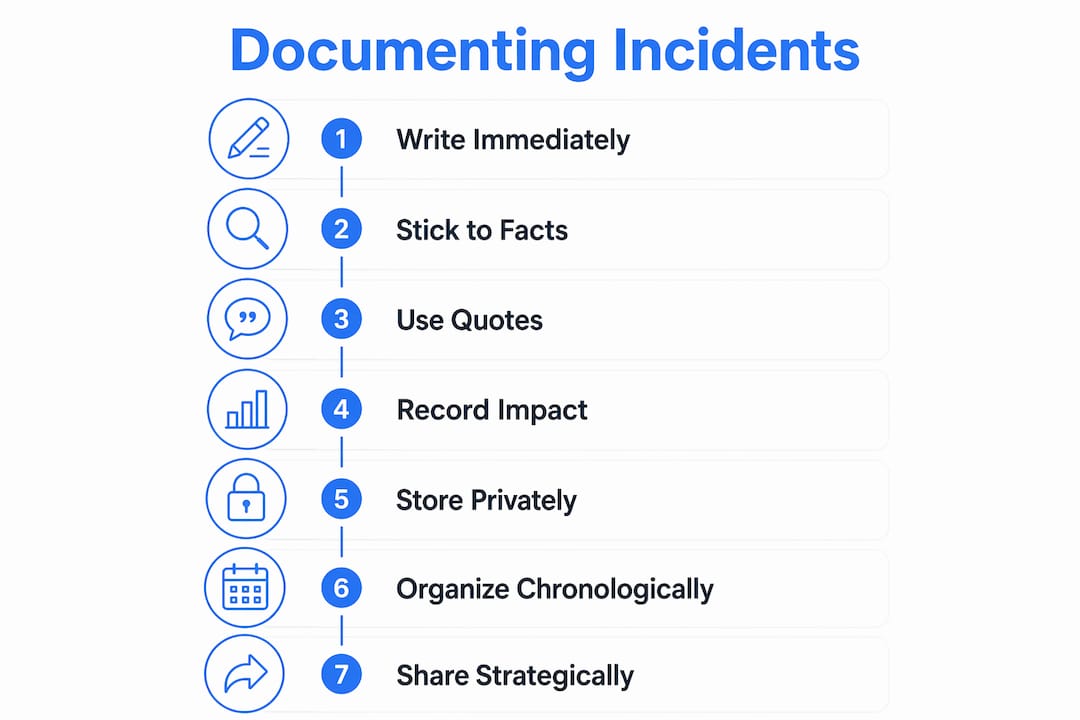
How to document incidents for custody court: step by step
Effective incident documentation requires discipline, not just intention. The following process produces records that hold up under legal scrutiny.
Step 1: Write immediately. Log the incident the same day, ideally within two hours. Include the exact time you are writing, separate from the time the incident occurred.

Step 2: Stick to observable facts. Describe what you saw, heard, or received. Avoid words like "seemed," "appeared to," or "was trying to." Courts treat interpretation as opinion, not fact.
Step 3: Use direct quotes. If the other parent said something significant, write their exact words in quotation marks. Note the date, time, and setting of the statement.
Step 4: Record the impact on your children. Note behavioral changes, physical symptoms, or statements the children made after the incident. Keep these descriptions factual and specific.
Step 5: Store records privately. Your incident log is not a communication tool. Never share it with the other parent or reference it in shared apps like OurFamilyWizard. It is a legal preparation document.
Step 6: Organize chronologically with categories. Group entries by issue type, such as missed pickups, communication violations, or parental alienation behaviors. Organizing evidence chronologically in a binder with pattern summaries saves money on legal fees and improves attorney effectiveness.
Step 7: Share with your attorney strategically. Prepare a summary document that highlights patterns before your legal consultations. Your attorney needs context, not a raw dump of every entry. A well-organized summary lets them focus on strategy rather than sorting through data.
For a detailed walkthrough of this process, Replycalmly's guide on how to document co-parenting issues covers each step with court-specific examples.
Key takeaways
Incident documentation is only as powerful as the consistency, timing, and organization behind it. Courts reward parents who build longitudinal records, not those who scramble to reconstruct events before a hearing.
| Point | Details |
|---|---|
| Define before you document | Incident documentation is contemporaneous factual record-keeping, not a personal journal or complaint log. |
| Timing determines credibility | Entries written within hours qualify under Federal Rule of Evidence 803(5) and carry far more legal weight. |
| Documentation is not evidence | Raw records must be organized, authenticated, and legally framed before a court will admit them. |
| Keep logs private | Sharing your incident log with the other parent or on shared platforms compromises your legal strategy. |
| Patterns beat single incidents | Consistent records over 3–6 months demonstrate sustained behavior, which is what courts use to make custody decisions. |
Why I think most parents start documenting too late
I have seen this play out repeatedly. A parent arrives at their first attorney consultation with a handful of screenshots and a vague memory of events from six months ago. Their attorney has to work backward, reconstructing a timeline from fragments. That process is expensive, incomplete, and often unconvincing to a judge.
Accurate, contemporaneous logs prevent gaslighting and denial tactics by the other parent. The moment you have a dated, factual entry, the other parent cannot simply say "that never happened." The record exists. That shift in credibility is not a minor advantage. It is often the difference between a judge believing you and a judge viewing both parties as equally unreliable.
The other mistake I see constantly is emotional entries. A parent writes "he showed up drunk and was completely irresponsible." That entry is an opinion. It will be challenged and dismissed. The same entry written as "at 6:22 p.m., the other parent arrived with slurred speech, unsteady gait, and smelling of alcohol. The child refused to get in the car and said she was scared" is a factual record. Courts respond to the second version.
Start your log before you think you need it. Consistency over months is what builds a credible picture. One week of entries looks reactive. Six months of entries looks like the truth.
— Devin
How Replycalmly helps you build a court-ready record
If you are managing a high-conflict co-parenting situation, the documentation burden is real. Replycalmly is built specifically for this challenge. The platform combines structured incident logging with a response generator that produces calm, court-appropriate replies to difficult messages.
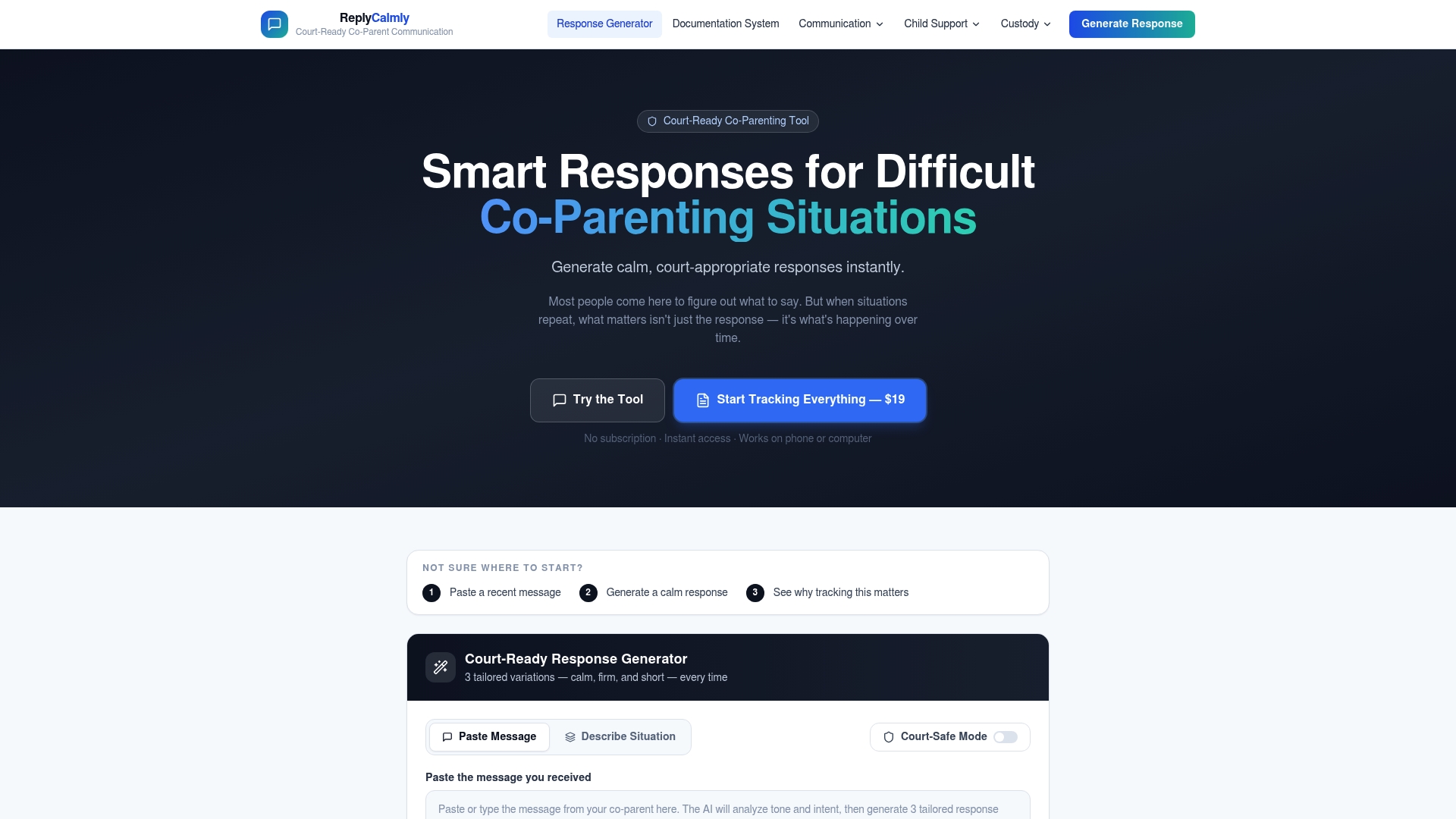
You can track incidents by category, visualize patterns over time, and build the kind of organized record that attorneys and judges find credible. Replycalmly also integrates with OurFamilyWizard to strengthen accountability without replacing court-mandated tools. Start by exploring the best co-parenting apps for documentation to find the right fit for your situation. If you need help managing your communication right now, the co-parent response generator gives you calm, firm, and short reply options for any message you receive.
FAQ
What is incident documentation in family court?
Incident documentation in family court is a contemporaneous written record of specific events relevant to custody or co-parenting disputes. Courts use these records to identify behavioral patterns and evaluate the best interest of the child.
What should I include in an incident log entry?
Each entry should include the date, exact time, location, direct quotes, witness names, observable facts, and any effects on the children. Avoid opinions or interpretations, which courts treat as unreliable.
How is incident documentation different from evidence?
Documentation is raw material. It becomes admissible evidence only after it is organized, authenticated with metadata, and legally framed by your attorney to meet court standards.
How long should I keep incident records before court?
Consistent records over 3–6 months are more persuasive to judges than sporadic notes. The longer and more consistent your log, the stronger the pattern evidence it creates.
Should I share my incident log with the other parent?
No. Your incident log is a private legal preparation document. Sharing it with the other parent or storing it on shared platforms like OurFamilyWizard can compromise your legal strategy and expose your process.