
Communication records are the documented history of every message, call, and exchange between co-parents. In custody disputes and high-conflict co-parenting situations, knowing why maintain communication records can determine whether a judge sees you as credible, organized, and child-focused. Courts treat written records as objective evidence. They carry far more weight than verbal testimony because they preserve exact wording, timestamps, and context that memory alone cannot reliably reproduce. Starting your records early and keeping them consistently is the single most protective step you can take for your case and your peace of mind.
Why do communication records matter in custody court?
Courts rely on contemporaneous communication records as objective evidence that preserves exact wording, timestamps, and participants. That reliability is why judges consistently prefer written documentation over a parent's verbal account of what was said or agreed upon.

Informal messages carry evidentiary weight equal to formal agreements in many custody proceedings. A text sent at 11:00 PM about a missed pickup reflects real-time intent and obligation. Courts read those messages as a window into how each parent actually behaves, not just how they present themselves in a hearing.
The legal risks of missing records are serious. Failure to preserve electronic communications once litigation is reasonably anticipated can result in court sanctions, adverse inference instructions, or default judgments. That means a judge can assume the missing records would have hurt your case.
Authentication matters just as much as preservation. Screenshots alone often fail authentication in court because they lack chain-of-custody documentation and verifiable metadata. Saving original files, email headers, and app-generated logs gives your records the legal foundation they need to be admissible.
- Save original message files, not just screenshots
- Preserve email headers and metadata alongside message content
- Log the date, time, and platform for every significant exchange
- Note the names of all participants in any group conversation or call
Pro Tip: After any significant phone call with your co-parent, send a brief written follow-up summarizing what was discussed and agreed upon. This creates a verifiable paper trail that is far harder to contest than memory alone.
How to maintain communication records effectively
The most effective record-keeping system is one you will actually use every day. Consistency matters more than complexity. A simple, structured log maintained in real time beats an elaborate system you abandon after two weeks.
Start by choosing a format that fits your life. Some parents use a dedicated notebook. Others use a spreadsheet or a purpose-built app. The format matters less than the habit. Every entry should capture the date, time, platform, participants, and a factual summary of what was communicated.
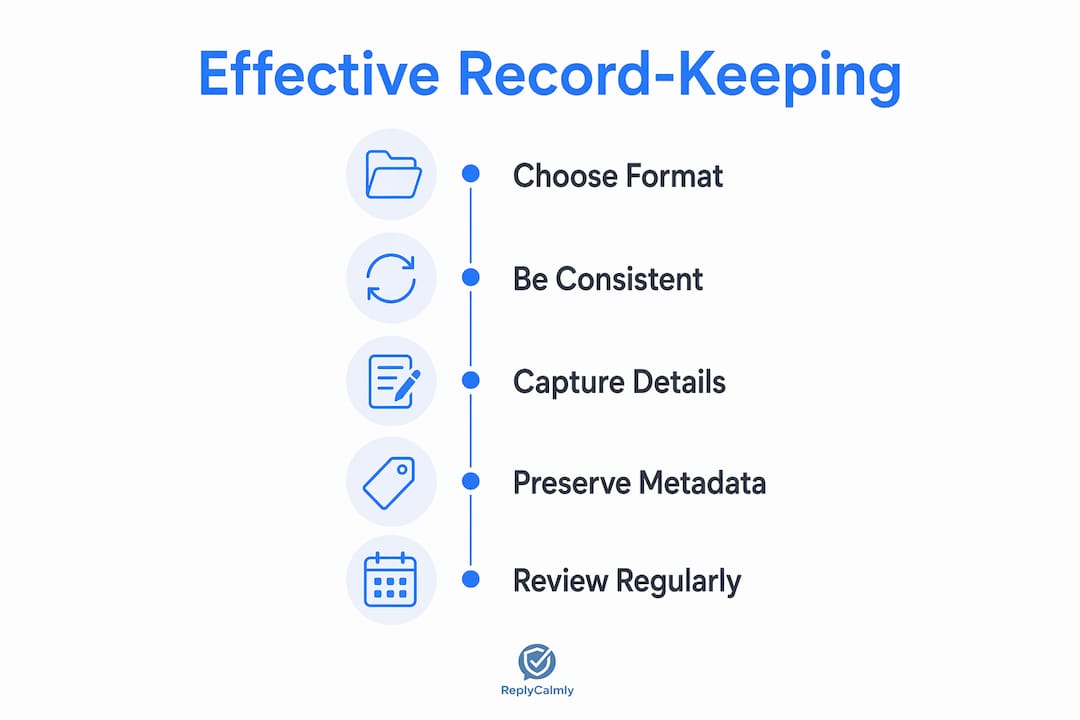
Digital communications governance ensures all communication types and metadata are captured and preserved in legally defensible ways. Applying that same principle to co-parenting means treating every text, email, voicemail, and app message as a potential exhibit, not just a casual exchange.
Back up your records in at least two locations. A local copy on your device and a secure cloud backup protects against phone loss, accidental deletion, or technical failure. Losing records because of a broken phone is avoidable and courts will not excuse it.
| Record type | Best practice for maintaining it |
|---|---|
| Text messages | Export full threads monthly; preserve metadata and timestamps |
| Emails | Save to a dedicated folder; never delete; export periodically |
| Voicemails | Record or transcribe immediately; note date and duration |
| App messages | Use platform export features; save confirmation receipts |
| Verbal conversations | Follow up in writing within 24 hours with a summary |
| Incident logs | Log date, time, behavior, and impact on the child immediately |
- Use a step-by-step logging process to build consistency from day one
- Set a weekly reminder to back up and review your records
- Keep records in a secure location your co-parent cannot access or alter
- Document incidents the same day they occur, while details are fresh
Pro Tip: Treat your communication log like a medical chart. Record facts only: what was said, when, and by whom. Leave out emotional commentary. Factual entries are far more credible in court than entries that read as venting.
What emotional benefits come from keeping communication logs?
Structured communication logs reduce reactive, emotion-driven responses. When you have a written record of what was actually said, you respond to facts rather than your memory of how something felt. That shift alone lowers conflict significantly in high-conflict co-parenting situations.
Maintaining structured logs reduces uncertainty and allows factual responses rather than reactive emotional responses in court. Parents who document consistently report feeling more grounded during disputes because they know exactly what happened and when.
Isolated messages without context can be manipulated to create misleading narratives. Keeping complete, contextual threads prevents your co-parent from selectively presenting only the messages that support their version of events. Your full record tells the complete story.
Documentation also creates communication discipline. When you know every message is being logged, you tend to write more carefully and professionally. That habit protects you legally and models healthy communication for your children.
- Review your log before responding to any difficult message
- Use records to identify patterns in your co-parent's behavior over time
- Share written summaries after verbal discussions to confirm mutual understanding and reduce surprises
- Recognize that co-parenting incident logging is a tool for clarity, not conflict escalation
What challenges make record-keeping hard, and how do you fix them?
The biggest obstacle to good record-keeping is emotional bias. Parents in high-conflict situations sometimes omit messages that make them look bad or that they find embarrassing. Incomplete records are dangerous. A judge who discovers selective documentation loses trust in everything you submit.
Waiting for a formal legal trigger to preserve evidence leads to the loss of critical early communications that often provide key timeline details. The time to start logging is before you think you need to. Early records establish baseline behavior and protect you if conflict escalates later.
Technical gaps create real problems. Deleted texts, expired voicemails, and inaccessible call logs disappear permanently if you do not act quickly. Most carriers retain call records for a limited period. Export and save everything as soon as a dispute becomes possible, not after it becomes certain.
Privacy and secure storage are non-negotiable. Your records may contain sensitive information about your child, your finances, or your legal strategy. Store them in password-protected locations. Do not share access with anyone who is not your attorney.
- Start logging from the first sign of conflict, not after a court filing
- Document unfavorable exchanges too. Selective records destroy credibility
- Use third-party tools that create impartial, timestamped records your co-parent cannot alter
- Consult your attorney about why documenting co-parenting messages protects your legal position
Communication inconsistency over time can be as damaging as missing records entirely. Gaps in your log raise questions about what you chose not to preserve. Regular, complete documentation is the only standard that holds up in court.
Key Takeaways
Maintaining complete, consistent communication records is the most reliable legal and emotional protection available to parents in custody disputes.
| Point | Details |
|---|---|
| Start early | Begin logging before conflict escalates to preserve critical early timeline evidence. |
| Authenticate records | Save original files with metadata, not just screenshots, to meet court admissibility standards. |
| Log everything | Document unfavorable messages too. Selective records destroy credibility with judges. |
| Back up consistently | Store records in two secure locations to prevent loss from device failure or deletion. |
| Use records emotionally | Review your log before responding to difficult messages to stay factual and calm. |
Records as risk management, not paperwork
Most parents think of communication records as a legal formality. I think of them as the most practical form of risk management available in a custody dispute. The parents who come out of high-conflict situations with their credibility intact are almost always the ones who started documenting early, logged everything without editing for optics, and treated their records as a living document rather than a last-minute exhibit.
What surprises people is how much the act of logging changes their own behavior. When you write down what happened immediately after it occurs, you stop rehearsing grievances in your head. You have the facts. That clarity reduces the emotional spiral that high-conflict co-parenting creates. It also makes you a better communicator because you start writing messages you would be comfortable seeing in court.
Viewing communication preservation as risk management rather than legal formalism results in stronger evidence retention and less stress. That framing shift is everything. You are not building a case against your co-parent. You are protecting your child's interests and your own rights with documented facts. Start today, log consistently, and let the record speak for itself.
— Devin
How Replycalmly supports parents with communication and documentation
Parents managing high-conflict co-parenting situations need more than good intentions. They need tools that make consistent, professional communication realistic on the hardest days.
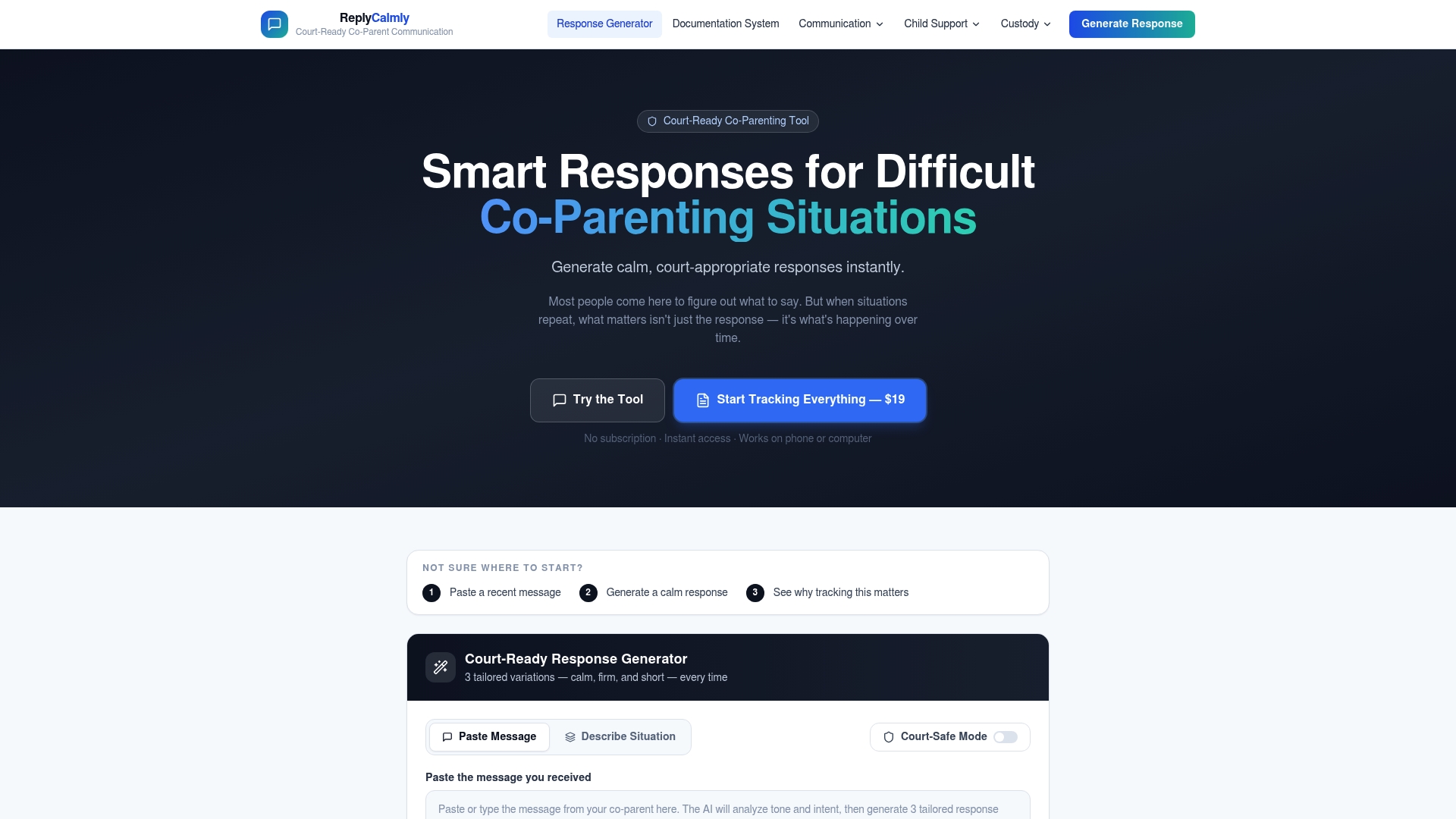
Replycalmly is built specifically for that challenge. The platform generates calm, court-appropriate responses to difficult messages and tracks communication patterns over time through a structured incident dashboard. Whether you are navigating a custody modification or managing daily conflict, Replycalmly gives you a documented, professional record without the emotional cost of drafting every message from scratch. The parallel parenting guide covers high-conflict strategies in depth, and the co-parent response generator lets you paste any message and get a reply that stays within legal boundaries.
FAQ
Why should I maintain communication records in a custody case?
Courts treat written records as objective evidence that is more reliable than verbal testimony. Complete, organized logs significantly increase your credibility and protect your legal position.
What types of communication should I document?
Document all texts, emails, voicemails, app messages, and verbal conversations. Follow up any phone call with a written summary sent to your co-parent within 24 hours to create a verifiable record.
Can screenshots be used as evidence in family court?
Screenshots alone often fail court authentication standards because they lack verifiable metadata and chain-of-custody documentation. Save original files and export full message threads with timestamps instead.
How soon should I start keeping communication logs?
Start logging at the first sign of conflict, before any court filing. Early evidence preservation protects critical timeline details that are often lost when parents wait for a formal legal trigger.
Does documenting communication help reduce conflict emotionally?
Structured logs allow you to respond to facts rather than feelings, which lowers reactive conflict. Parents who document consistently report feeling more grounded and less reactive during disputes.